Quick Reference
How to Choose a Rifle Scope: Optics Buying Guide

| Time & Effort | |
|---|---|
Read Time | 10 min read |
How to Choose a Rifle Scope: Optics Buying Guide
Handbook article
From The Boise Gun Club Handbook
You just dropped $800 on a new hunting rifle and now you're standing in a gun store staring at a wall of scopes priced anywhere from $89 to $3,000. The guy behind the counter is pushing a 6-24x50 with a Christmas tree reticle, and your buddy swears by the same 3-9x40 he's been running for fifteen years. Meanwhile, you're not sure what half these numbers even mean.
Here's the thing -- picking a scope isn't complicated once you understand a handful of concepts. Get those right and the rest falls into place.
What the Numbers on a Scope Actually Meanedit
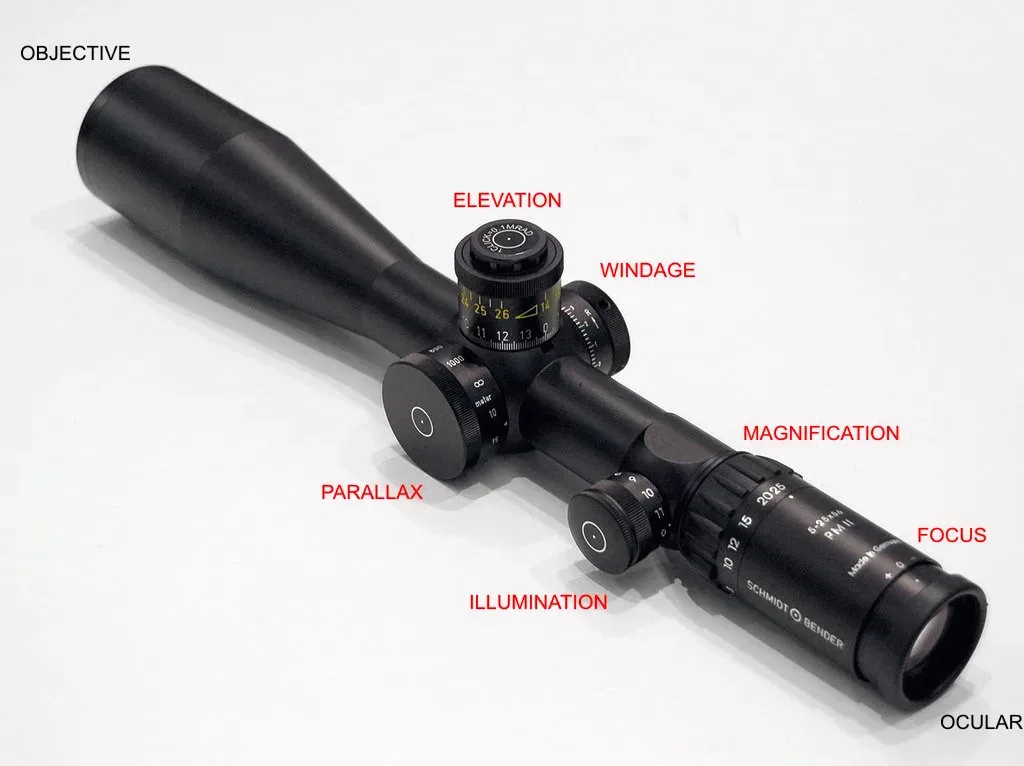
Every scope has a model designation that tells you two things immediately. Take 3-9x40: the first part (3-9x) is the magnification range -- this scope zooms from 3 power to 9 power. The second number (40) is the diameter of the objective lens in millimeters -- that's the big glass on the front of the scope.
A fixed scope gives you one magnification level, like a 6x. Simpler, often more rugged, less flexible. A variable scope lets you dial between a low and high range. Variable scopes dominate the market today because they work across a wider range of situations -- you can run it low in heavy timber and crank it up for a cross-canyon shot.
How Much Magnification Do You Actually Need?edit
This is where most first-time buyers go wrong -- they buy too much. More magnification sounds better on paper, but it narrows your field of view, amplifies every wobble in your hold, and makes fast target acquisition harder. A 25x scope on a deer stand at 150 yards is miserable to use.
Here's a practical breakdown by application:
| Magnification Range | Best Use Case |
|---|---|
| 1–4x | Close range, timber hunting, tactical |
| 3–9x | Deer hunting, general-purpose shooting |
| 4–16x | Mid-range shooting, varmints |
| 5–25x+ | Long-range precision shooting |
A 3-9x40 covers the majority of hunting and general shooting situations. It's not exciting, but it works -- and that's why it's been the workhorse setup for decades.
The Objective Lens and Lightedit
That second number in the scope designation controls how much light comes through the glass. A larger objective lens gathers more light, which matters most during low-light conditions -- early morning, late evening, or heavy overcast.
| Objective Size | Characteristic |
|---|---|
| 32mm | Lightweight, compact, easy to mount low |
| 40mm | Balanced -- good performance without bulk |
| 50mm | Better low-light performance |
| 56mm | Maximum light, requires higher rings |
Key Point: Glass quality matters more than objective size. A well-built scope with a 40mm objective and quality glass will outperform a cheap scope with a 50mm objective. The big lens on a poorly made scope just means you see a blurry, dim image in a larger circle.
MOA vs. MRAD -- The One Thing That Confuses Everyoneedit
Scopes don't adjust in inches. They adjust in angular units -- either MOA (Minute of Angle) or MRAD (milliradians). Understanding the difference is genuinely useful.
MOA is the easier one to visualize. One minute of angle equals roughly 1 inch at 100 yards. Double the distance, double the adjustment. Miss a target at 400 yards by 8 inches? Dial 2 MOA and you're on. Per Field & Stream, most riflescopes sold in the U.S. are formatted in MOA, and turrets typically click in ¼ MOA increments -- four clicks per MOA.
MRAD (also called MIL or MIL-dot) works on a 1-to-1,000 ratio. One milliradian equals 1 meter of measurement at 1,000 meters -- or 1 inch at 1,000 inches. MRAD scopes typically click in 0.1 milliradian increments, giving you 10 clicks per mil. According to Field & Stream, competition shooters often find MRAD elevation holdovers easier to memorize -- for a 140-grain 6.5 Creedmoor, the elevation correction at 1,000 meters is around 9.8 mils versus 33.5 MOA. Smaller numbers are easier to remember under pressure.
For ranging targets without a rangefinder, MRAD has a practical edge. If you know a whitetail buck stands roughly 1 yard at the shoulder and he measures 4 mils tall in your reticle, you divide 1,000 by 4 -- he's at 250 yards. The math works cleanly in your head.
Key Point: Per Field & Stream, there is no practical performance difference between MRAD and MOA. One is not more accurate or more scientific than the other. What matters is that your reticle and your turrets are in the same system. An MOA reticle with MOA turrets works perfectly. Mix them and you'll be doing math on every shot.
Here's a quick comparison:
| Factor | MOA | MRAD |
|---|---|---|
| Click value | ¼ MOA per click | 0.1 MIL per click |
| At 100 yards | ~1 inch per MOA | ~0.36 inches per 0.1 MIL |
| Common in U.S. | Yes, most consumer scopes | Less common, growing |
| Competition use | Common | Preferred by many |
| Mental math | Familiar for U.S. shooters | Cleaner metric ratios |
First Focal Plane vs. Second Focal Planeedit
This is the other big decision -- and it matters more if you plan to use your reticle for holdovers or ranging.
In a First Focal Plane (FFP) scope, the reticle scales up as you zoom in. That means the hash marks in the reticle stay accurate at every magnification level. If your reticle has a 2-mil holdover mark, it's good at 5x, 12x, or 20x. This is why FFP is preferred for long-range shooting -- you can use holdovers at any zoom setting.
In a Second Focal Plane (SFP) scope, the reticle stays the same apparent size regardless of magnification. This looks cleaner and less cluttered at low power, but the reticle measurements are only accurate at one specific magnification -- usually the highest. According to Field & Stream, if you want to accurately measure with MRAD or MOA, you'll want a first focal plane reticle so measurements stay constant across all magnification levels.
| First Focal Plane (FFP) | Second Focal Plane (SFP) | |
|---|---|---|
| Reticle scales with zoom | Yes | No |
| Holdovers accurate at all magnifications | Yes | Only at one magnification |
| Better for | Long-range precision | Hunting, general use |
| Reticle appearance at low power | Can look fine/crowded | Always clean |
For a deer hunter shooting inside 300 yards who dials to max power for every shot, SFP is fine. For a long-range shooter using a 5-25x who's dialing at various zoom levels, FFP keeps everything honest.
Turrets -- What They Do and Why a Zero Stop Mattersedit
Turrets are the dials on top and side of the scope that adjust your point of impact. The top turret adjusts elevation (up/down) and the side turret adjusts windage (left/right).
On a basic hunting scope, turrets are often capped -- you zero it, cap the turrets, and don't touch them again. That's fine for most hunting.
For long-range and precision work, you want exposed turrets you can dial on the fly. A zero stop is a mechanical feature that lets you return to your original zero quickly -- you dial up for a long shot, then spin back down and stop right at zero without counting clicks. Per Rocky Mountain Optics, this feature is critical for long-range shooters.
Durability -- What to Actually Look Foredit
A scope that loses zero under recoil or fogs up in the rain is useless, regardless of how good the glass looked on the shelf. Any scope worth running should have:
- Shockproof construction -- handles recoil without losing zero
- Waterproof sealing -- O-ring sealed, purged with nitrogen or argon
- Fog resistance -- internal gas purging prevents fogging when temps change
- Aircraft-grade aluminum housing -- standard on quality scopes
Cheap scopes fail under these conditions. That's not a knock on budget shooting -- it's just physics. A $150 scope on a hard-recoiling rifle is a gamble.
Mounting -- Don't Skip Thisedit
The best scope in the world won't perform if it's mounted wrong. Mounting problems are responsible for a lot of unexplained accuracy issues that shooters blame on ammo or their rifle.
The basic process:
- Attach the base to your rifle's receiver
- Install rings on the base
- Set eye relief -- the distance from your eye to the scope where you see a full, clear image
- Level the reticle
- Torque all screws to spec with a proper torque driver
Safety Note: Eye relief is the one that bites people. Set it too short and the scope comes back into your eyebrow under recoil -- that's called scope bite, and it's a fast way to need a bandage. Most scopes have 3-4 inches of eye relief. Set it at the range of the relief, not the minimum.
If you're shooting long range, you may need a 20 MOA rail instead of a standard 0 MOA base. A 20 MOA rail angles the scope slightly downward relative to the bore, giving you more elevation adjustment available for distant shots. For standard hunting distances, a flat rail is fine.
Zeroing Your Scopeedit
Zeroing aligns where the scope says the bullet will go with where it actually goes. Most shooters zero at 100 yards -- it's a common standard distance and easy to verify.
The basic process:
- Fire a three-shot group at your target
- Measure where the group landed relative to your point of aim
- Dial the appropriate corrections on your turrets
- Repeat until your group is centered on your aiming point
Some setups zero at 50 yards (short-range or rimfire) or 200 yards (longer-range setups where a 200-yard zero covers a broader effective range). The right zero distance depends on what you're doing with the rifle.
Common Mistakes That'll Cost Youedit
These come up constantly at the range, and they're all avoidable:
- Buying too much magnification. A 4-16x on a deer rifle mostly collects dust above 9x.
- Choosing cheap glass. Clarity and light transmission determine what you actually see. Specs on paper don't.
- Skipping proper mounting. Poor torque, unleveled reticle, wrong eye relief -- any one of these will wreck your accuracy.
- Ignoring eye relief. Scope bite is a real thing and it's not a story you want to tell.
- Mismatching reticle and turrets. MOA reticle with MRAD turrets means you're converting units on every correction. According to Field & Stream, this is one of the most common errors shooters make.
Putting It All Together -- A Decision Frameworkedit
Before you spend a dollar, answer these four questions:
1. What are you doing with this rifle? Hunting at moderate ranges? A 3-9x or 4-12x SFP scope in MOA will serve you well. Long-range precision? Step up to a 5-25x FFP scope, and consider MRAD if you plan to use holdovers.
2. What distances will you actually shoot? Match magnification to your realistic shots, not your aspirational ones.
3. MOA or MRAD? If you're shooting in the U.S. with no long-range precision goals, MOA is simpler. If you're competing, shooting past 600 yards regularly, or working with a spotter, MRAD is worth learning.
4. What's your realistic budget? Spend more on glass than you think you need to. A $400 scope on a $600 rifle outperforms a $100 scope on a $1,200 rifle -- that's not opinion, it's just how optics work.
Here's a quick setup guide by use case:
| Use Case | Magnification | Focal Plane | Reticle System |
|---|---|---|---|
| Beginner / general use | 3-9x40 | SFP | MOA |
| Deer / big game hunting | 3-9x or 4-12x | SFP | MOA |
| Varmint / mid-range | 4-16x | SFP or FFP | MOA or MRAD |
| Long-range precision | 5-25x | FFP | MRAD |
Go Deeperedit
Loading comments...