Specifications
AR-15
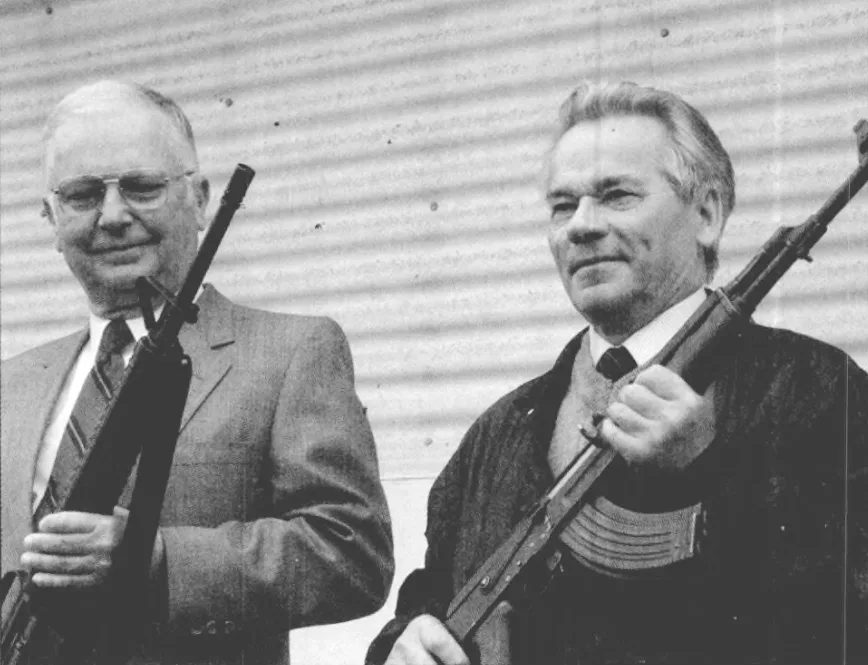
Stoner and Kalashnikov with their designs — a rare Cold War meeting between the architects of America's and the Soviet Union's most iconic rifles.
(Photo by Sgt. Chris Lawson) (Public domain)
| Manufacturer | |
|---|---|
| Made By | ArmaLite (original); multiple manufacturers (current) |
| Designer | Eugene Stoner |
| Origin | United States |
| Specifications | |
| Caliber | 5.56×45mm NATO / .223 RemingtonAlso: .300 Blackout, 6.5 Grendel, .224 Valkyrie |
| Action | gas operated |
| Capacity | 30 rounds (standard); 20 rounds (alternative) |
| Barrel | 16–20 inches (civilian); 14.5 inches (carbine) |
| Length | 32–39 inches |
| Weight | 6.5–8.5 lbs (unloaded) |
| Feed | STANAG-pattern detachable box magazine |
| Sights | Carry handle iron sights (original); flat-top Picatinny rail with optics mount (modern); red dot or scope common |
| Production | |
| Designed | 1956 |
| In Production | 1959 |
| Produced | Millions (civilian hands) |
| Variants | |
| |
| Service Use | |
U.S. Air Force (early adoption for base security)U.S. Military (M16/M4 select-fire derivatives)Civilian sport shooters and hunters (United States) | |
| Cultural Note | |
| Often called 'America's Rifle,' the AR-15 is the most popular semi-automatic rifle platform in the United States, with millions in civilian ownership. Its extreme modularity has made it the centerpiece of ongoing national debates on firearms policy, while also spawning a massive aftermarket parts and accessories industry. The 1994 federal assault weapons ban paradoxically accelerated its popularity, and patent expirations turned it into a highly competitive open-market platform. | |
| Related Firearms | |
| |
AR-15: America's Modern Sporting Rifle
Firearms encyclopedia article
From The Boise Gun Club Handbook
| Specification | Details |
|---|---|
| Manufacturer | ArmaLite (Original), Multiple (Current) |
| Type | Semi-Automatic Rifle |
| Caliber(s) | 5.56×45mm NATO/.223 Remington (Primary) |
| Capacity | 30 rounds (standard) |
| Barrel Length | 16-20 inches (civilian), 14.5 inches (carbine) |
| Overall Length | 32-39 inches |
| Weight (unloaded) | 6.5-8.5 lbs |
| Action Type | Direct Impingement Gas-Operated |
| Year Introduced | 1959 |
Overviewedit
You've probably heard more arguments about the AR-15 than any other rifle in American history. Some folks call it America's rifle, others want it banned--but here's what it actually is: a lightweight, reliable, endlessly customizable platform that's been around since 1959.
Eugene Stoner designed it at ArmaLite as a military rifle, but it's evolved into something much bigger. The modularity is what hooks people--you can build everything from a precision long-range rig to a compact home defense setup using the same basic receiver. With millions in civilian hands and more aftermarket parts than you can shake a stick at, it's become the Lego set of the gun world.
The direct impingement gas system keeps things simple and light.
The direct impingement gas system keeps things simple and light. No heavy piston banging around above your barrel, just gas channeled straight back to cycle the bolt.
That's why these rifles shoot so accurately and handle so well--the engineering actually makes sense once you get your hands on one.
History & Developmentedit
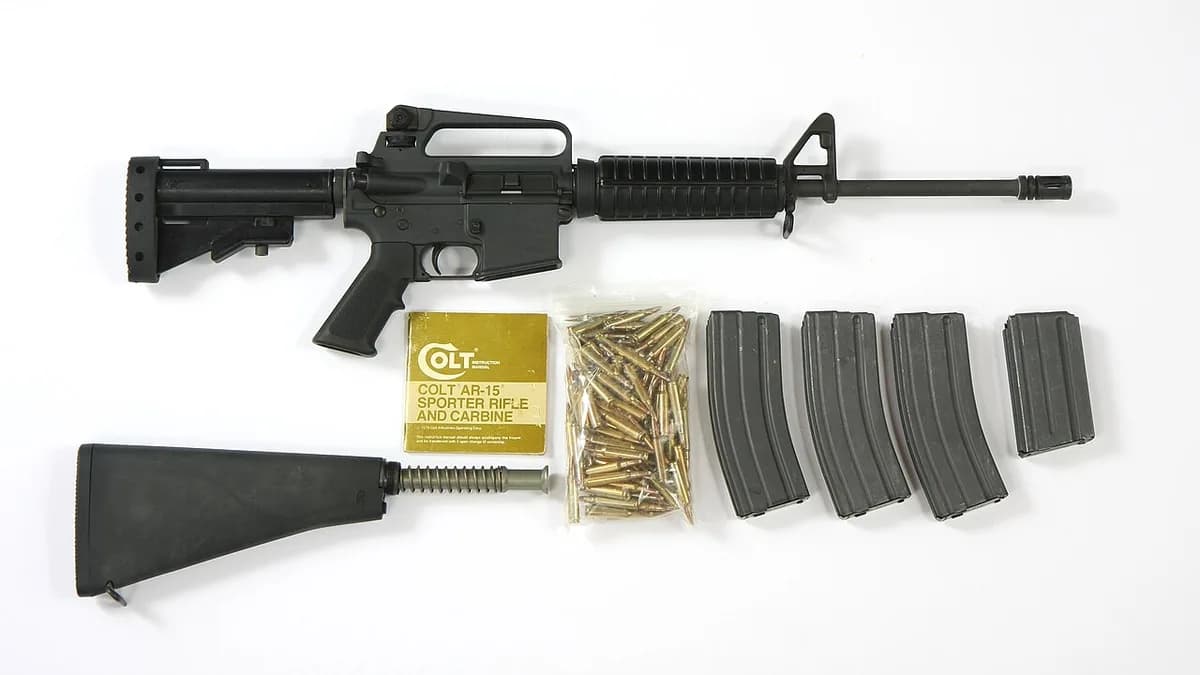
Original ArmaLite Design
Back in 1956, Eugene Stoner had a problem. The military wanted a lightweight rifle, but everything on the market was a boat anchor compared to what he had in mind. Working at ArmaLite--a tiny California company--he started with aircraft aluminum and built something that looked like it came from the future.
The AR-15 (ArmaLite Rifle Model 15) weighed nearly two pounds less than the M14 everyone was carrying. Instead of a traditional piston system, Stoner used direct impingement--gas tapped from the barrel and sent straight back to the bolt carrier. The straight-line stock design put the bore axis right into your shoulder, which meant less muzzle climb and faster follow-ups.
Key Milestones in AR-15 Development and Market Evolution
Military Adoption and Issues
ArmaLite couldn't find buyers for their space-age rifle, so they sold the rights to Colt in 1959. Colt knew how to work with the military and got the Air Force interested first--base security needed something lighter than battle rifles. By the time Vietnam ramped up, the military adopted the select-fire M16 variant.
Those early M16s had problems--ammunition issues, maintenance problems, and a reputation for jamming when you needed them most. But Colt worked through the bugs, and the platform proved itself over time.
| Era | Key Development | Impact |
|---|---|---|
| 1956-1959 | Eugene Stoner designs AR-15 at ArmaLite | Revolutionary lightweight design |
| 1959 | Colt acquires rights from ArmaLite | Military production capability |
| 1963 | First civilian semi-auto sales | Commercial market entry |
| 1964-1970 | M16 military adoption and early issues | Combat testing and refinement |
| 1994-2004 | Federal Assault Weapons Ban | Workaround innovations, market expansion |
| Late 1970s-2000s | Key patents expire | Open competition, lower prices |
Civilian Market Evolution
Meanwhile, they started selling semi-auto versions to civilians in 1963.
The 1994 assault weapons ban accidentally turned the AR-15 into a cottage industry. Manufacturers figured out workarounds, prices stayed reasonable, and shooters discovered just how much you could customize these things. When the key patents expired in the late '70s and early 2000s, everybody and their brother started making AR-15s. Competition drove prices down and quality up--exactly what you'd expect in a free market.
Technical Specificationsedit
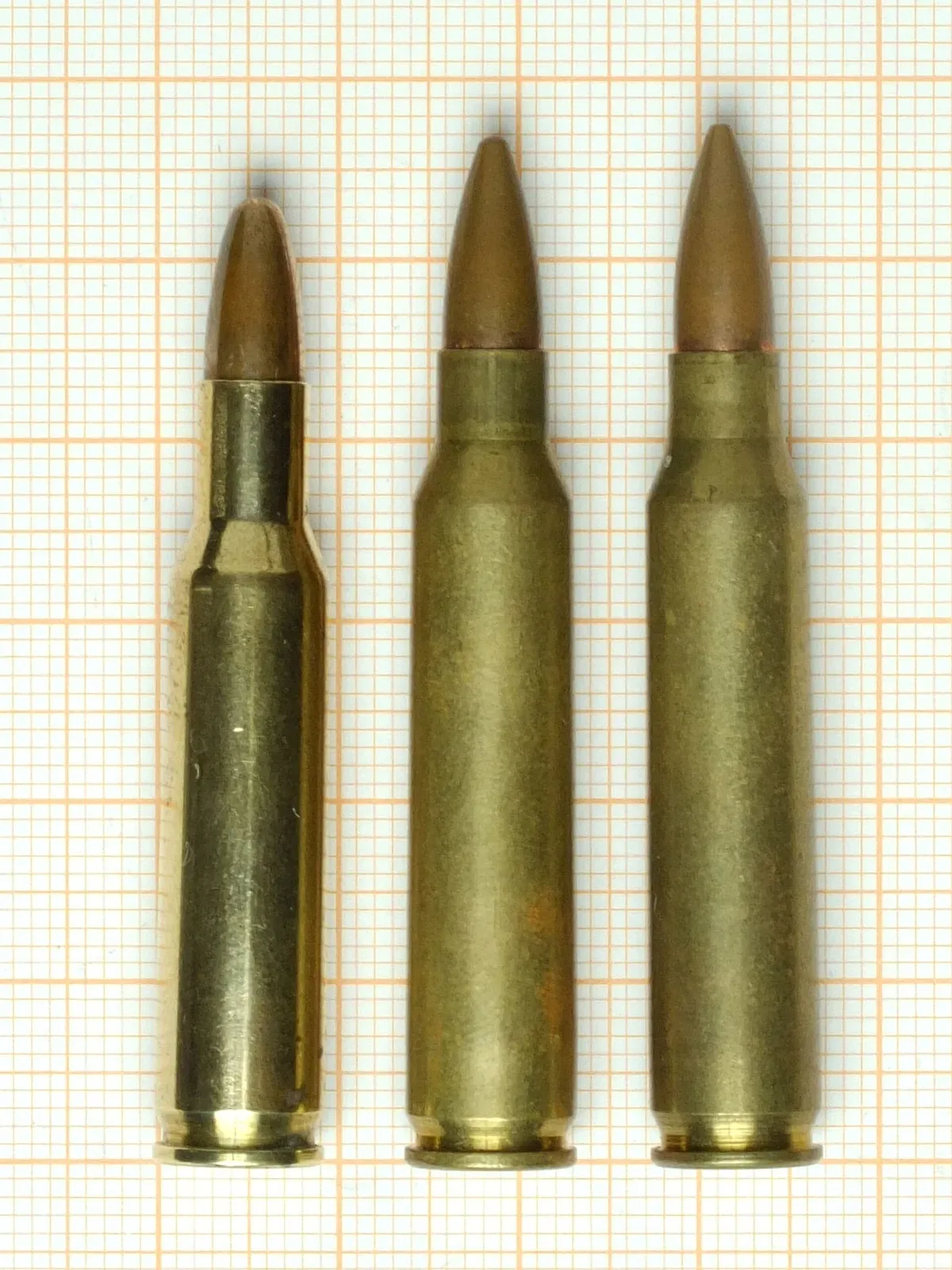
Gas System Operation
The gas system: Direct impingement sounds complicated, but it's actually simpler than most rifles. When you fire, some propellant gas gets tapped from a port in the barrel and travels back through a tube to hit the bolt carrier. That drives the bolt carrier back, extracts the spent case, cocks the hammer, and strips a new round from the magazine on the way forward. No pistons, no extra weight--just gas pressure doing the work.
Direct Impingement Gas System Operation Cycle
Lockup and Magazine System
Lockup and feeding: The bolt locks into a barrel extension using seven lugs--more than most bolt-action rifles use. This gives you consistent lockup shot after shot, which is why accuracy stays predictable. Standard magazines hold 20 or 30 rounds and use the STANAG pattern, so magazines from different manufacturers usually play nice together.
Most modern AR-15s come with a flat-top receiver that's got a full-length Picatinny rail for optics. The old carry handle sights work fine, but most people end up mounting a red dot or scope anyway. Handguards use M-LOK or KeyMod mounting systems now, so you can bolt on whatever accessories actually make sense for your setup.
Modern Features and Safety
The safety sits in the trigger guard where your finger naturally finds it. There's also a firing pin safety that prevents discharge unless the bolt is fully closed--important when you're loading or unloading. Some variants have a magazine disconnector that prevents firing without a magazine inserted, but that's not universal across all manufacturers.
Variants & Modelsedit
Standard Military Patterns
The AR-15 family tree got complicated fast once everyone started making their own versions:
Standard configurations include:
- Original 20-inch barrel setup with fixed stock and carry handle
- A2 variant with improved sights and heavier barrel profile
- A3/A4 models with removable carry handles and flat-top receivers
| Configuration | Barrel Length | Stock Type | Primary Use |
|---|---|---|---|
| A1 Original | 20" | Fixed | Service/Competition |
| A2 Standard | 20" | Fixed | Match/Precision |
| A3/A4 Flat-top | 20" | Fixed | Optics Platform |
| M4 Carbine | 16" | Collapsible | General Purpose |
| Dissipator | 20" | Variable | Reduced Recoil |
| Mk12 SPR | 18" | Variable | Precision/DMR |
| AR Pistol | 7"-14.5" | Brace | Compact/CQB |
Civilian Configurations
Carbine variants use 16-inch barrels--the minimum legal length without NFA paperwork--and collapsible stocks. The M4-style carbine became hugely popular because it handles better in tight spaces while still reaching out to reasonable distances.
Specialty builds cover everything from Dissipator rifles (20-inch barrel with carbine gas system for softer recoil) to Mk12 SPR precision variants with 18-inch stainless barrels. AR-15 pistols use short barrels with pistol braces instead of stocks, staying legal while maximizing maneuverability.
Alternative Cartridges
Caliber variants opened up when manufacturers started making uppers in .300 Blackout, 6.5 Grendel, .224 Valkyrie, and other cartridges. You can swap uppers in about 30 seconds, which turns one lower receiver into multiple rifles.
| Cartridge | Case Type | Typical Use | Notes |
|---|---|---|---|
| 5.56/.223 | Standard | General Purpose | Original chambering |
| .300 Blackout | Modified | Suppressed/Short Barrel | Subsonic capability |
| 6.5 Grendel | Necked | Long Range | Superior ballistics |
| .224 Valkyrie | Necked | Precision/Varmint | High velocity |
| 6.8 SPC | Necked | Hunting/Defense | More energy |
| .458 SOCOM | Straight | Big Game | Heavy projectiles |
Operating System Variants
Some companies make piston-driven variants that replace the direct impingement system with a more traditional piston setup. These run cleaner but add weight and complexity--tradeoffs worth considering depending on your intended use.
Performance Characteristicsedit
Accuracy Potential
Accuracy: A properly built AR-15 will outshoot most shooters. Quality examples regularly print sub-MOA groups at 100 yards with good ammunition and optics. The rigid receiver design and consistent bolt lockup create a stable platform, while free-floating handguards eliminate pressure points that can throw off precision shots.
Reliability Factors
Reliability: Modern AR-15s are light-years ahead of those early M16s in Vietnam. Quality builds routinely run thousands of rounds between malfunctions when properly maintained:
- Quality builds routinely run thousands of rounds between malfunctions when properly maintained
- Direct impingement system has fewer moving parts than piston alternatives
- System does blow more debris back into the action compared to piston designs
Brand selection matters more with AR-15s than most rifles. Some manufacturers cut corners on critical parts like bolt carrier groups or barrel steel, while others maintain strict quality control. Do your homework before buying, especially in the budget category.
Handling Characteristics
Handling: The straight-line stock design and intermediate cartridge make for pleasant shooting. Muzzle rise stays minimal, follow-up shots come fast, and the rifle balances well for most shooters. You can tune the buffer system for different ammunition weights or shooting disciplines, fine-tuning how the rifle cycles.
Notable Usersedit
Military and Law Enforcement
Military and law enforcement adopted the M16/M4 variants across all service branches, while patrol officers and SWAT teams nationwide carry semi-auto versions. The platform's modularity lets them configure rifles for specific missions--from close-quarters work to designated marksman roles.
Competitive Shooting
Competitive shooters gravitated toward AR-15s in 3-Gun, Service Rifle, and precision rifle competitions. The platform's accuracy potential and fast handling make it competitive across multiple shooting disciplines. High Power and Service Rifle competitors still use 20-inch variants that can reach out to 600 yards with iron sights.
Hunting Applications
Hunters discovered that AR-15s work great for varmints, predator control, and even big game when chambered appropriately. The quick follow-up shots help with multiple coyotes or hogs, while the modular design lets you optimize the rifle for specific hunting situations.
Civilian Market
Civilian shooters embrace AR-15s for everything from home defense to recreational shooting. The customization options let you build exactly what you want, whether that's a lightweight carbine or a precision long-range rig. Collections tend to grow--once you understand the platform, it's hard to stop at just one.
The BGC Takeedit
The AR-15 earned its popularity through actual performance, not marketing hype. Yes, it's politically controversial, but mechanically it's just a well-engineered rifle that happens to be highly customizable.
The AR-15 earned its popularity through actual performance, not marketing hype. The modular design means you can build one rifle for multiple roles, or build multiple rifles optimized for specific tasks.
Quality varies dramatically between manufacturers, so buy from companies with proven track records. A properly built AR-15 from a reputable maker will serve you well for decades. Skip the bargain-basement options--this isn't the place to save money on critical components.
The learning curve is worth climbing. Once you understand how these rifles work, you can maintain, modify, and optimize them better than most firearms. Parts availability is excellent, aftermarket support is unmatched, and you'll never lack for upgrade options.
If you're considering an AR-15, handle a few different configurations before buying.
Figure out what you actually need, then build or buy accordingly. A 20-inch rifle shoots differently than a 16-inch carbine, and what works for competition might not work for home defense.
- Gls Guns(Sumner, IA)
- Bi-mart - Yakima (Fruitvale Ave)(Yakima, WA)
- New Philly Sportsman Specialities(New Philadelphia, OH)
- R&R Sports & Outdoors(Brandon, FL)
Loading comments...