Details
Eugene Morrison Stoner
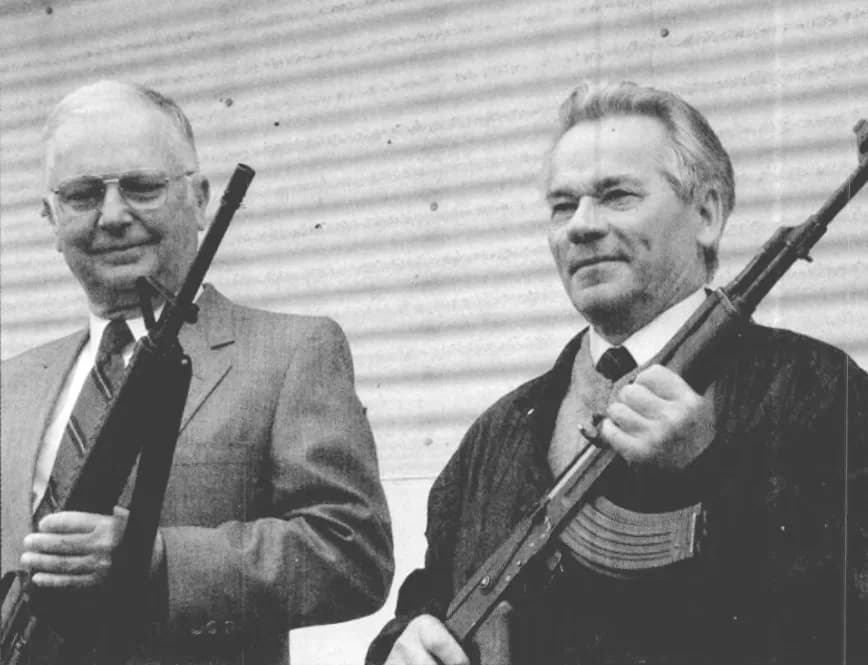
Stoner and Kalashnikov together with their iconic designs — a rare historical photograph of the two architects of modern assault rifle design.
| Biography | |
|---|---|
| Born | November 22, 1922, Gosport, Indiana |
| Died | April 24, 1997, Palm City, Florida |
| Nationality | American |
| Legacy | |
| Known For | Designing the ArmaLite AR-10 and AR-15 rifles, which became the M16 and M4 carbine in U.S. military service; pioneering the application of aerospace materials and engineering to small arms design |
| Key Innovation | Gas-operated bolt and carrier system with straight-line recoil geometry, aluminum receivers, and polymer furniture; modular rifle platform architecture |
Eugene Stoner: The Man Behind the AR-15 and America's Most Influential Rifle Design
Firearms encyclopedia article
From The Boise Gun Club Handbook
Overviewedit
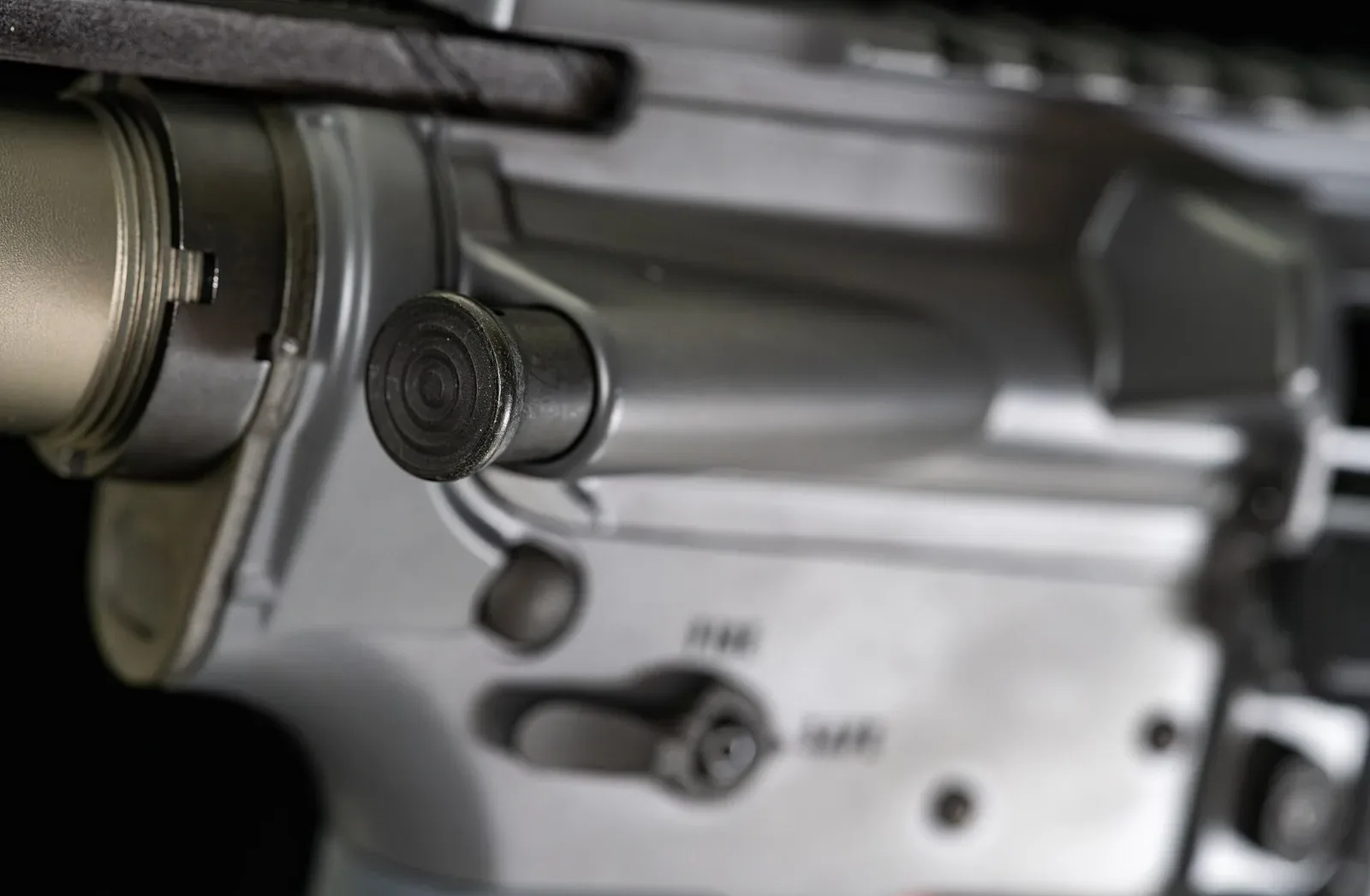
Eugene Morrison Stoner (November 22, 1922 – April 24, 1997) was an American machinist and firearms designer whose work reshaped infantry weapons for the second half of the twentieth century and beyond. He is most closely associated with the ArmaLite AR-10 and the AR-15 -- the latter adopted by the U.S. military as the M16 rifle and, in shortened form, the M4 carbine. Stoner held no formal engineering degree. He built his knowledge on a machine shop floor, refined it in the South Pacific with a Marine Corps armourer's kit, and spent the rest of his life applying aerospace materials science to small arms in ways that nobody in the industry had seriously attempted before.
His gas-operated bolt and carrier system -- widely misidentified as "direct impingement" -- became the mechanical foundation for the most widely produced rifle platform in American history. The AR pattern's straight-line recoil, lightweight aluminum receivers, and polymer furniture were all departures from the prevailing doctrine of his era.
Almost seventy years after the AR-10's debut, the basic architecture Stoner developed is still the baseline against which every other infantry rifle gets measured.
Early Life & Backgroundedit
Depression Era and Early Career
Stoner was born in Gosport, Indiana, and the family eventually relocated to Long Beach, California, where he graduated from Long Beach Polytechnical High School. When the Depression foreclosed any realistic path to college, he went to work in 1939 as a machinist for Vega Aircraft Company -- a firm that would later become part of what is now Lockheed Martin Corporation. That job introduced him to precision manufacturing and, critically, to the armament systems being installed on military aircraft as the country geared up for war.
World War II Service
When the United States entered World War II, Stoner enlisted in the U.S. Marine Corps and was assigned to aviation ordnance. He served in the South Pacific and in northern China -- theatres where he worked as an armourer with heavy-caliber automatic weapons. The combination of machine shop discipline and hands-on combat arms experience gave him a practical foundation that no university program could have replicated.
He understood how weapons got built and how they got used and abused under field conditions.
Aerospace Industry Experience
After the war ended in 1945, Stoner went to work in the machine shop at Whittaker, an aircraft equipment manufacturer, eventually rising to design engineer. That aerospace background -- lightweight alloys, tight tolerances, unconventional materials -- followed him into every firearm he touched.
| Period | Position | Company | Key Experience |
|---|---|---|---|
| 1939-1942 | Machinist | Vega Aircraft Company | Precision manufacturing, aircraft armament systems |
| 1942-1945 | Aviation Ordnance | U.S. Marine Corps | Combat arms experience, South Pacific & Northern China |
| 1945-1954 | Machine Shop → Design Engineer | Whittaker | Aerospace materials, lightweight alloys |
Key Contributionsedit
ArmaLite and the AR-10
In 1954, Stoner joined ArmaLite as chief engineer. ArmaLite was a small division of Fairchild Engine & Airplane Corporation, headquartered in a leased space near Hollywood, California. The company was never intended to be a mass manufacturer -- it was conceived as a design shop that would develop weapons using aerospace materials and sell or license the results. According to the Small Arms Review, ArmaLite counted just nine employees by 1956, but the thinking was genuinely different from anything happening at the major defense contractors.
Stoner and ArmaLite founder George Sullivan planned to take the lightweight alloys and radical polymers that the aviation industry had normalized and build rifles with them. The early output included prototypes:
- AR-3, AR-9, AR-11, and AR-12 prototypes (none reached production)
- AR-5 survival rifle (.22 Hornet, adopted as MA-1 by USAF)
- AR-7 takedown rifle (.22 LR, still produced today by Henry Repeating Arms)
The AR-5, a survival rifle chambered in .22 Hornet, was adopted by the U.S. Air Force as the MA-1 Survival Rifle, and it put ArmaLite on the military's radar as a credible design house. The subsequent AR-7, chambered in .22 LR with a takedown design that stored inside its own hollow polymer stock, went on to a long commercial life and is still produced today by Henry Repeating Arms as the U.S. Survival Rifle.
The serious work came in 1955 and 1956 with the ArmaLite AR-10. This was a select-fire infantry rifle chambered in 7.62×51mm NATO, and it weighed just 3.29 kg (7.25 lb) -- a genuinely striking number for a full-power battle rifle of that era. The AR-10 introduced several features that would define the platform for decades:
- Forged aluminum alloy receivers
- Phenolic composite furniture
- Straight-line stock aligned with bore
- Novel gas-operated bolt and carrier system
The AR-10 was submitted to the U.S. Army's Aberdeen Proving Ground late in 1956. Some Springfield Armory test staff called it the best lightweight automatic rifle they had ever evaluated. But it arrived late in the testing cycle, and the Army chose the more conventional T44 -- which entered service as the M14 rifle -- partly on institutional momentum and partly because the AR-10 simply hadn't had enough time to work out its early prototype issues.
A catastrophic barrel failure during testing didn't help.
| Model | Year | Chambering | Weight | Status | Notable Features |
|---|---|---|---|---|---|
| AR-3, AR-9, AR-11, AR-12 | ~1954-1955 | Various | - | Prototypes only | Early experiments |
| AR-5 (MA-1) | 1956 | .22 Hornet | - | Adopted by USAF | Survival rifle |
| AR-7 | 1959 | .22 LR | 2.5 lbs | Commercial success | Takedown, stores in stock |
| AR-10 | 1956 | 7.62×51mm NATO | 7.25 lbs | Limited production | First modern assault rifle |
| AR-15/M16 | 1958/1963 | .223 Remington | 6.35 lbs | Mass production | Most influential design |
The AR-10's design was subsequently licensed to the Dutch firm Artillerie Inrichtingen, which produced the rifle through 1960 for several military customers including Portugal and Sudan.
The Gas System -- Getting the Terminology Right
Stoner's bolt and carrier piston system is the mechanical heart of the AR platform, and it has been mischaracterized for most of its existence. The patent -- U.S. Patent 2,951,424, filed in 1956 and granted September 6, 1960 -- states explicitly:
This invention is a true expanding gas system instead of the conventional impinging gas system. — U.S. Patent 2,951,424
Calling it "direct impingement" is technically inaccurate, though the term has stuck so firmly that even manufacturers use it.
Here is what actually happens: gas is tapped from a port in the barrel and travels rearward through a gas tube to a chamber inside the bolt carrier. The bolt itself is fitted with piston rings. When pressurized gas enters the carrier, the bolt acts as a piston -- the carrier moves rearward, the cam pin rotates and unlocks the bolt head, and the gas vents out through ports in the side of the carrier. Per Forgotten Weapons, a cleaner description is an "in-line internal piston" -- the piston axis is co-linear with the barrel, which is why the system produces the straight-line recoil characteristics that make the AR platform easier to control in automatic fire than a conventional tilting-piston design.
Stoner's Internal Expanding Gas System (often misnamed 'direct impingement')
The trade-off is that the system is ammunition-specific. There is no adjustable gas port or valve to compensate for varying propellant pressures or barrel lengths -- a constraint that became operationally consequential in Vietnam, and that has driven the aftermarket piston conversion industry ever since.
The AR-15 -- Stoner's Design, But Not His Alone
At the U.S. military's request, Robert Fremont and Jim Sullivan took the AR-10 and scaled it down to fire the .223 Remington cartridge. The resulting ArmaLite AR-15 was submitted to CONARC testing in 1958 -- ten rifles and one hundred 25-round magazines. Testing found that:
A five-to-seven man team armed with AR-15s could match the firepower of an eleven-man team with M14s, and AR-15 armed soldiers could carry three times the ammunition by weight.
The AR-15 was also found to be three times more reliable than the M14 in those trials, per the ArmaLite AR-15 Wikipedia entry.
The bureaucratic journey from prototype to service rifle
None of that was enough. General Maxwell Taylor vetoed the AR-15 in favor of the M14. By 1959, ArmaLite was losing money and sold the rights to both the AR-10 and AR-15 to Colt's Patent Firearm Company. Colt relocated the charging handle from its original position under the carry handle to the rear of the receiver, rebranded the rifle the Colt ArmaLite AR-15 Model 01, and began marketing it globally. The first military sale went to Malaya on September 30, 1959.
The rifle's path into U.S. service was a bureaucratic slog. General Curtis LeMay ordered 8,500 after seeing a demonstration in the summer of 1960, then requested 80,000 more after his promotion to Air Force Chief of Staff -- only to be blocked by Taylor, now Chairman of the Joint Chiefs. Ten rifles went to Vietnam in 1961 for Special Forces evaluation. The field reports were enthusiastic. By January 1963, Secretary of Defense Robert McNamara had received confirmation that M14 production couldn't meet demand, and the AR-15 was the only rifle positioned to fill the gap.
He ordered its adoption despite documented deficiencies, most notably the lack of a chrome-plated chamber. The redesigned rifle was designated the M16 in December 1963 and went into production in March 1964.
The Vietnam Reliability Crisis
The M16's early service record in Vietnam was genuinely bad, and the causes are worth understanding clearly because they are often misattributed to Stoner's design. The AR-15/M16 system was built around a specific ball powder. In the rush to field the rifle, the decision was made to substitute DuPont stick powder -- which produced more fouling than the original specification. The rifle's tight tolerances, already stressed by the humid jungle environment, were not designed to handle the additional carbon load.
Per the Wideners source, the rifle was initially advertised as "self-cleaning" -- which was catastrophically wrong under those conditions.
The Army also resisted Stoner and the Air Force's position on the forward assist -- a device to manually push the bolt into battery when a round fails to seat. Stoner, Colt, and the Air Force all considered it an unnecessary expense. The Army insisted. The result was two variants: the Air Force's M16 without a forward assist, and the XM16E1 (later M16A1) with one for the other service branches. A forward assist cannot fix a chamber packed with carbon fouling, but the argument at the time was about institutional comfort as much as engineering reality.
| Issue | Root Cause | Army's Response | Actual Solution |
|---|---|---|---|
| Jamming/Fouling | DuPont stick powder vs. specified ball powder | Blamed rifle design | Reverted to ball powder |
| Chamber corrosion | No chrome lining in humid environment | Added forward assist | Chrome-lined chambers |
| Poor maintenance | Marketed as "self-cleaning" | Minimal training | Issued cleaning kits |
| Reliability perception | Institutional resistance to new platform | Continued criticism | Field experience proved reliability |
The actual fixes -- reverting to ball powder, issuing cleaning kits, and chrome-lining chambers -- addressed the real problems. The M16A1 that emerged from those corrections became a mature and reliable combat weapon.
The Stoner 63 and Modular Weapons
Stoner left ArmaLite in 1961, a year before Fairchild severed its connection to the company, and initially served as a consultant for Colt. He moved on to Cadillac Gage, where he developed the Stoner 63 Weapons System -- a modular platform that could be reconfigured as a standard automatic rifle, light machine gun, medium machine gun, or solenoid-fired fixed machine gun. Once again, Fremont and Sullivan adapted a Stoner design for the .223 Remington cartridge. The Stoner 63 used by U.S. Special Forces through the Vietnam era -- it remained in special operations service until approximately 1983 -- demonstrated that the modular rifle concept Stoner had been building toward was tactically viable, even if it never achieved broad adoption.
Stoner also designed the TRW 6425 25mm Bushmaster auto cannon during this period, a design later manufactured by Oerlikon-Bührle as the Oerlikon KBA 25mm.
| System | Years Active | Configurations | Cartridge | Primary Users |
|---|---|---|---|---|
| Stoner 63 | 1963-1983 | Rifle, LMG, MMG, Fixed MG | .223 Remington | U.S. Special Forces |
| TRW 6425 Bushmaster | 1970s | Auto cannon | 25mm | Later produced as Oerlikon KBA |
| Ares LMG (Stoner 86) | 1970s-1980s | Light machine gun | 5.56×45mm | Limited adoption |
| SR-25 | 1990s-present | Precision rifle | 7.62×51mm NATO | U.S. SOCOM, Navy (Mk 11) |
ARES and the SR-25
In 1972, Stoner co-founded ARES Incorporated in Port Clinton, Ohio. His work there produced the Ares Light Machine Gun (also known as the Stoner 86), an evolution of the Stoner 63, and the Future Assault Rifle Concept (FARC) -- an experimental program that explored not only new weapon architectures but also new ammunition types including polymer and telescoping cartridges. Stoner left ARES in 1989.
In 1990, he joined Knight's Armament Company (KAC), where he returned to the AR-10 concept with nearly three decades of M16 field data to inform the redesign. The result was the SR-25 (Stoner Rifle-25), a 7.62 NATO semi-automatic precision rifle that was adopted by U.S. Special Operations Command and the U.S. Navy as the Mark 11 Mod 0 Sniper Weapon System. He also worked on the Stoner 96 at KAC -- another iteration of the modular weapons system concept -- and contributed to the SR-50, a .50 BMG semi-automatic sniper rifle. Only four SR-50 prototypes were completed before the project was set aside in favor of available platforms like the Barrett M82.
Among Stoner's last projects was the Colt 2000, a semi-automatic pistol developed in collaboration with Colt. According to the Wideners source, Colt made modifications to the design after submission without consulting the designers, and the pistol shipped with a reputation for accuracy and reliability problems.
Impact on Firearms Developmentedit
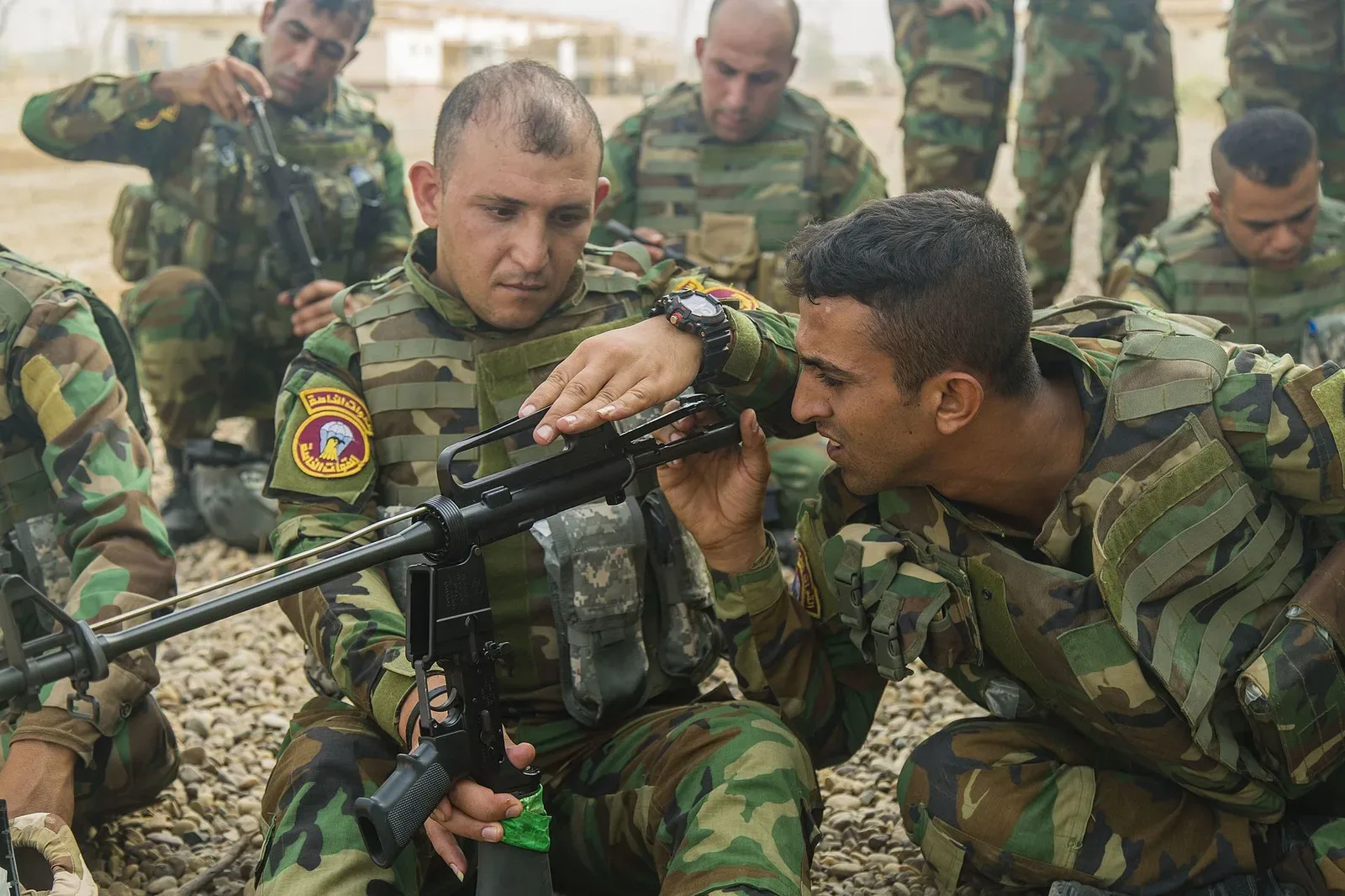
Design Philosophy Revolution
Stoner's most consequential contribution wasn't a single firearm -- it was a design philosophy. He applied aerospace engineering logic to small arms at a moment when the dominant approach was still rooted in machined steel and wood. Aluminum receivers, polymer furniture, straight-line recoil geometry, and a gas system located co-axially with the barrel were all departures from existing doctrine.
The AR-10 appeared in 1956 weighing 7.25 pounds in a full-power NATO caliber -- a number that contemporaries found almost implausible.
| Innovation | Traditional Approach | Stoner's Solution | Impact |
|---|---|---|---|
| Receiver Material | Machined steel | Forged aluminum alloy | 40% weight reduction |
| Furniture | Wood | Phenolic composites/polymers | Weather resistance, weight savings |
| Recoil Management | Tilting bolt, offset stock | Straight-line, inline system | Improved controllability |
| Gas System | External piston | Internal expanding gas | Simplified manufacturing |
| Modularity | Fixed configuration | Upper/lower split | Infinite customization potential |
Platform Architecture and Modularity
The modularity built into the AR platform from its early iterations turned out to be its most durable feature. The upper and lower receiver split, connected by two takedown pins, means a single serialized lower receiver can accept a nearly infinite variety of uppers, barrels, and caliber conversions. That architecture has driven the civilian AR market into a category so large that no definitive count of AR-pattern rifles in American hands is possible.
Global Influence on Service Rifles
The straight-line recoil system also had downstream effects beyond the AR family. The AR-18, developed at ArmaLite after the AR-15 rights were sold to Colt, used a conventional short-stroke piston but retained many of the ergonomic and manufacturing innovations Stoner had established. That action influenced:
- Steyr AUG
- HK416
- British SA80
- Israeli Tavor
A lineage of service rifles that now spans dozens of countries.
Stoner's design influence on modern rifle development
Modern Military Applications
The SR-25's adoption as the Mark 11 Mod 0 demonstrated that Stoner's core architecture could be scaled back up to full-power calibers for precision applications -- completing a circle that began with the 7.62mm AR-10 in 1955. Modern Designated Marksman Rifles fielded by U.S. and allied forces trace a direct line back to that work.
Perhaps the most telling measure of Stoner's impact is negative space:
Despite decades of effort and several formally funded programs, the U.S. military has not successfully fielded a general-issue combat rifle that represents a fundamental departure from the platform Stoner established.
The M4 carbine that American soldiers carry today is a direct mechanical descendant of work done in a nine-person shop near Hollywood in 1956.
Later Life & Legacyedit
Meeting with Kalashnikov
On May 16, 1990, Stoner and Mikhail Kalashnikov -- designer of the AK-47 -- met for the first time in Washington, D.C. The two men spent several days together: visiting the Smithsonian Institution, the NRA's National Firearms Museum, a hunting lodge at Star Tannery where they went shooting, and the Marine Corps base at Quantico, where they watched new weapons being tested. According to Wikipedia's account, both men -- intimately familiar with the other's work -- shared a common bond and became friends, reportedly needing no interpreter to communicate what mattered most.
It's a striking image: the two designers whose rifles defined the Cold War's ground-level violence, meeting as old men and finding more in common than the governments that had used their work.
Neither held a formal engineering degree. Both had learned by doing.
Both watched their designs take on lives entirely beyond their control.
Final Years and Death
Stoner's health declined in the mid-1990s. He died of brain cancer on April 24, 1997, at his home in Palm City, Florida, at age 74. He was interred at Quantico National Cemetery in Quantico, Virginia. He was survived by his wife, Barbara Hitt Stoner, whom he had married in 1965, along with four children from his first marriage, seven grandchildren, and four great-grandchildren. Barbara Hitt Stoner died February 17, 2022, and was interred with her husband.
Stoner never put his name on a production rifle for the commercial market -- something the Wideners source notes with some puzzlement, given the commercial opportunity that existed as AR-pattern rifles proliferated in the 1990s. Whether that reflects a preference for designing over marketing, or simply a personality disinclined toward self-promotion, he never said. What is documented is that he was still working on projects in his garage when he died.
The BGC Takeedit
Stoner is one of those figures the firearms community has a complicated relationship with -- not because of anything he did wrong, but because his most famous design got tangled up in politics, procurement failures, and a culture war that would have baffled him.
The M16's early Vietnam reputation wasn't his fault. The Army changed the powder, didn't issue cleaning kits, and then blamed the rifle. That's a procurement story, not a design story.
What strikes me about Stoner's career is the consistency of the underlying idea. From the AR-10 in 1955 to the SR-25 in the early 1990s, he kept returning to the same core problems: reduce weight, manage recoil geometry, make the system modular, make it reliable. He didn't get it perfect the first time -- nobody does -- but he kept refining. The Stoner 63 was ahead of its time for modularity. The SR-25 was the AR-10 concept finally getting a fair shake with three decades of engineering refinement behind it.
The other thing worth saying: Stoner worked in an era when the designer and the procurement system were in constant friction. The AR-10 lost to the M14 partly because it showed up late. The AR-15 nearly got killed by Maxwell Taylor's personal preference for a heavier round. The Colt 2000 got degraded by production decisions made without his input. He kept designing anyway. That's not a small thing.
His meeting with Kalashnikov is the kind of moment that doesn't get enough attention. Two men who armed opposing sides of the Cold War, sitting down for dinner in Washington D.C. and finding they had more to say to each other than to the governments that had spent decades exploiting their work. Whatever they talked about, it probably made more sense than most of the procurement decisions made with their rifles.
Referencesedit
- https://en.wikipedia.org/wiki/Eugene_Stoner
- https://www.wideners.com/blog/historic-profile-eugene-stoner/
- https://www.forgottenweapons.com/how-does-it-work-stoners-ar-system/
- https://en.wikipedia.org/wiki/ArmaLite_AR-15
- https://smallarmsreview.com/the-evolution-of-a-legend-eugene-stoner-and-his-curiously-versatile-black-rifle/
Last Updated: February 27, 2026
- Gls Guns(Sumner, IA)
- Bi-mart - Yakima (Fruitvale Ave)(Yakima, WA)
- New Philly Sportsman Specialities(New Philadelphia, OH)
- R&R Sports & Outdoors(Brandon, FL)
Loading comments...