Quick Reference
Beginner's Guide to Shotgun Sports: Trap, Skeet, and Sporting Clays

| Time & Effort | |
|---|---|
Read Time | 10 min read |
Beginner's Guide to Shotgun Sports: Trap, Skeet, and Sporting Clays
Handbook article
From The Boise Gun Club Handbook
You show up at a clay range for the first time and someone hands you a shotgun, points at an orange disc screaming across the sky, and says "just follow it." You shoot. You miss. You shoot again. And somewhere around the third or fourth broken clay, something clicks -- and you get it. That's how most people get hooked on clay sports. The question is just knowing which game to start with.
Trap, skeet, and sporting clays all use the same basic tool -- a shotgun and clay targets -- but they're distinct disciplines with different rhythms, different challenges, and different learning curves. Here's what you actually need to know before you show up.
What Are Clay Target Sports?edit
Clay target shooting is exactly what it sounds like: mechanical launchers called traps throw clay discs (commonly called clay pigeons) into the air, and you shoot them. The clays are typically orange or black, roughly the size of a hockey puck, and they fly anywhere from 40 to 70 mph depending on the discipline.
All three disciplines -- trap, skeet, and sporting clays -- are shot with a shotgun. You're not aiming like a rifle shooter; you're pointing and swinging through a moving target. That distinction matters. The first thing most instructors tell new shooters is point, don't aim. Your eye tracks the target, your gun follows, and you pull the trigger.
All three games share the same foundational gear requirements: eye protection and ear protection, mandatory on every range worth visiting.
The Three Disciplines Explainededit
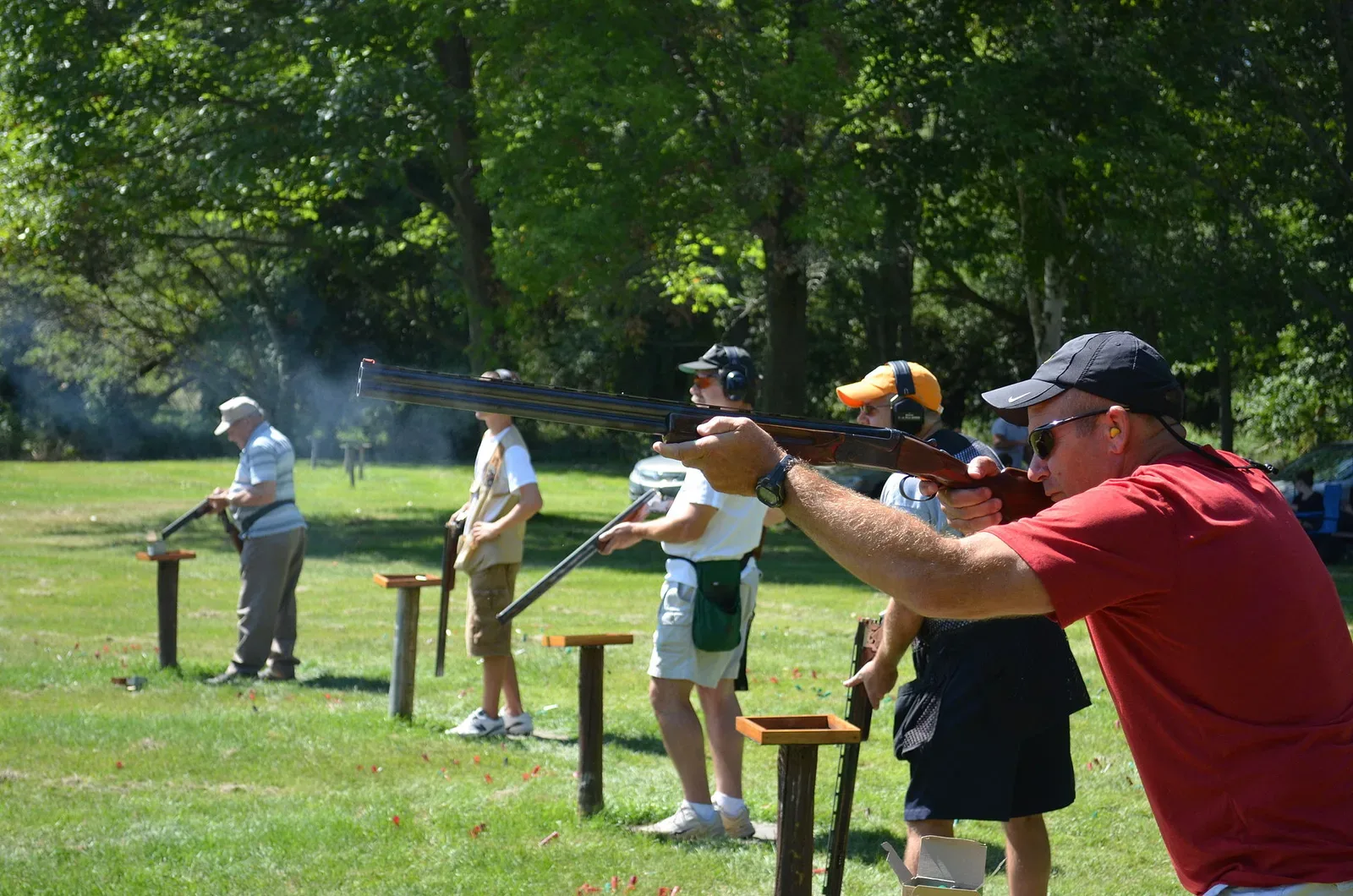
Trap
Trap shooting is where most beginners start, and there's a good reason for that. In trap, targets are launched away from the shooter from a single house in front of the shooting stations. The angles vary slightly left, right, and center -- but the general direction of flight stays consistent: out and away.
That predictability is what makes trap the friendliest entry point. You're not chasing a target flying at your face or crossing hard left to right. You're tracking something moving away from you, which gives your brain a moment to process what's happening before you react.
You shoot from five stations arranged in a shallow arc behind the trap house. Squads typically rotate through the stations, with each shooter firing a set number of shells per station. One target at a time, one shot (or two, depending on the format) per target.
Pro Tip: Trap teaches you the fundamentals -- reading the target, staying focused, controlling your swing, and following through. Those skills transfer directly to every other clay sport.
Skeet
Skeet introduces more complexity. Targets come from two houses -- a high house on your left and a low house on your right -- and you shoot from seven stations arranged in a semicircle, plus an eighth station in the center.
The targets fly on crossing and incoming paths, which means faster visual processing and more precise timing. Some shots have both a high-house and low-house target thrown simultaneously, a true pair that requires you to break two birds in quick succession.
Skeet is a natural step up from trap. Once you've built confidence tracking away targets, the crossing presentations in skeet sharpen your swing and timing in ways trap can't fully replicate. Many shooters find skeet is where their technique really tightens up.
Sporting Clays
Sporting clays is the most varied of the three -- and the hardest to describe in a sentence. The common comparison is "golf with a gun," and it fits. You move from station to station across a course, often spread over significant acreage, and each station presents a completely different target scenario.
One station might throw a high crossing bird. The next simulates a flushing quail. Another sends a clay rolling across the ground to imitate a rabbit. Per one instructor's description at Mid-Hudson Sporting Clays in New Paltz, NY, the traps at each station -- sometimes marked A, B, and C -- each have different trajectories and are released on command.
Sporting clays pulls in elements of both trap and skeet while adding variety, elevation changes, and target combinations you won't see in either of the structured disciplines. For a group that includes both beginners and more experienced shooters, it's often the most engaging option because the variety keeps everyone challenged.
| Discipline | Target Direction | Stations | Difficulty for Beginners | Best For |
|---|---|---|---|---|
| Trap | Away from shooter | 5 in a fixed arc | Low -- predictable angles | First-timers, building fundamentals |
| Skeet | Crossing and incoming | 7 + center | Moderate -- more angles, faster pace | Step up from trap |
| Sporting Clays | Every direction | 10-15+ stations on a course | Variable -- beginner courses available | Mixed groups, most variety |
What to Expect Your First Dayedit
Most ranges follow a similar check-in process. You'll typically watch a safety briefing or video before you ever touch a gun. Staff will walk you through where the courses are, how the trap machines work, and what the range commands mean.
According to Jacksonville Clay Target Sports, first-time shooters are asked to watch a brief safety video upon arrival, and staff explain how to operate card readers and trap machines. Don't skip any of that. It's not formality -- it's the foundation for not being the person who ruins everyone else's day on the range.
If you want actual instruction -- proper stance, gun mount, where to look, how to call for the target -- book a lesson with one of the range's independent instructors. Most ranges list them separately from the walk-up range access. The difference between your first 25 targets with instruction versus without instruction is dramatic.
The "Intro to Sporting Clays" package at Mid-Hudson Sporting Clays, for reference, includes gun rental, two boxes of ammo (50 rounds), 50 targets, ear and eye protection, and 45 minutes of shooting instruction for $90 per person. Packages like that are common at established ranges and are worth every dollar for a first visit.
Safety Note: Eye and ear protection are mandatory on every range. Keep your firearm unloaded until you're at the station and ready to shoot. Always point the muzzle in a safe direction. These aren't suggestions -- range officers will pull you off the course for violations.
Gear You Need (And What You Can Rent)edit

You don't need to own a shotgun to try clay sports. Most ranges rent guns -- typically 12-gauge over-unders or semi-automatics -- and sell shells on site. Ear and eye protection is also usually available for rent.
If you're showing up as a true beginner, here's the practical gear breakdown:
| Item | Buy or Rent | Notes |
|---|---|---|
| Shotgun | Rent to start | 12-gauge is standard for all three disciplines |
| Shells | Buy at range | 12-gauge target loads; range usually sells them |
| Eye Protection | Rent or own | Shooting glasses, not sunglasses |
| Ear Protection | Rent or own | Foam plugs work; electronic muffs are better |
| Clothing | Own | Comfortable layers, closed-toe shoes |
Closed-toe shoes matter more than people expect -- you're walking on gravel, grass, and uneven terrain, especially in sporting clays. Wear something you'd hike in, not sandals.
For the shotgun itself: if an instructor gives you a choice between an over-under (break-action, two barrels stacked vertically) and a semi-automatic, the semi-auto typically has less felt recoil. That matters for beginners. The over-under requires you to manually eject spent shells; the semi-auto does it for you. Either works fine -- just know what you're holding.
Which Discipline Should You Start With?edit
Start with trap. That's the consistent advice from experienced shooters and range instructors alike, and the reasoning is straightforward: the targets move in a predictable direction, you shoot one at a time, and early success builds the confidence that keeps people coming back.
According to Etowah Valley Sporting Clays, trap shooting's predictable target paths and single-target presentation make it easier to focus on form, stance, and timing without being overwhelmed. Many new shooters improve faster with trap, and when you see consistent results early, the experience becomes more enjoyable.
Once you've broken a few dozen clays in trap and the basic mechanics feel natural -- gun mount, cheek weld, swing, trigger pull -- skeet is a logical next move. The crossing and incoming targets will challenge your timing in new ways.
Sporting clays can come at any point. If a facility has a designated beginner course (Etowah Valley's Green Course is one example, specifically designed for comfort and confidence), there's no reason a first-timer can't start there. If the only option is the full competition course, get some trap reps under your belt first.
What the First Few Stations Actually Feel Likeedit
Expect to miss. That's not pessimism -- that's the honest reality of the first 10 to 15 targets for almost everyone. The first target you call for will probably startle you. The second one you'll track but shoot behind. By the fifth or sixth, you'll start to feel the rhythm.
The key mental shift is understanding you're not aiming at where the clay is -- you're shooting where it's going. That's called lead, and it's the core skill of all clay shooting. Your brain will fight you on this for a while because every other shooting context trains you to align your sights on the target directly.
When it clicks, it's immediately obvious. The clay doesn't just chip -- it explodes into a puff of orange dust, and that's a satisfying feedback loop that's hard to replicate in other sports.
Key Point: Point, don't aim. Follow the target with your eyes, let the gun follow your eyes, and pull the trigger while you're swinging -- not after you've stopped.
Safety on the Rangeedit
Clay ranges are generally safe environments because the rules are enforced and the culture supports it. But you need to know the basics before you step onto any course.
- Keep the action open and the gun unloaded until you're at a shooting station and ready to shoot.
- Always point the muzzle downrange or in a safe direction.
- Wear eye and ear protection from the moment you're near any shooting activity -- not just when it's your turn.
- Never sweep anyone with the muzzle, even an unloaded gun.
- Call for your target only when you're in position and ready.
- If something feels wrong -- malfunction, confusion, unsafe situation -- take your finger off the trigger, keep the muzzle pointed safely, and get help from the range officer.
Range officers monitor the courses and will address safety violations. Take their instructions immediately and without argument. They're not being difficult -- they're doing their job.
Practical Tips for Your First Visitedit
A few things that make the day go smoother:
- Book a lesson if it's your first time. Walk-up range access is fine once you know what you're doing. For day one, an instructor makes the experience exponentially more productive.
- Arrive early. Check-in, safety briefing, and gear rental all take time. Don't schedule yourself tight.
- Don't get in your own head about missing. Every shooter at that range missed plenty of targets when they started. Missing is how you learn.
- Take breaks. Shotgun shooting is more physically demanding than people expect -- your shoulder, your focus, and your neck all fatigue. Especially with rental guns or unfamiliar equipment.
- Ask questions. Range staff and experienced shooters are almost universally willing to help beginners. The clay shooting community tends to be welcoming.
Getting Startededit
Find a range near you that offers instruction for beginners -- most established clay facilities have independent instructors on staff or listed on their site. Call ahead, ask about beginner packages, and confirm they have rental equipment available. Bring closed-toe shoes, dress in layers if the weather is variable, and plan on two to three hours for your first visit.
You'll probably leave having broken fewer clays than you'd hoped and wanting to come back immediately. That's a successful first day. Last Updated: March 30, 2026
- J & L Gunsmithing(Chesapeake, VA)
- Gls Guns(Sumner, IA)
- Tkc Customs(Wimberley, TX)
- Oliver Firearms(Spartanburg, SC)
Loading comments...