Quick Reference
Trap Shooting Guide

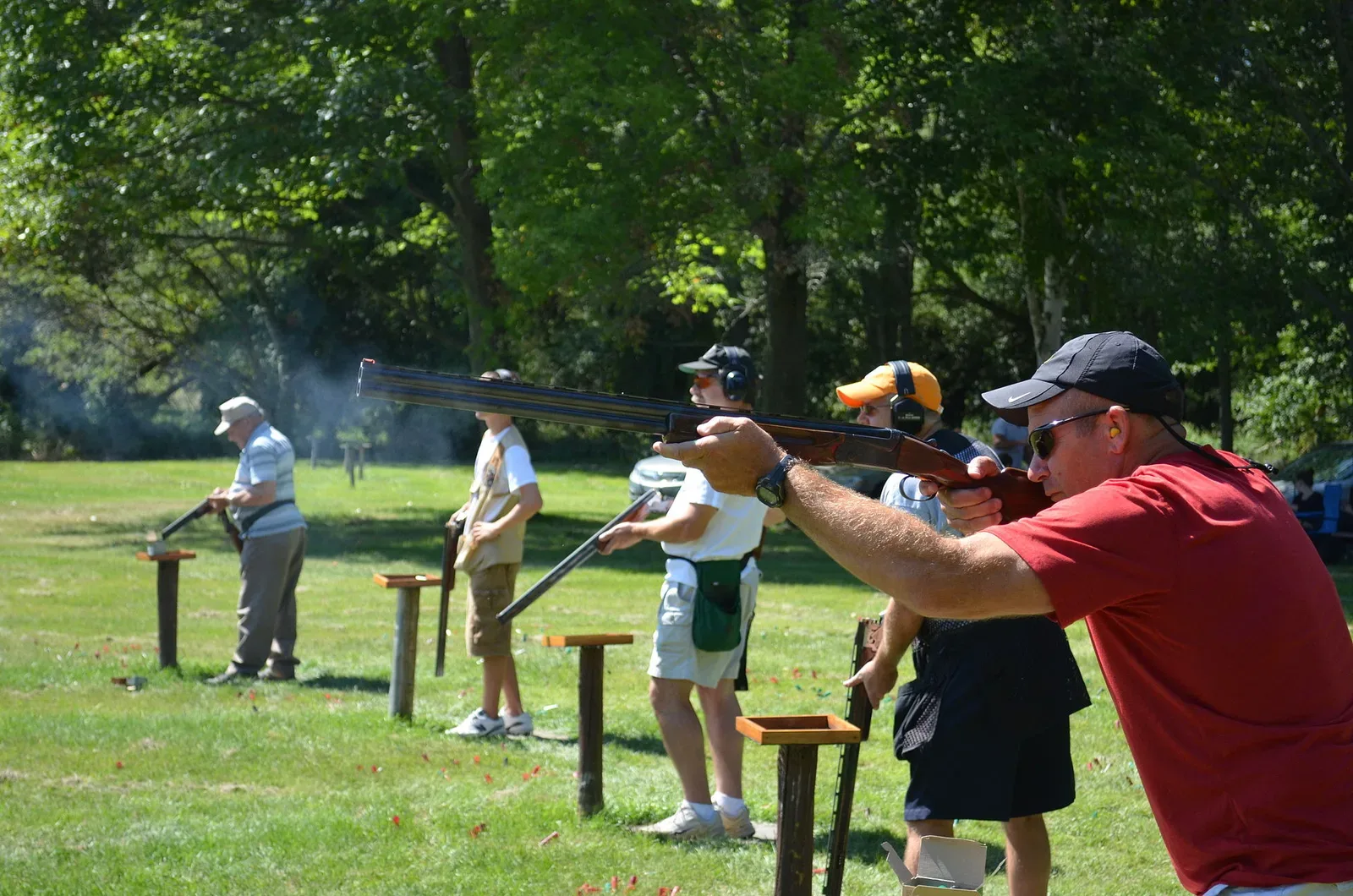
A typical American trap shoot showing the firing line and station layout — the fundamental setup that defines trap shooting's format and safety structure.
Jesrushton (CC BY-SA 3.0)
| Time & Effort | |
|---|---|
Read Time | 9 min read |
| Practice Time | 25 targets per round, typically 100+ rounds recommended for practice sessions |
Equipment Needed | |
| |
| Prerequisites | |
| |
Safety | |
| |
Key Takeaways | |
| |
Organization | |
| Amateur Trapshooting Association (ATA) | |
| Divisions | |
Singles (16 yards)Handicap (19-27 yards)DoublesOlympic TrapWobble Trap | |
Related Topics | |
| |
Trap Shooting
Handbook article
From The Boise Gun Club Handbook
Trap teaches you to track fast-moving targets and make consistent hits on rising birds—skills that transfer directly to upland hunting and clay sports.
You stand in a line with four other shooters, call for a clay target to be thrown away from you at unknown angles, and try to break it with one shot. It's been around since the 1700s, attracts 4,500+ shooters to its Grand Championship in Illinois each August, and remains the most straightforward way to learn shotgun fundamentals.
Don't let the formal reputation fool you. Yes, some trap clubs have jacket requirements and social protocols from 1950, but most modern facilities care more about safety than your wardrobe.
How Trap Worksedit
Field Layout and Sequence
A standard round is 25 targets shot from five stations, five targets per station. You start at station one, shoot five clays, then move right to station two.
The trap machine sits 16 yards in front of you in a concrete house, oscillating left and right within a 54-degree arc.
Standard trap field layout and shooting sequence
Target Presentation
You don't know where in that arc your target will emerge until you call "Pull" and it appears.
Targets fly away from you at roughly 42 mph, rising at a consistent angle but heading anywhere from hard left to hard right. You have maybe 1.2 seconds from target appearance to effective breaking range. Miss that window and the clay gets too far out for reliable hits.
Scoring System
Scoring is simple: hit equals one point, miss equals zero. Perfect score is 25 straight, which sounds easy until you realize good shooters consider 100 straight (four consecutive perfect rounds) a significant achievement.
Station three throws you a hard right target. You mount your gun, swing through the clay's flight path, and fire when your barrel passes the target. Clay dust at 35 yards means one point. Shoot behind it and watch the clay sail away unbroken—zero points. No style points or second chances.
Trap Variationsedit

Primary Disciplines
Singles is the foundation discipline. One target per call, shot from 16 yards behind the trap house. Most beginners start here because it's the most predictable format. Any reliable 12-gauge works—your duck gun, your home defense shotgun, whatever cycles consistently.
Handicap uses the same target presentations as singles, but moves you farther back based on your skill level. New shooters start at 19 yards, champions shoot from 27 yards. The ATA assigns your yardage based on your scores—break 96 or better and you "earn a punch" (more distance).
Equipment needs match singles, though longer barrels help at extended yardages.
Doubles throws two targets simultaneously from fixed positions—one angling left, one angling right. You get one shot per target, typically taking the easier target first then swinging to the harder one.
Over/under shotguns work well here since you can use different chokes in each barrel. Semi-autos give you a faster second shot, but you're stuck with single choke. Two quick shots on crossing targets rewards gun handling over raw accuracy.
| Discipline | Distance | Targets | Equipment Notes |
|---|---|---|---|
| Singles | 16 yards | 1 per call | Any reliable 12-gauge |
| Handicap | 19-27 yards | 1 per call | Longer barrels helpful |
| Doubles | 16 yards | 2 simultaneous | O/U or semi-auto preferred |
| Olympic Trap | Variable | 1 per call (62 mph) | Specialized equipment |
| Wobble Trap | 16 yards | 1 per call (2 shots allowed) | Standard trap gun |
Advanced Formats
Olympic Trap is a different animal entirely. Fifteen machines throw targets at 62 mph from a buried bunker, with more extreme angles and faster flight. Skip this unless you're seriously pursuing international competition.
Wobble Trap adds vertical oscillation to the machine's movement, creating more unpredictable flight paths. Two shots allowed per target. Not ATA-sanctioned but popular for hunters wanting more realistic practice.
Classification Systemedit
Classifications let you compete against shooters of similar ability rather than getting crushed by champions shooting perfect scores.
The ATA uses letter grades based on your average scores over recent registered targets:
| Class | Average Score | Skill Level | Typical Characteristics |
|---|---|---|---|
| AA | 97.00%+ | Elite | Champions, perfect rounds common |
| A | 94.00-96.99% | Advanced | Consistent high scores |
| B | 89.00-93.99% | Intermediate | Solid fundamentals |
| C | 84.00-88.99% | Novice | Learning consistency |
| D | Below 84.00% | Beginner | Developing basics |
You start unclassified and earn classification after shooting enough registered targets to establish an average. Most clubs also run preliminary handicap events where unclassified shooters compete together.
Nobody competent judges you for your class—focus on improving your average rather than sandbagging to stay in an easier class.
Your First Shootedit
Essential Preparation
Show up 30 minutes early with a 12-gauge shotgun, 100+ rounds of target loads, eye and ear protection, and about $15-25 for targets and range fees. Tell someone at the desk you're new.
| Essential Items | Optional Items | Cost |
|---|---|---|
| 12-gauge shotgun | Extra choke tubes | - |
| 100+ target loads | Shooting vest | $25-40 |
| Eye protection | Shell bag | $5-15 |
| Ear protection | Towel | $2-5 |
| Range fees | Notebook | $15-25 |
Most clubs assign experienced shooters to help newcomers learn the routine. Don't worry about slowing things down—everyone expects a learning curve.
Field Procedures
Safety is non-negotiable:
- Keep your action open when moving between stations
- Load only one shell at a time unless shooting doubles
- Point your muzzle downrange at all times
- Follow the range officer's commands immediately
You'll be assigned to a squad of five shooters. When your squad is called, walk to the trap field and take position at station one. The shooter in position one calls for their first target, shoots, then the next shooter calls for theirs. After everyone shoots five targets, the squad rotates one station to the right.
Club Etiquette
Most clubs appreciate help with simple tasks—picking up empty hulls, replacing broken targets in the machine, or keeping score. Volunteering shows you're trying to fit in rather than just using the facility.
Skills That Actually Matteredit
Fundamental Mechanics
Gun mounting determines everything else. Your gun needs to come to the same position on your shoulder and face every single time. Inconsistent mount means inconsistent point of impact, which means missed targets you should have broken.
Target tracking separates good shooters from mediocre ones. You need to see the target immediately when it appears, identify its flight path, and start your swing. Hesitation kills you—targets are moving 60+ feet per second.
Swing timing requires matching your barrel speed to target speed, then firing when your sight picture looks right.
Most misses happen because shooters stop their swing when they pull the trigger. Follow through like a golf swing.
Shot calling means knowing where your shot went before you see the result. Good shooters can tell you "behind" or "over" immediately after firing. This feedback loop accelerates improvement.
Critical sequence for successful target engagement
Station Adjustments
Each shooting position creates different target angles. Station one sees more left-angle targets, station five sees more right angles. Adjust your stance and pre-mount position accordingly.
Training That Worksedit
Live-fire practice is expensive and time-consuming—dry-fire work lets you groove your fundamentals at home for free.
Dry-Fire Practice
Practice bringing the gun to identical position 20+ times daily. Track moving objects—birds, cars—with an empty gun. Work on smooth trigger press without stopping your swing. Practice different stance angles in your garage. Rehearse identical pre-shot preparation.
Live-Fire Focus
Live-fire should focus on target reading and swing timing. Shoot practice rounds before registered events to confirm your zero and warm up your timing. Many good shooters arrive an hour early just to shoot practice targets.
Formal instruction helps, but most trap fundamentals are learnable through observation and practice. Watch good shooters during their pre-shot routine and steal techniques that make sense for your build and style.
Common Mistakesedit
- Buying specialized equipment too early wastes money. Learn the sport with basic gear before investing in adjustable combs and custom stocks. Most shooting problems are technique issues, not equipment issues.
- Lifting your head to watch the target destroys consistency. Keep your cheek welded to the stock throughout the shot sequence. Head lifting causes missed targets you know you aimed correctly.
- Stopping your swing when you pull the trigger causes the most common miss in trap shooting. Your barrel must continue moving through the target's flight path even after the shot breaks.
- Don't change your technique based on one bad round. Every shooter misses targets they should break. Trust your process and keep practicing rather than overhauling your fundamentals because of temporary problems.
- Foot position determines your swing arc and balance. Set up wrong and you'll fight the target instead of flowing with it.
What It Costsedit
| Category | Starter | Competitive |
|---|---|---|
| Initial Equipment | $400-800 | $2,000-5,000 |
| Per Event | $15-25 | $25-50 |
| Annual (ammo, fees, travel) | $800-1,500 | $3,000-8,000 |
Gas and lodging for major shoots add up quickly. Reloading equipment pays for itself if you shoot 5,000+ rounds annually. Competition guns hold value better than field guns if you decide to upgrade.
Organizationsedit
The Amateur Trapshooting Association (ATA) governs most American trap shooting. Join them first if you plan to shoot registered targets. Their rulebook defines equipment requirements, classifications, and safety protocols.
Pacific International Trapshooting Association (PITA) makes sense if you live on the West Coast and want to shoot their events. The Scholastic Clay Target Program (SCTP) handles youth and collegiate competition.
Find your nearest trap club, show up on a practice night, and tell them you want to learn. Most trap shooters remember learning the same lessons and are happy to help beginners.
See Alsoedit
- Skeet Shooting - Crossing targets from two trap houses
- Sporting Clays - Multiple target presentations on wooded courses
- Find Events
Last Updated: January 29, 2026
Loading comments...