Quick Reference
F-Class Long Range Shooting

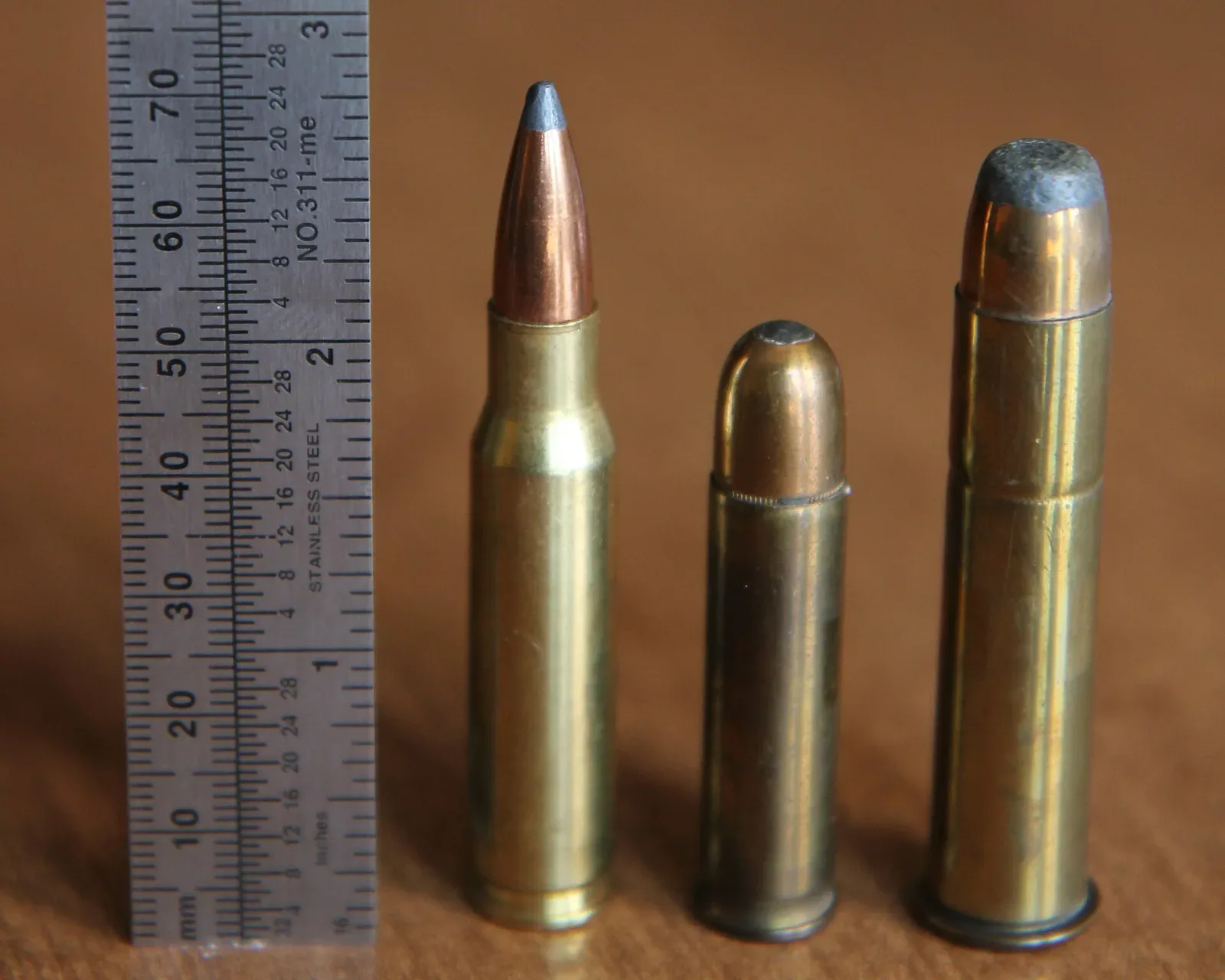
.308 Winchester in multiple configurations — FMJ, soft-point, and hollow-point loads serve different purposes in F-Class competition and hunting.
JHobbs (CC BY-SA 4.0)
| Time & Effort | |
|---|---|
Read Time | 11 min read |
Equipment Needed | |
| |
| Prerequisites | |
| |
Safety | |
| |
Key Takeaways | |
| |
Organization | |
| National Rifle Association (NRA) / International Confederation of Fullbore Rifle Associations (ICFRA) | |
| Divisions | |
F-TR (Target Rifle)F-OpenF-Standard.22 F-ClassMid-Range F-ClassPalma F-Class | |
Related Topics | |
| |
F-Class Long Range
Handbook article
From The Boise Gun Club Handbook
F-Class lets you shoot for precision at distances out to 1,200 yards without needing iron sight eyes or benchrest money--but don't mistake "accessible" for "cheap" or "easy."
- What you're signing up for: Prone shooting with scopes and bipods, chasing X-rings the size of dinner plates at 1,000 yards
- The reality check: Plan on $5,000+ for gear that won't frustrate you, and years to get genuinely competitive
- Why shooters love it: Pure accuracy without time pressure, and a community that actually helps newcomers
What F-Class Actually Isedit
Origins and Philosophy
George Farquharson started this whole thing in Canada in the late 1980s when his eyes couldn't handle iron sights anymore. The sport kept his name--though after a bad day at 1,000 yards, you might hear shooters claim the "F" stands for something else entirely.
Evolution of F-Class competition from Canadian innovation to international sport
You shoot prone with a scoped rifle, using bipods or front rests depending on your division. Distances run from 300 yards out to 1,200, though most matches stick to the 600-1,000 yard range. Unlike rapid-fire games, F-Class gives you time--30 minutes for your first string, 20 for the rest. No rushing, just pure precision.
Target and Scoring Challenges
Here's what separates F-Class from other accuracy sports: the targets are brutal. At 1,000 yards, the X-ring measures 5 inches and the 10-ring is 10 inches. Miss that 10-ring by an inch and you've dropped a full point.
Benchrest might deliver tighter groups, but it's basically an engineering exercise. F-Class makes you actually shoot the rifle.
The sport keeps growing while others struggle with participation because plenty of folks want to see how small they can group at serious distances.
National championships pull 200+ shooters regularly, and the World Championships happen every two years. Turns out plenty of folks want to see how small they can group at serious distances.
The Divisions That Matteredit
F-TR Division
F-TR is where most people start. You're limited to .308 Winchester or .223 Remington, bipods only, and some matches cap your scope power. The cartridge restrictions level the field and keep you focused on shooting instead of chasing exotic wildcats.
F-Open Division
F-Open is the anything-goes class. Any caliber, front rests allowed, unlimited scope magnification. Popular cartridges include .300 WSM, .284 Winchester, and various 6.5mm wildcats. The rifles often look like benchrest guns with tactical stocks. If you enjoy the technical side as much as the shooting, F-Open scratches that itch.
| Division | Cartridge Limits | Equipment Allowed | Scope Power | Best For |
|---|---|---|---|---|
| F-TR | .308 Win, .223 Rem | Bipods only | Often limited | Shooting fundamentals |
| F-Open | Any caliber | Front rests allowed | Unlimited | Equipment development |
| F-Standard | Service cartridges | Between TR/Open | Varies | ICFRA competition |
Other Divisions
F-Standard sits between them--an ICFRA division using standard service cartridges with equipment somewhere between F-TR and F-Open. Most US shooters ignore it.
You'll also see .22 F-Class for rimfire practice and Mid-Range matches shot at 300-700 yards. Both help new shooters get started without needing a 1,000-yard range.
- Choose F-TR if you want to focus on shooting fundamentals
- Choose F-Open if you like equipment development and ballistic calculations
- Either way, you're signing up for a technical challenge
The Gear Reality Checkedit
Rifle and Scope Priorities
Start with the rifle and scope--they determine your accuracy ceiling. Everything else can be upgraded later.
The biggest newbie mistake is mounting a $500 scope on a $2,000 rifle. Plan to spend 50-70% of your rifle budget on glass.
For rifles, Savage F-Class models offer the cleanest entry point around $1,500-2,500. Custom actions dominate serious competition but cost $3,500+.
Your scope needs at least 20x magnification, target turrets, and parallax adjustment. Budget $800-1,200 minimum, with competitive glass running $2,000-4,000.
| Component | Entry Level | Competitive | Premium |
|---|---|---|---|
| Rifle | $1,500-2,500 | $3,500-5,000 | $8,000+ |
| Scope | $800-1,200 | $2,000-3,000 | $4,000+ |
| Bipod/Rest | $200-400 | $800-1,500 | $2,000+ |
| Ammo (per round) | $2-4 | $1-2 (handload) | $3-5 |
| Total Initial | $3,500-5,000 | $8,000-12,000 | $15,000+ |
Support Equipment
F-TR shooters need a solid bipod--Harris models work to start, but Atlas and similar premium bipods make life easier. F-Open requires a front rest, and the good ones from SEB or Farley cost $800-1,500.
Everyone needs a quality rear bag and shooting mat, plus a spotting scope that actually lets you see bullet holes at 1,000 yards.
Ammunition Considerations
Don't forget ammunition costs. Match-grade .308 runs $2-4 per round, F-Open cartridges cost more. Most serious competitors handload, which drops costs to $1-2 per round but requires time and equipment investment.
How Scoring Actually Worksedit
Ring System and Measurements
F-Class uses 10-ring scoring with an X-ring for ties. At 1,000 yards, rings step down in 5-inch increments from the 5-inch X-ring to the 35-inch 5-ring. Miss the 5-ring entirely and you've got a zero.
| Distance | X-Ring | 10-Ring | 9-Ring | 8-Ring | 7-Ring | 6-Ring | 5-Ring |
|---|---|---|---|---|---|---|---|
| 1,000 yards | 5" | 10" | 15" | 20" | 25" | 30" | 35" |
| 900 yards | 4.5" | 9" | 13.5" | 18" | 22.5" | 27" | 31.5" |
| 600 yards | 3" | 6" | 9" | 12" | 15" | 18" | 21" |
Match Format and Timing
Scores show total points plus X-count: "200-15X" means maximum points with 15 X-ring hits. A typical Long-Range aggregate might include 20 shots each at 800, 900, and 1,000 yards for 600 possible points.
You get unlimited sighters for your first string in 30 minutes, then 2-3 sighters for each 20-minute follow-up string. Electronic targets are becoming common and provide instant feedback, but plenty of clubs still use paper with manual scoring.
Classification System
Shooters are classified by their last 120 shots: Master (97.5%+), Expert (95-97.49%), Sharpshooter (92.5-94.99%), Marksman (87.5-92.49%), and Unclassified below that. This keeps competition fair within skill levels while giving you clear goals.
| Classification | Score Percentage | Skill Level | Typical Score (200 possible) |
|---|---|---|---|
| Master | 97.5%+ | Expert competitor | 195+ |
| Expert | 95-97.49% | Seasoned shooter | 190-194 |
| Sharpshooter | 92.5-94.99% | Intermediate | 185-189 |
| Marksman | 87.5-92.49% | Developing | 175-184 |
| Unclassified | <87.5% | Beginner | <175 |
Key rules newcomers need to know:
- Prone position only
- Specific cartridge limits for F-TR
- Equipment dimension restrictions
- Crossfires score zero
- Safety violations result in immediate disqualification
Getting Your Feet Wetedit
Call the match director before showing up--most ranges require safety briefings for newcomers. Many clubs run "come and try" days where experienced shooters provide equipment and coaching. The F-Class community is exceptionally welcoming because growing the sport benefits everyone.
Step-by-step process for entering your first F-Class match
Zero your rifle at 100 yards and confirm it shoots sub-MOA consistently. Don't worry about exact long-range data--experienced shooters can help with dial-ups.
Run a tall target test to verify your scope tracks properly. Discovering tracking problems during a match ruins your whole day.
Learn basic range commands: "Commence firing" starts each string, "Cease fire" stops everything immediately. Most matches use squadding systems where you rotate between shooting, scoring, and target duties. Don't view scoring time as lost--you'll learn to read targets and understand wind patterns.
Bring the following to your first match:
- More ammo than calculated (60-80 rounds typical)
- Organized equipment setup
- Tools and accessories readily accessible
- Range-specific items (ear protection, shooting mat)
The Money Talkedit
Initial Investment
Initial equipment runs $3,500-5,000 for basic competitive gear, up to $8,000-15,000 for serious setups. Match fees typically cost $40-120 locally, $150+ for major championships. Most matches require NRA membership for insurance, adding $45 annually.
Ongoing Annual Costs
Annual costs hit $1,500-2,500 for casual competition, $4,000-8,000 if you're serious. Hidden expenses include barrel replacements every 1,500-3,000 rounds ($400-800 installed), reloading equipment ($800-2,000 setup), and travel for major matches.
Ammunition alone can cost $2,000+ annually for active competitors. Practice rounds, match ammo, load development--it adds up fast. This isn't a budget-friendly hobby, and the costs never really stop.
Finding Matches and Trainingedit
Range Requirements
F-Class needs 600-1,000 yard capable ranges, which limits your options compared to shorter-distance sports. The NRA club finder helps, though F-Class John's website (fclassjohn.com) provides better match calendars and range directories.
Major Venues
Major venues include Camp Perry in Ohio, Whittington Center in New Mexico, and various military ranges. Most clubs host monthly matches during shooting season--typically March through October in colder climates.
Online communities like AccurateShooter.com forums and Facebook F-Class groups announce matches early and provide insider knowledge about specific venues. Start locally even if it means driving 2-3 hours. Building relationships with nearby competitors provides mentorship and reduces travel costs.
Loading comments...