Specifications
Glock 17

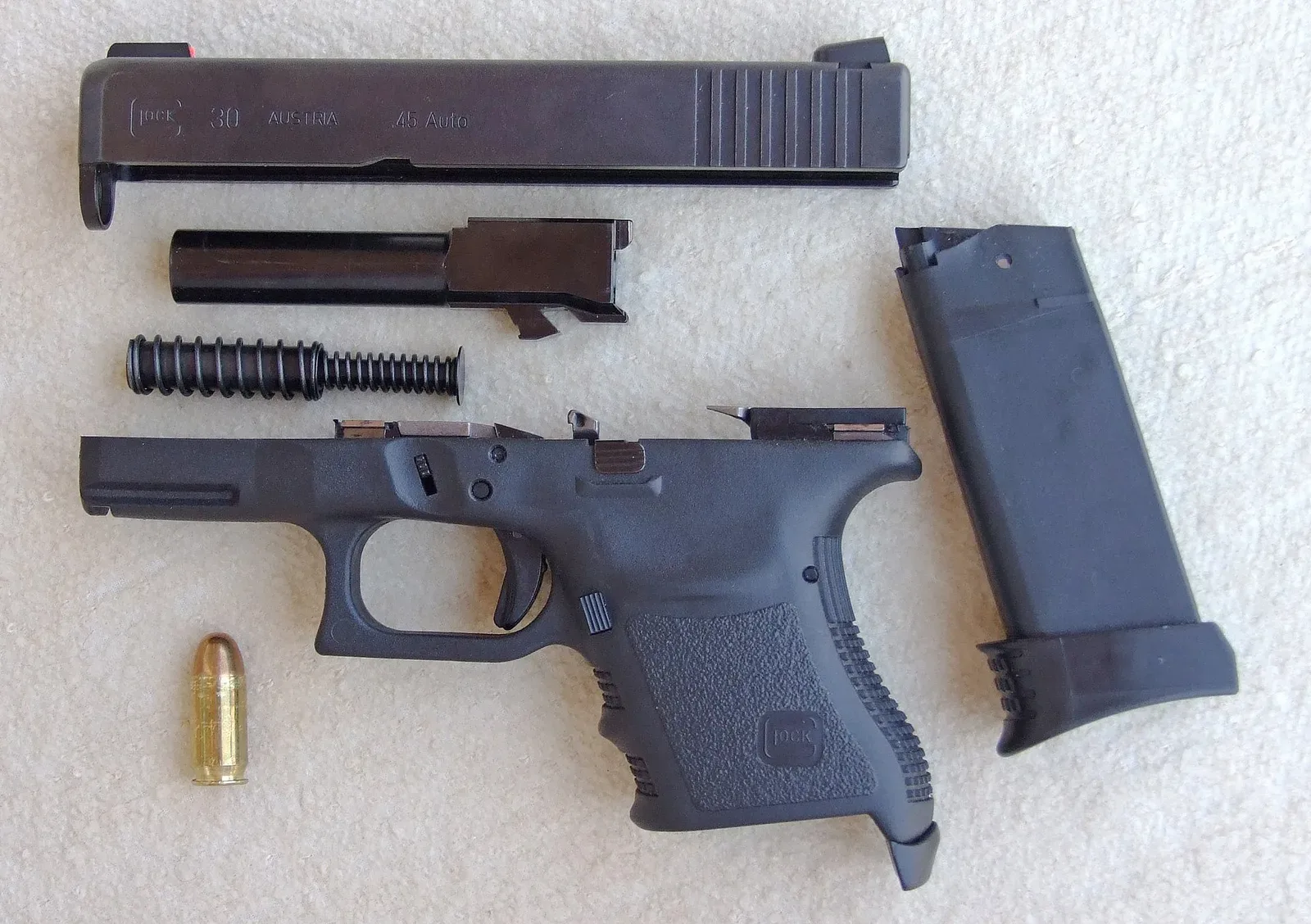
Field-stripped Glock 30 showing the characteristic simplicity of Glock's design — fewer than 34 parts, most of which are visible here in separated form.
Jan Hrdonka en:User:Hrd10 (Public domain)
| Manufacturer | |
|---|---|
| Made By | Glock Ges.m.b.H. |
| Designer | Gaston Glock |
| Origin | Austria |
| Specifications | |
| Caliber | 9×19mm Parabellum |
| Action | striker fired |
| Capacity | 17 rounds |
| Barrel | 4.49 in (114 mm) |
| Length | 7.32 in (186 mm) |
| Weight | 22.05 oz (625 g) |
| Feed | Detachable box magazine |
| Sights | Fixed three-dot polymer |
| Performance | |
| Eff. Range | 50 meters |
| Muzzle Vel. | 375 m/s (1,230 ft/s) |
| Production | |
| Designed | 1982 |
| In Production | 1983 |
| Produced | Over 10 million (all Glock models) |
| Unit Cost | $500-600 USD |
| Variants | |
| |
| Service Use | |
Austrian Armed ForcesNorwegian Armed ForcesSwedish Armed ForcesThousands of police agencies worldwide | |
| Cultural Note | |
| Revolutionary design that established the modern striker-fired pistol template | |
| Related Firearms | |
Glock 17
Firearms encyclopedia article
From The Boise Gun Club Handbook
| Quick Stats | |
|---|---|
| Manufacturer | Glock Ges.m.b.H. |
| Type | Semi-automatic pistol |
| Caliber | 9×19mm Parabellum |
| Capacity | 17 rounds (standard) |
| Barrel Length | 4.49 in (114 mm) |
| Overall Length | 7.32 in (186 mm) |
| Weight (unloaded) | 22.05 oz (625 g) |
| Action Type | Striker-fired |
| Year Introduced | 1982 |
In 1982, an Austrian curtain rod manufacturer named Gaston Glock decided to build a pistol. He had zero experience with firearms but plenty of experience with polymers--and that combination changed everything. The Glock 17 wasn't the first striker-fired pistol or the first to use polymer, but it was the first to get both right at the same time.
What Glock created became the template every modern service pistol follows. Polymer frame, striker-fired action, no external safeties, and magazines that hold more rounds than your grandfather's 1911. The G17 didn't win over shooters through slick marketing--it earned respect by working when other guns quit.
You'll find G17s in cop holsters from Stockholm to Seoul, and there's a reason for that. When agencies bet their officers' lives on a pistol, they pick the one that goes bang every time you pull the trigger.
History & Developmentedit
Gaston Glock approached pistol design like an outsider because he was one. Instead of copying what everyone else was doing, he talked to Austrian military experts about what they actually wanted. They wanted reliability, high capacity, and simplicity. Traditional gun companies were still making all-steel pistols with external safeties and 8-round magazines.
The Austrian military adopted Glock's P80 prototype in 1982. Commercial production started the following year as the Glock 17--named for its 17-round magazine capacity.
Early buyers were skeptical about the polymer frame. "Plastic gun" became a dismissive term until people realized this plastic gun kept working after their steel guns jammed.
Evolution of the Glock 17 platform
Law enforcement agencies started paying attention in the late 1980s. The G17 offered 17 rounds where most service revolvers held 6. It had fewer parts than traditional pistols, which meant fewer things to break.
The G17 offered 17 rounds where most service revolvers held 6. It had fewer parts than traditional pistols, which meant fewer things to break.
Cops could qualify with it faster because there were no external safeties to remember under stress.
Glock has refined the design through five generations while keeping the core concept intact. Gen 2 added grip texture. Gen 3 brought the accessory rail. Gen 4 introduced interchangeable backstraps. Gen 5 removed the finger grooves and added ambidextrous controls. Each generation addressed real-world feedback while maintaining the reliability that made the platform successful.
Technical Specificationsedit
Operating System
The G17 uses a short-recoil operated system with a modified Browning tilting barrel. Instead of multiple locking lugs, it uses a single locking block--simpler and more reliable. The barrel tips up to unlock from the slide during cycling, just like a 1911 but with fewer parts to machine and fit.
Magazine & Controls
The magazine holds 17 rounds in a double-stack configuration. You can also use 19, 24, 31, or 33-round magazines if you need more capacity. The mag release is reversible for left-handed shooters, though you'll need to swap some internal parts on older generations.
Standard sights are three-dot polymer. They work but they're fragile--expect to replace them if you train seriously. Steel night sights and adjustable target sights are available from the factory. MOS (Modular Optic System) variants come cut for red dot optics.
Safety Systems
The Safe Action trigger system incorporates three internal safeties: trigger safety, firing pin safety, and drop safety. No external manual safety--the gun fires when you pull the trigger and doesn't fire when you don't. Some people love this simplicity. Others want a thumb safety they can engage.
Materials & Finish
The frame is reinforced polymer with steel rails and a steel locking block embedded where stress concentrates. The slide gets a Tenifer treatment that's harder than most finishes--you can drag it across concrete and barely scratch it.
Variants & Modelsedit
Generation 1 (1982-1988): The original with smooth grip frame and no accessory rail. Collectors pay stupid money for these now.
| Generation | Years | Key Features | Notable Changes |
|---|---|---|---|
| Gen 1 | 1982-1988 | Smooth grip, no rail | Original design |
| Gen 2 | 1988-1998 | Checkered grip | Improved texture |
| Gen 3 | 1998-present | Accessory rail, thumb rests | Most common variant |
| Gen 4 | 2010-2017 | Modular backstraps, dual recoil spring | Customizable grip |
| Gen 5 | 2017-present | No finger grooves, ambi controls | Enhanced barrel rifling |
Generation 2 (1988-1998): Added checkering and improved grip texture. Still no rail, which some people prefer for concealed carry.
Generation 3 (1998-present): Added the accessory rail and thumb rests. Most aftermarket parts are designed around Gen 3 specs.
Generation 4 (2010-2017): Introduced the modular backstrap system and dual recoil spring assembly. The backstraps let you adjust grip circumference.
Generation 5 (2017-present): Removed finger grooves, added ambidextrous slide stop, and improved the trigger. The barrel gets enhanced rifling that Glock calls "Marksman."
Special variants include the G17L with a 6.02-inch barrel for competition, MOS models cut for optics, and training versions that fire marking cartridges. The core G17 remains the foundation--everything else is a variation on the theme.
Performance Characteristicsedit
Accuracy
The G17 shoots about as accurately as you'd expect from a service pistol. It'll group 3-4 inches at 25 yards with decent ammo--good enough for defensive work but not winning any bullseye matches. The consistent trigger pull helps with repeatability, even though the trigger itself feels like a service trigger.
Reliability
Reliability is where the G17 built its reputation. The simple action, generous tolerances, and robust construction create a pistol that runs dirty, wet, or neglected. It digests everything from 115-grain ball to 147-grain subsonics without complaint. Field reports document pistols running over 100,000 rounds with basic maintenance.
Recoil Management
Recoil management benefits from the pistol's size and the polymer frame's shock absorption. The grip angle works for most shooters, though some find it points high compared to a 1911. Muzzle flip stays manageable for quick follow-up shots. The low bore axis keeps recoil moving straight back instead of rotating the gun upward.
What Worksedit
The G17 earned its reputation through institutional adoption, not marketing campaigns. When military and police agencies worldwide choose the same pistol, they're telling you something important about its reliability.
Simplicity defines the platform. Fewer parts mean fewer failure points.
- No external safeties to manipulate under stress
- Consistent trigger pull from first to last round
- Simple manual of arms: load, point, shoot
The 1911 trigger pull is consistent from first round to last.
High capacity gives you 17 rounds where older service pistols offered 8. The magazines are robust and widely available. Parts support is extensive--you can build an entire G17 from aftermarket components if you wanted to.
The polymer construction saves weight without sacrificing durability. The Tenifer finish resists corrosion better than traditional bluing. You can leave a G17 in a patrol car holster for years without babying it.
What Doesn't Workedit
The trigger feels utilitarian because it is. Glock designed it for reliability and consistency, not refinement. You get noticeable take-up before a somewhat mushy break.
Aftermarket triggers can improve this, but the factory trigger gets the job done without exciting anyone.
Grip ergonomics don't suit everyone. The angle works for most shooters but feels wrong to others. The aggressive texturing can be uncomfortable during extended shooting sessions. Finger grooves on older generations don't align with all hand sizes.
Standard polymer sights are fragile and offer basic three-dot configuration. Serious users replace them immediately. The slide serrations provide adequate grip but can be difficult with wet or gloved hands.
Ejection patterns can be inconsistent. Some G17s throw brass over your right shoulder into your face--annoying for left-handed shooters or anyone standing to your right. It's not dangerous but it's irritating.
Notable Usersedit
The Austrian Armed Forces adopted the G17 as their service pistol in 1982, followed by Norway and Sweden. Multiple NATO allies and other military forces worldwide have since adopted various Glock models based on the G17 platform.
Thousands of law enforcement agencies carry Glocks, from small-town departments to federal agencies. The simplicity and reliability made it popular with departments transitioning from revolvers to semi-automatics.
Competition shooters use G17s in USPSA Production division, IDPA, and other practical shooting sports. The platform's reliability and aftermarket support make it a solid choice for serious competitors.
Civilian users appreciate the same qualities that attracted institutional buyers--reliability, capacity, and simplicity. The G17 works as a home defense gun, concealed carry pistol (though it's large for that role), and general-purpose shooting tool.
The BGC Takeedit
The Glock 17 succeeded because it solved real problems instead of chasing features nobody needed. While other manufacturers were perfecting single-action triggers and polished finishes, Glock built a pistol that worked when it mattered.
Is it the perfect pistol? No. The trigger won't win any awards for smoothness, and the grip doesn't fit every hand perfectly. But perfection was never the goal--consistency was.
The G17 performs the same whether it's clean or dirty, hot or cold, new or worn.
Four decades later, every major manufacturer offers a striker-fired, polymer-framed pistol that follows the template Glock established. That tells you everything you need to know about whether they got it right. The G17 changed the industry because it changed what shooters expected from a service pistol.
If you want a pistol that starts every time and runs forever, the G17 delivers that promise. Everything else is just details.
- Gls Guns(Sumner, IA)
- Bi-mart - Yakima (Fruitvale Ave)(Yakima, WA)
- New Philly Sportsman Specialities(New Philadelphia, OH)
- R&R Sports & Outdoors(Brandon, FL)
Loading comments...