Legal Details
Legislation

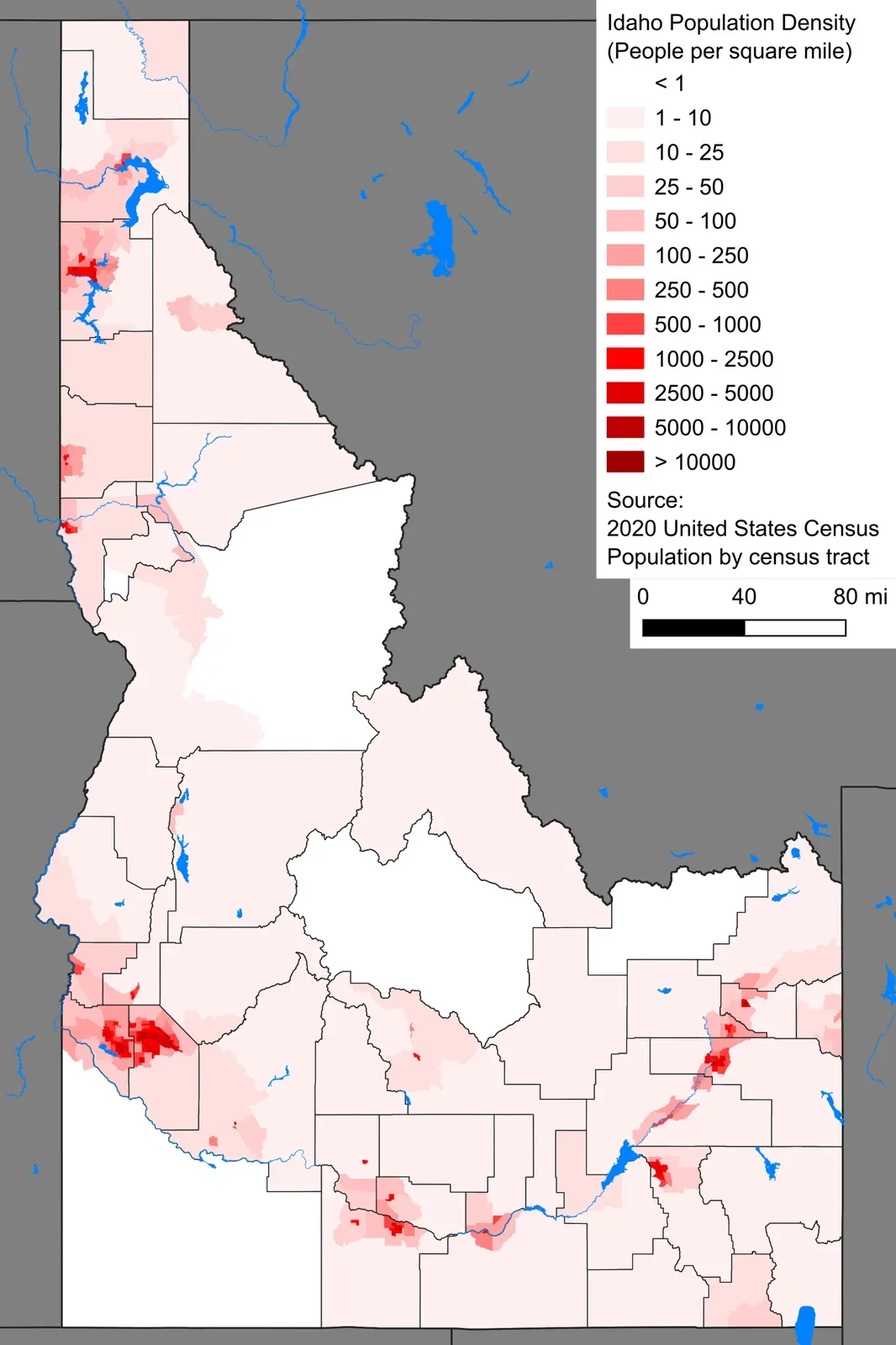
Idaho population density map (2020 census) — preemption law applies statewide, but enforcement varies significantly between urban Boise/Coeur d'Alene and rural counties.
Crossover1370 (CC0)
| Identification | |
|---|---|
| Jurisdiction | |
Territory | Idaho |
Idaho Government Building Gun Laws: What You Can and Can't Carry Where
Legal information and analysis
From The Boise Gun Club Handbook
This is educational information, not legal advice. Laws change. Consult an attorney for your specific situation.
Idaho is one of the most permissive states in the country for gun owners — but even here, certain government buildings are off-limits, and getting caught in the wrong place with a firearm can turn a legal carry into a criminal charge fast.
The Foundation: Idaho's Preemption Lawedit
Before getting into specific buildings, you need to understand the legal architecture underneath all of it. Idaho Code Ann. § 18-3302J — the state's preemption statute — strips local governments of the power to invent their own gun rules. Per the statute:
"Except as expressly authorized by state statute, no county, city, agency, board or any other political subdivision of this state may adopt or enforce any law, rule, regulation, or ordinance which regulates in any manner the sale, acquisition, transfer, ownership, possession, transportation, carrying or storage of firearms or any element relating to firearms and components thereof, including ammunition."
The legislature was explicit about its intent: it wants to "wholly occupy the field of firearms regulation" in Idaho. That means Boise can't pass its own gun ordinance, Ada County can't add permit requirements, and no city council can decide to ban carry in City Hall unless state law gives them that authority.
The only carve-out for local government is discharge ordinances — counties and cities can regulate firing a gun within their boundaries, but even those ordinances can't touch lawful self-defense, hunting, and sport shooting ranges. Local governments can also regulate the location and construction of shooting ranges under Chapter 26, Title 55, Idaho Code. That's it. Everything else is off the table for local lawmakers.
This matters enormously for the government building question: if a city or county wants to post a "no guns" sign on its courthouse, it needs state statutory authority to back that up. A sign without statutory authority doesn't create a criminal prohibition under Idaho's preemption scheme.
Where State Law Actually Prohibits Carryedit
Idaho Code Ann. § 18-3302C is the primary statute creating prohibited-places criminal liability. It covers three categories of government-adjacent facilities:
- Courthouses — carrying a concealed weapon in a courthouse is prohibited
- Juvenile detention facilities — prohibited
- Jails — prohibited
These prohibitions apply regardless of whether you have a concealed weapons license. Per the NRA-ILA summary of Idaho law, § 18-3302C makes carrying a concealed weapon in these locations a crime.
Key Point: The courthouse prohibition is the one that catches people most often. If you drive to the county courthouse to renew your vehicle registration and you're carrying — that's a problem. The prohibition doesn't distinguish between wings of the building or what you're there to do.
Schools: A Separate Statute with More Complexityedit
Public and private schools get their own treatment under Idaho Code Ann. § 18-3302D. Firearm possession is prohibited on the property of any private or public elementary or secondary school, and extends to:
- Any portion of a building, stadium, or structure on school grounds being used for a school-sponsored activity at the time of the violation
- School-provided transportation
- School-sponsored activities, programs, or events regardless of location — meaning if the school play is at the civic center, students can't have firearms there during the event
There are exceptions carved into § 18-3302D:
- An adult non-student with a firearm secured and locked in their vehicle in an unobtrusive, nonthreatening manner
- A person lawfully possessing a firearm in a private vehicle while dropping off or picking up students or school employees
- Any person or employee authorized to carry by the board of trustees of the school district or governing board
That last exception is significant — Idaho law explicitly allows school boards to arm employees or staff if they choose to do so. This is a state-level policy decision delegated to local boards, not a gun restriction.
Colleges and Universities: The Enhanced License Exceptionedit
Public colleges and universities occupy a unique middle ground under Idaho Code Ann. § 18-3309. Governing boards — including the Board of Regents of the University of Idaho and the boards of trustees of state colleges and universities — are authorized to prescribe rules and regulations relating to firearms on their property.
Here's the catch that changes everything for many carriers:
That authority "shall not extend to regulating or prohibiting the otherwise lawful possession, carrying or transporting of firearms or ammunition by persons" with an enhanced carry license or a license as a qualified retired law enforcement officer.
So the default is that colleges can regulate guns on campus — but holders of Idaho's enhanced concealed weapons license can override those rules almost everywhere on campus. Almost. Even enhanced license holders are prohibited from carrying:
- In student dormitories and residence halls
- Inside any public entertainment facility building on campus — but only if that facility is properly posted at each public entry point notifying attendees of the restriction during the game or event
If the entertainment facility isn't properly posted, the prohibition doesn't apply to enhanced license holders.
Key Point: A standard concealed weapons license doesn't get you onto a college campus if the university has adopted firearms regulations. You need an enhanced license for that campus carry protection. This distinction matters enormously if you're a student or employee.
Enhanced License Requirements
Since the enhanced license unlocks campus carry rights that a standard license doesn't, it's worth knowing what it takes to get one. Per Idaho Code Ann. § 18-3302K and the NRA-ILA summary:
| Requirement | Standard License | Enhanced License |
|---|---|---|
| Minimum age | 21 (18-20 via provisional) | 21 |
| Idaho residency | Not required | 6 consecutive months minimum |
| Training course | Sheriff may require | Mandatory 8-hour in-person course with live fire, within 12 months of application |
| Curriculum | Flexible | Must meet statutory requirements |
| Valid for | 5 years | 5 years |
| Campus carry | No | Yes (with exceptions) |
The enhanced license also gets broader recognition in other states — per NRA-ILA, Delaware, Minnesota, Nevada, Washington State, and Wisconsin recognize Idaho's enhanced permit only, while other states recognize the standard resident permit.
Private Property on Government Land: A Nuance Worth Knowingedit
Idaho Code Ann. § 18-3302(25) draws a line that many people miss. Private property owners and private businesses can restrict firearms on their property — that's a standard property rights rule. But that power has a limit:
Private restrictions cannot apply to property owned by the state of Idaho or its political subdivisions that is normally and habitually open to the public and is leased, rented, licensed, or loaned to a private entity — unless the use is for:
- A private event by invitation only
- A commercial event that charges admission
- Any other event with restricted access whether or not admission is charged
Practical example: If a private vendor sets up a booth in a public county fairground, they can't unilaterally declare that space a gun-free zone for everyday open access. But if they're running a ticketed event with restricted entry, different rules apply.
Prohibited Persons: Who Can't Carry Anywhereedit
The building restrictions don't matter much if you're already prohibited from possessing a firearm. Idaho Code Ann. § 18-3316 prohibits anyone with a felony conviction in any jurisdiction from purchasing, owning, possessing, or having custody or control of a firearm — unless that conviction has been expunged, pardoned, set aside, or firearm rights otherwise restored under applicable law.
Beyond felons, Idaho's prohibited persons list under § 18-3302(11) includes:
- Anyone currently charged with or convicted of a crime punishable by imprisonment over one year
- Fugitives from justice
- Unlawful users of marijuana or other controlled substances (per 21 U.S.C. § 802)
- Persons adjudicated as lacking mental capacity, mentally ill, gravely disabled, or incapacitated (per Idaho Code Ann. §§ 18-210, 66-317, 15-5-101(a))
- Anyone dishonorably discharged from the armed forces
- Aliens illegally present in the United States
- Anyone who renounced U.S. citizenship
- Persons subject to certain active protection orders restraining them from contact with an intimate partner or child
- Anyone free on bond or personal recognizance pending trial for a disqualifying offense
Minors have their own restrictions: it's a misdemeanor for anyone under 18 to possess a firearm without written parental permission or while accompanied by a parent or guardian (§ 18-3302E). A separate provision under § 18-3302F makes it a crime for anyone under 18 to possess a handgun or — except as provided by federal law — a sawed-off rifle, sawed-off shotgun, or fully automatic weapon.
Idaho's Permitless Carry Frameworkedit
Understanding the government building restrictions requires understanding what the baseline legal carry looks like in Idaho. In 2016, Idaho eliminated the requirement that people obtain a permit before carrying a concealed handgun. In 2019, the age for permitless carry was lowered from 21 to 18. In 2020, the legislature extended permitless carry eligibility from Idaho residents to any U.S. citizen.
Under current law, you can carry concealed without a license in Idaho if you are:
- 18 years of age or older
- A U.S. citizen or current member of the U.S. Armed Forces
- Not otherwise disqualified under state or federal law
Idaho still issues licenses — and people get them primarily for reciprocity with other states that require a permit. The state operates as a shall-issue jurisdiction: if you meet the qualifications, the sheriff must issue the license. Per § 18-3302(7), the standard license minimum age is 21, though sheriffs can issue to 18-20 year olds under the provisional license framework at § 18-3302(20).
Open carry is legal in Idaho — the concealed weapons statute at § 18-3302(4)(a) and (b) explicitly excludes "any deadly weapon located in plain view" and "any lawfully possessed shotgun or rifle" from the concealed carry licensing requirements.
Key Point: Permitless carry does not override prohibited-place restrictions. Carrying without a permit in a courthouse is still illegal — the permitless carry law only removes the license requirement for otherwise lawful carry in otherwise lawful locations.
Where You Can Carry in Government Context: Quick Referenceedit
| Location | Standard Permit | Enhanced Permit | Permitless Carry |
|---|---|---|---|
| Courthouse | ❌ Prohibited (§ 18-3302C) | ❌ Prohibited | ❌ Prohibited |
| Jail | ❌ Prohibited (§ 18-3302C) | ❌ Prohibited | ❌ Prohibited |
| Juvenile detention facility | ❌ Prohibited (§ 18-3302C) | ❌ Prohibited | ❌ Prohibited |
| Public K-12 school property | ❌ Prohibited (§ 18-3302D) | ❌ Prohibited | ❌ Prohibited |
| School-sponsored events (off-campus) | ❌ Prohibited for students | ❌ Prohibited for students | ❌ Prohibited for students |
| Public university campus (if regulations adopted) | ❌ Restricted by campus rules | ✅ Generally allowed (§ 18-3309) | ❌ Restricted by campus rules |
| University dormitories/residence halls | ❌ Prohibited | ❌ Prohibited (§ 18-3309) | ❌ Prohibited |
| Posted university entertainment facility (during event) | ❌ Prohibited | ❌ Prohibited if properly posted | ❌ Prohibited |
| City hall / county offices (not courthouse) | ✅ Generally allowed under preemption | ✅ Allowed | ✅ Allowed |
| Public parks | ✅ Generally allowed | ✅ Allowed | ✅ Allowed |
| State-owned property open to public | ✅ Generally allowed | ✅ Allowed | ✅ Allowed |
Note: "Generally allowed" means no state statute prohibits it. Always verify current posting and any applicable administrative rules for specific facilities.
The Intoxication Ruleedit
This applies everywhere, including government buildings where carry is otherwise legal. Idaho Code Ann. § 18-3302B makes it a crime to carry a concealed weapon when intoxicated or under the influence of an intoxicating drink or drug. If the violation occurs on a college or university campus, the penalty escalates: per NRA-ILA's summary of Idaho law, the offender must have any Idaho concealed carry license revoked for three years and becomes ineligible to obtain or renew any such license during that period.
Reciprocity: Carrying Into and Out of Idahoedit
Idaho's Attorney General is required under § 18-3302(17) to negotiate reciprocal agreements with other states. Per the NRA-ILA and Patriot Pawn and Gun summaries of Idaho law, Idaho recognizes valid concealed weapons licenses from all states — you don't need to have a formal bilateral agreement for your out-of-state permit to be honored here. The requirement is simple: the permit must be in your physical possession.
Idaho's own permits, however, face a patchwork of recognition elsewhere:
| Recognition Category | States |
|---|---|
| Enhanced permit only | Delaware, Minnesota, Nevada, Washington State, Wisconsin |
| Resident permit only | Colorado, Florida, Maine, Michigan, New Hampshire, North Dakota |
Per NRA-ILA: reciprocity agreements are subject to frequent change. Verify before crossing state lines.
Non-residents can apply for an Idaho concealed weapons license. Per the Idaho Sheriffs' Association FAQ cited in source material, Idaho doesn't distinguish between resident and non-resident licenses — they're the same license.
Pending Legislation: House Bill 621edit
According to NRA-ILA, House Bill 621 — a concealed carry clarification bill — was printed and introduced in the House State Affairs Committee as of March 2, 2026. The 2026 legislative session opened January 12, 2026. No further details on HB 621's provisions or status are available from the sources reviewed for this article. If carry law clarification is in play, watch this bill.
What About Red Flag Laws and Registration?edit
Idaho does not have a red flag (ERPO) law, per NRA-ILA. There's nothing in the sourced material suggesting one is pending.
On registration: Idaho's Constitution (Art. I, § 11) explicitly prohibits "licensure, registration or special taxation on the ownership or possession of firearms or ammunition." A 2023 law reinforced this by prohibiting any state or local government entity from keeping a registry of privately owned firearms or their owners, except records kept during the regular course of a criminal investigation and prosecution or as otherwise required by law. Per NRA-ILA's summary, this is codified at Idaho Code Ann. § 18-3326A(2).
NFA Items in Idahoedit
Per NRA-ILA, Idaho does not have laws restricting "assault weapons," large-capacity magazines, machine guns, personally made or unserialized firearms, or accelerators (bump stocks, forced reset triggers). NFA items including suppressors, short-barreled rifles, short-barreled shotguns, and machine guns are not prohibited by Idaho state law — federal NFA rules still apply, but Idaho adds no additional restrictions on top of them.
The BGC Takeedit
Idaho's preemption law is one of the strongest in the country, and it does real work. The average Idahoan can walk into their county clerk's office carrying a pistol and be on completely solid legal ground. The prohibited-place list is short and specific: courthouses, jails, juvenile detention facilities, and K-12 schools. That's manageable to remember.
The college campus situation is where it gets genuinely complicated, and the standard vs. enhanced license distinction matters more than most people realize. If you're on or around a university campus regularly — as a student, employee, or just someone who parks nearby — the enhanced license is worth the extra training and the wait. Eight hours and a live-fire qual is not a high bar, and it preserves rights that a standard license doesn't.
The preemption statute is only as good as the enforcement behind it. If a local official posts a no-guns sign in a building without state statutory authority for that restriction, the sign doesn't create criminal liability under Idaho law — but you may still end up in a confrontation that's expensive to sort out even if you're right. Know the statute numbers. Idaho Code Ann. § 18-3302J is your answer to anyone claiming local authority to disarm you in a public building.
The bottom line: Idaho keeps its prohibited-place list tight — courthouses, jails, juvenile detention, and K-12 schools are off-limits by statute, everything else defaults to the preemption law's broad protection, and an enhanced license opens doors on college campuses that a standard permit won't.
Resourcesedit
- https://legislature.idaho.gov/statutesrules/idstat/title18/t18ch33/sect18-3302j/
- https://codes.findlaw.com/id/title-18-crimes-and-punishments/id-st-sect-18-3302j/
- https://giffords.org/lawcenter/state-laws/concealed-carry-in-idaho/
- https://www.nraila.org/gun-laws/state-gun-laws/idaho/
- http://patriotpawnandgun.com/wp/ifr1-legal/7-idaho-code-ann-18-3302/
- https://www.atf.gov/media/15311/download
- https://codes.findlaw.com/id/title-18-crimes-and-punishments/id-st-sect-18-3302/
Last Updated: March 05, 2026
- Ace Hardware of Sandusky(Sandusky, MI)
- New Philly Sportsman Specialities(New Philadelphia, OH)
- Atwoods Ranch & Home #46(LACY LAKEVIEW, TX)
- G & P Distributors(McConnellsburg, PA)
This is not legal advice
This guide provides general information about federal and state firearms laws based on publicly available statutes. Laws change frequently and vary significantly by state. Always verify current laws in your jurisdiction. Consult a qualified attorney for legal advice on your specific situation. When in doubt, contact local law enforcement or state police.
Loading comments...