Details
Machine Gun

The M2 Browning .50-caliber machine gun — in service since 1933 and still standard on military vehicles worldwide, making it history's most durable weapons platform.
| Origins | |
|---|---|
| Invented | 1884 |
| Inventor | Hiram Stevens Maxim |
| Country | United Kingdom |
| Timeline | |
| Era | Late 19th century onwards |
| Impact | |
| Significance | Ended 19th century cavalry-and-bayonet charge tactics by enabling sustained automatic fire, fundamentally reshaping infantry warfare and establishing suppressive fire principles still used in modern combat. |
Machine Gun: The Weapon That Remade Modern Warfare
Firearms encyclopedia article
From The Boise Gun Club Handbook
Overviewedit
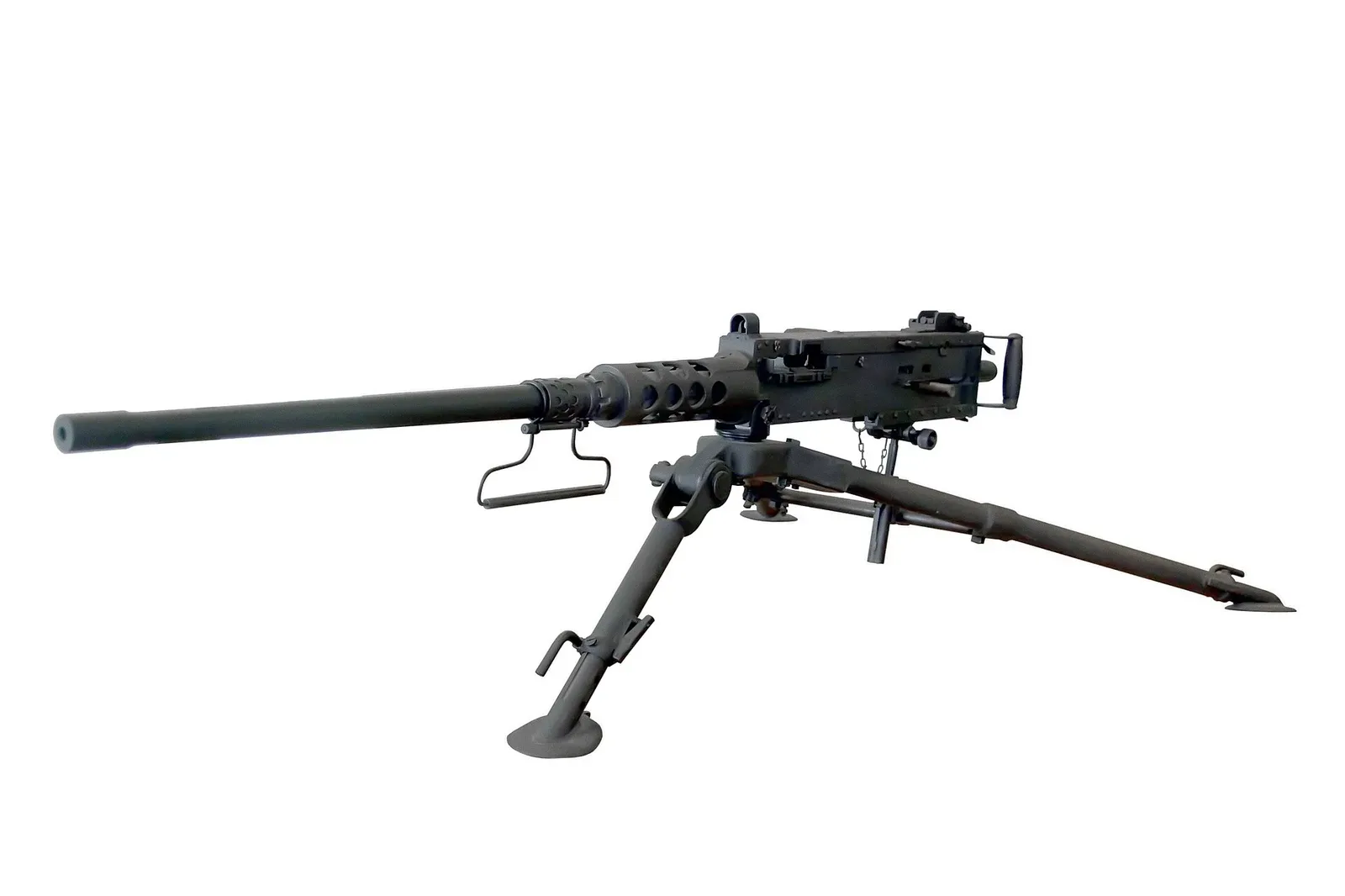
The machine gun is the weapon that ended the 19th century's idea of what a battlefield looked like. Before it, infantry tactics still carried the DNA of Napoleonic warfare — massed formations, bayonet charges, the assumption that enough men moving fast enough could take ground. The machine gun killed that assumption outright, and the wars fought in its shadow killed millions of soldiers who hadn't yet learned the lesson.
A machine gun is a firearm that feeds, fires, and ejects cartridges automatically for as long as the trigger is held and ammunition remains — powered by the mechanical energy of firing itself.
That distinction, between a manually-operated rapid-fire weapon and a genuinely self-powered one, is the line Hiram Stevens Maxim crossed in 1884. What followed reshaped colonial empires, ground two world wars into prolonged slaughter, and established principles of fire and maneuver that still govern infantry tactics today.
Development Historyedit
The Maxim Breakthrough
Hiram Stevens Maxim was an American-born inventor working in London when he began developing his gun in Hatton Garden in 1884. His first British patents date to June and July 1883, and the first prototype was demonstrated to invited guests in October 1884.
That November, he founded the Maxim Gun Company with financing from Albert Vickers, son of steel entrepreneur Edward Vickers.
The key insight was using recoil energy — the same rearward force that kicks a rifle back into a shooter's shoulder — to do the mechanical work of cycling the action.
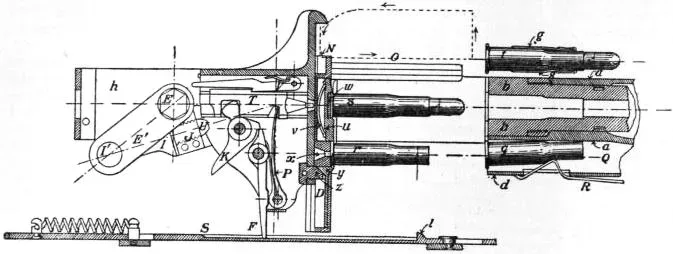
Recoil energy acting on the breech block ejects the spent cartridge and chambers the next round. Maxim's earliest designs used a 360-degree rotating cam to reverse the block's movement, which was later simplified to a toggle lock. This made it vastly more efficient than everything that came before it:
- Hand-cranked Mitrailleuse of 1851
- Gatling gun of 1861
- Gardner gun of 1874
- Nordenfelt gun of 1873
Those weapons required a gunner to continuously operate a mechanism. The Maxim just needed someone to hold the trigger.
The original Maxim was water-cooled, with a jacket around the barrel holding approximately one gallon of water. This let it sustain its rate of fire far longer than air-cooled designs, which would overheat and seize under sustained fire. The tradeoff was weight — the original gun weighed approximately 136.5 pounds, and while a lone soldier could technically fire it, standard practice called for a crew of four to six men:
- A gunner to operate the weapon
- Loaders to feed ammunition
- Ammunition carriers for resupply
- Water supply management personnel
Trials demonstrated it could fire 600 rounds per minute, which one contemporary comparison put as equal to the output of 60 riflemen.
| Machine Gun Model | Nation | Year Adopted | Weight | Rate of Fire | Feed System |
|---|---|---|---|---|---|
| Maxim Gun (Original) | Britain | 1884 | 136.5 lbs | 600 rpm | 250-round belt |
| Maschinengewehr 08 | Germany | 1908 | ~136 lbs | 450-500 rpm | 250-round fabric belt |
| Pulemyot Maxim | Russia | 1910 | ~140 lbs | 520-580 rpm | 250-round belt |
| Vickers Machine Gun | Britain | 1912 | 116.5 lbs | 450-500 rpm | 250-round belt |
| Colt-Browning M1895 | USA | 1895 | 35 lbs | 400-450 rpm | Belt fed |
| M1904 Maxim | USA | 1904 | ~136 lbs | 600 rpm | 250-round belt |
Key milestones in Maxim gun development and adoption
International Adoption
The Maxim Gun Company eventually merged with a Swedish competitor, Nordenfelt, becoming the Maxim Nordenfelt Guns and Ammunition Company, before being absorbed entirely into Vickers, which produced the refined Vickers machine gun — 20 pounds lighter than the original Maxim and introduced into the British Army in 1912.
Other nations didn't wait for Vickers. The German Army adopted the Maschinengewehr 08 — a direct Maxim derivative — and by the time war broke out in 1914 had approximately 12,000 in service. That number grew to 100,000 within a short period. Russia's Pulemyot Maxim was likewise a near-direct copy, with domestic production at Tula Arsenal beginning in earnest around 1910. The design spread because it worked, and because no one had yet produced anything that challenged it on its own terms.
American Development
Meanwhile, in 1890, John Browning designed a lighter, air-cooled, gas-operated machine gun that entered production as the Colt-Browning M1895. In direct response to U.S. trials interest in that weapon, Maxim introduced his own air-cooled Extra Light Rifle Calibre Maxim in 1895 — the first air-cooled Maxim and, at the time, the lightest complete machine gun in the world that one man could carry. Its air-cooling mechanics were poorly understood at the time, however, and the gun overheated quickly. Maxim himself estimated it could fire no more than 400 rounds before requiring a cooling pause. It was a commercial failure — only 135 were built.
The U.S. Army formally adopted the Maxim Machine Gun, Caliber .30, Model of 1904 as its first standard rifle-caliber heavy machine gun. The first 50 guns came from Vickers, Sons & Maxim in the UK. Colt was contracted for domestic production but delays meant only 287 M1904 Maxims were ever manufactured. The Army moved on to the Browning M1917 before the M1904 saw significant combat.
How It Worksedit
Recoil Operation Mechanism
Maxim gun short recoil operation cycle
The Maxim's operating principle — short recoil operation — became one of the foundational action types in firearms design. When a cartridge fires, the barrel and breech face recoil rearward together under chamber pressure. After a short travel, they unlock; the barrel stops and returns forward while the bolt continues rearward, extracting and ejecting the spent case. The bolt then rides forward again under spring pressure, stripping a fresh round from the belt and chambering it. The toggle lock holds the breech closed during firing and releases it as pressure drops to safe levels.
| Component | Function | Key Innovation |
|---|---|---|
| Recoil System | Uses firing energy to cycle action | Self-powered operation |
| Toggle Lock | Secures breech during firing | Simplified from 360° cam |
| Water Jacket | Barrel cooling system | Sustained fire capability |
| Canvas Belt | 250-round ammunition feed | Continuous firing |
| Breech Block | Extraction and ejection | Automated cartridge handling |
Ammunition Feed and Cooling
Cartridges were fed from a 250-round canvas belt. The rate of fire ran 550–600 rounds per minute in standard configuration, with muzzle velocity of approximately 744 meters per second depending on caliber and ammunition.
The water jacket surrounding the barrel was critical to sustained fire. Air-cooled barrels of the era would overheat and fail within a few hundred rounds of rapid fire. Water absorbs heat far more efficiently, allowing the gun to fire continuously — the main tactical advantage over everything else available. The cost was the weight of the water itself, the jacket, and the logistics of keeping the gun supplied with cooling water in the field.
German MG 08 Variations
The German MG 08, the most significant Maxim derivative in World War I, operated on the same recoil principle and fed from 250-round fabric belts. It sat on a distinctive sled mount — the Schlitten — that was stable but heavy, designed for static defensive positions. The MG 08/15, Germany's attempt at a lighter, more mobile version, added a bipod and wooden buttstock but retained the water jacket, resulting in a weapon weighing 33 pounds that still needed belt ammunition — heavier than Allied light machine guns but with a more sustained rate of fire.
Impact on Warfare & Societyedit
Colonial Warfare Applications
The Maxim gun's first sustained combat use came not in Europe but in Africa. During the Battle of the Shangani on October 25, 1893, 700 soldiers used five Maxim guns to repel 5,000 Matabele warriors during the First Matabele War in Rhodesia. The weapon played a significant role in the broader Scramble for Africa — historian Martin Gilbert called it "the weapon most associated with imperial conquest."
Whatever happens, we have got / The Maxim gun, and they have not. — Hilaire Belloc
Historical accounts note, though, that the Maxim's significance in colonial warfare was partly psychological. Its destructive power was most pronounced when African opponents could be drawn into pitched battles in open terrain — the gun's static weight and crew requirements made it less effective in fluid bush fighting. Early models also suffered reliability problems in the field. Colonel Charles Callwell, writing in his 1906 book Small Wars, noted that older machine gun designs "jammed at Ulundi, they jammed at Dogali, they jammed at Abu Klea" — though he acknowledged the Maxim was considerably more reliable than its contemporaries.
| Battle/Conflict | Date | Forces | Outcome | Significance |
|---|---|---|---|---|
| Battle of Shangani | Oct 25, 1893 | 700 soldiers vs 5,000 Matabele | Maxim victory | First major combat use |
| Battle of the Somme | July-Nov 1916 | British vs German MG positions | 60,000 casualties (Day 1) | Demonstrated lethality vs mass assault |
| Stalingrad | 1942-43 | Soviet PM M1910s vs German forces | Soviet defensive success | Urban warfare application |
| Russo-Ukrainian War | 2022-present | PM M1910 vs modern forces | Ongoing effectiveness | 140-year service span |
World War I Transformation
National military establishments were also slow to grasp the weapon's implications for conventional warfare between European powers. When World War I opened in August 1914, the British Expeditionary Force equipped its infantry battalions with just two Vickers machine guns each — a number that would seem almost quaint by 1916, when the Machine Gun Corps was formed to centralize the weapon's use and the Lewis light machine gun was being pushed down to platoon level.
The Battle of the Somme — July 1 through November 18, 1916 — provided the defining demonstration of what machine guns could do to mass infantry assaults. British forces suffered nearly 60,000 casualties on the first day alone, with German MG 08s positioned in interlocking fields of fire across the Allied axis of advance. The sheer density of fire that even a handful of machine gun positions could generate against troops in the open made traditional assault tactics suicidal. Armies that had spent generations training soldiers to advance under fire found that no amount of courage could overcome the arithmetic.
How machine guns forced tactical evolution in WWI
The tactical response was the trench system — not a tactical choice so much as a survival mechanism. If you couldn't cross open ground without being cut down, you went underground. The Western Front stalemated within months of the war's opening, a condition that persisted for four bloody years and produced the characteristic imagery of World War I: men in trenches, artillery barrages, wire, mud, and machine gun nests.
British and Allied forces developed barrage fire in 1916 — a method allowing machine gun teams to fire at high elevation over the heads of advancing friendly infantry, dropping rounds onto enemy positions ahead of an assault. This opened the possibility of machine gun support during an attack rather than just defense. By late 1917, the Germans developed elite stormtrooper formations that used infiltration tactics, bypassing strong points and using weapons including the MG 08/15 to maintain suppressive fire during mobile assaults.
By 1917, 90 percent of German small arms ammunition was going into machine guns — the weapon had restructured the entire logistical apparatus behind an army.
Light Machine Gun Development
The demand for something more mobile than the Vickers or MG 08 drove the development of light machine guns. The Lewis Gun, invented by American Colonel Isaac Newton Lewis, became the most-used light machine gun of the war — fielded by Belgium, Russia, the U.S. Marine Corps, and British and Commonwealth forces, weighing 26 pounds and mobile enough for one man to carry. Germany even used captured examples. By 1917, British infantry had at least one Lewis Gun per platoon.
The French Chauchat took a different approach — cheaper, faster to manufacture, designed for "walking fire" where a gunner could advance and shoot simultaneously. It was widely considered unreliable, with screws working loose during firing, misaligned sights, and a magazine prone to dirt ingestion. Its rate of fire was only 250 rounds per minute. When the U.S. entered the war, arriving troops received 16,000 Chauchats; attempts to rechamber them for .30-06 ammunition strained the receivers and compounded the reliability problems.
- Lewis Gun - 26 pounds, one-man portable, 750 rpm
- Chauchat - French design for "walking fire", 250 rpm
- Browning M1918 - 20-round magazine, arrived July 1918
John Browning's M1918 Automatic Rifle arrived in France in July 1918 and first saw action in September — too late to significantly influence the war's outcome. It used a 20-round box magazine and was originally designed for walking fire rather than as a fixed light machine gun. General John Pershing held back their deployment, wary of German forces capturing and copying the design.
World War II Legacy
The PM M1910 — the Soviet Maxim derivative on a distinctive wheeled Sokolov mount — carried the weapon's design into World War II. At Stalingrad, Soviet defenders positioned PM M1910s in the ruins of buildings, creating interlocking fire zones that turned the urban battlefield into a killing ground for advancing German forces. The water-cooled barrel allowed sustained fire without overheating — a genuine advantage in the prolonged, close-quarters fighting that defined that battle. The gun's robust construction also held up in harsh winter conditions where some more modern designs faltered.
The German MG 34 and MG 42 — though not direct Maxim descendants — owed their design philosophy to the principles Maxim established: high cyclic rate, belt feed, and the concept of the machine gun as the primary firepower element of an infantry squad rather than a crew-served specialist weapon. The MG 42 in particular, with its approximately 1,200 rounds-per-minute cyclic rate, pushed that philosophy to an extreme that Allied soldiers found psychologically as much as physically devastating.
Modern Relevanceedit
Continuing Service Record
The Maxim design's longevity is genuinely difficult to overstate. The Vickers machine gun, the Maxim's direct descendant, remained in British Army service until 1968. The PM M1910 served Soviet and Soviet-aligned forces through World War II and into the Cold War era.
| Weapon System | Era | Weight | Status | Notes |
|---|---|---|---|---|
| Original Maxim | 1884 | 136.5 lbs | Museum piece | Foundational design |
| Vickers Machine Gun | 1912-1968 | 116.5 lbs | Retired | 56 years British service |
| PM M1910 | 1910-present | 140 lbs | Active (Ukraine) | 115+ years service |
| Cased Telescoped LMG | 2015 | 14.5 lbs | Development | 90% weight reduction |
| Modern Derivatives | Present | 15-30 lbs | Active worldwide | Maxim principles retained |
Contemporary Combat Applications
In 2022, both sides in the Russo-Ukrainian War were documented using PM M1910 Maxims — some retrofitted with red dot sights and mounted on technicals, others apparently unmodified from their original configuration, still on iron wheels.
It only works when there is a massive attack going on... then it really works. So we use it every week. — Ukrainian soldier, Battle of Bakhmut, March 2023
On September 7, 2025, a volunteer defender over Kyiv used a Maxim gun to shoot down a Russian Kh-69 cruise missile — according to Euromaidan Press, using approximately $11 worth of ammunition. A weapon designed in 1884, firing at an air-launched cruise missile in 2025. The design has outlasted every military and political system that originally fielded it.
Modern Design Evolution
On the developmental side, the Cased Telescoped Light Machine Gun introduced at the Special Operations Forces Industry Conference in 2015 weighed 14.5 pounds — produced under the U.S. Army's Lightweight Small Arms Technologies Program, which aimed to reduce ammunition weight by 40 percent and weapon weight by 35 percent. Compared to the original Maxim at 136.5 pounds, the trajectory of machine gun development across 130 years is a reduction of roughly 90 percent of the original weight while maintaining or exceeding the original's lethality.
The conceptual framework Maxim established — automatic fire, belt feed, sustained suppression, dedicated crew — runs directly through every belt-fed machine gun in service today. The M240, the M2 Browning, the PKM — all of them trace their operational doctrine back to the tactical problems and solutions the Maxim gun surfaced on the killing fields of the Western Front and the colonies of the late Victorian empire.
The BGC Takeedit
The machine gun is the hinge point of modern firearms history. Everything before it, you can trace a line from the hand cannon to the musket to the rifle — steady improvements in accuracy, range, and reliability, but fundamentally the same transaction: one trigger pull, one round downrange, manual action to continue. Maxim broke that transaction permanently.
What strikes me most about the Maxim story isn't the invention itself — brilliant as it was — it's the lag between when the weapon existed and when military establishments genuinely understood what it meant. The gun was proven in Africa in the 1880s and 1890s. European armies watched, took notes, acquired the weapons, and then in 1914 still sent men walking upright across open fields into their fire. That's not stupidity — it's the difficulty any institution faces when new technology invalidates doctrine that took generations to build. The machine gun didn't just change how wars were fought; it exposed how slowly the humans directing wars could update their assumptions.
The other thing worth saying plainly: the machine gun's first major applications were colonial. It was a tool of empire before it was a tool of industrial warfare between peer competitors. Belloc's poem — we have got the Maxim gun, and they have not — was meant as satire, but it captured something real about the asymmetry the weapon created and how casually that asymmetry was employed. That history doesn't diminish the engineering achievement, but it's part of the full picture.
And then there's the image of a Ukrainian volunteer in 2025, standing behind a gun that Hiram Maxim demonstrated in a London workshop in 1884, shooting down a cruise missile. Whatever you think about war, that's a hell of a footnote to a design that's outlasted the British Empire, the German Empire, the Soviet Union, and probably several generations of defense contractors who were certain they'd replaced it.
Referencesedit
- https://online.norwich.edu/online/about/resource-library/how-machine-gun-changed-combat-during-world-war-i
- https://en.wikipedia.org/wiki/Maxim_gun
- https://thecanadiansoldier.com/en-us/blogs/guns-militaria/tactical-evolution-the-maxim-machine-gun-through-ww2
- https://www.historyhit.com/light-machine-guns-of-world-war-one/
- https://www.usni.org/magazines/proceedings/1942/september/machine-guns-past-present-and-future
Last Updated: February 27, 2026
- Gls Guns(Sumner, IA)
- Bi-mart - Yakima (Fruitvale Ave)(Yakima, WA)
- New Philly Sportsman Specialities(New Philadelphia, OH)
- R&R Sports & Outdoors(Brandon, FL)
Loading comments...