Legal Details
Legislation

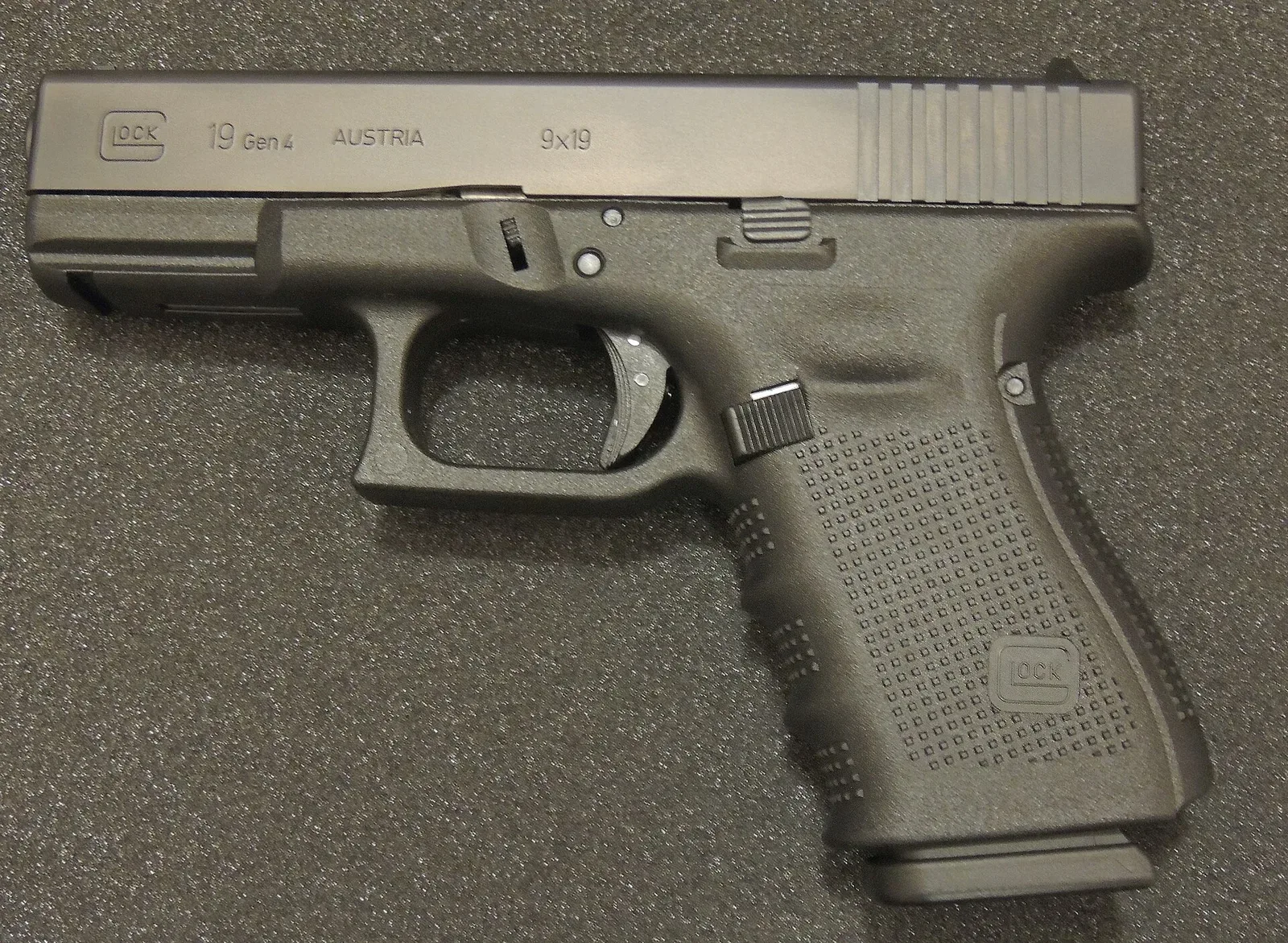
The Glock 19 Gen 5 — a modern semi-automatic pistol meeting federal firearm definitions as a weapon designed to expel a projectile by combustion.
Martin1998cz (CC BY-SA 3.0)
| Identification | |
|---|---|
| Jurisdiction | |
Territory | Idaho |
Idaho Prohibited Persons: Who Cannot Legally Own or Possess a Firearm
Legal information and analysis
From The Boise Gun Club Handbook
This is educational information, not legal advice. Laws change. Consult an attorney for your specific situation.
If you're prohibited from owning a firearm under state or federal law and you're caught with one anyway, you're looking at felony charges, years in prison, and fines that will ruin you financially. Knowing exactly where the lines are drawn isn't optional.
Two Sets of Rules: State and Federaledit
Idaho has relatively permissive gun laws by most measures. Constitutional carry, no waiting periods, solid preemption — the state generally trusts its residents. But none of that matters if you're a prohibited person. Federal law always controls when it comes to firearms. Even if Idaho law would otherwise allow you to possess a gun, federal law can still bar you from doing so. You need to be clear under both frameworks before you pick up a firearm.
This means two separate sets of disqualifiers apply to Idaho residents — one from Idaho Code § 18-310 and one from 18 U.S.C. § 922(g). They overlap significantly, but they're not identical, and both can land you in prison.
Federal Prohibited Persons Under 18 U.S.C. § 922(g)edit
Federal law is the floor. It applies to every person in every state, including Idaho. Per 18 U.S.C. § 922(g), it is unlawful for any of the following categories of persons to ship, transport, possess, or receive any firearm or ammunition:
| # | Category | Key Trigger |
|---|---|---|
| 1 | Convicted felon | Any crime punishable by imprisonment exceeding one year |
| 2 | Fugitive from justice | Fled to avoid prosecution or testimony |
| 3 | Unlawful drug user or addict | Illegal use of or addiction to any controlled substance |
| 4 | Mental defective / committed | Adjudicated mentally defective OR committed to a mental institution |
| 5A | Illegal alien | Unlawfully present in the United States |
| 5B | Non-immigrant visa holder | Lawfully admitted on a non-immigrant visa (with exceptions) |
| 6 | Dishonorable discharge | Discharged from the Armed Forces under dishonorable conditions |
| 7 | Renounced citizenship | U.S. citizen who formally renounced citizenship |
| 8 | Domestic violence restraining order | Active qualifying court order (see below for specifics) |
| 9 | Domestic violence misdemeanor conviction | Convicted in any court of a misdemeanor crime of domestic violence |
A conviction for violating 18 U.S.C. § 922(g) is a felony. Under 18 U.S.C. § 924(a)(8) the maximum is 15 years. It was 10 until the Bipartisan Safer Communities Act raised it in June 2022, and you will still find the old number on a lot of law firm pages that never got updated. "Fined under this title" routes to 18 U.S.C. § 3571, which puts the ceiling at $250,000 for an individual felony conviction, and a sentence can include up to three years of supervised release on top.
Key Point: The most common charge under § 922(g) is prior felony conviction. Per the U.S. Sentencing Commission's FY 2024 data, 90.4% of the 7,419 individuals convicted under § 922(g) in FY 2024 were convicted because of a prior felony conviction. The average sentence was 71 months.
The Felony Conviction Threshold
"It shall be unlawful for any person who has been convicted in any court of, a crime punishable by imprisonment for a term exceeding one year... to ship or transport in interstate or foreign commerce, or possess in or affecting commerce, any firearm or ammunition." — 18 U.S.C. § 922(g)(1)
The trigger is the potential sentence, not what you actually received. If you were convicted of a crime that could have resulted in more than a year in prison — even if you got probation — you're a prohibited person under federal law. The law also applies to misdemeanor convictions if the maximum punishment exceeds one year.
What "Possession" Actually Means
Possession under federal law includes both actual possession (the gun is on your person) and constructive possession (the gun is somewhere you have access to and control over — your car, your home, your workplace). You don't have to be holding it. You don't have to own it. If you have access and control, you can be charged.
Possession also doesn't have to be exclusive. Multiple people can simultaneously be charged with possession of the same firearm — for example, all occupants of a vehicle where a firearm is found.
The Restraining Order Disqualifier
The domestic violence restraining order prohibition under § 922(g)(8) isn't automatic for every protective order. Per 18 U.S.C. § 922(g)(8), the order must meet all of the following:
- It was issued after a hearing where the person received actual notice and had an opportunity to participate
- It restrains the person from harassing, stalking, or threatening an intimate partner or the partner's child
- It either (A) includes a finding that the person represents a credible threat to the physical safety of the intimate partner or child, OR (B) by its terms explicitly prohibits the use of physical force against the intimate partner or child
If all three conditions are met, you are federally prohibited from possessing firearms for the duration of that order.
The Armed Career Criminal Act
If you have three or more prior convictions for violent felonies or serious drug crimes and you're convicted under § 922(g), you face a mandatory minimum of 15 years under the Armed Career Criminal Act (ACCA), found at 18 U.S.C. § 924(e). Per U.S. Sentencing Commission FY 2024 data, 2.6% of § 922(g) cases were sentenced under ACCA, with an average sentence of 199 months — over 16 years.
Idaho State Law: Idaho Code § 18-310edit
Idaho's state-level prohibited persons framework operates alongside the federal system. The key statute is Idaho Code § 18-310, which governs what happens to your civil rights — including firearm rights — when you're convicted of a felony in Idaho.
During Incarceration, Probation, and Parole
Per Idaho Code § 18-310(1), a sentence of custody to the Idaho State Board of Correction suspends all civil rights of the person sentenced, including the right to ship, transport, possess, or receive a firearm. This suspension continues through probation and parole — not just during active incarceration.
After Final Discharge: The Two-Track System
Idaho uses a two-track approach to firearm rights restoration upon final discharge. Per Idaho Code § 18-310(2):
"Upon final discharge, a person convicted of any Idaho felony shall be restored the full rights of citizenship, except that for persons convicted of treason or those offenses enumerated in paragraphs (a) through (hh) of this subsection the right to ship, transport, possess or receive a firearm shall not be restored."
"Final discharge" means satisfactory completion of imprisonment, probation, and parole — all three, as applicable.
Track 1 — Automatic Restoration: If your Idaho felony conviction is not on the enumerated list in § 18-310(2)(a)–(hh), your firearm rights are automatically restored upon final discharge. No application required.
Track 2 — No Automatic Restoration: If your conviction is on the enumerated list, firearm rights are not automatically restored. You must apply to the Commission of Pardons and Parole, and you cannot apply until five years after final discharge.
The Enumerated Offenses: Permanent Disqualifiers Without Parole Board Action
The following convictions under Idaho law block automatic firearm rights restoration. Per Idaho Code § 18-310(2), this list applies to convictions on or after July 1, 1991 (with an exception for murder and voluntary manslaughter involving a firearm, which apply regardless of conviction date):
| Offense | Idaho Code Citation |
|---|---|
| Aggravated assault | § 18-905, 18-915 |
| Aggravated battery | § 18-907, 18-915 |
| Assault with intent to commit a serious felony | § 18-909, 18-915 |
| Battery with intent to commit a serious felony | § 18-911, 18-915 |
| Burglary | § 18-1401 |
| Domestic battery (felony) | § 18-918 |
| Enticing of children (felony) | § 18-1509 |
| Forcible sexual penetration by use of a foreign object | § 18-6604 |
| Indecent exposure (felony) | § 18-4116 |
| Injury to child (felony) | § 18-1501 |
| Intimidating a witness (felony) | § 18-2604 |
| Lewd conduct with a minor under 16 | § 18-1508 |
| Sexual abuse of a child under 16 | § 18-1506 |
| Sexual exploitation of a child | § 18-1507 |
| Felonious rescuing prisoners | § 18-2501 |
| Escape (charged/convicted/on probation for felony) | § 18-2505 |
| Unlawful possession of a firearm | § 18-3316 |
| Degrees of murder | § 18-4003 |
| Voluntary manslaughter | § 18-4006(1) |
| Assault with intent to murder | § 18-4015 |
| Administering poison with intent to kill | § 18-4014 |
| Kidnapping | § 18-4501 |
| Mayhem | § 18-5001 |
| Rape | § 18-6101 |
| Robbery | § 18-6501 |
| Ritualized abuse of a child | § 18-1506A |
| Cannibalism | § 18-5003 |
| Felonious manufacture/delivery/possession of controlled substance | § 37-2732 |
| Drug trafficking | § 37-2732B |
| Threats against state officials (felony) | § 18-1353A |
| Unlawful discharge of firearm at dwelling/building/vehicle | § 18-3317 |
| Unlawful possession of destructive devices | § 18-3319 |
| Unlawful use of destructive device or bomb | § 18-3320 |
| Attempt, conspiracy, or solicitation to commit any of the above | §§ 18-306, 18-1701, 18-2001 |
Key Point: According to Idaho Code § 18-310(3), even if you're eligible to apply to the Commission of Pardons and Parole, the Commission cannot restore firearm rights to anyone convicted of first-degree murder, second-degree murder, or any enumerated felony where the sentence was enhanced for use of a firearm during the commission of that felony. Those are permanent bars with no restoration pathway.
Out-of-State Felony Convictions
Per Idaho Code § 18-310(4), persons convicted of felonies in other states or jurisdictions are treated the same as Idaho felons for firearm rights purposes. They are not eligible for automatic restoration in the same manner described in § 18-310(2). The same framework applies — they are prohibited from possessing firearms unless and until rights are restored through the appropriate process.
Idaho State Penalty for Felon in Possession
Under Idaho Code § 18-3316, a person previously convicted of a felony who purchases, owns, possesses, or has under his custody or control any firearm is guilty of a felony, punishable by up to five years in state prison and a fine not to exceed $5,000.
The Rights Restoration Maze: A Real-World Warningedit
The interplay between state rights restoration and federal law is genuinely complicated, and you can end up in federal prison even when you think you've cleared your state obligations. The Duke Center for Firearms Law analyzed an Idaho Supreme Court case — United States v. Gutierrez — that illustrates exactly how this trap works.
In that case, Antonio Gutierrez was convicted of felony burglary in Idaho in 2000. Years later, a state court reduced his convictions to misdemeanors under a state law that allows such relief. The order stated he should no longer "be considered a convicted felon." But the Idaho Supreme Court held that his original burglary convictions — which appear on the § 18-310(2) enumerated list — meant he was still in the category requiring the separate Pardons and Parole restoration process. The misdemeanor reduction didn't trigger automatic firearm rights restoration for that class of offense.
The Idaho Supreme Court was explicit about the narrow scope of that ruling:
"Our decision today is narrowly tailored to the question regarding the automatic restoration of firearm rights, which is specifically governed by statute. This opinion does not support the inference that a defendant who has had his conviction amended to a misdemeanor would still carry the trappings of a felony conviction in any area other than firearm rights. As an example, such an individual would be fully eligible to vote, to serve on a jury, or to hold public office."
The takeaway: getting your conviction reduced or expunged under state law does not automatically restore your federal firearm rights. Federal law provides that expunged or set-aside convictions, or those for which civil rights have been restored, shall not be considered convictions for federal purposes — but whether Idaho's specific restoration mechanisms satisfy the federal standard is a legal question that requires an attorney's analysis in your specific situation.
Key Point: If you've had a felony conviction reduced, expunged, or had civil rights restored through any mechanism, consult a firearms attorney before you touch a gun. The Gutierrez case shows that what feels like a clean slate under state law may not be a clean slate under federal law.
The "Knowingly" Requirement After *Rehaif*edit
In Rehaif v. United States, the U.S. Supreme Court held that to sustain a conviction under § 922(g), the government must prove the defendant knew the status that made them ineligible to possess firearms. As the Duke Center for Firearms Law notes, this doesn't mean you have to know you were legally barred — it means you must have had knowledge of the underlying status itself (e.g., that you had been convicted of a felony, or that you had been committed to a mental institution). This creates a potential defense avenue in cases where a defendant genuinely and reasonably was unaware of their disqualifying status.
What Doesn't Restore Your Rightsedit
Some common assumptions that are flat wrong:
- Finishing your sentence does not automatically restore rights for persons convicted of the enumerated offenses in § 18-310(2). You must go through the Pardons and Parole application process, and you cannot apply until five years after final discharge.
- Getting a conviction reduced to a misdemeanor under state law doesn't necessarily restore firearm rights — as the Gutierrez case above demonstrates.
- A governor's pardon may or may not restore firearms rights depending on the specific terms of the pardon. This requires legal analysis.
- Moving to Idaho from another state doesn't give you a clean slate. Out-of-state felony convictions are treated the same as Idaho felony convictions for firearm rights purposes under § 18-310(4).
The Idaho Firearm Definition: State vs. Federaledit
The definitions of "firearm" differ slightly between state and federal law, and this matters.
Under Idaho Code § 18-3302(2)(d), "firearm" means any weapon that will, is designed to, or may readily be converted to expel a projectile by the action of an explosive. That definition runs on what the weapon is designed to do, not on the condition it happens to be in, and it governs the whole of Title 18, Chapter 33.
Under 18 U.S.C. § 921(a)(3), the federal definition includes: (A) any weapon (including a starter gun) which will, is designed to, or may readily be converted to expel a projectile by action of an explosive; (B) the frame or receiver of any such weapon; (C) any firearm muffler or firearm silencer; or (D) any destructive device.
Key Point: The federal definition explicitly includes frames and receivers, as well as suppressors. A prohibited person who possesses just the lower receiver of an AR-15 — even without the rest of the rifle assembled — has committed a federal violation.
A Practical Decision Treeedit
Before touching a firearm in Idaho, run through this checklist:
| Question | If YES... |
|---|---|
| Have you ever been convicted of a crime carrying more than 1 year potential imprisonment? | You are likely federally prohibited — consult an attorney |
| Are you on probation or parole for any felony? | You are prohibited under Idaho Code § 18-310(1) |
| Have you completed your sentence for a § 18-310(2) enumerated offense? | Firearm rights are NOT automatically restored — apply to Pardons and Parole after 5 years |
| Are you under a qualifying domestic violence protective order? | You are federally prohibited under § 922(g)(8) |
| Have you been convicted of any domestic violence misdemeanor? | You are federally prohibited under § 922(g)(9) |
| Have you been adjudicated mentally defective or committed to a mental institution? | You are federally prohibited under § 922(g)(4) |
| Are you an unlawful user of or addicted to any controlled substance? | You are federally prohibited under § 922(g)(3) |
| Are you in the U.S. illegally or on a non-immigrant visa? | You are likely federally prohibited under § 922(g)(5) |
If any of these apply to you, do not assume you can figure out the answer on your own. The penalties are felony-level and the law is more technical than it appears.
The bottom line: Both Idaho law and federal law create prohibited person categories, and federal law controls when there's any conflict. If you have any felony conviction anywhere in your past — or any of the other disqualifying conditions listed above — you need to get your rights formally restored through the correct legal process before you touch a firearm, or you're looking at federal felony charges with an average sentence measured in years.
Resourcesedit
- https://codes.findlaw.com/id/title-18-crimes-and-punishments/id-st-sect-18-310/
- https://www.law.cornell.edu/uscode/text/18/922
- https://www.youridattorney.com/firearm-offenses
- https://www.ussc.gov/research/quick-facts/section-922g-firearms
- https://firearmslaw.duke.edu/2021/08/what-convictions-serve-as-disqualifiers-for-firearm-possession
- https://www.heddinglawfirm.com/federal-felon-with-firearm
- https://www.hooperlawoffices.com/blog/2020/july/can-a-convicted-felon-carry-a-firearm-in-boise-i/
Last Updated: March 05, 2026
- Ace Hardware of Sandusky(Sandusky, MI)
- New Philly Sportsman Specialities(New Philadelphia, OH)
- Atwoods Ranch & Home #46(LACY LAKEVIEW, TX)
- G & P Distributors(McConnellsburg, PA)
This is not legal advice
This guide provides general information about federal and state firearms laws based on publicly available statutes. Laws change frequently and vary significantly by state. Always verify current laws in your jurisdiction. Consult a qualified attorney for legal advice on your specific situation. When in doubt, contact local law enforcement or state police.
Loading comments...