Specifications
Ruger 10/22
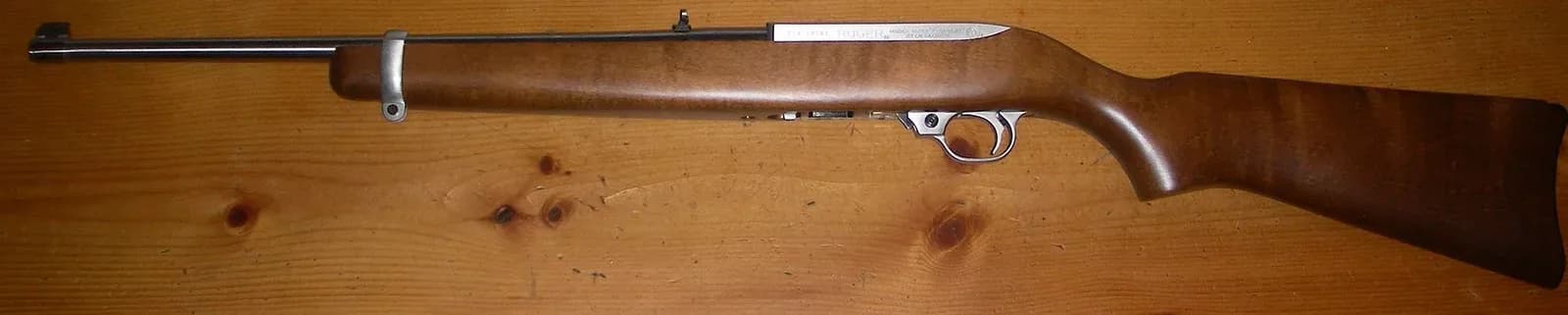
The 10/22 Stainless with Butler Creek folding stock — a popular aftermarket configuration that exemplifies the rifle's modularity and customization potential.
MyName (Firstinduty (talk)) (Public domain)
| Manufacturer | |
|---|---|
| Made By | Sturm, Ruger & Co. |
| Designer | Bill Ruger |
| Origin | United States |
| Specifications | |
| Caliber | .22 LR |
| Action | blowback |
| Capacity | 10 rounds (rotary magazine) |
| Barrel | 18.5 inches (standard carbine); 16.1 inches (Compact); heavy barrel (Target) |
| Weight | Approximately 5 lbs (standard carbine) |
| Feed | Detachable rotary magazine |
| Sights | Gold bead front sight, adjustable leaf rear sight; receiver grooved for tip-off scope mounts |
| Performance | |
| Eff. Range | 50+ yards (practical accuracy) |
| Production | |
| Designed | 1964 |
| In Production | 1964 |
| Produced | 7,000,000+ |
| Variants | |
| |
| Service Use | |
U.S. Military marksmanship training unitsPolice academies4-H clubsBoy Scouts of AmericaCollege shooting teams | |
| Cultural Note | |
| The Ruger 10/22 is widely regarded as America's most popular .22 rimfire rifle, with over 7 million units sold since 1964. It has become the standard training rifle for youth shooting programs, military marksmanship instruction, and competitive smallbore shooting, and is celebrated for its revolutionary rotary magazine design, modular barrel system, and unmatched aftermarket customization ecosystem. | |
| Related Firearms | |
| |
Ruger 10/22: America's Most Beloved .22 Rifle
Firearms encyclopedia article
From The Boise Gun Club Handbook
If you've been around guns for more than five minutes, you've either owned a 10/22 or wished you had one. Since 1964, this little rifle has taught more Americans how to shoot than any other firearm in history -- and for good reason.
The 10/22 isn't just another .22 rifle. It's the Swiss Army knife of rimfire guns -- reliable enough to bet your life on, accurate enough to win matches, and simple enough that your kid can field-strip it after a range session.
With over 7 million sold, the 10/22 has become the standard by which all other .22 rifles get measured. You'll find them in gun safes from Alaska to Florida, doing everything from teaching kids their first shooting lessons to clearing squirrels from bird feeders. The fact that Ruger barely changed the design in 60 years tells you everything you need to know about how right they got it from the start.
How We Got Hereedit
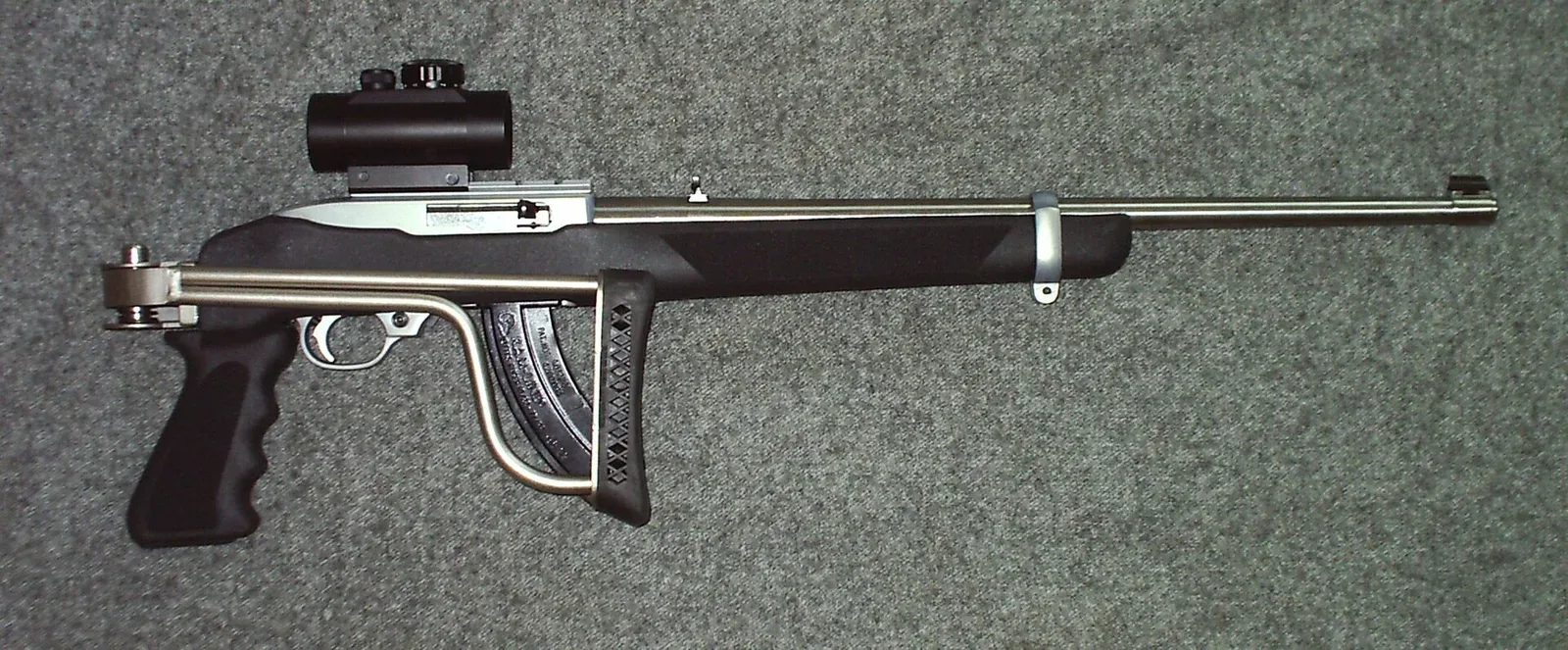
Bill Ruger had a simple idea in 1964: build a semi-auto .22 that actually worked. Sounds easy, but most .22 autos of that era jammed more than they shot. Ruger looked at the feeding problems, the extraction issues, and the general unreliability plaguing rimfire semi-autos and engineered solutions that still work today.
The Engineering Breakthrough
The breakthrough was that rotary magazine. Instead of stacking cartridges on top of each other like a traditional box mag -- where the rims can lock up and cause a world of hurt -- Ruger arranged them in a circle. Each cartridge sits in its own little pocket, feeding smoothly into the chamber every time.
| Innovation | Problem Solved | How It Works |
|---|---|---|
| Rotary Magazine | Rim lock-up in traditional box magazines | 10 cartridges arranged in circle, each in own pocket |
| Barrel Block System | Barrel threading/pressing issues | Barrel mounted in separate block bolted to receiver |
| Anti-Bounce Bolt | Doubling/slam-fires | Firing pin and bolt interaction prevents uncontrolled firing |
Key Innovations That Stuck
Then there's the barrel block system. Most rifles thread or press the barrel into the receiver. Ruger mounted the barrel in a separate block that bolts to the receiver. This makes the whole system more rigid and lets you swap barrels without a gunsmith.
Forty years before AR-15s made modularity cool, Ruger was already engineering interchangeable barrel systems and modular design concepts.
The anti-bounce bolt system solved another problem that plagued semi-auto .22s -- doubling. The bolt can't slam forward and fire another round because of how Ruger designed the firing pin and bolt interaction. It's an elegant solution that works every time.
Six decades of 10/22 evolution and major milestones
What You're Actually Gettingedit
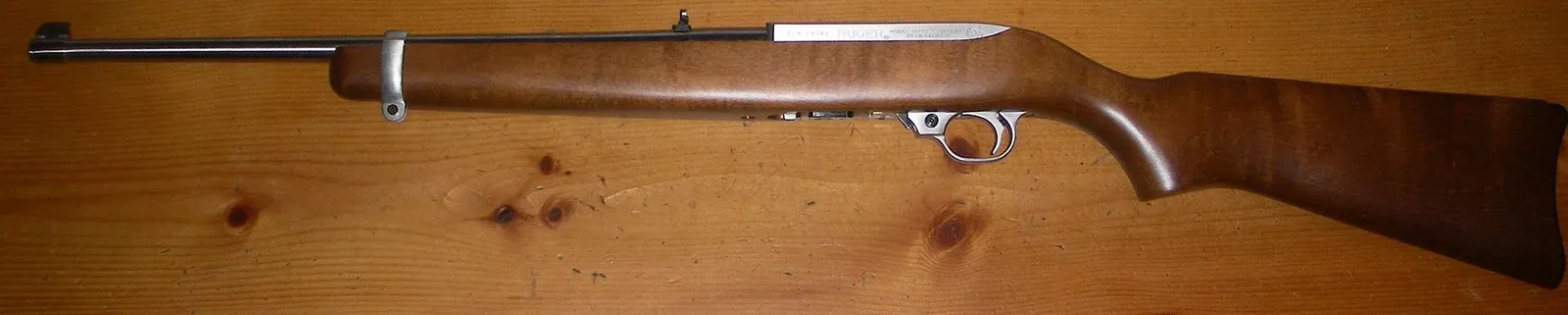
The Action Explained
The heart of the 10/22 is a straight blowback action that cycles off the force of the fired cartridge. No gas system, no complex timing -- just physics doing its job. The bolt rides in machined grooves in the receiver, keeping everything aligned shot after shot.
10/22 straight blowback operating cycle - simple physics in action
Magazine System
That rotary magazine holds 10 rounds and rarely gives trouble. Unlike box magazines that can develop feed lips issues or spring problems, the rotary design just works. The magazine release is a simple lever behind the trigger guard -- push it forward and the mag drops out.
Sights and Safety
Standard sights are basic but functional: a gold bead up front and an adjustable leaf in the rear. The receiver comes grooved for tip-off scope mounts, though most people upgrade to a Picatinny rail or Weaver base for better optics options.
The cross-bolt safety sits in the front of the trigger guard where your finger naturally finds it. Push it in for safe, push it out to fire. The bolt locks open automatically on an empty magazine, so you know when it's time to reload.
The Whole Familyedit
Ruger has spun the 10/22 action into more variants than you can shake a stick at.
Core Models
| Model | Barrel Length | Weight | Key Features | Best For |
|---|---|---|---|---|
| Carbine | 18.5" | 5 lbs | Hardwood stock, classic design | General purpose, traditional shooters |
| Compact | 16.1" | 4.5 lbs | Shorter length of pull | Youth, smaller-framed shooters |
| Target | 20" heavy | 7 lbs | Laminated stock, heavy barrel | Precision shooting, competition |
| Tactical | 16.1" | 5.5 lbs | Synthetic stock, threaded barrel | Training, suppressor use |
| Takedown | 18.5" | 4.7 lbs | Splits in half at button push | Backpacking, compact storage |
| Charger | 10" | 3.5 lbs | Pistol configuration | Plinking, braced pistol builds |
Specialized Variants
The Charger pistol uses the same action in a pistol format. It's an interesting concept, though most people end up putting a brace on it anyway.
Real-World Performanceedit
Accuracy Standards
Here's what you can actually expect from a 10/22: With decent ammunition like CCI Mini Mags or Federal Champions, a standard carbine will print 1.5 to 2-inch groups at 50 yards all day long. The heavy-barrel models tighten that up to an inch or better.
| Performance Metric | Standard Carbine | Target Model | Notes |
|---|---|---|---|
| Accuracy @ 50yds | 1.5-2" groups | Sub-1" groups | With quality ammunition |
| Reliability | 99%+ | 99%+ | Rotary magazine prevents most failures |
| Recoil | Negligible | Negligible | Suitable for all age groups |
| Ammunition Compatibility | Universal | Universal | Eats bulk to match ammo |
| Maintenance Interval | 1000+ rounds | 1000+ rounds | Can go longer if needed |
If you're getting worse than that, check your ammunition or your scope mount.
Reliability Record
Reliability is where the 10/22 really shines. These rifles will eat anything you feed them -- from bulk pack Winchester to expensive match ammo -- and ask for more.
With a 10/22, feeding failures are almost unheard of. The rotary magazine design simply eliminates the rim-lock issues that plague other .22 semi-autos.
I've seen 10/22s go thousands of rounds between cleanings and still function perfectly. The rotary magazine design means feeding failures are almost unheard of.
Recoil is basically non-existent. A 10-year-old can shoot one comfortably, and you can run through a brick of ammunition without developing a flinch. The rifle weighs enough to be steady but not so much that it becomes cumbersome during long shooting sessions.
Who Actually Uses These Thingsedit
Training and Education
The 10/22 shows up everywhere in the shooting world. Consider these applications:
- Military marksmanship units for initial training
- Police academies for fundamentals instruction
- 4-H clubs and Scout troops for youth programs
- College shooting teams for smallbore competition
College shooting teams use them for smallbore rifle competition, where properly set up 10/22s compete head-to-head with custom target rifles costing five times as much.
Civilian Applications
In the civilian world, the 10/22 is often someone's first rifle and rarely their last. You'll find them doing:
- Pest control on farms and ranches
- Backyard marksmanship training
- Truck guns for varmint control
- First rifle for new shooters
The BGC Takeedit
After six decades, the 10/22 remains the gold standard for .22 rifles because Ruger got the fundamentals right from day one. It's reliable, accurate, affordable, and infinitely customizable -- a combination that's rare in any product category.
Is it perfect? No rifle is. The factory trigger is adequate but not great, though that's easily fixed. The stock is functional but basic on most models. The sights work but aren't anything special.
Here's the thing though -- all of these issues are easily addressed with aftermarket parts, and the rifle's bones are so good that it's worth the investment.
If you own just one .22 rifle, make it a 10/22. If you own ten rifles and don't have a 10/22, you're missing something important.
It's the rifle that does everything well and nothing poorly -- and sometimes that's exactly what you need.
- Gls Guns(Sumner, IA)
- Bi-mart - Yakima (Fruitvale Ave)(Yakima, WA)
- New Philly Sportsman Specialities(New Philadelphia, OH)
- R&R Sports & Outdoors(Brandon, FL)
Loading comments...