Quick Reference
Safe Firearm Storage Options

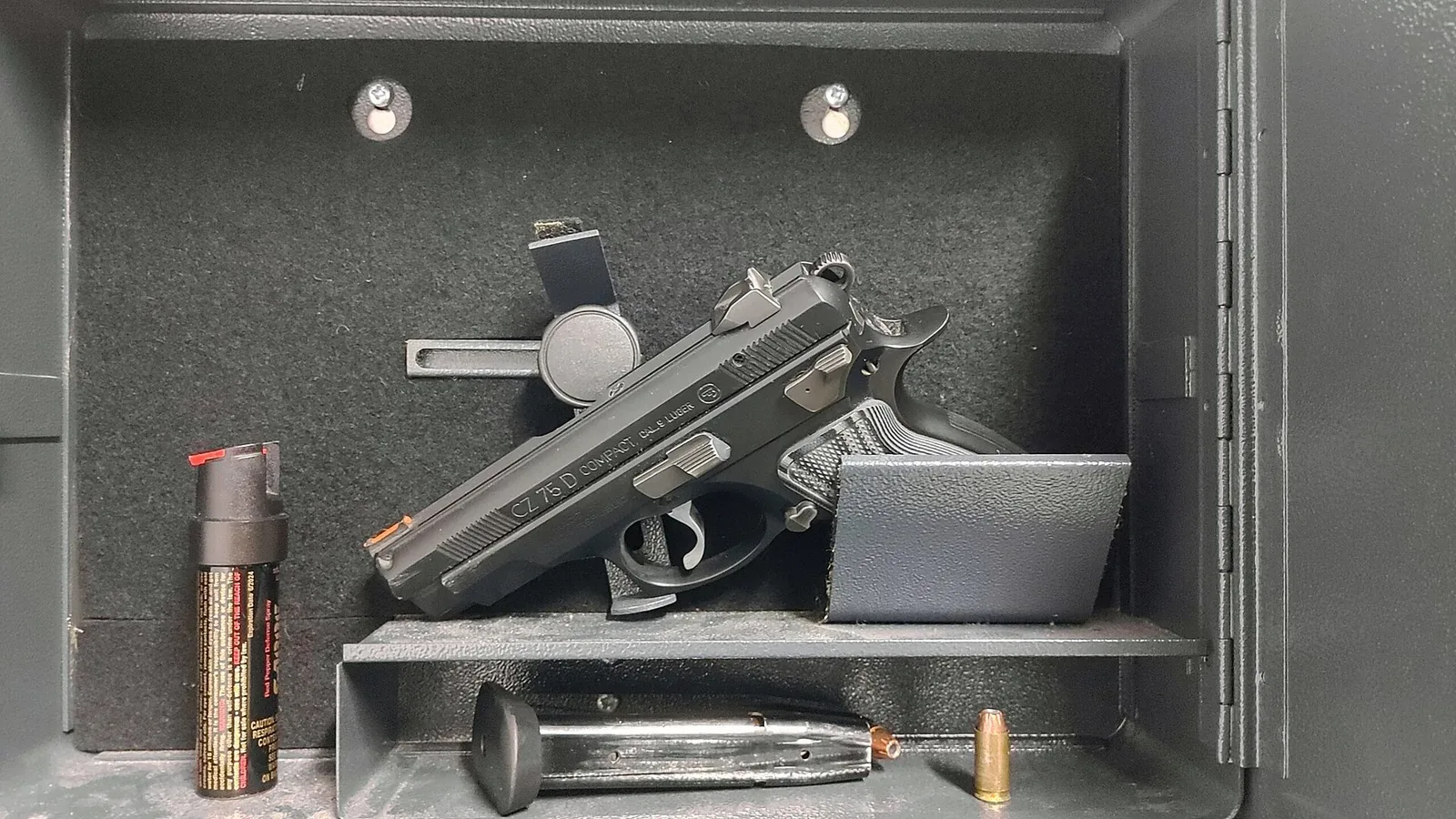
A courthouse gun safe interior reveals the heavy-duty locking mechanism and steel construction required for secure public firearms storage.
Cimmerian praetor (CC BY-SA 4.0)
| Time & Effort | |
|---|---|
Read Time | 11 min read |
Equipment Needed | |
| |
Safety | |
| |
Key Takeaways | |
| |
Related Topics | |
| |
Safe Firearm Storage Options
protecting your family while maintaining quick access
From The Boise Gun Club Handbook
Your storage setup determines whether your guns protect your family or become a liability—there's no middle ground here.
You're balancing three things: who's in your house, what you're securing, and how fast you need to reach it. The single guy with a carry pistol has different needs than a family with kids and a rifle collection.
Idaho doesn't mandate specific storage for most gun owners, but that legal freedom doesn't mean you can skip responsibility. Smart storage prevents accidents, stops unauthorized access, and protects your investment from theft.
Quick Access vs. Deep Storageedit
Not every gun needs the same accessibility. Your bedside pistol serves a different mission than that hunting rifle you dust off once a season.
Quick access storage gets you to your gun in seconds during a break-in. We're talking bedside safes with electronic or biometric locks. The trade-off? Limited capacity and less protection against thieves with time and tools.
Deep storage prioritizes security over speed—those 500-pound gun safes that take minutes to open. Nobody's grabbing anything from these at 3 AM, but nobody's walking out with them either.
| Storage Type | Access Time | Security Level | Best For | Capacity |
|---|---|---|---|---|
| Quick Access | 2-10 seconds | Medium | Defensive firearms | 1-3 guns |
| Deep Storage | 1-5 minutes | High | Collections, hunting rifles | 10-50+ guns |
| Hybrid | 15-30 seconds | Medium-High | Mixed needs | 3-10 guns |
Decision flowchart for choosing storage type based on firearm purpose
Don't keep loaded rifles "staged" around your house. That's not tactical thinking—that's poor judgment waiting for a tragedy.
Full-Size Gun Safesedit
If you own more than a couple firearms, you need a real safe, not a sheet metal cabinet masquerading as security.
Essential Features
Here's what actually matters:
- 12-gauge steel body or thicker—anything less bends with a pry bar
- 1/4-inch door steel minimum for actual break-in resistance
- 30-minute fire rating at 1200°F to protect against house fires
- 300+ pounds because heavy safes stay put
- Electronic or mechanical lock—key-only locks get defeated easily
- Bolt-down hardware that you actually use
| Feature | Minimum Standard | Premium Standard | Why It Matters |
|---|---|---|---|
| Body Steel | 12-gauge | 7-gauge | Pry bar resistance |
| Door Steel | 1/4 inch | 1/2 inch | Cutting/drilling protection |
| Fire Rating | 30 min @ 1200°F | 60 min @ 1400°F | House fire survival |
| Weight | 300+ lbs | 800+ lbs | Theft deterrence |
| Lock Type | Electronic/Mechanical | Redundant system | Reliability |
| Price Range | $800-1500 | $2000-5000 | Value vs. protection |
Capacity ratings are marketing lies. A "24-gun safe" means 24 bare rifles standing perfectly upright with no optics or slings. Reality? Figure half the stated capacity once you add scopes and accessories.
Installation and Placement
Installation matters as much as the safe itself. Bolt it to floor and wall studs—a safe that tips over or rolls out on a dolly isn't providing security.
Hide it in an interior closet, not visible from windows where thieves window-shop.
Recommended Brands
Liberty, Browning, Fort Knox, and Sturdy Safe make solid options from $800-$3000. Cheaper than that gets you the illusion of security, not actual protection.
Quick Access Handgun Safesedit
Your defensive handgun needs speed-of-access that doesn't compromise on keeping unauthorized hands away.
| Lock Type | Speed | Reliability | Battery Life | Stealth | Cost |
|---|---|---|---|---|---|
| Electronic Keypad | Fast (2-3 sec) | High* | 1-2 years | Quiet | $100-300 |
| Biometric | Fastest (1-2 sec) | Medium | 6-12 months | Silent | $200-600 |
| Mechanical Simplex | Medium (3-5 sec) | Highest | N/A | Audible clicks | $150-400 |
| RFIR/Smart | Fast (2-3 sec) | Low | 3-6 months | Quiet | $300-800 |
When maintained properly
Electronic Keypads
Electronic keypads work reliably if maintained. Change batteries annually whether needed or not. Practice your code until muscle memory takes over—four to six digits balances security with speed.
Downside: electronics fail at the worst moments.
Biometric Systems
Biometric readers vary wildly in quality. Cheap units fail when your finger's wet, dirty, or cold. Quality brands like Vaultek work consistently, but you pay for that reliability.
Register multiple fingers during setup—if you jam your primary digit, you need backup options.
Mechanical Options
Mechanical simplex locks need no batteries and rarely fail. Fort Knox and V-Line make excellent simplex boxes. The five-button system becomes intuitive with practice. Slightly slower than electronic, and button presses make noise.
Smart locks with RFID or apps sound cool until your phone dies or Bluetooth glitches at 2 AM. I'm not trusting my defensive firearm access to wireless connectivity.
Mounting Requirements
Mount these properly or don't bother. An unbolted bedside safe is a carrying case for thieves. Use the included hardware—bolt to your nightstand, inside a drawer, or to the floor.
Cable Locks and Trigger Locksedit
These ship with new guns thanks to federal requirements, but they're slightly better than nothing by a narrow margin.
Cable locks thread through the action, preventing loading or operation. They work for basic child safety, not burglary deterrence. Anyone with bolt cutters defeats them in seconds. Use them as supplemental security inside larger safes or temporary transport compliance.
Trigger locks theoretically block the trigger. In practice, many pop off with a screwdriver or brute force. Some designs can cause negligent discharges if removed improperly. I don't trust trigger locks for anything except satisfying transport laws in restrictive states.
If cable locks on closet rifles constitute your security plan, you need an upgrade immediately.
Portable Safes and Lock Boxesedit
These fill the middle ground—bigger than bedside boxes, smaller than gun room safes. Most run 0.5 to 2 cubic feet, weigh 20-50 pounds, and hide under beds or in closets.
Stack-On, Vaultek, and GunVault make decent options for $150-$400.
Look for 14-gauge steel minimum, pry-resistant doors, and internal hinges. The lock quality matters more than steel thickness on smaller units.
They work well for apartment living where 700-pound safes aren't feasible, vehicle storage when unavoidable, travel security in hotel rooms, and multiple access points throughout larger homes.
They don't work for long-term storage of collections or serious theft protection. Portable means thieves can make them portable too.
Vehicle Storageedit
Guns stolen from vehicles fuel street crime nationwide—your convenience becomes someone else's weapon.
Console locks and cables around seat frames aren't security theater—they're not even good theater. Vehicle-specific safes that bolt to the frame provide actual protection. Console Vault and Lock'er Down make integrated solutions that work.
Better option: Don't store guns in vehicles. Regularly leaving firearms in your truck because it's convenient puts guns in criminal hands.
Storage for Homes with Childrenedit
The Gold Standard
Kids in the house changes everything—every firearm gets secured every time, no exceptions.
The gold standard: unloaded, locked, separate from ammunition. Yes, this affects quick access for home defense. That's the price of responsible parenting.
Balanced Approaches
Options that balance child safety with defensive needs include biometric bedside safes programmed only for adult fingerprints, concealment furniture with electronic locks in adult-only areas, or a full safe for collections plus one defensive gun in quick-access adult location.
| Storage Method | Child Safety | Adult Access | Cost | Recommended Age |
|---|---|---|---|---|
| Unloaded + Locked + Separate Ammo | Highest | Slowest | Low | Any age |
| Biometric Safe (adults only) | High | Medium | Medium | 10+ years |
| Concealment Furniture | Medium | Fast | High | 15+ years |
| Cable Lock Only | Low | Fast | Very Low | Not recommended |
Education vs. Security
Educating kids about firearms reduces curiosity but doesn't eliminate risk. When my kids' friends visit, I don't trust their parents' gun safety lessons. My security doesn't depend on other people's parenting.
Common Mistakes That Cost Youedit
Sizing and Installation Errors
- Buying too small—you'll acquire more firearms, so buy the next size up from current needs
- Skipping bolt-down installation—unanchored safes are portable gun containers for thieves
- Cheap electronic locks—that $200 safe with "military-grade" electronics will fail
Technology and Placement Issues
- Single access point—if your only quick gun is in the bedroom and trouble starts in the kitchen, you're out of luck
- Ignoring humidity control—guns rust in sealed safes without dehumidifiers. Get a Golden Rod.
- Window-visible placement—don't advertise gun ownership to anyone casing your property
Common storage mistakes and their consequences
A $1,000 safe protecting $5,000 in firearms beats $6,000 in guns with no secure storage. Your firearms are your responsibility from purchase to grave—storage isn't optional, it's fundamental gun ownership.
See Alsoedit
- Cash America Pawn(BRYAN, TX)
- Bi-mart - Yakima (Fruitvale Ave)(Yakima, WA)
- New Philly Sportsman Specialities(New Philadelphia, OH)
- R&R Sports & Outdoors(Brandon, FL)
Loading comments...