Organization Info
TrackingPoint

| Overview | |
|---|---|
Founded | 2011 |
Headquarters | Austin, Texas |
Disciplines | Precision guided firearm technology; development and manufacture of networked rifle systems with ballistic computing and digital target locking |
TrackingPoint: The Precision Guided Firearm That Changed What "Accurate" Means
Firearms encyclopedia article
From The Boise Gun Club Handbook
Overviewedit
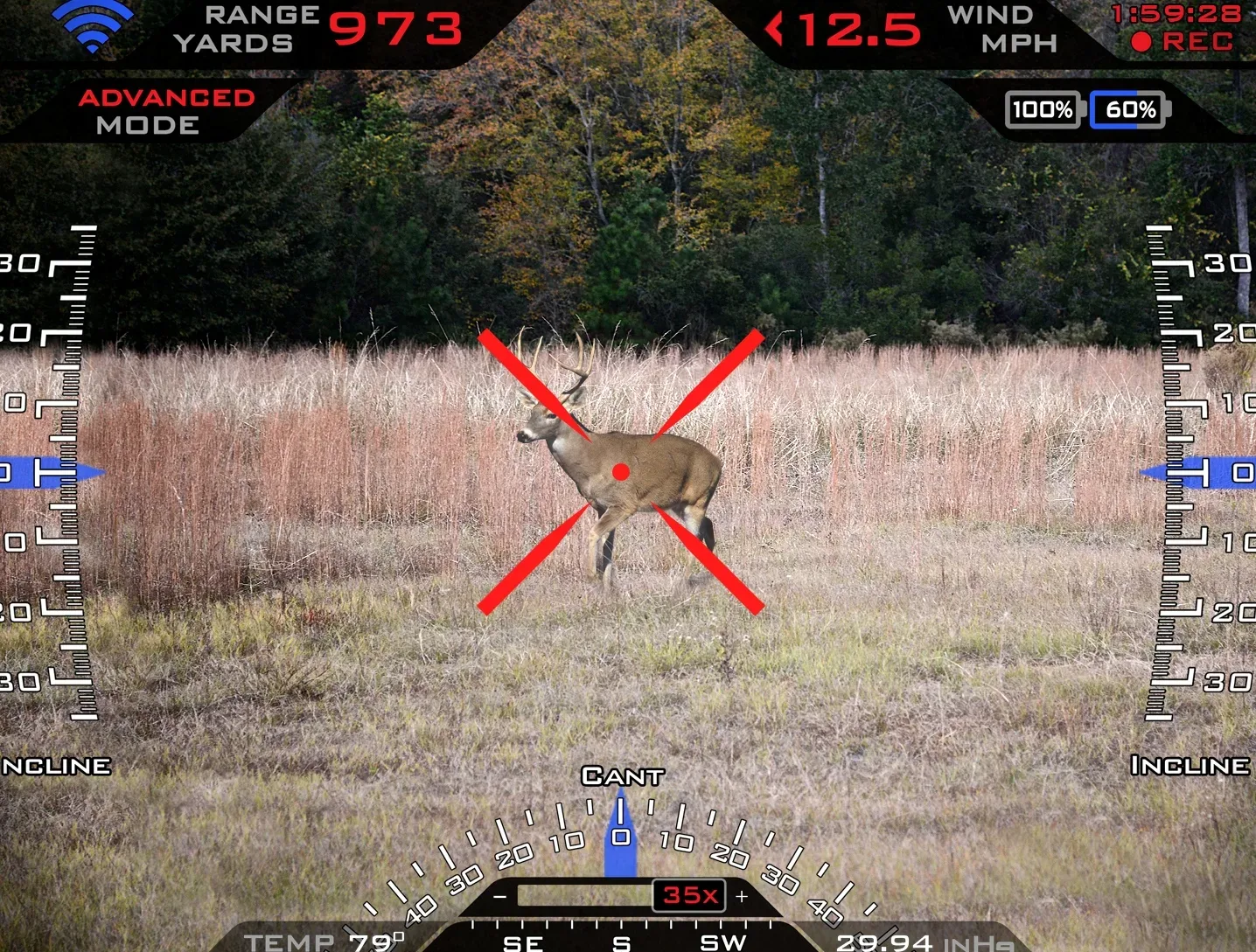
TrackingPoint is an applied technology company founded in Austin, Texas, that built the first commercially available precision guided firearm (PGF) — a rifle system that calculates a complete ballistic solution, locks onto a target, and physically prevents the gun from firing until the barrel is aligned with that solution. In plain terms: you tag the target, pull the trigger, and hold it back. The gun fires when it decides the shot is right, not when your finger does.
| Traditional Rifle | TrackingPoint PGF |
|---|---|
| Shooter calculates ballistics | Computer calculates ballistics |
| Fires when trigger pulled | Fires when barrel aligned with solution |
| Skill determines accuracy | System determines accuracy |
| Human controls timing | Computer controls timing |
| 500+ years of precedent | Fundamental inversion of control |
The Fundamental Inversion
That's not a subtle distinction. It's a fundamental inversion of how every rifle in the previous 500 years of firearms history worked. From the matchlock forward, the shooter's skill — breath control, trigger discipline, reading wind, estimating range — was the variable that determined whether the bullet hit.
TrackingPoint moved the variable that determines accuracy out of the human and into a Linux-powered computer bolted to the receiver.
The company's commercial run was short. It opened sales in January 2013, attracted U.S. Army interest by January 2014, survived a high-profile hacking demonstration in 2015, and was acquired by Talon Precision Optics of Jacksonville, Florida in November 2018. But the questions it raised — about skill, access, ethics, and cybersecurity in weapons — are still live debates in military procurement and civilian shooting culture.
History & Foundingedit
Origins and Prototype Development
John McHale formed TrackingPoint in February 2011. A working prototype followed within weeks, completed in March 2011 according to Wikipedia.
Key milestones in TrackingPoint's seven-year commercial run
That timeline — concept to prototype in roughly a month — reflects that the core technology wasn't being invented from scratch. The underlying components existed: laser rangefinders, ballistic computers, digital tracking scopes. TrackingPoint's contribution was integrating them into a single system where the scope, the trigger, and the ballistic solution talked to each other in real time.
Leadership and Market Entry
By the time the company surfaced publicly, Jason Schauble — a retired special operations Marine captain, Silver and Bronze Star recipient, and former vice president of Remington's Global Military Products division — was serving as company president. Schauble brought both the military credibility and the commercial firearms industry connections that a startup selling $17,000-plus rifles would need.
Jet fighter lock-and-launch technology onto a combat rifle. — Jason Schauble, TrackingPoint President
The company spent three years and a team of 70 people developing the technology before the first product hit the market, according to NPR. That's a substantial investment for a niche firearms startup, and it showed in the price tags: the initial XS-series bolt-action rifles carried retail prices up to $22,000.
Product Evolution
The first product officially went on sale in January 2013. A second product line — the AR Series semi-automatic smart rifle — followed in January 2014, expanding the system beyond bolt-action long-range platforms into semi-automatic configurations chambered in 7.62 NATO, 5.56 NATO, and .300 BLK.
| Product | Launch Date | Configuration | Caliber | Price Range |
|---|---|---|---|---|
| XS Series | January 2013 | Bolt-action | .338 Lapua Magnum, .300 Win Mag | $17,000-$22,000 |
| AR Series | January 2014 | Semi-automatic | 7.62 NATO, 5.56 NATO, .300 BLK | Not specified |
| M1400 | September 2016 | Bolt-action | .338 Lapua Magnum | Not specified |
| ShadowTrak 6 | 2018 | Bolt-action | 6.5mm Creedmoor | Not specified |
Mission & Activitiesedit
Target Market and Positioning
TrackingPoint described its target customer as hunters and competitive shooters — particularly a younger generation comfortable with smartphones and social media. Schauble told NPR that the system was designed to make shooting "more fun" and shareable: the integrated Wi-Fi server streamed live scope video to a nearby iPad, and every shot was recorded for replay or upload to YouTube and Facebook.
That pitch is worth pausing on, because it tells you something about what the company thought it was selling. This wasn't positioned as a military procurement play, at least not publicly. It was framed as the "smart rifle" sitting alongside the smart car and the smartphone — consumer technology that happened to be a firearm.
Core Technology: XactSystem
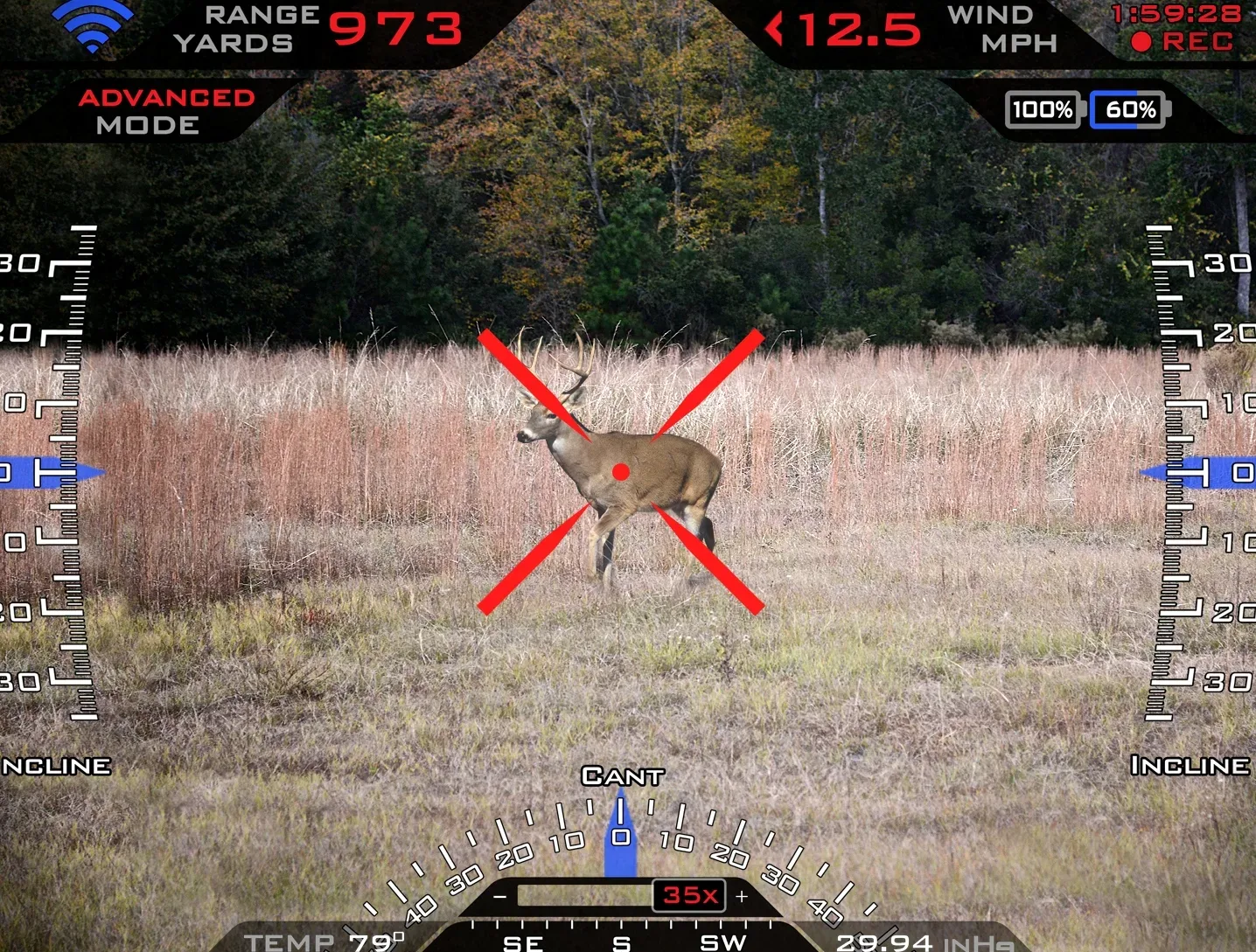
The core system, which TrackingPoint called the XactSystem or Tag Track Xact, worked like this: the shooter tags a desired impact point on the target using a button near the trigger, locking a red dot electronically onto that point. The Networked Tracking Scope (NTS) then calculates a full firing solution — accounting for:
- Range measurement and environmental factors
- Wind speed and direction compensation
- Cant and inclination adjustments
- Coriolis effect and spin drift calculations
- Temperature and pressure variations
TrackingPoint XactSystem firing sequence - the fundamental process that inverted traditional rifle operation
The scope's reticle shifts to show where the barrel needs to be pointed for that solution. When the shooter squeezes and holds the Guided Trigger, the rifle fires only when the barrel alignment matches the computed solution closely enough.
| System Component | Function | Capability |
|---|---|---|
| Tag Track Xact | Target locking | Red dot locks onto impact point |
| Networked Tracking Scope (NTS) | Ballistic computation | Range, wind, cant, Coriolis, spin drift |
| Guided Trigger | Fire control | Prevents firing until alignment achieved |
| ShotView App | Remote viewing | Stream scope video to mobile devices |
| ShotGlass | Wearable display | Transmit scope view to shooter's eye |
Performance Specifications
According to DefenseReview, the system could also hit moving targets — at introduction, targets moving up to 10-15 mph. By the time the M1400 was introduced in September 2016, that capability had expanded to targets moving at 20 mph (32 km/h), with target acquisition time of 2.5 seconds. The 2018 ShadowTrak 6, chambered in 6.5mm Creedmoor, could hit 20 mph moving targets in 1 second.
The actual rifle hardware for the early XS series was provided by Surgeon Rifles, according to DefenseReview. Variants of the bolt-action lineup used .338 Lapua Magnum and .300 Winchester Magnum. The M1400, introduced in September 2016, was a squad-level .338 Lapua Magnum bolt-action capable of targets out to 1,400 yards (1,280 m). It ran 45 inches (110 cm) long with a 22-inch (560 mm) barrel and weighed 15.4 lbs (7.0 kg).
| Model | Target Speed | Acquisition Time | Max Range | Weight | Barrel Length |
|---|---|---|---|---|---|
| Early XS Series | 10-15 mph | Not specified | Not specified | Not specified | Not specified |
| M1400 (2016) | 20 mph (32 km/h) | 2.5 seconds | 1,400 yards (1,280 m) | 15.4 lbs (7.0 kg) | 22 inches (560 mm) |
| ShadowTrak 6 (2018) | 20 mph | 1 second | 1,000 yards (914 m) | 14.6 lbs (6.6 kg) | Not specified |
Extended Capabilities
The ShotView app extended the system's reach beyond what the shooter's own eye could see. By streaming the scope's heads-up display to smartphones, tablets, and eventually purpose-built goggles, TrackingPoint enabled shots fired around corners or from concealed positions — with the shooter watching a live feed rather than looking through the scope directly. Vice reported a demonstration of a shooter hitting an explosive target at 500 yards using goggles rather than direct sight, and noted the app had been tested with Google Glass, though Glass's latency proved too high for reliable use at long range.
The ShotGlass wearable glasses — transmitting the scope's view to the shooter's eye — were introduced alongside the M1400 in September 2016, according to Wikipedia.
Impact on Firearmsedit

Skill Democratization
To understand why TrackingPoint matters historically, you have to go back to what precision long-range shooting actually requires. The United States Army Research Laboratory published an error budget analysis for sniper weapon fire control in 1999 that quantified every variable between the shooter and a hit at distance — wind estimation, range measurement, trigger jerk, cant, all of it. Elite military snipers spend years learning to manage those variables. The skill gap between a trained sniper and an untrained shooter at 800 yards is enormous and took decades of institutional investment to produce.
TrackingPoint didn't close that gap by training shooters better. It automated the variables. NPR documented a novice shooter hitting a target at 500 yards on the first attempt at a range outside Austin, in Liberty Hill, Texas.
A skill that had required years of practice was compressed into a single session with a $22,000 rifle.
That's the historical moment worth marking.
Military Adoption
The military implications were obvious. In January 2014, the U.S. Army purchased six TrackingPoint fire control systems to evaluate the target acquisition and aiming technology. The Army integrated the system onto the XM2010 Enhanced Sniper Rifle for testing, according to Wikipedia. The Army's interest confirmed that TrackingPoint wasn't just a civilian novelty — it represented a genuine capability jump that state-level military organizations took seriously.
Civilian Ethics Debate
The civilian debate was sharp. Chris Wilbratte, a hunter interviewed by NPR, called it "shooting fish in a barrel" and argued the system eliminated the skill component that gave hunting its ethical framework under fair chase principles. Chris Frandsen, a West Point graduate and Vietnam veteran, went further — arguing the technology shouldn't be in civilian hands at all because it made mass-casualty attacks at distance easier to execute.
Schauble's response addressed the access concern directly: TrackingPoint sold directly to consumers rather than through dealers, vetting buyers personally. The scope also had password protection that disabled the precision guidance system without the owner's code — the rifle could still fire as a conventional firearm, but the Tag Track Xact functionality was locked out.
The Cybersecurity Revelation
Then came the hacking problem. In 2015 — reported by Wired in 2017 — computer security researchers Runa Sandvik and Michael Auger demonstrated that the rifle's Wi-Fi capability, when enabled, left the targeting computer open to remote exploitation. The attack vector was the software's naive design: a skilled attacker could gain root access to the system over Wi-Fi, alter operating parameters (including making the computer believe the bullet weighed anywhere from 0.4 ounces to 72 pounds, causing the system to miscalculate the firing solution), or brick the targeting computer entirely.
They could not, according to the reported findings, force the rifle to fire — the mechanical trigger remained under the shooter's physical control. But they could make it miss, reliably and without the shooter knowing why.
| Vulnerability Type | Attack Vector | Potential Impact | Limitations |
|---|---|---|---|
| Remote Wi-Fi Exploit | Network access when Wi-Fi enabled | Alter ballistic parameters | Cannot force rifle to fire |
| Parameter Manipulation | Root access to targeting computer | Bullet weight: 0.4 oz to 72 lbs | Mechanical trigger remains user-controlled |
| System Disruption | Software compromise | Complete targeting computer failure | Rifle functions as conventional firearm |
An attacker could:
- Alter ballistic parameters (bullet weight from 0.4 oz to 72 lbs)
- Cause systematic targeting errors without shooter awareness
- Completely disable the targeting computer system
- Access achieved through Wi-Fi when networking enabled
This was a genuinely new category of firearms vulnerability. No one had previously needed to think about whether their rifle's aiming system could be remotely compromised over a wireless network. TrackingPoint had imported the cybersecurity problems of consumer electronics into a weapons platform, and the Sandvik-Auger demonstration made that concrete in a way no theoretical warning could.
Platform Expansion
The AR Series expansion in January 2014 broadened the system's reach considerably. Semi-automatic configurations in 5.56 NATO put the precision guidance system on a platform with a far lower barrier to entry than the $17,000-plus bolt-action rifles — and connected the technology to the policy debates already surrounding AR-platform firearms. Remington Arms had earlier expressed interest in licensing the TrackingPoint technology for rifles at around the $5,000 price point, according to NPR, which would have put the system within reach of a much larger buyer pool. Whether those conversations ever produced a product is not on the public record.
Current Statusedit
Acquisition and Continuity
In November 2018, Talon Precision Optics, LLC of Jacksonville, Florida purchased TrackingPoint's assets, according to Wikipedia. The acquisition was announced via press release on PR Newswire. Talon's owner's manual for the RapidLok SA references TrackingPoint's PGF technology directly, indicating continuity of the precision guided firearm concept under the new ownership.
Final Product Developments
Also in 2018, prior to the acquisition, TrackingPoint had introduced the ShadowTrak 6 — a bolt-action in 6.5mm Creedmoor capable of hits at 1,000 yards (914 m), with compatibility with Hornady's 147gr ELD-M match bullet and 143gr ELD-X hunting bullet. At 14.6 lbs (6.6 kg), it was slightly lighter than the M1400.
The original TrackingPoint website domain (tracking-point.com) is listed as the company's site in Wikipedia's entry, though the current operational status of that URL is unclear.
Legacy Technology
What TrackingPoint started — the integration of real-time ballistic computing, digital target locking, and networked data sharing into a single rifle system — didn't die with the company's original ownership. The SmartShooter electronic rifle sight, developed separately, applies similar principles of electronically controlled fire to military small arms. The broader concept of networked, data-driven individual weapons is now an active area in military procurement across multiple countries.
The BGC Takeedit
TrackingPoint is one of the more genuinely interesting things to happen in small arms in the last fifty years, and it gets undersold because it didn't survive long enough as an independent company to fully prove itself out.
The technology worked. That's not in question. Novice shooters hitting targets at 500 yards on first attempts, moving target acquisition under 2.5 seconds at 1,400 yards — these aren't marketing claims that fell apart under scrutiny.
The Army bought the hardware and put it on a service rifle for evaluation. That's about as credible a field endorsement as a startup gets.
The hacking vulnerability was a real problem, not a theoretical one, and Sandvik and Auger did the firearms world a favor by surfacing it publicly. But here's the thing: the vulnerability was in the Wi-Fi implementation, not in the underlying concept of computerized fire control. Military systems manage networked hardware security all the time. The question is whether the resources exist to do it right, and a startup selling $22,000 hunting rifles to a niche market probably didn't have the security engineering budget to match its ambition.
The "fair chase" debate is real, but it's also older than TrackingPoint. Scope magnification, laser rangefinders, ballistic calculators, suppressors — every generation of targeting technology has had the same argument. At some point the line is arbitrary, and exactly where you draw it says more about your personal values than about any objective principle.
TrackingPoint was the first time most people in the firearms community had to seriously consider that a rifle could be remotely compromised. That's a door that doesn't close.
What I find historically significant here is the cybersecurity angle, not the accuracy angle. Any future weapon system with networked electronics — and there will be many — inherits this problem. The Sandvik-Auger demonstration in 2015 should be a permanent part of any serious conversation about smart weapons development, civilian or military.
The company is gone in its original form. The technology isn't.
Referencesedit
- https://en.wikipedia.org/wiki/TrackingPoint
- https://www.npr.org/sections/alltechconsidered/2013/05/15/184223110/new-rifle-on-sale
- https://newatlas.com/trackingpoint-precision-guided-firearms-scopes-digital/25264/
- https://defensereview.com/trackingpoint-xactsystem-precision-guided-firearm-pgf-package-with-integrated-networked-tracking-scope-heads-up-display-and-guided-trigger-for-future-snipers/
- https://www.vice.com/en/article/this-smart-rifle-lets-you-shoot-a-quarter-mile-without-looking/
- https://talonprecisionoptics.com/wp-content/uploads/RapidLok-SA-Owners-Manual.pdf
- https://www.grandviewoutdoors.com/predator-hunting/trackingpoint-launches-first-precision-guided-ar
Last Updated: February 27, 2026
- Gls Guns(Sumner, IA)
- Bi-mart - Yakima (Fruitvale Ave)(Yakima, WA)
- New Philly Sportsman Specialities(New Philadelphia, OH)
- R&R Sports & Outdoors(Brandon, FL)
Loading comments...