Details
Matchlock
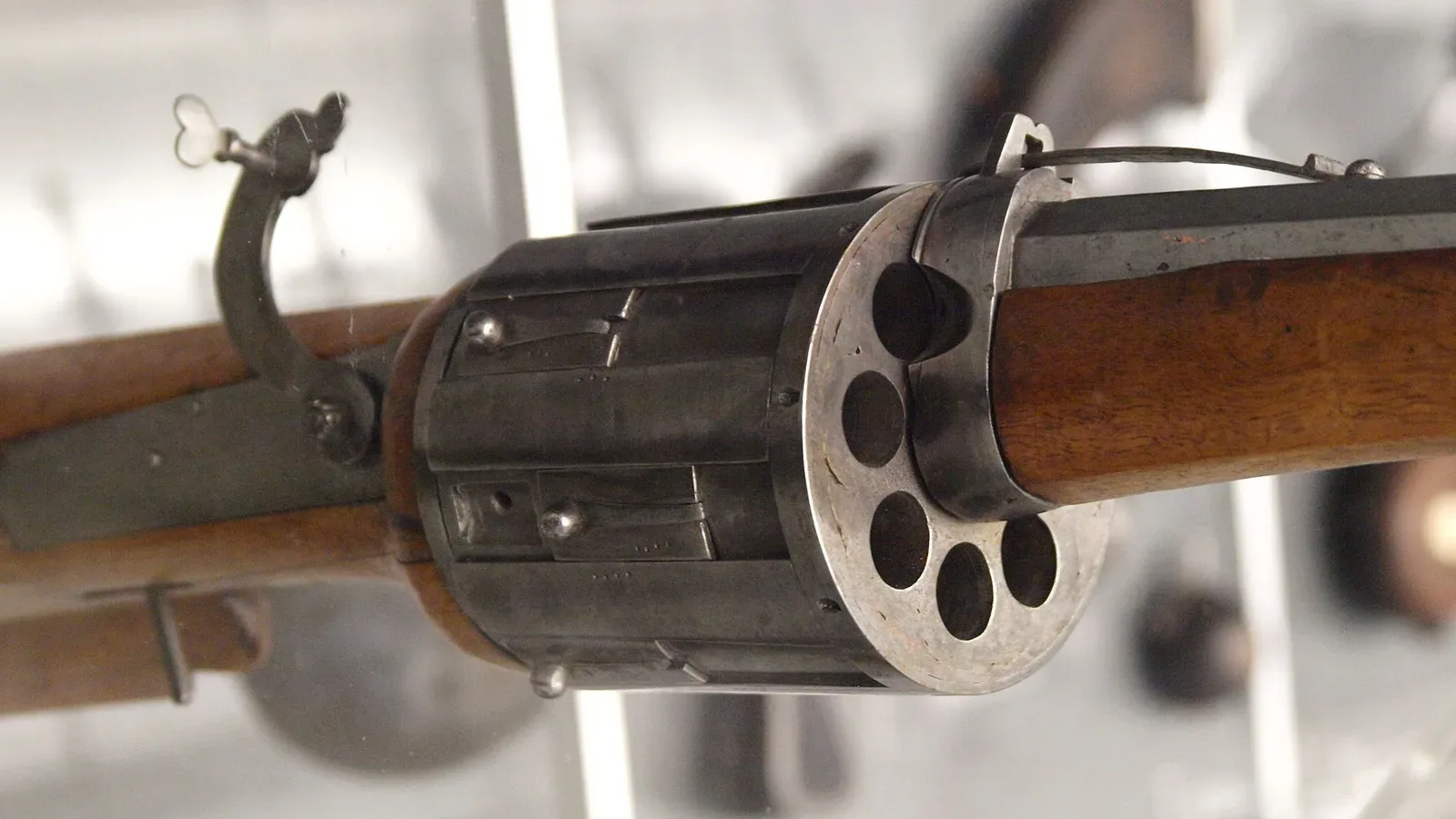
A Drehling revolver (ca. 1580) — Nuremberg's rare attempt at multi-shot matchlock design, with rotating cylinder predating the cap-and-ball revolver by centuries.
| Origins | |
|---|---|
| Invented | 1411 |
| Country | Europe |
| Timeline | |
| Era | 15th century |
| Replaced By | Flintlock |
| Impact | |
| Significance | The first mechanical firing device applied to small arms, introducing the trigger mechanism and enabling soldiers to aim firearms while firing, which fundamentally transformed warfare and military tactics. |
Matchlock: The Mechanism That Changed Everything
Firearms encyclopedia article
From The Boise Gun Club Handbook
Overviewedit
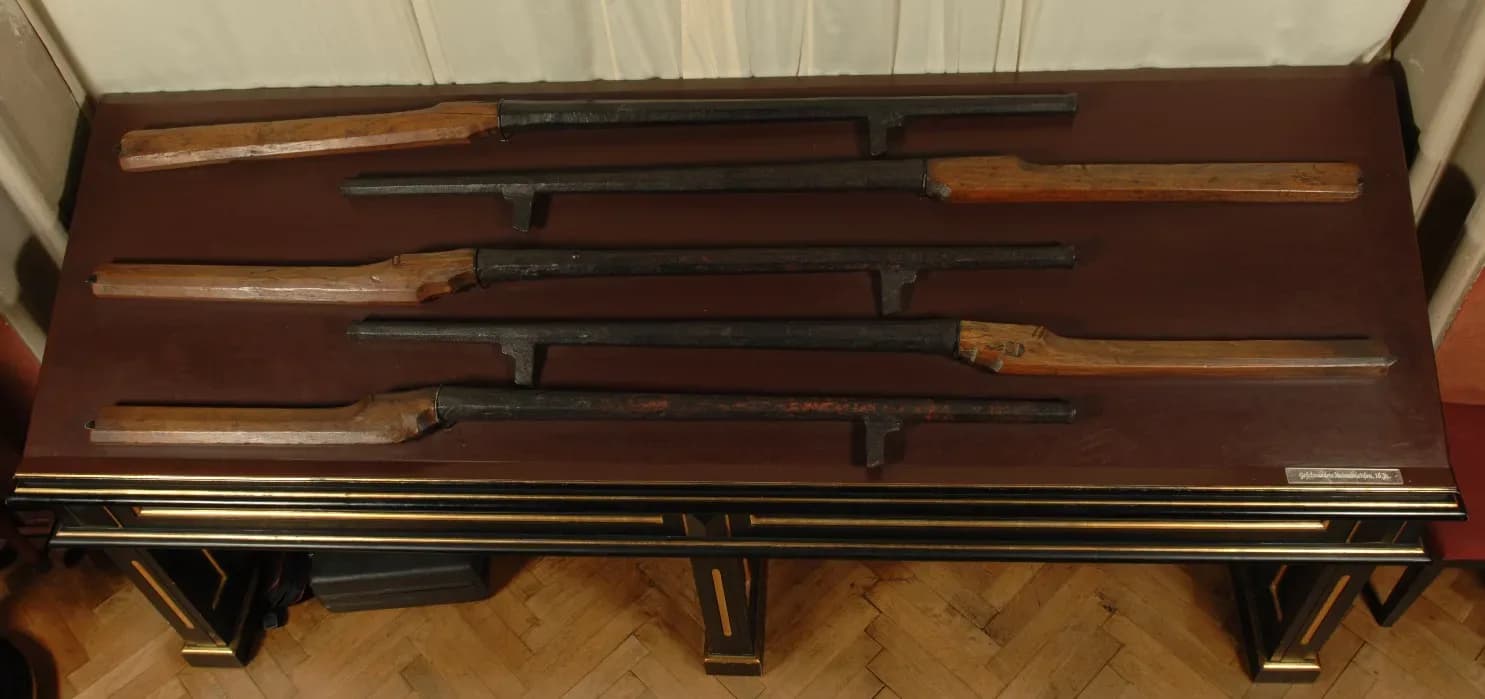
Before the matchlock, firing a gun required two people -- or one very distracted person trying to hold a weapon steady, aim it, and simultaneously press a burning cord to a touchhole with a free hand. The matchlock solved that problem with a piece of curved metal and a trigger, and in doing so changed the entire trajectory of warfare.
The matchlock is a firearm ignition mechanism in which a burning slow match -- a chemically treated cord that smolders rather than flares -- is held in a clamp at the end of a curved lever called a serpentine. The firing sequence works as follows:
- Burning slow match held in serpentine clamp
- Trigger pulled, serpentine drops to flash pan
- Match ignites priming powder
- Flash travels through touchhole to main charge
The matchlock was the first mechanical firing device ever applied to small arms, transforming warfare by allowing aimed fire from a single operator.
It sounds simple now. In the 15th century, it was a revolution.
Development Historyedit
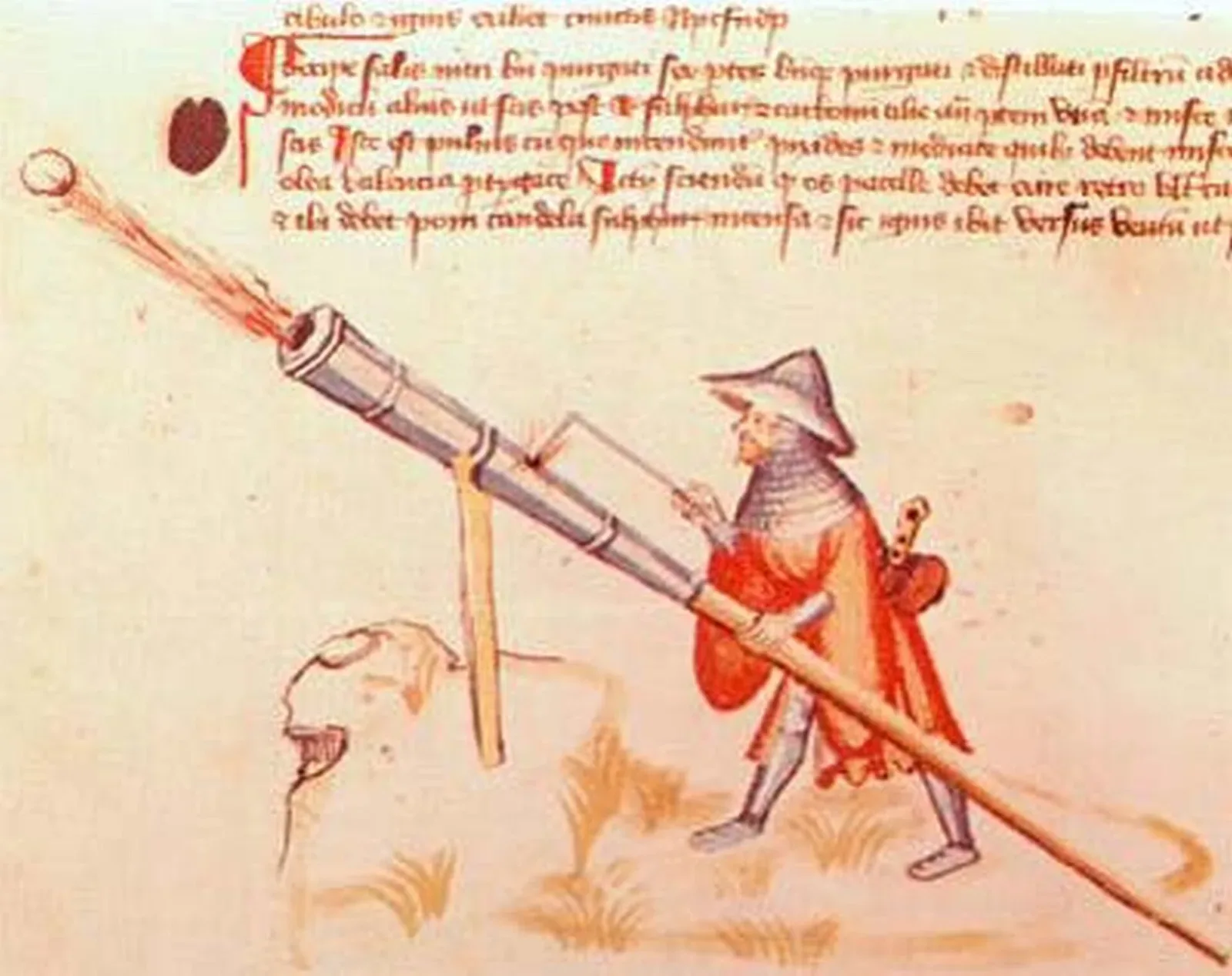
The hand cannon -- essentially a miniature cannon on a pole -- had been around since roughly 1350. It worked, in the loosest sense of the word. You loaded powder and projectile, touched a smoldering ember or slow match to the touchhole, and hoped for the best. As the NRA Museums describes it, the process was awkward enough that a soldier often needed an assistant just to handle the ignition while he tried to aim and hold the weapon steady.
Early European Development
The matchlock solved this by mounting the match on the gun itself. The earliest form appeared in Europe by 1411, per Wikipedia, and in the Ottoman Empire by 1425.
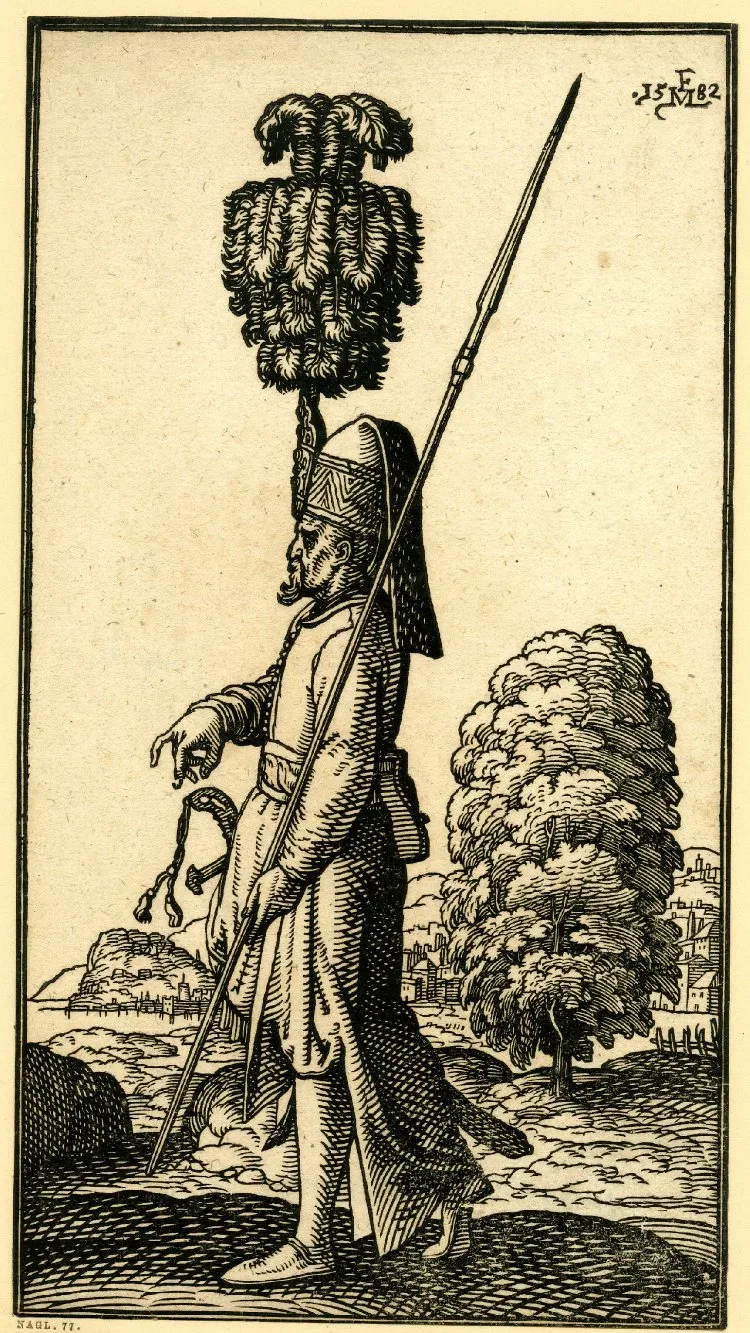
The Janissary corps of the Ottoman Army has references to possible arquebus use dating as far back as 1394, though historians including Gábor Ágoston acknowledge those early references are disputed -- it isn't clear until mid-15th century inventories whether the weapons listed were handheld firearms or small cannons. Scholar Godfrey Goodwin puts the first confirmed Janissary matchlock use no earlier than 1465.
The mechanism appeared in an Austrian manuscript from the mid-15th century, and the first dated illustration of a working matchlock mechanism is from 1475. By the 16th century, per Wikipedia, matchlocks were in universal use across European armies.
The term that gets attached to these early weapons is arquebus -- though it went by a remarkable number of names. Britannica lists the following variants:
- harquebus
- hacquebut
- hagbutt
- hachbuss
- caliver
The term "musket" eventually became the standard designation for the heavier military versions.
Global Spread and Adoption
| Region | Introduction Date | Key Details |
|---|---|---|
| Europe | 1411 | First mechanical matchlock mechanism |
| Ottoman Empire | 1425 | Janissary corps adoption (confirmed 1465) |
| India | 1526 | Introduced by Babur with Ottoman arquebuses |
| China | 16th century | Portuguese introduction, used into 19th century |
| Japan | 1543 | Portuguese introduction at Tanegashima island |
| Global Military | 16th century | Universal adoption across European armies |
The spread of the technology tells you something about how significant it was. Improved Ottoman arquebuses reached India with Babur in 1526. The Chinese obtained matchlock technology from the Portuguese in the 16th century -- though Wikipedia notes that Turkish muskets may have reached China before Portuguese ones did -- and Chinese forces continued using matchlock firearms into the 19th century.
The Portuguese introduced the weapon to Japan in 1543 when a Chinese junk carrying Portuguese adventurers was driven by a storm to anchor at the island of Tanegashima. The local lord, Tanegashima Tokitaka (1528--1579), purchased two matchlock rifles from the Portuguese and immediately put a swordsmith to work copying both the barrel and the firing mechanism. Within a few years, per Wikipedia, the tanegashima had permanently changed how war was fought in Japan.
The name of the weapon -- tanegashima -- came from the island itself, which is how significant that moment was to Japanese military culture.
How It Worksedit
The mechanics are straightforward enough that a 15th-century swordsmith could reverse-engineer one in days.
The Slow Match System
The slow match is the starting point. It isn't a fuse in the modern sense -- it's a length of cord soaked in a potassium nitrate (saltpetre) solution and dried. Once ignited, it burns very slowly and steadily, smoldering rather than flaming. According to Owlcation's comparative analysis of early ignition systems, this avoided the problem of needing to "strike a light" before each shot, which was unreliable well before friction matches existed.
Mechanical Operation
The serpentine holds a short length of this burning cord in a clamp. On early designs, it was a simple S-shaped lever pinned to the stock -- called a serpentine lock -- that the shooter manipulated by hand to bring the match down to the pan. Later designs added a proper trigger mechanism connected by mechanical linkage, so pressing the trigger dropped the serpentine automatically. On release, a spring pulled the serpentine back clear of the pan -- a safety feature that mattered, given what was sitting in that pan.
| Component | Function | Key Features |
|---|---|---|
| Slow Match | Ignition source | Potassium nitrate-treated cord, burns steadily |
| Serpentine | Match holder | S-shaped lever, clamps burning cord |
| Flash Pan | Primer chamber | Contains fine priming powder |
| Touchhole | Ignition pathway | Connects pan to main charge |
| Trigger | Firing mechanism | Drops serpentine to pan (later designs) |
| Spring | Safety feature | Returns serpentine to safe position |
The flash pan itself sits at the side of the barrel, connected to the main powder charge inside via the touchhole. A small amount of fine priming powder in the pan catches the match's ember, flares, and sends fire through the touchhole to detonate the main charge. This two-stage ignition -- primer then main charge -- remained the fundamental operating principle of all small arms through the percussion era.
Variants and Improvements
A later variant, the snap matchlock, used a weak spring to drive the serpentine forward when a button or trigger was pressed, rather than using a sustained trigger pull. According to Wikipedia, this type saw limited military use because the match was often extinguished by the impact with the pan, but it appeared in target weapons where a precise, consistent trigger action mattered more than rapid follow-up shots.
Adding a rifled barrel to a matchlock improved accuracy at longer ranges but created a significant tactical tradeoff -- the bullet had to be pounded down into the grooves, making reloading substantially slower. For most soldiers, a smooth bore and a faster reload was the better trade.
Impact on Warfare & Societyedit
Tactical Revolution
The matchlock made the shoulder-aimed firearm possible as a practical military weapon. Before it, the hand cannon required enough manual coordination to apply a match that aiming was almost incidental. The matchlock gave the shooter both hands for the weapon and a trigger for the shot -- and that freed up enough attention to actually aim.
The matchlock made the shoulder-aimed firearm possible as a practical military weapon, shifting the balance from edged weapons to firearms permanently.
Tactically, this shifted how armies used infantry. The standard doctrine of the era was volley fire: line up, fire simultaneously, create a wall of lead. Individual accuracy mattered less than coordinated mass effect. A line of matchlock musketeers could devastate a formation at ranges where swords and pikes were useless, and this changed the math on how many trained soldiers you actually needed in a given formation. The pike didn't disappear overnight -- musketeers were vulnerable during their slow reloads, and pike formations provided necessary protection -- but the balance between edged weapons and firearms shifted permanently toward firearms.
| Advantage | Military Impact | Tactical Change |
|---|---|---|
| Two-handed aiming | Improved accuracy | Individual marksmanship possible |
| Mechanical trigger | Coordinated volleys | Mass fire tactics |
| Shoulder-mounted | Stable firing platform | Line infantry formations |
| Extended range | Standoff capability | Reduced reliance on edged weapons |
| Mass production | Large-scale deployment | Restructured army composition |
Global Military Adoption
In Japan, the tanegashima's effect was documented and dramatic. Within a few years of its introduction in 1543, per Wikipedia, its use in battle had permanently altered Japanese warfare. The Battle of Nagashino in 1575 is the frequently cited example, where massed matchlock volleys broke traditional cavalry charges.
The weapon's spread also tells the story of 16th-century global trade and empire. The Portuguese carried the matchlock to India, Japan, and likely contributed to its spread through Asia. The Ottomans developed and exported their own versions. Chinese adoption followed Portuguese contact. By the late 16th century, a military force without matchlocks was fighting at a structural disadvantage.
Operational Limitations
The matchlock's weaknesses were real and well-documented, though. Rain was the obvious one -- wet match cord wouldn't stay lit, wet priming powder wouldn't ignite, and a musketeer in a downpour was essentially carrying an expensive club. Wind could extinguish the match or send sparks into neighboring powder charges.
At night, the match glowed and gave away the shooter's position. The smell of burning cord was distinctive enough to alert both enemy soldiers and game animals.
| Weakness | Military Problem | Tactical Limitation |
|---|---|---|
| Rain/moisture | Wet match won't ignite | Weather-dependent effectiveness |
| Wind | Extinguished match | Environmental vulnerability |
| Night operations | Glowing match visible | Position compromise |
| Logistics | 1 mile cord/year/soldier | Supply chain burden |
| Reload time | Slow rate of fire | Vulnerable between shots |
| Powder safety | Match near powder = explosion | Dangerous resupply operations |
And then there was the logistics problem. Wikipedia puts it plainly: keeping both ends of a match lit every night for a year required approximately a mile of match cord. For an army in the field, supplying match cord was a serious quartermaster headache that commanders had to plan around.
The danger around open powder was significant enough that soldiers handling ammunition resupply were among the first issued with self-igniting weapons like the wheellock and snaphance, per Wikipedia. A lit match near a powder horn being refilled was exactly the kind of accident that ended careers and lives simultaneously.
Despite these problems, the matchlock held its military position for over three centuries. The wheellock appeared in the early 1500s and addressed most of the matchlock's core weaknesses, but it was expensive -- the clock-like mechanism required skilled craftsmen and was difficult to repair in the field. Per the NRA Museums, wheellocks were primarily accessible to royalty and wealthy hunters, while common soldiers kept their matchlocks. The economics of equipping thousands of infantrymen kept the matchlock in service long after better options existed.
Modern Relevanceedit
The matchlock left European military service around 1750, finally replaced by the flintlock as the standard infantry arm. But "left service" is not the same as "disappeared."
Extended Service Life
In Japan, matchlocks continued in military use into the mid-19th century. In China, imperial army soldiers were still carrying matchlock guns into the middle decades of the 1800s. During the Sino-French War, Hakka settlers and Taiwanese aboriginals used matchlock muskets against French forces in the Keelung Campaign and the Battle of Tamsui, per Wikipedia.
The Hakka later used those same weapons to resist the Japanese invasion of Taiwan in 1895.
| Region/Group | Time Period | Context |
|---|---|---|
| Japan | Until mid-1800s | Military service |
| China | Through 1800s | Imperial army use |
| Taiwan | 1884-1895 | Sino-French War, Japanese invasion |
| Ethiopia | 19th century | Civilian population |
| Arabian Bedouins | Into 20th century | Family heirlooms |
| Tibet | Through 20th century | Nomad hunters, wolf control |
In Ethiopia, contemporary British historians noted that matchlocks and slings remained in common use among the population even after modern rifles were imported in the 19th century, per the 1911 Encyclopædia Britannica as cited by Wikipedia.
Arabian Bedouin families were still using matchlocks well into the 20th century -- passing them down as family heirlooms and sometimes choosing to convert flintlocks back to matchlock configuration, which says something about the mechanism's perceived reliability in their specific operating environment. The early 20th-century explorer Sven Hedin encountered Tibetan tribesmen on horseback carrying matchlock rifles along the Tibetan border with Xinjiang.
Tibetan nomad fighters used arquebuses during the annexation of Tibet by the People's Republic of China in the second half of the 20th century, and per Wikipedia, Tibetan nomads reportedly still use matchlock rifles to hunt wolves and other predatory animals. For a mechanism developed in the early 1400s, that's a remarkable service life.
Lasting Technical Legacy
The matchlock also established several principles that every subsequent ignition system built on. The flash pan and touchhole arrangement persisted through the wheellock, snaphance, and flintlock eras -- all the way to the percussion cap. The concept of a mechanical trigger that allowed the shooter to concentrate on aiming rather than manually applying ignition is so fundamental to every firearm made since that it barely registers as an invention anymore. It's just how guns work.
The matchlock also gave English a phrase still in use today. When the priming charge in the pan ignited but failed to set off the main charge -- due to a blocked touchhole or incomplete powder trail -- you got a dramatic flash and no shot. That's the origin of "flash in the pan": a lot of fire, no result.
The BGC Takeedit
The matchlock doesn't get enough credit in mainstream firearms history because it gets overshadowed by everything that came after it. The flintlock is more elegant. The percussion cap is more reliable. Cartridge firearms are what everyone actually shoots. The matchlock ends up as a footnote -- primitive, awkward, the thing before the real stuff.
That framing is wrong.
The matchlock was the moment firearms became practical for individual soldiers at scale. Before it, you had hand cannons that required two people to operate effectively, firing something that was closer to a controlled explosion than an aimed shot. The matchlock introduced the trigger, the shoulder stock as a functional aiming platform, and the concept of a self-contained lock mechanism -- three ideas that every firearm built since has relied on in some form.
The fact that it stayed in active military use for over 300 years in Europe, and longer than that in Japan, China, and parts of Africa and the Middle East, should settle any argument about whether it was a serious weapon. It was the dominant military firearm on earth for most of the period between 1450 and 1700. Armies built tactics around its specific strengths and weaknesses. Entire military doctrines -- volley fire, pike and shot formations, the tercio -- existed because of what the matchlock could and couldn't do.
The weaknesses were real. Rain, darkness, smell, the mile of match cord per year -- these aren't trivial problems. But every military that had access to wheellocks and still issued matchlocks to their infantry was making a rational economic and logistical decision, not a lazy one.
Simple, cheap, and repairable beats complex, expensive, and fragile when you're equipping ten thousand men who will abuse their equipment in the field.
What I find most interesting is the endpoints of the matchlock's service life. Bedouins converting flintlocks back to matchlocks. Tibetan nomads still hunting wolves with arquebuses in the modern era. That's not backwardness -- that's a mechanism that fit a specific set of conditions well enough that more "advanced" alternatives weren't actually improvements for those users. There's a lesson in that for anyone who assumes newer is always better.
Referencesedit
- https://en.wikipedia.org/wiki/Matchlock
- https://www.britannica.com/technology/matchlock
- https://www.nrablog.com/articles/2016/5/a-brief-history-of-firearms-earliest-firearms-early-ignition-systems
- https://www.battlemerchant.com/en/blog/firing-mechanisms-of-historical-rifle-replicas
- https://centerofthewest.org/2016/07/21/powder-hour-evolution-of-firearms/
- https://owlcation.com/humanities/matchlocks-wheellocks-and-flintlocks-how-early-small-arms-were-fired
- https://access.historyhit.com/bite-sized-history-collection/videos/how-to-fire-a-matchlock-musket
- https://warfarehistorynetwork.com/article/the-wheel-lock-history-of-the-pistol/
Last Updated: February 27, 2026
- Gls Guns(Sumner, IA)
- Bi-mart - Yakima (Fruitvale Ave)(Yakima, WA)
- New Philly Sportsman Specialities(New Philadelphia, OH)
- R&R Sports & Outdoors(Brandon, FL)
Loading comments...