Organization Info
ATF
Bureau of Alcohol, Tobacco, Firearms and Explosives
| Overview | |
|---|---|
Founded | 1972 |
Headquarters | United States |
Disciplines | Federal law enforcement agency investigating unlawful use, manufacture, and possession of firearms and explosives; arson and bombings; illegal trafficking and tax evasion related to alcohol and tobacco products; regulates sale, possession, and transportation of firearms, ammunition, and explosives in interstate commerce |
Bureau of Alcohol, Tobacco, Firearms and Explosives (ATF)
Firearms encyclopedia article
From The Boise Gun Club Handbook
Overviewedit
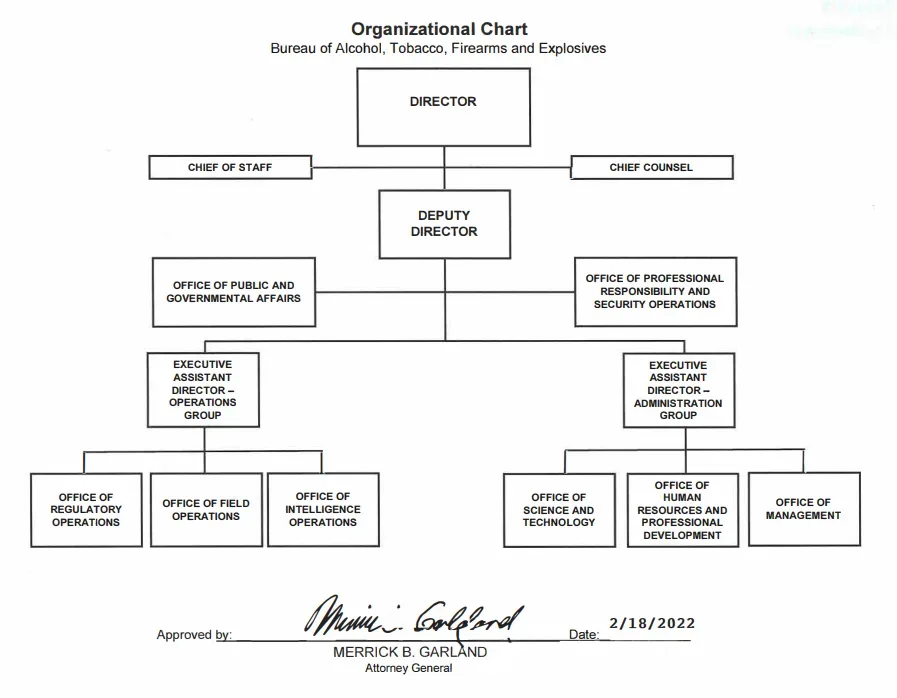
The Bureau of Alcohol, Tobacco, Firearms and Explosives (ATF, formally BATFE) is a federal law enforcement agency under the United States Department of Justice. Its mandate covers:
- Investigation and prevention of federal firearms and explosives offenses
- Arson and bombing investigations
- Illegal trafficking and tax evasion related to alcohol and tobacco
- Federal licensing system for firearms, ammunition, and explosives in interstate commerce
The ATF also regulates — through a federal licensing system — the sale, possession, and transportation of firearms, ammunition, and explosives in interstate commerce.
Organizational Structure
As of 2021, the bureau employed 5,285 people and operated on an annual budget of approximately $1.5 billion. Roughly 2,400 of those personnel are special agents; the remainder are Industry Operations Investigators (IOIs), analysts, forensic scientists, legal counsel, and support staff. ATF operates 26 field divisions across the country and maintains foreign offices in Canada, Mexico, Colombia, El Salvador, Lithuania, Iraq, and the Caribbean.
| Metric | Value |
|---|---|
| Total Personnel | 5,285 |
| Special Agents | ~2,400 |
| Annual Budget | $1.5 billion |
| Field Divisions | 26 |
| Foreign Offices | 7 (Canada, Mexico, Colombia, El Salvador, Lithuania, Iraq, Caribbean) |
| Parent Agency | Department of Justice |
| Established as Independent Bureau | July 1, 1972 |
Regulatory Authority
For anyone who buys, sells, or manufactures firearms in the United States, the ATF is the agency that sets the rules. It issues Federal Firearms Licenses (FFLs), inspects dealers, traces crime guns, and prosecutes the federal firearms cases that local prosecutors often can't or won't touch.
It is also, depending on who you ask, one of the most controversial federal agencies in existence — criticized from the left for doing too little and from the right for doing too much, sometimes simultaneously for the same action.
History & Foundingedit
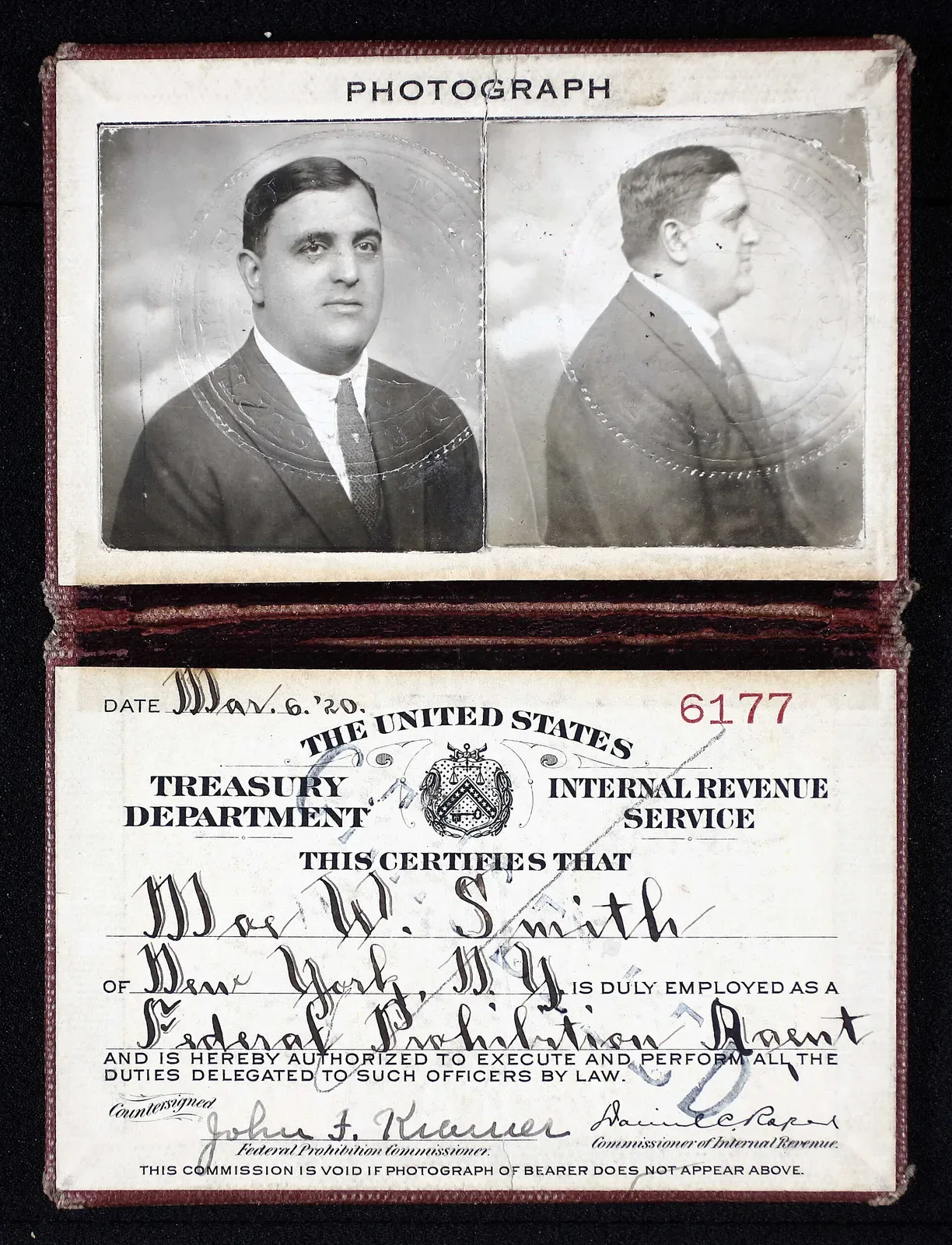
The ATF's institutional bloodline is old and tangled. According to historical sources, the agency traces back to 1886, when the Revenue Laboratory was established within the Treasury Department's Bureau of Internal Revenue. The more operationally relevant ancestor is the Bureau of Prohibition, formed as a unit of the Bureau of Internal Revenue in 1920 to enforce the Volstead Act — the legislation that gave teeth to the Eighteenth Amendment and launched Prohibition across the United States.
Pre-ATF Origins (1886–1933)
The Bureau of Prohibition became an independent agency within Treasury in 1927, was transferred to the Justice Department in 1930, and briefly became a division of the FBI in 1933. When Prohibition was repealed in December 1933, the unit bounced back to Treasury and was reconstituted as the Alcohol Tax Unit (ATU) of the Bureau of Internal Revenue.
Special Agent Eliot Ness and several members of The Untouchables — whose careers had been built on Prohibition enforcement — transferred into the ATU at this point.
Firearms Integration (1942–1968)
Firearms entered the ATU's portfolio in 1942, when responsibility for enforcing federal firearms laws was formally assigned to the unit. This was not a small addition. The National Firearms Act of 1934 had already established federal registration and taxation requirements for machine guns and other restricted weapons, using Congress's taxing power as the constitutional hook. Enforcing that law gave the ATU a foothold in firearms regulation that would grow substantially over the following decades.
In the early 1950s, the Bureau of Internal Revenue was renamed the Internal Revenue Service, and the ATU was handed tobacco tax enforcement as well. The unit's name changed accordingly to the Alcohol and Tobacco Tax Division (ATTD). Through the 1960s, the ATTD's primary law enforcement focus remained the pursuit of illegal liquor stills — the "revenuers" chasing moonshiners through the hills of the Southeast, a pursuit that had defined the agency's character since the post-Civil War era.
The Gun Control Act of 1968 changed everything. Congress, responding to the assassinations of President John F. Kennedy, Senator Robert F. Kennedy, and Reverend Martin Luther King Jr., passed sweeping new federal regulations on retail firearms sales and created broad categories of prohibited persons. The ATTD was renamed the Alcohol, Tobacco, and Firearms Division of the IRS and handed primary enforcement responsibility for the new law. For the first time, the initials "ATF" entered common use.
Two years later, Title XI of the Organized Crime Control Act of 1970 — the Explosives Control Act, codified at 18 U.S.C. Chapter 40 — extended federal regulation to the explosives industry and designated certain arsons and bombings as federal crimes. The Secretary of the Treasury administered the regulatory side; the ATF division of the IRS got the enforcement assignment.
| Year | Agency Name | Parent Department | Key Change |
|---|---|---|---|
| 1886 | Revenue Laboratory | Treasury/Bureau of Internal Revenue | Established |
| 1920 | Bureau of Prohibition | Treasury/Bureau of Internal Revenue | Volstead Act enforcement |
| 1927 | Bureau of Prohibition | Treasury (Independent) | Became independent agency |
| 1930 | Bureau of Prohibition | Justice Department | Transferred to Justice |
| 1933 | Bureau of Prohibition | Justice/FBI Division | Briefly merged with FBI |
| 1933 | Alcohol Tax Unit (ATU) | Treasury/Bureau of Internal Revenue | Post-Prohibition reconstitution |
| 1942 | ATU | Treasury/Bureau of Internal Revenue | Added firearms enforcement |
| 1950s | Alcohol and Tobacco Tax Division | Treasury/IRS | Added tobacco enforcement |
| 1968 | ATF Division | Treasury/IRS | Gun Control Act enforcement |
| 1972 | Bureau of ATF | Treasury (Independent) | Independent bureau status |
| 2003 | Bureau of ATFE | Justice Department | Post-9/11 transfer |
Modern ATF Formation (1970–2003)
On July 1, 1972, ATF was formally cut loose from the IRS and established as an independent bureau within the Treasury Department, per Department of Treasury Order No. 221. Rex D. Davis, who had headed the division since 1970, oversaw the transition and became the bureau's first director. Davis served until July 1, 1978. Under his tenure, federal firearms and explosives enforcement — not tax collection — became the stated primary mission of the new bureau, though alcohol and tobacco tax collection remained a significant revenue function.
The final major structural change came after September 11, 2001. The Homeland Security Act of 2002 transferred ATF from Treasury to the Department of Justice, effective January 24, 2003. The agency's name was updated to the Bureau of Alcohol, Tobacco, Firearms, and Explosives — adding "Firearms" explicitly to the formal title for the first time — though the acronym remained ATF. Simultaneously, the tax collection and alcohol regulatory functions were spun off into the newly created Alcohol and Tobacco Tax and Trade Bureau (TTB), which stayed within Treasury.
Mission & Activitiesedit
ATF's dual mandate — law enforcement and industry regulation — makes it structurally unlike most federal agencies. The same bureau that prosecutes armed felons also inspects gun stores, issues dealer licenses, and processes paperwork for suppressor transfers.
Law Enforcement Operations
On the enforcement side, ATF special agents carry 18 U.S.C. § 3051 authority:
- Carry firearms and serve warrants
- Make warrantless arrests for federal offenses committed in their presence
- Make warrantless arrests for felonies where probable cause exists
- Lead investigative authority over federal crimes committed with firearms or explosives
All ATF special agents require at minimum a Top Secret security clearance; many positions require TS/SCI/SAP clearance. Special agents currently number around 2,400 of the agency's approximately 5,000 total personnel.
Regulatory Functions
Industry Operations Investigators handle the regulatory side. They conduct inspections of firearms and explosives licensees and permittees — FFLs, manufacturers, importers, exporters — operating under the authority of the Gun Control Act, the National Firearms Act, the Arms Export Control Act, and the Organized Crime Control Act of 1970. Their work is less dramatic than a raid but arguably touches more gun owners' daily lives: an IOI visit to a gun store is routine business, not a crisis.
Technology and Tracing
The National Tracing Center runs the largest firearms tracing operation in the world. In FY2007, it processed over 285,000 trace requests from more than 6,000 law enforcement agencies across 50 countries. The web-based eTrace system allows agencies to submit trace requests and receive results in real time; as of the source data, over 2,000 agencies and 17,000 individuals used the system, including more than 33 foreign law enforcement agencies. Gun tracing follows a firearm from manufacturer or importer through the distribution chain to the first retail purchaser — information used to link suspects to guns, identify traffickers, and map interstate and international trafficking patterns.
| Function | FY2007 Volume | Description |
|---|---|---|
| Firearms Traces | 285,000+ requests | Processed from 6,000+ agencies in 50 countries |
| eTrace System Users | 17,000+ individuals | 2,000+ agencies, including 33 foreign agencies |
| Federal Prosecutions | 12,000+ referrals | Firearms, violent crime, narcotics cases |
| PSN Convictions (2001-02) | 7,700+ | Average sentence >5 years |
| NIBIN Comparisons | Real-time | Ballistic imaging across crime scenes |
The National Integrated Ballistic Information Network (NIBIN) is ATF's ballistic imaging tool, allowing federal, state, and local agencies to compare fired bullets and cartridge cases across crime scenes. ATF operates a fire research laboratory in Beltsville, Maryland, where full-scale reconstructions of criminal arson scenes can be built and studied.
Under the Project Safe Neighborhoods (PSN) framework, since 2001, ATF special agents have recommended more than 10,000 felons annually for federal prosecution on firearms possession charges. In PSN's first year (2001–2002), over 7,700 of those referrals resulted in convictions with average sentences exceeding five years. That number rose to over 12,000 prosecutions in FY2007. Roughly 90 percent of ATF's annual case referrals involve firearms, violent crime, or narcotics offenses.
ATF's Special Response Teams (SRTs) are its tactical element — specially trained special agents who conduct high-risk warrant service, undercover operations, surveillance, and protective details. SRT members are armed with Colt M4 carbines; standard-issue sidearm for ATF special agents is the Glock 19M.
Training and Equipment
Basic special agent training runs in two parts: approximately 12 weeks of the Criminal Investigator Training Program (CITP) at the Federal Law Enforcement Training Center (FLETC) in Glynco, Georgia, followed by roughly 15 weeks of Special Agent Basic Training (SABT), also at FLETC, covering firearms identification, trafficking investigations, explosives, arson, undercover techniques, and tactical training.
Impact on Firearmsedit
The ATF's relationship with American firearms culture is the central tension of its history — and it didn't start smoothly.
Early Controversies and Congressional Response
Almost immediately after taking on gun enforcement under the 1968 Gun Control Act, the bureau drew fire for how it used that authority. Complaints about ATF tactics led to Congressional hearings in the late 1970s and 1980s. The evidence that emerged was damaging.
ATF enforcement tactics were "constitutionally, legally, and practically reprehensible." — Senate Judiciary Subcommittee on the Constitution, 1982
A 1982 report of the Senate Judiciary Subcommittee on the Constitution stated flatly that ATF enforcement tactics were "constitutionally, legally, and practically reprehensible." The subcommittee found that ATF primarily targeted collectors and ordinary citizens on technical malum prohibitum charges — acts that are illegal only because a statute says so, not because they're inherently harmful — rather than violent criminal offenders. Testimony before ATF's Appropriations Subcommittee estimated that 75 percent of ATF gun prosecutions targeted people with no criminal intent.
Congress responded with the Firearm Owners Protection Act of 1986 (FOPA), which revised the Gun Control Act, tightened definitions of what federal law actually covered, reduced some technical violations to misdemeanors, and placed new limits on ATF search and seizure authority. FOPA also contained the provision that banned civilian transfer of machine guns manufactured after May 19, 1986 — a restriction that, in a notable twist of legislative history, was attached to a bill intended to reduce ATF overreach.
Ruby Ridge and Waco
The Ruby Ridge standoff beginning in June 1990 hardened the fault lines between ATF and the gun rights community. ATF informant Kenneth Fadeley recorded Randy Weaver selling him two short-barreled shotguns. The barrels, after Fadeley took possession, were found to be shorter than the legal minimum under federal law — requiring registration as a short-barreled shotgun and payment of a $200 tax under the NFA. ATF brought charges, then offered to drop them if Weaver would become an informant. When Weaver refused, ATF passed false information to other agencies — including fabricated claims about explosive booby traps, tunnels, bunkers, marijuana cultivation, felony convictions, and bank robbery — that inflated his threat profile. At trial, the gun charges were found to constitute entrapment, and Weaver was acquitted. But by then the incident had already escalated into a full siege involving the U.S. Marshals Service and FBI, resulting in the deaths of Weaver's son Samuel, his wife Vicki (shot by FBI sniper Lon Horiuchi), and U.S. Marshal Bill Degan.
Less than a year later came Waco. On February 28, 1993, ATF agents — accompanied by press — raided the Branch Davidian compound known as Mt. Carmel near Waco, Texas, to execute a federal search warrant. ATF Director Steve Higgins had specifically promised Treasury Under Secretary Ron Noble that the raid would be called off if undercover agent Robert Rodriguez reported that surprise had been lost. Rodriguez reported exactly that. Raid leaders pressed on anyway. The resulting exchange of gunfire killed six Branch Davidians and four ATF agents. The FBI Hostage Rescue Team took over the scene; a 51-day standoff ended on April 19, 1993, when the compound caught fire. A subsequent grand jury found that the deaths were suicides or caused by persons inside the building, but the follow-up investigation revealed 76 bodies, including 20 children. Director Stephen E. Higgins retired early shortly after the raid. Two supervisory agents, Phillip J. Chojnacki and Charles D. Sarabyn, were suspended, then reinstated with full back pay despite a Treasury Department finding of gross negligence. The incident was removed from their personnel files.
Timothy McVeigh cited both Ruby Ridge and Waco as his explicit motivation for the Oklahoma City bombing on April 19, 1995 — the two-year anniversary of the end of the Waco siege. McVeigh's target selection criteria required that the building house at least two of three federal law enforcement agencies: ATF, FBI, and DEA. Until September 11, 2001, the Oklahoma City bombing was the deadliest terrorist attack in U.S. history; it remains the deadliest act of domestic terrorism on American soil. McVeigh was executed by lethal injection on June 11, 2001, at the Federal Correctional Complex in Terre Haute, Indiana.
| Incident | Year | Key Issues | Outcome |
|---|---|---|---|
| Senate Judiciary Report | 1982 | "Constitutionally reprehensible" tactics | Led to FOPA passage (1986) |
| Ruby Ridge | 1990-1992 | Entrapment, false information to agencies | Gun charges: acquitted (entrapment) |
| Waco Raid | 1993 | Lost element of surprise, pressed forward | 4 ATF agents, 6 Davidians killed |
| Waco Siege End | April 19, 1993 | FBI takeover, 51-day standoff | 76 total deaths, including 20 children |
| Oklahoma City Bombing | April 19, 1995 | McVeigh cited Ruby Ridge/Waco | 168 deaths, deadliest domestic terrorism |
| Fast and Furious | 2009-2011 | 2,500+ guns to cartels | Agent Brian Terry killed, Congressional investigation |
Modern Scandals
Operation Fast and Furious — along with related operations:
- Operation Too Hot to Handle
- Operation Wide Receiver
— produced the most damaging scandal in ATF's modern history. The ATF's Phoenix Field Office, over objections from gun dealers and some agents, facilitated the sale of over 2,500 firearms to traffickers with known connections to Mexican drug cartels, without notifying Mexican authorities. The weapons included AK-47 rifles and FN 5.7mm pistols. Many were subsequently recovered at crime scenes in Arizona and throughout Mexico. One gun is alleged to have been the weapon used by a Mexican national to murder Customs and Border Protection Agent Brian Terry on December 14, 2010. Three supervisors of Fast and Furious — William G. McMahon, William Newell, and David Voth — were reported as being transferred and promoted following Congressional scrutiny. ATF denied the transfers constituted promotions. Special Agent Vince Cefalu, who had exposed Project Gunrunner in December 2010, was notified of his termination in June 2011, two days after Rep. Darrell Issa sent a letter to ATF warning against whistleblower retaliation.
In 2015, a proposed ATF rule to prohibit sales of certain 5.56x45mm ammunition was withdrawn following negative public and legislative response. In 2023, federal Judge Reed O'Connor of the Northern District of Texas vacated ATF's attempt to expand the definition of a firearm frame or receiver, ruling the agency had exceeded its statutory authority in attempting to regulate "readily convertible" or "80% receiver" kits.
The agency's regulatory reach has extended in both directions. A 2022 DOJ Office of the Inspector General audit found that thousands of firearms, firearm parts, and ammunition had been stolen from ATF's National Firearms and Ammunition Destruction (NFAD) branch between 2016 and 2019 — the same branch responsible for disposing of forfeited firearms. The audit found ATF had improved its processes but had not implemented all DOJ recommendations. Critics, including Reason magazine, noted the irony of an agency that would shut down a gun dealer for similar inventory failures continuing to operate with a single arrest and administrative reprimands.
Director Confirmation Battles
ATF's director confirmation history reflects the depth of the political conflict surrounding the agency. In 2006, the NRA lobbied Rep. F. James Sensenbrenner to add a provision to the Patriot Act reauthorization requiring Senate confirmation of ATF director nominees — a change that, once in place, the NRA used to block virtually every subsequent nominee. In 2007, President George W. Bush nominated U.S. attorney Mike Sullivan, a well-regarded career prosecutor, but Idaho senators Larry Craig and Michael D. Crapo blocked his confirmation after complaints from an Idaho firearms dealer. President Obama's 2010 nominee, Andrew L. Traver, never even received a Senate hearing. Subsequent failed nominations included Fraternal Order of Police president Chuck Canterbury (Trump) and former ATF agent David Chipman (Biden).
| President | Nominee | Year | Status | Blocking Factor |
|---|---|---|---|---|
| Bush (43) | Mike Sullivan | 2007 | Blocked | Idaho senators/dealer complaints |
| Obama | Andrew L. Traver | 2010 | Blocked | No Senate hearing granted |
| Obama | B. Todd Jones | 2013 | Confirmed | Served 2013-2015 |
| Trump | Chuck Canterbury | 2017 | Blocked | NRA opposition |
| Biden | David Chipman | 2021 | Blocked | Senate opposition |
| Biden | Steve Dettelbach | 2022 | Confirmed | 2 Republicans crossed party lines |
B. Todd Jones, nominated by President Obama, was confirmed on July 31, 2013, and served until March 31, 2015 — the only Senate-confirmed director for nearly a decade. Steve Dettelbach, nominated by President Biden, became the second confirmed director when the Senate approved him in July 2022, with a procedural maneuver required to advance the nomination and two Republicans crossing party lines to provide the margin.
Current Statusedit
As of the time of this writing, ATF operates under the Department of Justice with Daniel P. Driscoll serving as Acting Director, having assumed the role on April 10, 2025. The position cycled through several acting directors in rapid succession in early 2025: Steve Dettelbach departed January 17, Marvin G. Richardson briefly returned, then Kash Patel — FBI Director — was sworn in as acting ATF chief on February 24, 2025, per an AP report, before being replaced by Driscoll on April 10.
The agency continues to issue FFLs, conduct dealer inspections, trace crime guns, and refer firearms cases for federal prosecution. Ongoing regulatory activity visible in the Federal Register includes implementation of the Bipartisan Safer Communities Act provisions broadening the definition of who is "engaged in the business" as a firearms dealer, and a January 2026 rulemaking updating the definition of "unlawful user of or addicted to any controlled substance" as it applies to firearms purchase eligibility.
Calls for ATF's abolition — some from libertarian commentators, some from gun rights groups, and periodically from members of Congress — have circulated for decades without resulting in the agency's elimination. The debate continues to center on whether ATF's dual role as both firearms regulator and criminal enforcement agency creates structural conflicts, and whether the agency applies its standards to itself with the same rigor it applies to the industry it regulates.
The BGC Takeedit
The following is opinion, clearly labeled as such.
Here's the thing about ATF that makes it genuinely hard to evaluate: the criticism comes from every direction at once, and a lot of it is legitimate.
Gun owners have real grievances that go back decades — the 1982 Senate report wasn't written by the NRA, it was a bipartisan Congressional finding that the agency was going after the wrong people. Ruby Ridge started with an entrapment and ended with a dead mother shot through a door while holding her baby. Waco was a raid that leadership knew had lost its critical element of surprise and pressed forward anyway. Fast and Furious put 2,500 guns into cartel hands and then acted surprised when one of them turned up at a murder scene. Those aren't talking points — they're documented facts with Congressional records behind them.
At the same time, someone has to enforce the NFA and the Gun Control Act. The agency's tracing infrastructure — 285,000 trace requests processed in a single fiscal year — generates investigative leads that local departments genuinely rely on. Project Safe Neighborhoods put violent felons with guns in front of federal judges who could actually sentence them to meaningful time. That work matters.
Whatever you think of any given nominee, running a 5,000-person federal law enforcement agency on a permanent "acting" basis for sixteen years is its own kind of organizational dysfunction.
The confirmation fight is where the structural dysfunction becomes clearest. The NRA got Senate confirmation required for ATF directors, then used that requirement to block confirmations — leaving the bureau under acting leadership for the bulk of sixteen years. Whatever you think of any given nominee, running a 5,000-person federal law enforcement agency on a permanent "acting" basis for that long is its own kind of organizational dysfunction. It's hard to hold an agency accountable when it can't keep a permanent director.
The honest assessment: ATF has a track record of serious abuses that have never been fully reckoned with institutionally — supervisors reinstated after Waco, whistleblowers retaliated against after Fast and Furious, stolen guns from its own disposal facility. It also does work that would fall to somebody else if ATF disappeared tomorrow. The question the gun community has always asked — whether that work requires this particular agency with this particular history — remains genuinely open.
Referencesedit
- Bureau of Alcohol, Tobacco, Firearms and Explosives — Wikipedia: https://en.wikipedia.org/wiki/Bureau_of_Alcohol,_Tobacco,_Firearms_and_Explosives
- Alcohol, Tobacco, Firearms, and Explosives Bureau — Federal Register: https://www.federalregister.gov/agencies/alcohol-tobacco-firearms-and-explosives-bureau
- Bureau of Alcohol, Tobacco, Firearms and Explosives — EBSCO Research Starters: https://www.ebsco.com/research-starters/politics-and-government/bureau-alcohol-tobacco-firearms-and-explosives
- Bureau of Alcohol, Tobacco, Firearms and Explosives — Department of Justice: https://www.justice.gov/archives/bureau-alcohol-tobacco-firearms-and-explosives
Last Updated: February 27, 2026
- Gls Guns(Sumner, IA)
- Bi-mart - Yakima (Fruitvale Ave)(Yakima, WA)
- New Philly Sportsman Specialities(New Philadelphia, OH)
- R&R Sports & Outdoors(Brandon, FL)
Loading comments...