Specifications
AK-47 / AKM

The Type 2A AK-47 (1951–1955) featured a milled steel receiver — labor-intensive to produce, later replaced by the stamped AKM variant.
User:Nemo5576 (CC BY-SA 4.0)
| Manufacturer | |
|---|---|
| Made By | Izhmash (Kalashnikov Concern) |
| Designer | Mikhail Kalashnikov |
| Origin | Soviet Union |
| Specifications | |
| Caliber | 7.62x39mmAlso: 5.45x39mm (AK-74), 5.56x45mm (AK-101) |
| Action | Gas operated, rotating bolt |
| Capacity | 30-round detachable box magazine |
| Barrel | 16.3 in (415 mm) |
| Length | 34.3 in (870 mm) |
| Weight | 7.7 lb (3.47 kg) with empty magazine |
| Feed | 30-round detachable box magazine |
| Sights | Adjustable iron sights, 100-800 m |
| Performance | |
| Eff. Range | 380 yd (350 m) |
| Muzzle Vel. | 2,350 ft/s (715 m/s) |
| Rate of Fire | 600 rounds/min (cyclic) |
| Production | |
| Designed | 1947 |
| In Production | 1949-present |
| Produced | 75-100 million (all variants) |
| Variants | |
| |
| Service Use | |
Soviet/Russian Armed ForcesOver 100 national militariesMost widely used rifle in history | |
| Cultural Note | |
| The AK-47 appears on the flag of Mozambique and the coat of arms of East Timor and Zimbabwe. It is the most widely produced firearm in history. | |
| Related Firearms | |
AK-47 / AKM
Firearms encyclopedia article
From The Boise Gun Club Handbook
If you've ever wondered why the AK-47 shows up in every conflict from Vietnam to Afghanistan, it's simple -- the damn thing just works. Mikhail Kalashnikov designed this rifle in the Soviet Union with one goal: build something that illiterate conscripts could maintain and that would fire no matter what you threw at it. Mission accomplished.
With over 100 million manufactured worldwide, this is statistically the rifle you're most likely to encounter in any serious social unrest. Understanding the platform means understanding the backbone of small arms combat for the past 70 years.
The AK-47 isn't about precision -- it's about putting rounds downrange when your life depends on it. Those loose tolerances that make accuracy enthusiasts cringe? They're exactly why this rifle functions when others choke on dirt, sand, or neglect. You can literally pull one out of a mud puddle, shake it off, and get back to business.
Most folks call everything an "AK-47," but chances are you're looking at an AKM. The original '47 had a milled receiver that was expensive to make. The AKM that replaced it in 1959 uses stamped steel, weighs less, and became the template for virtually every AK-47 variant you see today.
History & Developmentedit
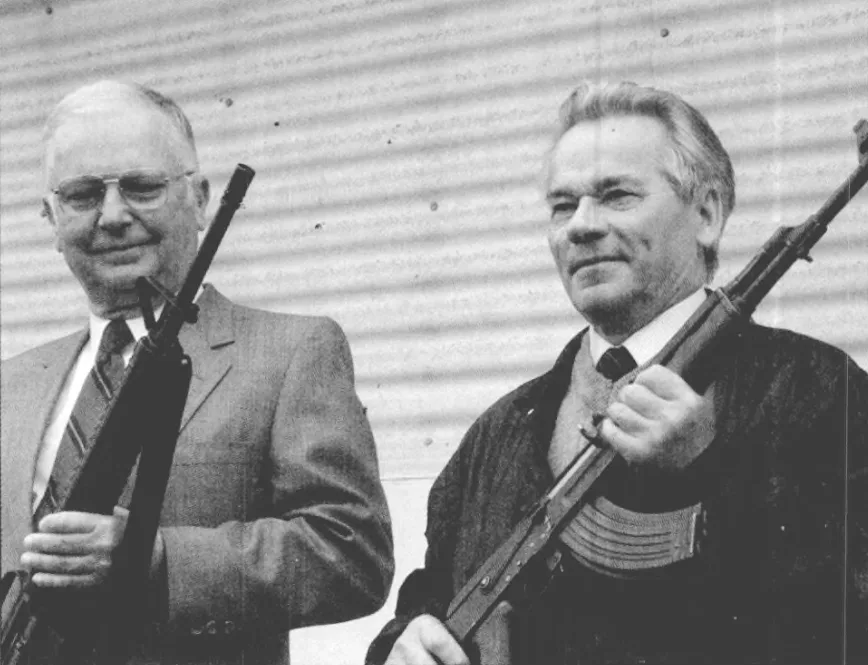
Origins and Design Philosophy
Mikhail Kalashnikov started sketching this design in 1945 while recovering from tank wounds. The Soviets had watched the Germans tear through their ranks with the StG 44 and wanted their own intermediate-cartridge rifle -- something between a submachine gun and a full-power battle rifle.
The design officially adopted in 1947 borrowed proven concepts from everywhere. The gas system echoes the American M1 Garand, the trigger group has Browning influences, and the safety selector is pure Soviet practicality.
Kalashnikov wasn't trying to reinvent the wheel -- he was building the most reliable wheel possible.
Evolution to AKM
Those early milled-receiver AK-47s were built like tanks but cost like tanks too. By 1959, economics forced the switch to the stamped AKM design. This wasn't just about saving money -- the new rifle was lighter, better balanced, and even more reliable than the original.
Global Proliferation
The Soviets spread this design like wildfire through military aid programs and licensing deals. China got the blueprints and cranked out Type 56s by the millions. East Germany, Poland, Yugoslavia -- everybody wanted in on the action. Before long, you could find AK-47 variants being manufactured on six continents.
Technical Specificationsedit
| Specification | AK-47 | AKM |
|---|---|---|
| Caliber | 7.62×39mm | 7.62×39mm |
| Action | Long-stroke gas piston | Long-stroke gas piston |
| Length | 34.3 in | 34.6 in |
| Barrel Length | 16.3 in | 16.3 in |
| Weight (empty) | 9.5 lbs | 8.5 lbs |
| Magazine Capacity | 30 rounds | 30 rounds |
| Rate of Fire | 600 rpm | 600 rpm |
| Receiver | Milled steel | Stamped steel |
The long-stroke gas system is deliberately over-gassed. Gas tapped from a port about six inches from the muzzle drives a piston that's connected directly to the bolt carrier. When that piston moves, everything moves -- violently and reliably.
The bolt rotates 35 degrees to lock up, and the whole cycle happens whether the rifle is clean or caked with crud.
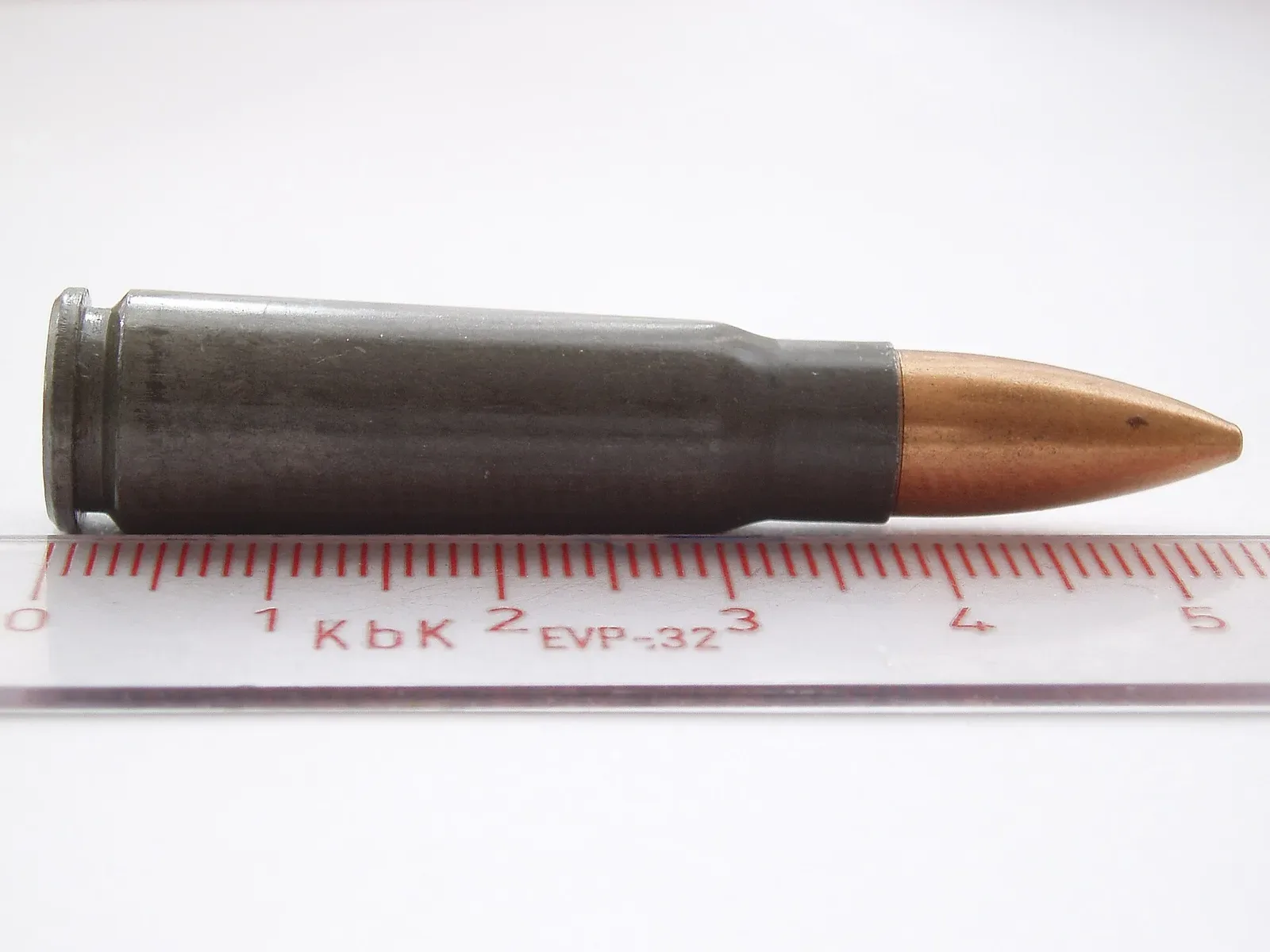
That curved magazine isn't just for looks -- it's designed around the tapered 7.62×39mm cartridge. You load it with a rocking motion: rear lug in first, then snap the front down. The paddle magazine release sits forward of the trigger guard where you can work it with your trigger finger.
The safety doubles as a dust cover, sealing off the trigger mechanism when engaged. Safe is up, semi is middle, full-auto is down. It's loud when you move it, but that's the least of your worries if you're shooting an AK-47 in anger.
Variants Worth Knowingedit
The family tree gets complicated fast, but here are the ones that matter:
Soviet/Russian Variants
- AK-47 (Type 1-3): Milled receiver, heavy construction, 1947-1959 production
- AKM: Stamped receiver version, became world standard
- AKMS: Side-folding triangle stock variant for paratroopers
The stamped receiver AKM versions were lighter, cheaper to make, and just as reliable. The AKMS offered convenient portability for specialized units.
International Variants
- Chinese Type 56: Mass-produced variant, found globally
- Yugoslav M70: Modified gas system, rifle grenade capability
- East German MPi-KM: Highest quality mass-produced variant
Each country that built AK-47s added their own touches -- different furniture, muzzle devices, manufacturing quirks. But the core operating system stayed the same because it worked.
What You Can Expectedit
Accuracy and Range
Don't buy an AK-47 expecting to thread needles at 500 yards. Most examples will give you 3-4 MOA with decent ammo, which translates to about a 12-inch group at 300 meters. That's adequate for the rifle's intended role -- putting effective fire on man-sized targets out to 400 yards.
| Performance Metric | Specification |
|---|---|
| Effective Range | 400 yards |
| Typical Accuracy | 3-4 MOA |
| Iron Sight Range | 300 yards |
| Terminal Performance | Superior to 5.56 NATO at close range |
| Full-Auto Control | Manageable bursts with training |
Ballistics and Terminal Performance
The 7.62×39mm cartridge hits harder than 5.56 NATO at typical engagement ranges. It's not a long-range precision round, but it punches through light cover and delivers solid terminal performance. Think of it as a rifle-fired .30-30 with better ballistics.
Handling Characteristics
Recoil is noticeable but manageable. The straight-line stock design means you feel every shot, but it's not punishing. Full-auto fire climbs predictably -- the rifle wants to rise and pull right. Controllable bursts are possible with practice, but this isn't a precision instrument.
The iron sights are basic but functional. Post front sight, U-notch rear graduated optimistically out to 800 meters. In reality, you're looking at effective iron sight range to about 300 yards for most shooters. The front sight adjusts for elevation with a special tool, windage requires drifting the rear sight.
Reliability Realityedit
Design Features
This is where the AK-47 earns its reputation. Those loose tolerances that hurt accuracy pay dividends when things get ugly. Mud test videos on YouTube show AK-47s functioning after abuse that would disable more precise rifles.
AK reliability system design philosophy
The key is that over-gassed system. It cycles so violently that fouling gets blown out rather than building up. Parts are big, simple, and robust. When something does break, it's usually easy to fix or replace in the field.
Maintenance Requirements
Maintenance is minimal by design. You can go thousands of rounds between cleanings if you have to. When you do clean it, the whole thing comes apart with no tools -- just push out one pin and the bolt carrier comes right out.
Common Wear Points
Common wear points include the bolt, bolt carrier, and trigger components after heavy use. Magazines are consumable items -- the feed lips and followers take a beating. But these are problems you encounter after tens of thousands of rounds, not hundreds.
The BGC Takeedit
The AK-47 platform represents practical engineering at its finest. It's not pretty, it's not precise, but it's probably the most reliable small arm ever mass produced. If you need something that will absolutely, positively function when everything else fails, this is your rifle.
The AK platform represents practical engineering at its finest. It's not pretty, it's not precise, but it's probably the most reliable small arm ever mass produced.
For American shooters, semi-auto AK-47 variants offer a taste of this legendary reliability in a legal package. Build quality varies wildly depending on the manufacturer -- surplus rifles from Eastern European countries generally offer the authentic experience, while domestic builds range from excellent to questionable.
The rifle's reputation sometimes overshadows its limitations. It's not a precision instrument, the ergonomics are dated, and modern AR platforms offer more modularity and accuracy potential. But if someone handed you an AK-47 and told you to survive the apocalypse with it, you could do a lot worse.
The 7.62×39mm cartridge hits the sweet spot between power and controllability for most defensive applications. It's not ideal for long-range work, but inside 300 yards it delivers consistent performance against soft targets and light cover.
Bottom line: the AK-47 earned its reputation through seven decades of conflict and continues to serve effectively in roles where reliability trumps precision. It's not the fanciest rifle on the rack, but it might be the one you'd want when everything goes sideways.
- Gls Guns(Sumner, IA)
- Bi-mart - Yakima (Fruitvale Ave)(Yakima, WA)
- New Philly Sportsman Specialities(New Philadelphia, OH)
- R&R Sports & Outdoors(Brandon, FL)
Loading comments...