Specifications
Colt Walker Revolver

| Manufacturer | |
|---|---|
| Made By | Whitneyville Armory (Eli Whitney Jr.) |
| Designer | Samuel Colt and Samuel Hamilton Walker |
| Origin | United States |
| Specifications | |
| Caliber | .44 caliber |
| Action | single action |
| Capacity | 6 rounds |
| Barrel | 9 inches |
| Length | 15.5 inches |
| Weight | 4.5 pounds |
| Feed | Manual cylinder loading with powder, ball, and percussion caps |
| Sights | Blade front sight, hammer-notch rear sight |
| Performance | |
| Eff. Range | 50-100 yards |
| Muzzle Vel. | 1,000-1,350 feet per second |
| Production | |
| Designed | 1846 |
| In Production | 1847 |
| Produced | 1,100 |
| Unit Cost | $25 |
| Variants | |
| |
| Service Use | |
Texas Mounted VolunteersTexas RangersU.S. Regiment of Mounted RiflemenMexican-American War combatants | |
| Cultural Note | |
| The official handgun of the State of Texas. Held the record as the most powerful commercially manufactured repeating handgun for 88 years (1847-1935). Muzzle energy nearly identical to a 4-inch-barreled .357 Magnum. Most powerful handgun ever issued by the U.S. military. | |
| Related Firearms | |
Colt Walker Revolver (1847)
Firearms encyclopedia article
From The Boise Gun Club Handbook
Overviewedit
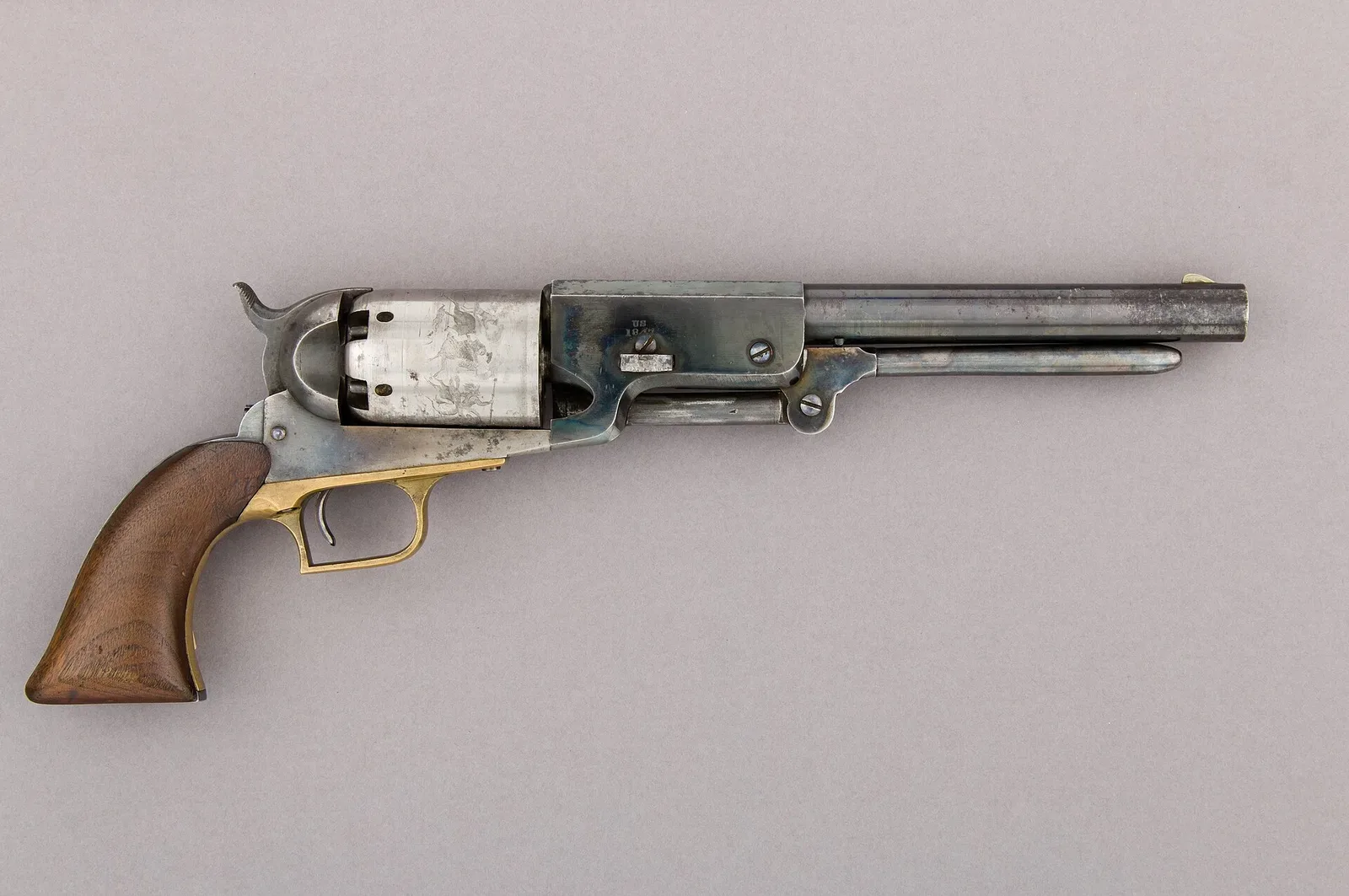
The Colt Walker—sometimes called the Walker Colt—is a single-action, six-shot black powder revolver chambered in .44 caliber, produced in 1847 from a design jointly credited to American firearms inventor Samuel Colt (1814–1862) and Texas Ranger Captain Samuel Hamilton Walker (1817–1847). It was the first practical six-shooter, and at 4.5 pounds unloaded with a 9-inch barrel, it was the largest and most powerful handgun Samuel Colt ever produced.
Only 1,100 were ever made. The gun saved Samuel Colt's career, armed the Texas Mounted Volunteers in the Mexican-American War, and set a power benchmark that no commercially produced repeating handgun would surpass for nearly 90 years.
It is the official handgun of the State of Texas.
Design Historyedit
Colt's Desperate Circumstances
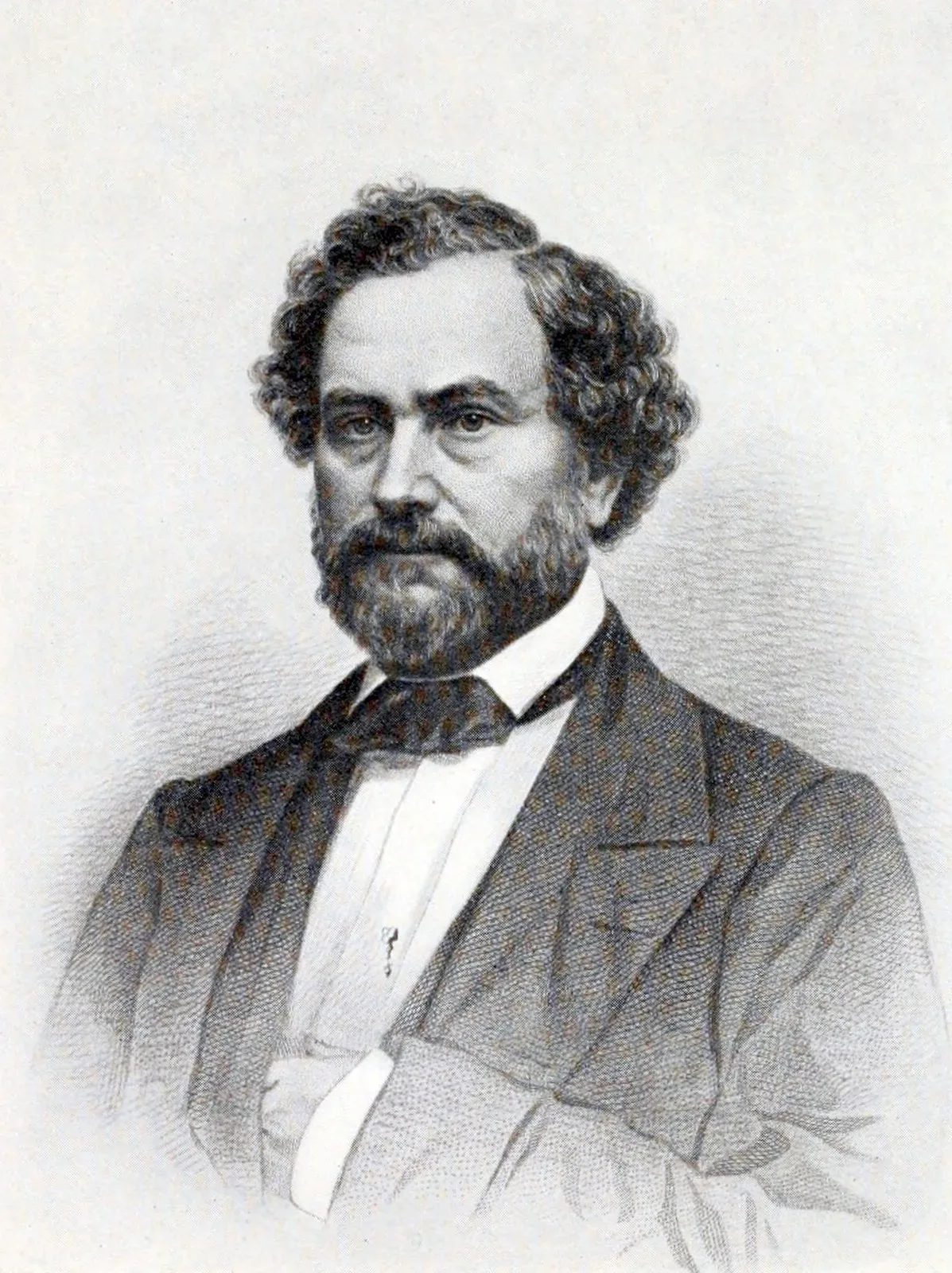
To understand why the Walker exists, you have to understand how badly things were going for Samuel Colt in the mid-1840s. His first company, the Patent Arms Manufacturing Company of Paterson, New Jersey, had already failed. He had no factory, no capital, and no government contracts. What he did have was a reputation—earned partly by the Colt Paterson, a five-shot .36 caliber revolver that the Republic of Texas had purchased in quantity and that Texas Rangers had used with notable effect against Comanche war parties.
When the Mexican-American War broke out in 1846, Samuel Walker—then a captain in the U.S. Regiment of Mounted Riflemen—approached the Ordnance Department about acquiring Colt revolvers for his men. The existing standard-issue sidearm was the single-shot Model 1842 Percussion Pistol, a .54 caliber muzzleloader carried in saddle pommel holsters. Walker had used the Paterson during his time as a Texas Ranger and wanted something heavier, more powerful, and capable of six shots.
Chief of Ordnance George Talcott wrote to an ordnance inspector on November 18, 1846, noting that nearly 1,000 "Colt's Pistols, Rifle caliber" might be needed—but that he doubted they could be obtained.
Key milestones in the Walker's development from Colt's business failure to production
The Walker-Colt Partnership
Colt moved fast. He wrote to Walker around November 27, 1846, soliciting a testimonial about the Paterson's combat record and positioning himself to land a government contract. Walker wrote back with exactly what Colt needed: an account of 15 Rangers fighting off 80 Comanche using Colt's revolvers. He also offered candid suggestions for improvement.
"Without your pistols we could not have had the confidence to have undertaken such daring adventures... with improvements I think they can be rendered the most perfect weapon in the world for light mounted troops." — Captain Samuel Walker to Samuel Colt
The two met in New York City and began developing the new design together. By December 2, 1846, Colt's correspondence confirmed that Walker's suggestions were being incorporated directly into the revolver's specifications. Walker secured a contract for 1,000 revolvers by December 7, 1846.
| Date | Event |
|---|---|
| November 18, 1846 | Chief of Ordnance notes need for ~1,000 "Colt's Pistols, Rifle caliber" |
| November 27, 1846 | Colt writes to Walker soliciting testimonial |
| December 2, 1846 | Colt confirms Walker's suggestions being incorporated |
| December 7, 1846 | Walker secures contract for 1,000 revolvers |
| January 6, 1847 | Contract officially approved by Secretary of War |
| January 9, 1847 | Colt signs manufacturing agreement with Whitney |
| October 1847 | First Walkers shipped to Veracruz, Mexico |
Manufacturing and Production
The contract was officially approved by the Secretary of War on January 6, 1847. Colt set a price of $25 per revolver.
Colt had no factory to build them. He turned to Eli Whitney Jr. of the Whitneyville Armory in Connecticut, signing an agreement with Whitney on January 9, 1847. Other manufacturers produced subcomponents that were assembled into complete revolvers at Whitney's facility. The first 1,000 revolvers were numbered by military company designation—C Company 1–220, A 1–220, B 1–220, D 1–220, and E 1–120—at Walker's specific request. An additional 100 revolvers were produced for the civilian market and as promotional gifts, bringing total production to 1,100.
The official specifications called for nine-inch rifled barrels of "best hammered cast steel," six-chamber cylinders of hammered cast steel strong enough to handle elongated projectiles, interchangeable lockwork parts, a case-hardened iron hammer and frame, and a sound black walnut stock bound with an iron strap. New York engraver Waterman Ormsby was commissioned to roll-engrave a battle scene on each cylinder—based on Walker's description of an 1844 fight between Texas Rangers and Comanche—a scene that carried forward onto the subsequent Dragoon revolvers as well.
Technical Characteristicsedit
Physical Specifications
The Walker is a big gun by any standard. At 15.5 inches overall and 4.5 pounds unloaded, it was impractical to carry on a belt—soldiers carried it in saddle-mounted holsters. The 9-inch barrel is rifled, and the six-chamber cylinder accepts a powder charge of 60 grains per chamber, more than twice what a typical black powder revolver of the era held.
| Specification | Value |
|---|---|
| Overall Length | 15.5 inches |
| Barrel Length | 9 inches |
| Weight (Unloaded) | 4.5 pounds |
| Caliber | .44 (ball diameter ~.454") |
| Capacity | 6 rounds |
| Powder Charge | 50-60 grains black powder |
| Bullet Weight | ~140 grains |
| Muzzle Velocity | 1,000-1,350 fps |
| Muzzle Energy | 500+ ft-lbs |
| Action Type | Single-action |
| Sights | Blade front, hammer-notch rear |
Power and Performance
It fires a .44 caliber lead ball, typically .454 inches in diameter and approximately 140 grains in weight, at muzzle velocities documented between 1,000 and 1,350 feet per second. Modern replicas firing modern FFFg black powder have produced muzzle energy in excess of 500 foot-pounds with both round ball and picket bullet loads.
The Walker held the record as the most powerful commercially manufactured repeating handgun from 1847 until 1935—a span of 88 years.
To put that in context: per Wikipedia's sourcing, its muzzle energy is nearly identical to that of a 4-inch-barreled .357 Magnum handgun. It also holds the record, according to Wikipedia, as the most powerful handgun ever issued by the U.S. military.
The sights are basic: a blade front sight and a hammer-notch rear sight. The action is single-action only—cock the hammer, pull the trigger. The trigger guard is a brass, square-backed design, a functional improvement over the Paterson's guardless folding trigger.
Loading procedure and common mechanical failures of the Walker system
Known Mechanical Issues
The Walker had real mechanical problems that its designers acknowledged almost immediately. Under 300 of the original 1,000 military revolvers were returned for repair due to ruptured cylinders. The failures were attributed to a combination of factors:
- Primitive metallurgy in cylinder walls
- Powder spilling across chamber mouths causing chain-fire
- Soldiers loading conical bullets backwards
- Inadequate loading lever latch dropping under recoil
Colt formally recommended loading no more than 50 grains per chamber rather than the maximum 60 grains. The period-correct fix for preventing chain-fire—where a spark ignites multiple chambers simultaneously—was to pack lard into the mouths of the chambers on top of each bullet after loading, a practice that black powder revolver shooters still use today.
The second major mechanical failure was the loading lever. The lever latch was inadequate and frequently dropped under recoil, which jammed the action and prevented follow-up shots. Soldiers improvised by wrapping a rawhide loop around both the barrel and loading lever to hold it in place. Both of these issues were addressed directly in the Dragoon series that followed.
Combat & Field Useedit
Initial Deployment
The first Walker revolvers shipped to Veracruz, Mexico, in October 1847. Although the revolvers had been purchased to arm Walker's Mounted Rifle Regiment, the first 394 A, B, and C Company revolvers were instead issued to the 1st Regiment, Texas Mounted Volunteers commanded by Colonel John Coffee Hays at Veracruz on October 26, 1847. In November 1847, 100 additional Walker pistols with A and B Company markings were issued to the U.S. Mounted Rifle Regiment—the unit originally intended to receive them.
| Unit | Revolvers Issued | Date | Location |
|---|---|---|---|
| 1st Regiment, Texas Mounted Volunteers | 394 (A, B, C Company) | October 26, 1847 | Veracruz |
| U.S. Mounted Rifle Regiment | 100 (A, B Company) | November 1847 | Mexico |
| 2nd Dragoon Regiment | 500 | ~1850 | Texas frontier |
| Returned at muster-out | 191 | May 8, 1848 | - |
| Lost/retained in service | 202 | - | - |
Field Performance Reports
Captain Samuel Walker himself never saw his revolver prove itself in a sustained engagement. He was shot and killed on October 9, 1847, while leading a charge at the Battle of Huamantla—armed, per the sources, with a pair of his namesake revolvers. He had carried two of them into the Mexican-American War.
Field reporting on the Walker's performance came primarily from medical officer John "Rip" Ford, who obtained two examples for himself at Veracruz and became the main contemporary source for accounts of the revolver in combat. His observation—that the Walker could carry as far and strike with the same or greater force as a Mississippi Rifle—was based largely on a single incident involving a Mexican soldier struck at over 100 yards. That range claim was unusual: the Walker was designed for engagements at 50 yards or less, though accounts of effective hits at 100 yards exist in the period record.
Service Life and Distribution
When the Texas Mounted Volunteers mustered out on May 8, 1848, they turned in 191 Walker revolvers; 202 were lost in service or retained by the Texians. The remaining 500 revolvers were delivered to the Ordnance Department in March 1848 and shipped to the Baton Rouge Arsenal for issue to the 2nd Dragoon Regiment and Texas Ranger companies operating on the Texas frontier around 1850. When those federalized Rangers left federal service, they were not required to return their revolvers, and per Rock Island Auction's sourcing of researcher Glenn Klein, there is no record of any of those revolvers being returned to the arsenal.
Surviving Walker revolvers and the Dragoon revolvers that followed them saw continued service through the Civil War, frequently in Confederate hands, providing significant firepower for mounted troops on both sides of the conflict.
Legacy & Influenceedit
Design Evolution
The Walker was not, by any honest assessment, a fully successful design—its cylinder failures and loading lever problems were serious enough that nearly a third of the military issue revolvers came back for repair. But its failure modes pointed directly toward the solutions that defined the next decade of Colt percussion revolvers.
The immediate successor was the Whitneyville-Hartford Dragoon, produced in approximately 240 units in 1847 and built largely from leftover Walker components. This was followed by the First Model Dragoon (approximately 7,000 produced, 1848–1850), the Second Model Dragoon (approximately 2,700, 1850–1851), and the Third Model Dragoon (approximately 10,500, 1851–1861). Each generation addressed the Walker's weaknesses:
- Barrels shortened from 9 inches to 7.5 inches
- Chambers sized for 50-grain charges rather than 60 grains
- Proper loading lever catch to prevent dropping under recoil
- Improved metallurgy and manufacturing techniques
| Model | Production Years | Approximate Quantity | Key Improvements |
|---|---|---|---|
| Whitneyville-Hartford Dragoon | 1847 | ~240 | Built from Walker components |
| First Model Dragoon | 1848-1850 | ~7,000 | 7.5" barrel, 50-grain chambers |
| Second Model Dragoon | 1850-1851 | ~2,700 | Improved loading lever catch |
| Third Model Dragoon | 1851-1861 | ~10,500 | Further refinements |
| Model 1860 Army | 1860-1873 | 200,000+ | Compact design, .44 caliber |
The Dragoon revolvers ultimately gave way to more compact designs, most notably the Model 1860 Army, as improvements in steel and manufacturing made the massive horse pistol format obsolete.
Business Impact
By the time Samuel Colt died in January 1862, well over 100,000 Colt revolvers were in circulation—an empire built on the contract Walker helped secure in 1847. Before the Walker, Colt had no factory and no future in the firearms business.
The Walker contract gave him both. The Walker's power record stood for the better part of a century. It was not surpassed as the most powerful commercially manufactured repeating handgun until the .357 Magnum arrived in 1935. It remains, per its record, the most powerful handgun ever issued by the U.S. military.
Collector Value and Records
In terms of collector value, the Walker's rarity—just 1,100 produced, many lost or destroyed in service—makes surviving examples among the most valuable American antique firearms in existence. A specimen sold on October 9, 2008 for $920,000.
| Sale Date | Price | Auction House | Notes |
|---|---|---|---|
| October 9, 2008 | $920,000 | - | Standard specimen |
| 2018 | $1,840,000 | Rock Island Auction | Complete with original case (world record) |
| Various dates | $430,000-$1,035,000 | Rock Island Auction | Documented provenance examples |
In 2018, Rock Island Auction sold what was described in America's 1st Freedom magazine as the only known surviving example complete with its original case for $1,840,000—a world record for a single firearm sold at auction at that time. Other Walker revolvers with documented provenance have sold in the $430,000–$1,035,000 range at Rock Island Auction's Premier sales.
On May 23, 2021, Texas Governor Greg Abbott signed a resolution—passed by the 87th Texas Legislature as S.C.R. 20—naming the 1847 Colt Walker the official handgun of the State of Texas. The resolution noted that the Walker was "America's first pistol to hold six rounds" and remains "the most powerful black powder pistol in existence."
Reproductions and Popular Culture
Reproduction Walkers have kept the gun accessible to shooters and collectors who can't spend six figures. Uberti and Pietta both produce functional percussion replicas. Between 1980 and 1982, approximately 5,019 Walker replicas were produced bearing the Colt name as part of the second-generation "F" series Colt Blackpowder Series—with barrels, cylinders, and backstops cast in Italy by Uberti and finished at Iver Johnson in Middlesex, New Jersey. A second phase ran from 1994 to 2002, during which at least 4,300 replicas were produced by the Colt Blackpowder Arms Company as part of the third-generation "Signature Series," with parts from Uberti and Armi San Marco and quality control handled by Iver Johnson. By that second phase, Colt had no direct involvement in production despite the use of its name under license.
In film, the Walker's sheer size has made it a recurring prop choice when directors want to make a visual statement. Clint Eastwood carried a pair—converted to fire metallic cartridge blanks—in The Outlaw Josey Wales. Kim Darby fired one as Mattie Ross in the 1969 True Grit, where the deliberate choice of the oversized Walker was intended to make her character look out of place carrying it—John Wayne's Rooster Cogburn misidentifies it on screen as a Dragoon. Robert Duvall's character Gus in Lonesome Dove also carried one. According to Wikipedia, True Grit (1969) was the first time an 1847 Colt Walker appeared in a movie.
The BGC Takeedit
The Walker is one of those guns where the story around it is almost as interesting as the gun itself. You've got a broke inventor with no factory, a Ranger captain who knew what he needed from a sidearm, and a government contract that had to be negotiated while Colt was essentially bluffing his way back into business. Walker's input wasn't ceremonial—his letters to Colt contain specific sight dimensions and design requirements, and the numbering scheme by company came directly from his request.
This was a genuine collaboration, not a marketing arrangement. What's underappreciated is how honestly bad the Walker was in certain respects. Nearly 30% of the military revolvers came back for cylinder repairs. The loading lever dropping under recoil wasn't a minor inconvenience—it locked the action at exactly the wrong moment. Colt knew it.
The Dragoon series was essentially a running list of Walker problems getting fixed one contract at a time. That's not a knock on the Walker; that's how firearms development actually works.
The Walker's value was proving the concept at scale under combat conditions, and the Dragoon series refined it into something durable enough to serve through the Civil War.
The power record is legitimately impressive. Better than a 4-inch .357 Magnum, from an 1847 black powder revolver, and that record held until 1935. Most handgun "firsts" get quietly revised when you look at the fine print. That one holds up.
If you want to shoot one today, the Uberti replicas are well-regarded and won't make your wallet hurt the way an original would. Load them conservatively—30 to 40 grains is plenty—and keep grease in the chamber mouths. The originals had the same advice in 1847.
Referencesedit
- https://en.wikipedia.org/wiki/Colt_Walker
- https://www.uberti-usa.com/black-powder-revolvers/1847-walker-revolvers
- https://www.rockislandauction.com/riac-blog/the-colt-walker-revolver-rebirth-of-samuel-colts-firearms-enterprise
- https://capitol.texas.gov/tlodocs/87R/analysis/html/SC00020F.htm
Last Updated: February 27, 2026
- Gls Guns(Sumner, IA)
- Bi-mart - Yakima (Fruitvale Ave)(Yakima, WA)
- New Philly Sportsman Specialities(New Philadelphia, OH)
- R&R Sports & Outdoors(Brandon, FL)
Loading comments...