Details
Eli Whitney
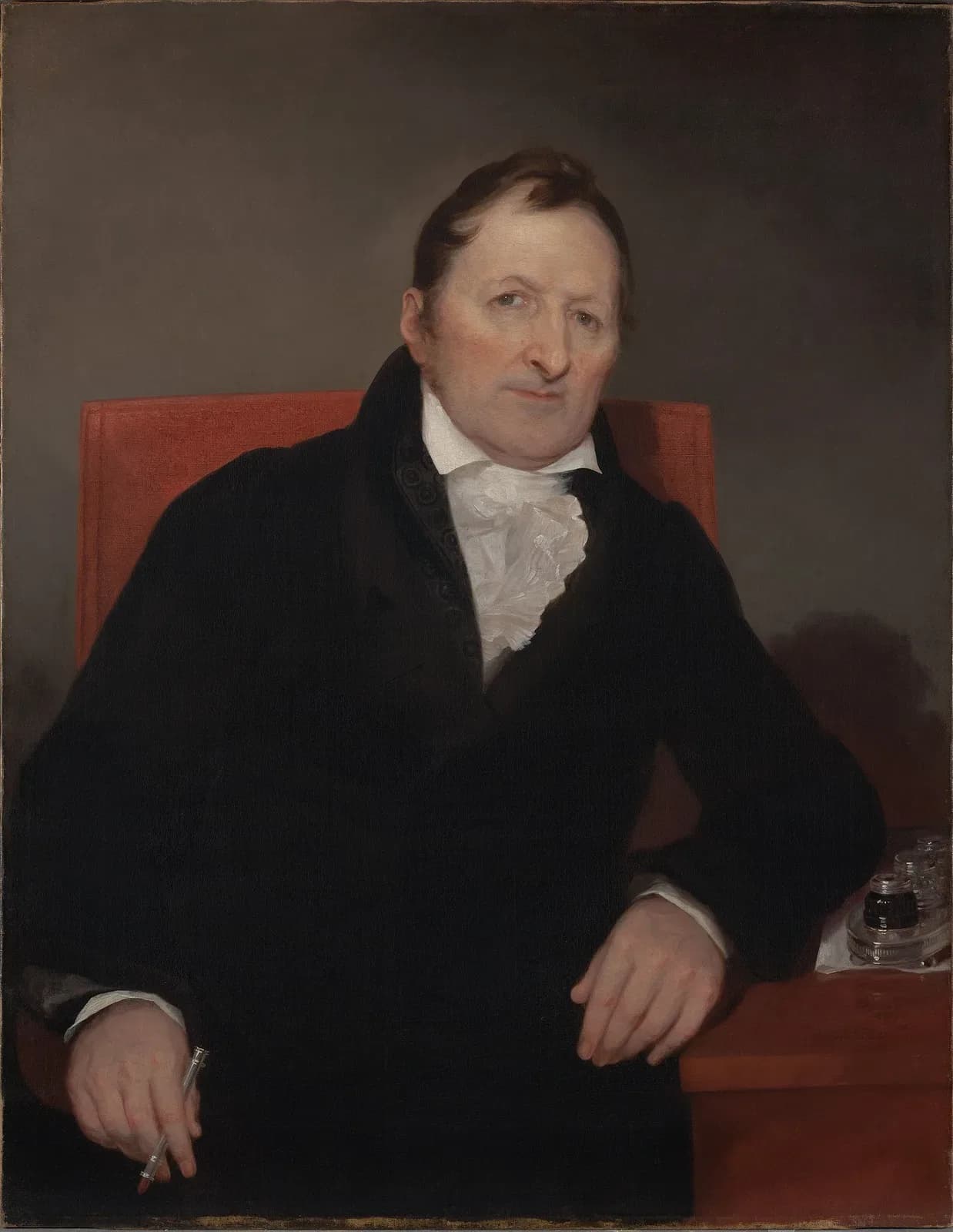
Eli Whitney as depicted on a 1940 commemorative U.S. stamp — the standard portrait used to honor his contributions to American manufacturing.
| Biography | |
|---|---|
| Born | 1765, Westborough, Massachusetts |
| Died | 1825 |
| Nationality | American |
| Legacy | |
| Known For | Cotton gin; promotion of interchangeable parts in weapons manufacturing; establishment of Whitney Armory |
| Key Innovation | Promoted interchangeable parts manufacturing and division of labor using powered machinery and unskilled laborers; established manufacturing systems that influenced the American System of Manufacturing |
Eli Whitney: The Man Who Didn't Invent Interchangeable Parts (But Changed Manufacturing Anyway)
Firearms encyclopedia article
From The Boise Gun Club Handbook
Overviewedit
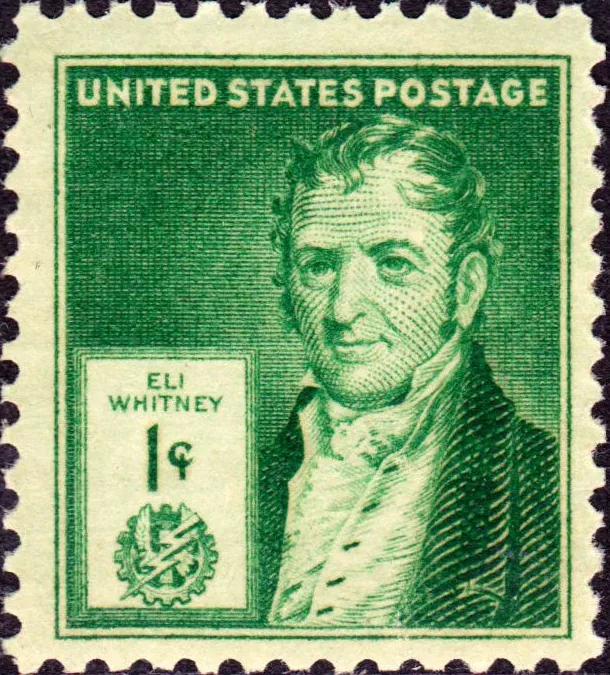
Eli Whitney occupies a strange position in the history of firearms—simultaneously one of the most celebrated and most overstated figures in American manufacturing. Born in Westborough, Massachusetts in 1765, Whitney is credited with two inventions that reshaped the country: the cotton gin and the promotion of interchangeable parts in weapons production. The reality of both is more complicated than the textbook version.
Whitney didn't actually invent interchangeable parts. Historians Merritt Roe Smith and Robert B. Gordon have since determined that Whitney never achieved true interchangeable parts manufacturing during his lifetime. His famous 1801 demonstration before Congress was later shown to have been staged.
Whitney didn't actually invent interchangeable parts—but the political and financial momentum his showmanship generated genuinely helped push American manufacturing toward the American System.
And yet, the systems developed at his armory—and the political and financial momentum his showmanship generated—genuinely helped push American manufacturing toward what would become the American System of Manufacturing, which eventually reshaped not just gunmaking but virtually every industry in the country.
That's a legacy worth understanding precisely, which means understanding where the legend diverges from the record.
Early Life & Backgroundedit
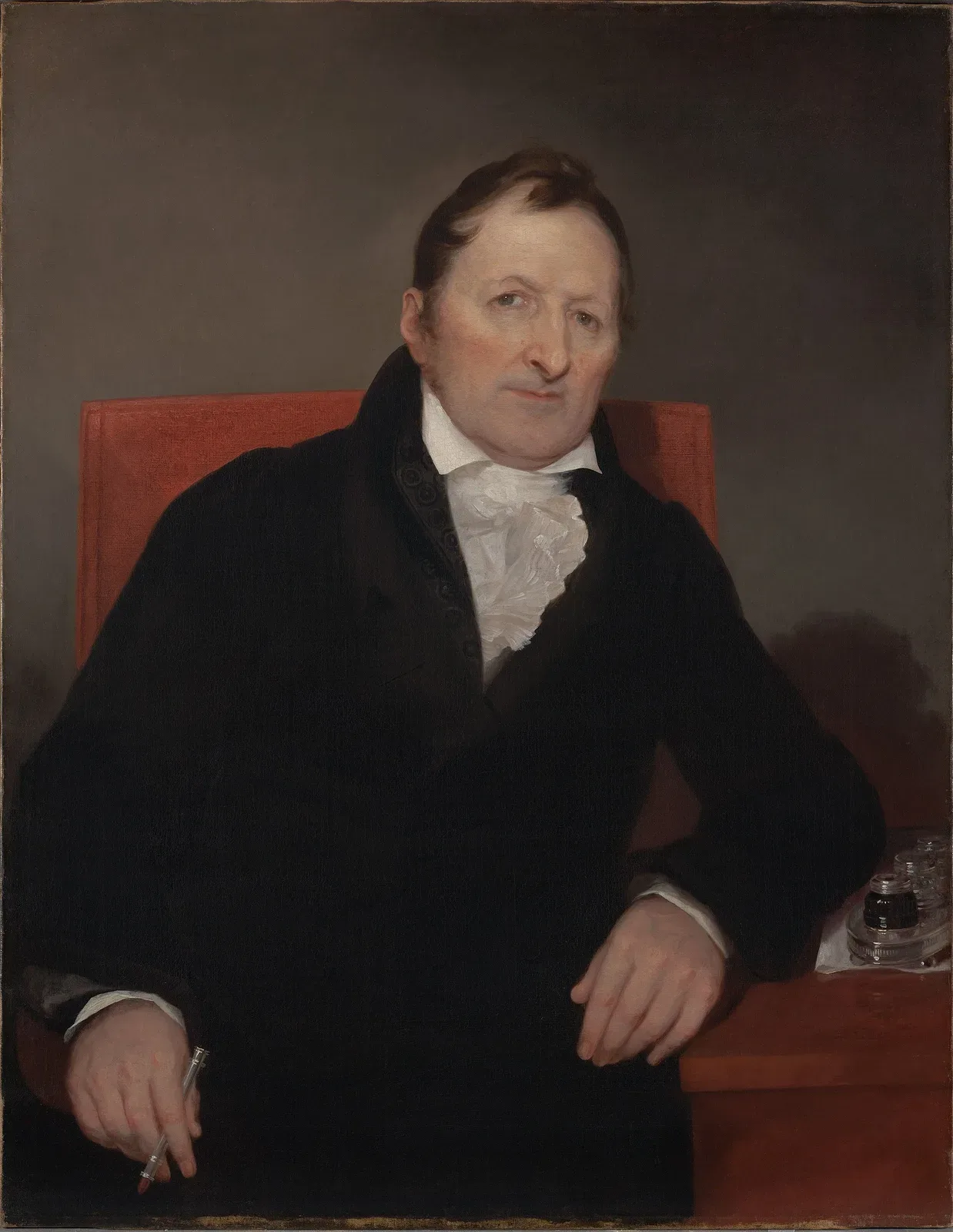
Whitney was born into a prosperous farming family in Massachusetts and, by his own account, showed mechanical aptitude early—manufacturing nails in his father's shop during the final years of the American Revolution. He graduated from Yale College in 1792, which placed him squarely among the educated elite of the young republic.
| Year | Age | Event |
|---|---|---|
| 1765 | 0 | Born in Westborough, Massachusetts |
| 1792 | 27 | Graduated from Yale College |
| 1794 | 29 | Patented the cotton gin (March 14) |
| 1795 | 30 | New Haven gin factory burns down |
After Yale, he traveled south to Georgia, where he worked on the plantation of the widow of General Nathaniel Greene, eventually becoming a business partner of her next husband, Phineas Miller. It was on that plantation that Whitney encountered the slow, labor-intensive process of separating cotton fibers from their seeds—work performed by enslaved people by hand.
At 27, on March 14, 1794, Whitney patented the cotton gin—a mechanical device that could remove seeds from cotton far faster than hand labor. The patent date makes him 27 at the time of the invention, and the machine made him immediately famous.
What it didn't make him was rich. The cotton gin was easily copied, patent infringement lawsuits recovered little, and the New Haven factory he built to manufacture the gin burned down in 1795. Whitney was left famous, influential, and nearly broke.
He was also, by this point, well-connected enough to see an opportunity when the federal government came looking for muskets.
what the cotton gin set in motion. According to the Eli Whitney Museum, the machine contributed to a boom in cotton agriculture and manufacture—and to a direct expansion of the violent systems of plantation enslavement. Whitney's most celebrated early invention is inseparable from that consequence.
Key Contributionsedit
In 1797 and 1798, with war against France appearing increasingly likely, Congress moved to rapidly expand military capacity. Per the Raab Collection, Congress voted $800,000 for the purchase of cannon and small arms. The army had a specific problem: muskets made by individual craftsmen were essentially one-of-a-kind objects, which meant that battlefield repair was nearly impossible. A broken lock couldn't be swapped out for a spare—it had to be custom-fitted by a skilled gunsmith.
The 1798 Musket Contract
In May 1798, Whitney wrote to the Secretary of the Treasury offering his machinery, water power, and workers for the manufacture of muskets. He won one of the contracts issued to private manufacturers—a 28-month agreement to produce 10,000 muskets, enough to outfit the majority of the expanded army. According to History.com, he obtained this contract in mid-1798.
| Contract Details | Specification |
|---|---|
| Contract Date | May 1798 |
| Duration | 28 months |
| Quantity | 10,000 muskets |
| Purpose | Outfit majority of expanded army |
| Actual Delivery | 8 years after deadline |
| Quality Assessment | Superior quality (per History.com) |
He then built a factory. According to Technical Assent, after two years of contract performance Whitney had produced exactly zero guns. Instead, he had spent the time building the facility on the Mill River between New Haven and Hamden, Connecticut, designing machinery, and training a workforce.
His logic—that building a better system for building muskets was more valuable than cranking out hand-crafted rifles in the short term—was not a position the government had contracted for.
Building a better system for building muskets was more valuable than cranking out hand-crafted rifles in the short term—a position the government had not contracted for, but one that would define his legacy.
It was, however, the position that would define his legacy.
The 1801 Demonstration
By January 1801, Whitney was overdue and had produced none of the promised weapons. He traveled to Washington to answer for his use of Treasury funds before a group that included outgoing President John Adams and President-elect Thomas Jefferson. What happened next became one of the most famous demonstrations in American manufacturing history—and one of the most scrutinized.
According to History.com, Whitney spread out the parts of ten disassembled muskets, selected components seemingly at random, and assembled functional firearms before the assembled officials. Per the Raab Collection, he then disassembled them and invited his observers to replicate the process. Congress was captivated.
The catch: it was later proven that Whitney's demonstration was staged. Per History.com, the parts had been marked beforehand and were not truly interchangeable. The Wikipedia article on interchangeable parts confirms that historians Smith and Gordon determined Whitney never actually achieved interchangeable parts manufacturing—his family's arms company did so after his death.
Jefferson still credited Whitney with inaugurating the machine age. Whitney still received renewed federal support. And the political moment—however manufactured—helped establish interchangeable parts as a standard the government would actively pursue and fund going forward.
Timeline showing Whitney's extended delivery schedule and subsequent contracts
The Whitney Armory
Whitney established his Whitney Armory on the Mill River between New Haven and Hamden. The site used water power to run the manufacturing machinery. According to the Eli Whitney Museum, there were approximately eighteen buildings in the factory village at Whitneyville by 1827.
The armory was not a solo operation in the intellectual sense. Per the museum:
- Whitney exchanged ideas with other industrialists and inventors
- Laborers moved between the Whitney Armory and other factories (including Simeon North's Armory in Middletown, Connecticut)
- Techniques and practices spread through worker mobility
- Development was a collective achievement across multiple Connecticut factories
Whitney's workforce was largely unskilled, by design. His goal, as described by the Raab Collection, was to use powered, specially designed machines to produce standardized parts that unskilled laborers could assemble—reducing both cost and dependence on scarce skilled gunsmiths. This division of labor was the real structural innovation, even if the interchangeability of the parts themselves was imperfect during Whitney's lifetime.
Fulfilling the Contract
Whitney finally delivered the last of the original 10,000 muskets eight years after the contract deadline—but per History.com, they were judged to be of superior quality. In 1812, with the outbreak of war, he was awarded a contract to manufacture 15,000 more muskets, with additional government contracts following. Per the Raab Collection, a July 16, 1823 letter from Whitney to Secretary of War John C. Calhoun documents a delivery of 500 muskets invoiced to the War Department—one of many such transactions that, taken together, established interchangeable parts as a manufacturing standard in the eyes of the federal government.
Impact on Firearms Developmentedit
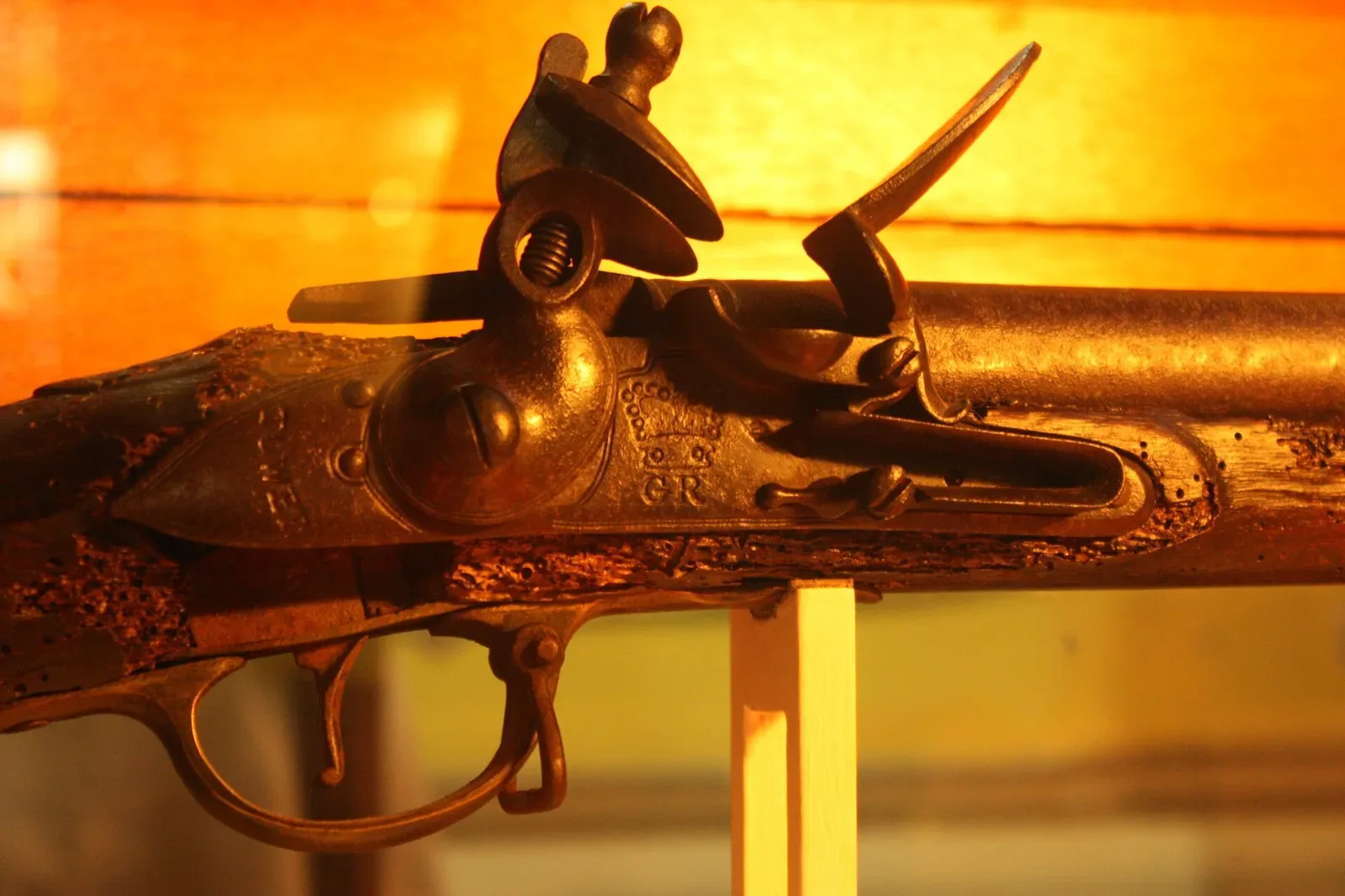
The story of interchangeable parts doesn't start with Whitney, and it doesn't end with him either. Understanding his actual place in that story requires knowing what came before.
Pre-Whitney Innovations
In the late 18th century, French General Jean-Baptiste Vaquette de Gribeauval promoted standardized weapons through what became known as the Système Gribeauval, issued as a royal order in 1765. Gribeauval provided patronage to gunsmith Honoré Blanc, who by around 1778 had begun producing firearms with interchangeable flintlock mechanisms—made carefully by craftsmen, but demonstrably swappable. Blanc demonstrated this before a committee of scientists, much as Whitney would later do before Congress.
In 1785, Thomas Jefferson—then serving as U.S. Ambassador to France—observed Blanc's work firsthand. Jefferson tried unsuccessfully to persuade Blanc to relocate to America, then wrote to the American Secretary of War with the concept. President George Washington approved of the idea, and the groundwork was laid for what would become the 1798 contracts.
Meanwhile, in Britain, London gunsmith Henry Nock delivered 12,010 interchangeable locks to the British Board of Ordnance between July 1793 and November 1795—before Whitney's American demonstration. And by 1803, Marc Isambard Brunel, working with Henry Maudslay at Portsmouth Block Mills in England, achieved genuine mass production using interchangeable parts for Royal Navy pulley blocks, with 45 machines performing 22 processes.
| Pioneer | Country | Achievement | Date |
|---|---|---|---|
| Jean-Baptiste Vaquette de Gribeauval | France | Système Gribeauval standardization | 1765 |
| Honoré Blanc | France | Interchangeable flintlock mechanisms | ~1778 |
| Henry Nock | Britain | 12,010 interchangeable locks delivered | 1793–1795 |
| Eli Whitney | USA | Congressional demonstration (staged) | 1801 |
| Marc Isambard Brunel | Britain | Mass production with interchangeable parts | 1803 |
| U.S. Government Armories | USA | True interchangeability achieved | 1822 |
American Developments
In America, the crucial mechanical steps were taken by others. Simeon North created one of the first true milling machines for metal shaping. Per the Wikipedia article on interchangeable parts, historians Smith, Gordon, and Diana Muir agree that before 1832, both North and John Hall could mass-produce guns using systems of rough-forged parts milled to near-correct size and filed to gauge by hand.
Hall, working at Harpers Ferry, is credited by Smith with the crucial improvement; Muir argues for North. The U.S. government achieved true interchangeability at its armories at Springfield Armory and Harpers Ferry in 1822, according to America's Best History—nearly two decades after Whitney's famous demonstration.
Development pathway from French origins to American Industrial Revolution
Industrial Revolution Impact
What Whitney contributed, then, was not the invention itself but the political legitimization of the concept. His contract, his demonstration, and his sustained delivery of muskets gave the federal government both confidence in and financial commitment to interchangeable manufacture. The NRA National Firearms Museum notes that many authorities credit Whitney's attempts as laying the foundation for the Industrial Revolution in America—specifically when combined with the innovations of John Hall.
The downstream effects were enormous. Per the Raab Collection, the American System was gradually applied to most types of manufacturing, enabling mass production for the first time and laying the basis for a consumer economy. Skilled machinists trained in armory practice spread interchangeable manufacturing to clockmakers, sewing machine manufacturers, reaper makers, typewriter companies, bicycle makers, and eventually the automobile industry. Alfred P. Sloan, long-time president of General Motors, noted in his 1964 memoir that Henry M. Leland brought interchangeable parts into automobile manufacturing—and that this represented a line of descent from Whitney through Leland to the auto industry.
Spread of interchangeable parts from armories to consumer industries
Later Life & Legacyedit
Whitney died in 1825. Per the Eli Whitney Museum, his nephews, son, and later owners of the site continued pursuing his legacy of industrial innovation until the last factory on the Mill River site closed in 1979—making the armory an active manufacturing site for roughly 180 years.
| Aspect | Whitney's Role | Historical Reality |
|---|---|---|
| Interchangeable Parts | Credited as inventor | Part of larger group effort |
| Milling Machines | Often credited | Did not invent |
| 1801 Demonstration | Proved concept | Later proven staged |
| Political Impact | Secured government funding | Legitimized the concept |
| Manufacturing Legacy | 180-year operation | Site active until 1979 |
Historical Reassessment
The historical reassessment of Whitney's actual achievements has been ongoing since the 1950s and 1960s, when historians of technology began examining the primary record more carefully. Charles Fitch, writing in 1882, had credited Whitney with successfully executing a firearms contract with interchangeable parts using the American System. That credit stood largely unchallenged for decades.
The revisionist work by Smith, Gordon, and others—widely known by the 1980s and 1990s—complicated the picture significantly without erasing Whitney's importance entirely. The Eli Whitney Museum puts it clearly: Whitney was not the inventor of interchangeable parts or the milling machines that enabled precision manufacturing. He was part of a large group of inventors, manufacturers, and laborers working toward similar goals in the early decades of the 1800s. What distinguished him was partly his showmanship, partly his political connections, and partly his ability to sustain a manufacturing operation long enough to actually deliver muskets at scale—even if years behind schedule.
The Cotton Gin Controversy
His cotton gin legacy remains contested on different grounds. The invention genuinely transformed cotton production and made Whitney famous. It also, per the Eli Whitney Museum, directly contributed to the expansion of plantation enslavement—a consequence Whitney's biography cannot sidestep.
The BGC Takeedit
Whitney is one of those historical figures who gets more interesting the closer you look. The grade-school version—genius inventor brings interchangeable parts to America, launches the Industrial Revolution—doesn't survive contact with the actual record. His 1801 demonstration was staged. He delivered his first contract eight years late. Historians with access to primary documents concluded he never actually achieved what he claimed.
And yet.
There's something worth respecting in what Whitney actually did accomplish. He looked at a 28-month contract for 10,000 muskets and decided the right move was to spend those 28 months building a factory and a system instead of cranking out hand-fitted guns. That's a bet most contractors wouldn't take, especially with federal money on the line.
The fact that he then talked his way out of the consequences with a staged demo says something about his salesmanship, sure—but it also says something about how far the government was willing to go to believe in the concept.
The honest version of Whitney's legacy is that he was a skilled promoter of a genuinely important idea he didn't fully deliver on—and that American manufacturing is better for the fact that he promoted it anyway.
The concept worked. Not because Whitney perfected it, but because the government's investment in it—legitimized in part by Whitney's political theater—funded the armory practice that eventually produced genuine interchangeability. North, Hall, and the federal armories at Springfield and Harpers Ferry got there. Whitney pointed the direction and kept the money flowing toward it.
The honest version of Whitney's legacy is that he was a skilled promoter of a genuinely important idea he didn't fully deliver on—and that American manufacturing is better for the fact that he promoted it anyway. That's a more complicated story than the legend, but it's also a more useful one.
Referencesedit
- https://www.technicalassent.com/insight/what-eli-whitneys-1798-gun-making-contract-can-teach-us
- https://www.raabcollection.com/eli-whitney-autograph/eli-whitney-signed-us-government-buys-muskets-eli-whitney
- https://en.wikipedia.org/wiki/Interchangeable_parts
- https://www.eliwhitney.org/eli-whitney-and-whitney-armory
- https://www.nramuseum.org/guns/the-galleries/a-prospering-new-republic-1780-to-1860/case-11-firearms-innovations/us-eli-whitney-model-1798-contract-flintlock-musket.aspx
- https://www.history.com/articles/interchangeable-parts
- https://americasbesthistory.com/abhtimeline1799m.html
Last Updated: February 27, 2026
- Gls Guns(Sumner, IA)
- Bi-mart - Yakima (Fruitvale Ave)(Yakima, WA)
- New Philly Sportsman Specialities(New Philadelphia, OH)
- R&R Sports & Outdoors(Brandon, FL)
Loading comments...