Details
Interchangeable Parts

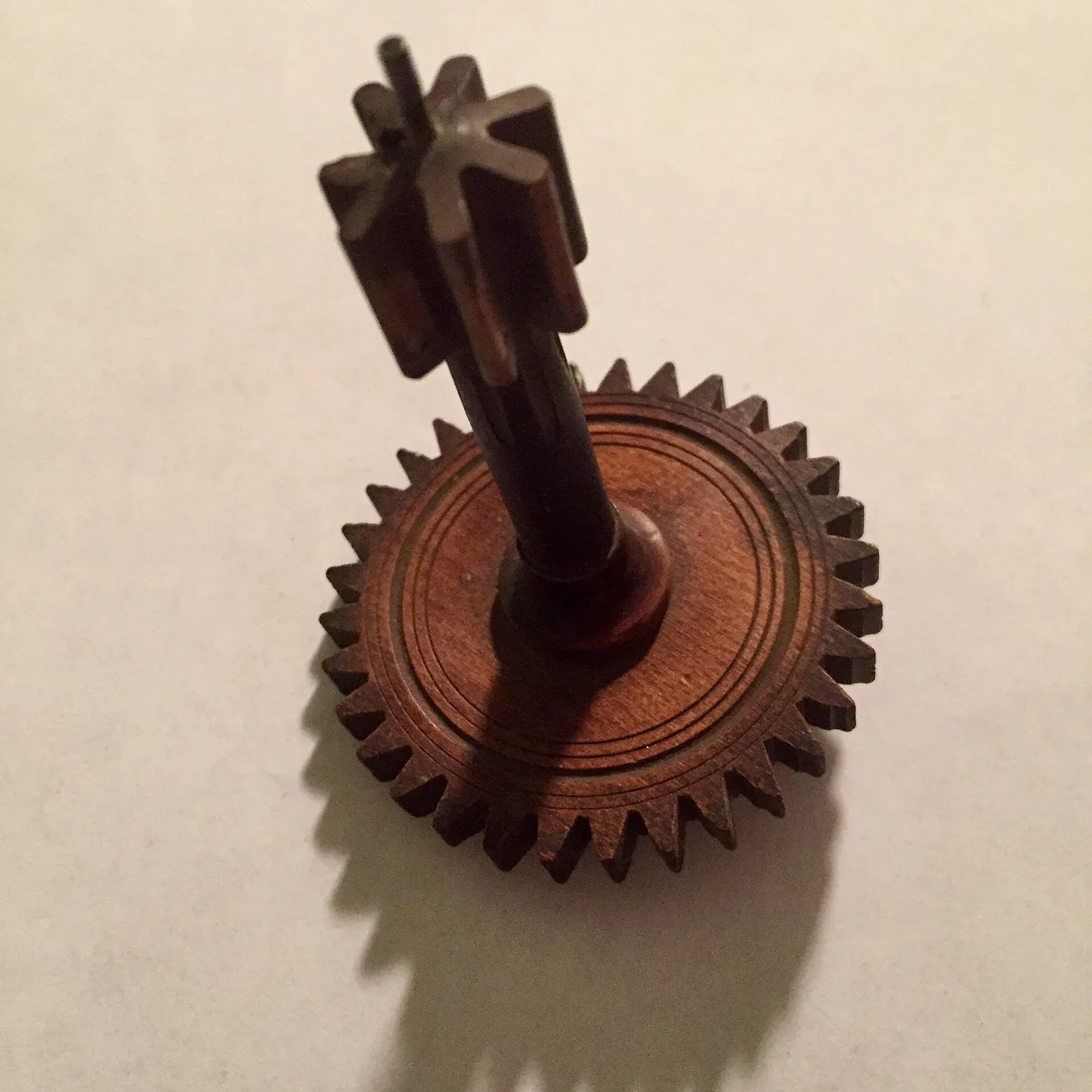
Eli Terry's milled wooden gear — the precision manufacturing that proved interchangeable parts could be mass-produced economically.
| Origins | |
|---|---|
| Invented | 1785 |
| Inventor | Honoré Blanc |
| Country | France |
| Timeline | |
| Era | Late 1700s to 1800s |
| Impact | |
| Significance | Manufacturing of components to precise standards enabling any part to function correctly in any corresponding assembly, revolutionizing firearms production and manufacturing across all industries |
Interchangeable Parts: The Manufacturing Revolution That Rewrote Warfare
Firearms encyclopedia article
From The Boise Gun Club Handbook
Overviewedit
For most of firearms history, every gun was essentially a one-of-a-kind object. A skilled craftsman built it by hand, fitting each part to every other part through a process of careful filing and adjustment. If a lock broke in the field, you didn't swap in a replacement part — you sent the gun back to an armorer, who hand-fit a new piece to that specific weapon. That was the state of the art well into the late 1700s.
Interchangeable parts — the manufacturing of components to a precise enough standard that any instance of a part will function correctly in any corresponding assembly — ended that era. But the transition took far longer, and involved far more people, than the popular story suggests. The idea wasn't the product of a single stroke of genius. It was the result of roughly a century of incremental work by French and American gunsmiths, government armories, and the armies of anonymous skilled workers who refined the techniques on the shop floor.
What makes this relevant to firearms history specifically is that guns were the proving ground. The geometric complexity of a musket lock was the hardest manufacturing problem of the era. Solving it for firearms meant solving it for everything else that came after.
Development Historyedit
Early Concepts and False Starts
The concept of standardized parts predates the industrial era by centuries, but early examples involved either simple geometries or very loose tolerances. According to AllAboutLean.com, the Arsenal of Venice pre-cut wooden ship components so they could be assembled with only minor adjustments. Christopher Polhem, a Swedish inventor, reportedly achieved interchangeability in his clock workshop as early as 1720, though the practice never spread beyond his own shop.
Jean-Baptiste Gribeauval (1715–1789) advanced standardization significantly within French artillery. He organized French cannon into five standardized classes — 4, 8, 12, 16, and 24 pounders — and pushed for uniformity in manufacturing. By 1780, his standardization efforts had produced a useful side effect: wooden carriage parts no longer required individual fitting and had become genuinely interchangeable. Gribeauval also formalized the use of go/no-go gauges for cannonball manufacturing, ensuring that balls fell within an acceptable tolerance band rather than simply passing a single dimension check. Round holes and round balls are relatively simple geometry, though. Musket locks were another problem entirely.
A French gunsmith named Guillaume Deschamps demonstrated interchangeable musket locks as early as 1723, but his parts cost roughly seven times what conventional locks cost to produce. He made only a few hundred guns in total. The proof of concept existed — the economics didn't.
| Pioneer | Period | Achievement | Limitation |
|---|---|---|---|
| Christopher Polhem | 1720 | Clock component interchangeability | Never spread beyond his workshop |
| Jean-Baptiste Gribeauval | 1780 | Cannon standardization, wooden carriage parts | Simple geometry only |
| Guillaume Deschamps | 1723 | Interchangeable musket locks | 7x cost, few hundred guns total |
| Honoré Blanc | 1785 | First mass demonstration, 10% cost premium | Destroyed by French Revolution |
| Eli Whitney | 1801 | Staged demonstration | Not genuinely interchangeable |
| John Hall | 1824 | True interchangeable locks | Limited to single workshop initially |
Honoré Blanc's Breakthrough
Honoré Blanc (1736–1801) is the figure who moved interchangeable parts from theoretical possibility to demonstrated reality. A French gunsmith who had been in charge of quality control for the French Army since 1763, Blanc developed the problem from the supply side: French gunsmiths, who found army contracts less profitable than supplying weapons to American Revolution soldiers, were increasingly refusing government work. The French Army faced a genuine supply crisis. Blanc's solution was to take control of production by eliminating the need for skilled craftsmen altogether.
According to AllAboutLean.com, Blanc's methods included:
- Developed specialized tools and gauges for precision measurement
- Used slow hardening process (burying parts in horse manure) to prevent warping
- Demonstrated publicly on July 8, 1785 at Château de Vincennes
- Achieved only 10% cost premium over conventional manufacture
The results were demonstrated publicly on July 8, 1785, in the courtyard of the Château de Vincennes. Blanc disassembled 50 musket locks, mixed the parts from all 50 at random, then selected components for 25 locks and assembled them — to the documented amazement of assembled French officials.
The French government established a workshop for Blanc, located in the dungeons of the Château de Vincennes — the same space that had previously held prisoners including Diderot and the Marquis de Sade — partly to protect him from fellow gunsmiths who now viewed him as a threat to their livelihoods. The French Revolution destroyed the workshop. His patron Gribeauval died in 1789. Blanc rebuilt independently and continued producing interchangeable locks at only about 10% additional cost over conventional manufacture before his death in 1801.
What happened next is one of the more frustrating episodes in the history of technology. After Blanc's death, a political dispute between proponents and opponents of interchangeable manufacture produced competing demonstrations and counter-demonstrations. The opponents won the argument. France abandoned the practice — and according to AllAboutLean.com, eventually forgot that it had ever developed it.
Timeline of key milestones in interchangeable parts development from concept to widespread implementation
The American Transfer
While serving as American minister to France, Thomas Jefferson witnessed Blanc's 1785 demonstration. He brought the concept back to the United States and became one of its most consistent political advocates in the early republic. Jefferson's role as a transmission vector for the idea — from Blanc's dungeon workshop to the American armory system — is one of the cleaner throughlines in this otherwise tangled story.
The young United States established two federal armories: one at Springfield, Massachusetts, and one at Harpers Ferry, West Virginia (then still Virginia). Achieving interchangeable parts was among their stated objectives from the outset, alongside simply providing a reliable domestic supply of weapons.
Whitney's Myth vs. Reality
Eli Whitney (1765–1825) is the name most Americans associate with interchangeable parts, and the association is largely a myth — or at minimum, a significant overstatement built on a staged performance.
Whitney was born in Westborough, Massachusetts in 1765 and graduated from Yale College in 1792. After his cotton gin factory in New Haven burned down in 1795, and after years of patent disputes that left him little financial reward from that invention, he secured a government contract in 1798 to manufacture 10,000 muskets for the United States — an extraordinary quantity for the era — at a cost of $134,000, to be delivered within roughly 28 months.
By January 1801, Whitney had not produced a single one of the promised muskets. Called to Washington to justify his use of Treasury funds before outgoing President John Adams and President-elect Jefferson, Whitney put on a demonstration: he appeared to select musket components at random from a pile, then assembled working guns before the officials' eyes. The performance earned him renewed federal support and widespread renown.
It was later proven to be staged. According to History.com, Whitney had "duped government authorities" about his actual level of achievement. Analysis of surviving Whitney muskets confirms there was no genuine interchangeability of the lock components. According to AllAboutLean.com, he was also careful not to disassemble the complex locks — he only swapped the locks between wooden gun stocks, a much looser tolerance operation — and used only ten gun stocks that had been specially adjusted to accept all ten locks. As historian M.R. Smith wrote in 1980, the duplicitous nature of the performance was clear.
Whitney ultimately delivered the 10,000 muskets — eight years late, with the last arriving in January 1809. According to History.com, they were judged to be of superior quality, and he subsequently produced 15,000 more within four years. He was a capable manufacturer and an effective manager. But the interchangeability he claimed was largely aspirational during his lifetime. According to the Schiller Institute source, when Whitney died in 1825, his armory had still not developed complete interchangeability through machining.
The Whitney Armory did contribute to the broader development of the technique — machinists and techniques moved between Whitney's operation, Simeon North's Armory in Middletown, Connecticut, and the federal armories, carrying ideas with them. But Whitney's personal role was closer to promoter and facilitator than inventor.
Hall's True Achievement
The man who actually solved the problem — demonstrably, verifiably, with parts that genuinely swapped between guns — was John Hancock Hall (1781–1841), working at Harpers Ferry.
Hall was sent to Harpers Ferry to set up an independent workshop, physically separated from the rest of the armory. That separation was both a technical necessity and a political reality: the Harpers Ferry superintendent actively obstructed him, making it difficult to obtain men, materials, machines, or adequate workspace. Hall had to solve interchangeability while fighting institutional resistance.
His insight was that interchangeability was fundamentally a precision problem. According to AllAboutLean.com, conventional gun lock parts were manufactured to a precision of ±0.2 mm. Hall determined that interchangeability required ±0.02 mm — an order of magnitude tighter. To achieve and verify this, he developed new measurement techniques, built sturdier machines to reduce vibration, improved milling technology, and implemented a system of 63 gauges to check component tolerances. By 1824, according to historian Donald Hoke (cited in menmachineandthecarbine.org), government officials touring his factory could confirm that his lock parts were completely interchangeable.
The next milestone was interchangeability across workshops — meaning a part made at one facility would fit a gun assembled at another. Hall achieved this together with Simeon North by 1834, when North's and Hall's lock parts were confirmed to interchange. Springfield Armory did not reach the same standard until 1849.
Historians differ slightly on the precise timing. The menmachineandthecarbine.org source notes that historian Merritt Monroe Smith concluded North did not reach Hall's level of interchangeability by 1827, while historian Donald Hoke places Hall's achievement at 1824 based on the government inspection visit. The core finding — that Hall achieved genuine interchangeability years before anyone else in the American system — is not disputed.
How It Worksedit
The manufacturing challenge of interchangeable parts is harder than it sounds. Making two parts that look the same is easy. Making two parts that will function identically in any assembly, without hand fitting, requires controlling every relevant dimension to tolerances far tighter than the human eye can detect — and then verifying those tolerances on every part produced.
The solution that emerged from the American armory system had three components working together.
| Component | Purpose | Hall's System | Springfield (Civil War) |
|---|---|---|---|
| Gauges | Tolerance verification | 63 specialized gauges | 150+ gauges |
| Tolerance | Dimensional precision | ±0.02 mm (vs ±0.2 mm conventional) | Similar precision |
| Go/No-Go System | Quality control | Part passes "go" but fails "no-go" | Same principle |
| Jigs & Fixtures | Positioning accuracy | Custom positioning tools | Standardized across contractors |
| Machine Precision | Reduced variation | Improved milling, reduced vibration | Further mechanization |
The Three-Component System
The three core components of the system were:
- Gauges: Go/no-go system checking both ends of tolerance range
- Jigs and fixtures: Specialized tools locking parts into precise positions
- Better machines: Improved milling technology with reduced vibration
Gauges and Quality Control
First, gauges. Hall used 63 of them. Springfield Armory used at least 150 during the Civil War, according to menmachineandthecarbine.org. The go/no-go gauge system — borrowed and refined from Gribeauval's cannon manufacturing — worked by checking both ends of the tolerance range. A part passed through the "go" gauge if it wasn't too large. If it also passed through the "no-go" gauge, it was too small. Only parts that cleared the first and failed the second were within spec. This gave manufacturers a practical, fast method to screen every component without requiring skilled measurement judgment on each piece.
Second, jigs and fixtures. Whitney's genuine contribution to the system was his development of specialized jigs and fixtures that locked parts and cutting tools into precise relative positions for each machining operation. A worker didn't need to measure or judge — the fixture positioned everything correctly, and the cut was made. According to the Schiller Institute source, this allowed Whitney to divide labor so that a single worker might perform "one single and simple operation" repeatedly, drilling the same feature on many different parts as they moved through production.
Third, better machines. Hall improved milling technology and built sturdier equipment specifically to reduce vibration, which was a primary source of dimensional variation. The feedback loop between tighter tolerances and better machines ran in both directions: the need for interchangeability drove machine improvement, and better machines made tighter tolerances achievable.
The gauge-based quality control system that enabled interchangeable manufacturing
The Hand-Filing Reality
Even with all three in place, hand filing remained part of the process well into the mid-1800s. According to the Schiller Institute source, Whitney's musket parts required "some hand filing" to achieve final interchangeability as late as 1801. According to the CommonPlace.online source on the Whitney legend, hand filing to finish parts to gauge remained crucial through the end of the 19th century, even at Springfield. True machine-only interchangeability — without any hand fitting at final assembly — was a goal approached gradually rather than achieved in a single moment.
Impact on Warfare & Societyedit
Field Repair Revolution
The military case for interchangeable parts was straightforward: a broken gun in the field should be fixable with a replacement part, not a trip back to an armory. Before interchangeable manufacture, when a lock component failed, the weapon was effectively out of service until a craftsman could hand-fit a new piece to that specific gun. With genuinely interchangeable parts, a soldier — or at minimum a field armorer — could swap in a replacement and put the weapon back into action.
According to menmachineandthecarbine.org, this field repair argument was compelling enough that the Ordnance Department was willing to pay the higher manufacturing costs that precision production required. The same source notes that Chief of Ordnance Ripley made adherence to established patterns and gauges a contractual requirement for Civil War-era arms contractors, effectively forcing standardization across the private sector through the leverage of government purchasing.
Civil War Implementation
The Civil War demonstrated both the achievement and the limits of interchangeability as it existed by the 1860s. Springfield Armory, the North's primary production center, used its gauge and pattern system to coordinate production across multiple private contractors — supplying firms with the part patterns, gauges, and gun models they needed to manufacture to specification. According to menmachineandthecarbine.org, "only with the Civil War did uniformity among products from different plants become widespread."
At the same time, the source is direct that the process was never entirely perfected during the war, due to the experimental state of machines and fluctuations in materials and labor. Samuel Colt's operation illustrates the gap between near-interchangeability and the real thing. Colt produced revolvers that were mechanically uniform but still required hand fitting at final assembly — the parts were close enough to call uniform, but not truly interchangeable in the strict sense. According to historian Donald R. Hoke, as cited in menmachineandthecarbine.org, "nineteenth century manufacturers never thought of interchangeability as an absolute and interchangeability meant different things to different manufacturers."
| Industry | Achievement Year | Interchangeability Level | Source |
|---|---|---|---|
| Firearms (Hall) | 1824 | Complete lock interchangeability | Government inspection |
| Firearms (Springfield) | 1849 | Full armory standard | 25 years after Hall |
| Sharps Carbines | 1859+ | Almost entirely interchangeable | Robbins & Lawrence |
| Singer Sewing Machines | ~1900 | Full interchangeability | 75 years after Hall |
| Cadillac Automobiles | 1907 | Demonstration-level | Still newsworthy |
One of the clearer success stories of Civil War-era interchangeable manufacture was the Robbins & Lawrence Company, which produced both machine tools and Sharps carbines. According to menmachineandthecarbine.org, the Robbins & Lawrence machinists spent years developing the tooling to make their parts approach true interchangeability. The evolution is visible in the product: Sharps carbines from the 1851–1855 period had mostly interchangeable parts; by the 1859 model and afterward, they were almost entirely interchangeable. The relationship between Richard Lawrence of Robbins & Lawrence and Christopher Spencer — inventor of the Spencer repeating rifle — was close enough that certain parts, including tumblers, bridles, mainsprings, and mainspring swivels, were interchangeable between 1859-and-later Sharps models and 1860 and 1865 Spencer models.
Industrial Diffusion
The armories trained the workforce that built American industry. According to AllAboutLean.com, hundreds of machinists and technicians who worked in the armory system eventually moved into other industries, carrying the knowledge and culture of precision manufacture with them. Typewriters, sewing machines, bicycles, and eventually the automobile all benefited from this diffusion.
How armory-developed interchangeable parts techniques spread across American industry
The timeline is slower than the legend suggests. Singer did not achieve interchangeability in sewing machines until around 1900, according to AllAboutLean.com. A famous 1907 demonstration with three Cadillac Model K automobiles — completely disassembled, parts mixed, then reassembled, with the vehicles going on to complete a 2,000-mile reliability test — was considered a remarkable achievement at the time, not a routine expectation. What is now the baseline assumption of manufacturing was, as recently as 1907, a feat worth publicizing.
Modern Relevanceedit
Interchangeable parts are now so thoroughly embedded in manufacturing that the concept is invisible. The M10 bolt purchased in America will fit the M10 nut purchased in China. The replacement barrel for your AR-15 will drop into the upper receiver without fitting. The spare firing pin for your bolt-action rifle will function identically to the original. None of this requires a craftsman. All of it traces back to the gauge systems and precision machinery developed in 18th- and 19th-century gun shops.
For shooters specifically, the legacy shows up in ways that are easy to take for granted. Parts interchangeability across manufacturers — the direct descendant of Hall's 63-gauge system and Ripley's Civil War-era contracting requirements — means that:
- Magpul magazines feeding reliably in Colt-pattern lowers
- Mil-spec BCGs swapping between rifles from different manufacturers
- NATO STANAG specifications ensuring cross-compatibility
- Replacement parts fitting without hand adjustment
The modern precision machining industry — CNC mills, coordinate measuring machines, statistical process control — is a direct extension of the same problem Hall was solving at Harpers Ferry in the 1820s. The mil-spec tolerances numbers are dramatically tighter now, and the measurement tools are orders of magnitude more capable. The fundamental insight is unchanged: if you specify the dimension, verify every part, and control the process, you can make things that reliably fit together without human adjustment at assembly.
The field repair argument that sold the Ordnance Department on interchangeable parts in the 1800s is still the argument that drives military small arms standardization today. NATO STANAG specifications for ammunition and magazine dimensions exist for the same reason Ripley required his Civil War contractors to work to pattern gauges: when the gun breaks in a bad place at a bad time, you need to know that the part from the other guy's kit will fit.
The BGC Takeedit
The Eli Whitney story is one of the more durable pieces of American mythology, and it's worth being straight about what actually happened. Whitney was a capable manufacturer and a gifted self-promoter who understood, correctly, that interchangeable manufacture was the future. He talked a better game than he delivered, staged a demonstration that misled government officials, and died without achieving what he claimed. The armory system's real progress happened at Harpers Ferry under John Hall — a man who fought bureaucratic obstruction while solving a genuinely hard precision engineering problem — and later at Springfield.
The Whitney legend matters because it's a clean example of how we tend to attach complex, collective technological achievements to a single heroic name.
This isn't a minor historical footnote. Honoré Blanc did the first real demonstration in 1785. Jefferson carried the idea across the Atlantic. Hall cracked the precision problem. North proved cross-workshop interchangeability. Robbins & Lawrence pushed it into repeating arms. Hundreds of anonymous armorers, machinists, and file workers refined it on the shop floor over decades. None of them got the textbook entry.
What's also worth noting is how slowly this spread, even after the technical problem was solved. Hall achieved interchangeable locks by the mid-1820s. Springfield didn't reach that standard until 1849. Singer sewing machines weren't there until 1900. The Cadillac demonstration was news in 1907. The gap between proving something is possible and making it routine is almost always longer and harder than the breakthrough moment suggests. That's as true in manufacturing as it is anywhere else.
Every time you swap a part between two guns from different manufacturers and it works without fitting, you're standing on 200 years of incremental precision work by people most of us have never heard of.
For the firearms world specifically, the line from Hall's 63 gauges at Harpers Ferry to modern mil-spec tolerances is direct and unbroken. This legacy shapes everything we do with firearms today.
Referencesedit
- https://www.eliwhitney.org/eli-whitney-and-whitney-armory
- https://www.allaboutlean.com/230-years-interchangeability/
- https://www.history.com/articles/interchangeable-parts
- https://archive.schillerinstitute.com/educ/hist/eiw_this_week/v5n11_mar11_1794.html
- https://www.menmachineandthecarbine.org/interchangeability
- https://commonplace.online/article/how-eli-whitney-single-handedly-started-the-civil-war/
- https://www.jstor.org/stable/3101392
Last Updated: February 27, 2026
- Gls Guns(Sumner, IA)
- Bi-mart - Yakima (Fruitvale Ave)(Yakima, WA)
- New Philly Sportsman Specialities(New Philadelphia, OH)
- R&R Sports & Outdoors(Brandon, FL)
Loading comments...