Details
John C. Garand
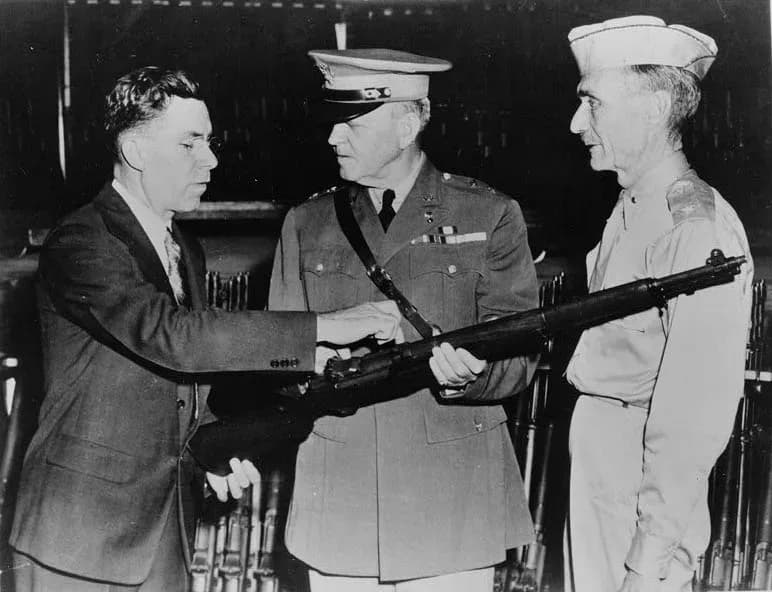
John Garand demonstrates the M1 Garand to senior Army officials — the designer personally educated military leadership on his rifle's operation.
| Biography | |
|---|---|
| Born | January 1, 1888, St. Rémi, Quebec, Canada |
| Died | February 16, 1974, Springfield, Massachusetts |
| Nationality | Canadian-American |
| Legacy | |
| Known For | Designing the M1 Garand rifle, the first semi-automatic rifle adopted as the primary service weapon by a major military power |
| Key Innovation | United States Rifle, Caliber .30, M1 (M1 Garand) - a gas-actuated, semi-automatic infantry rifle adopted by the U.S. Army on January 9, 1936 |
John Garand: The Man Who Armed America's Infantry
Firearms encyclopedia article
From The Boise Gun Club Handbook
Overviewedit
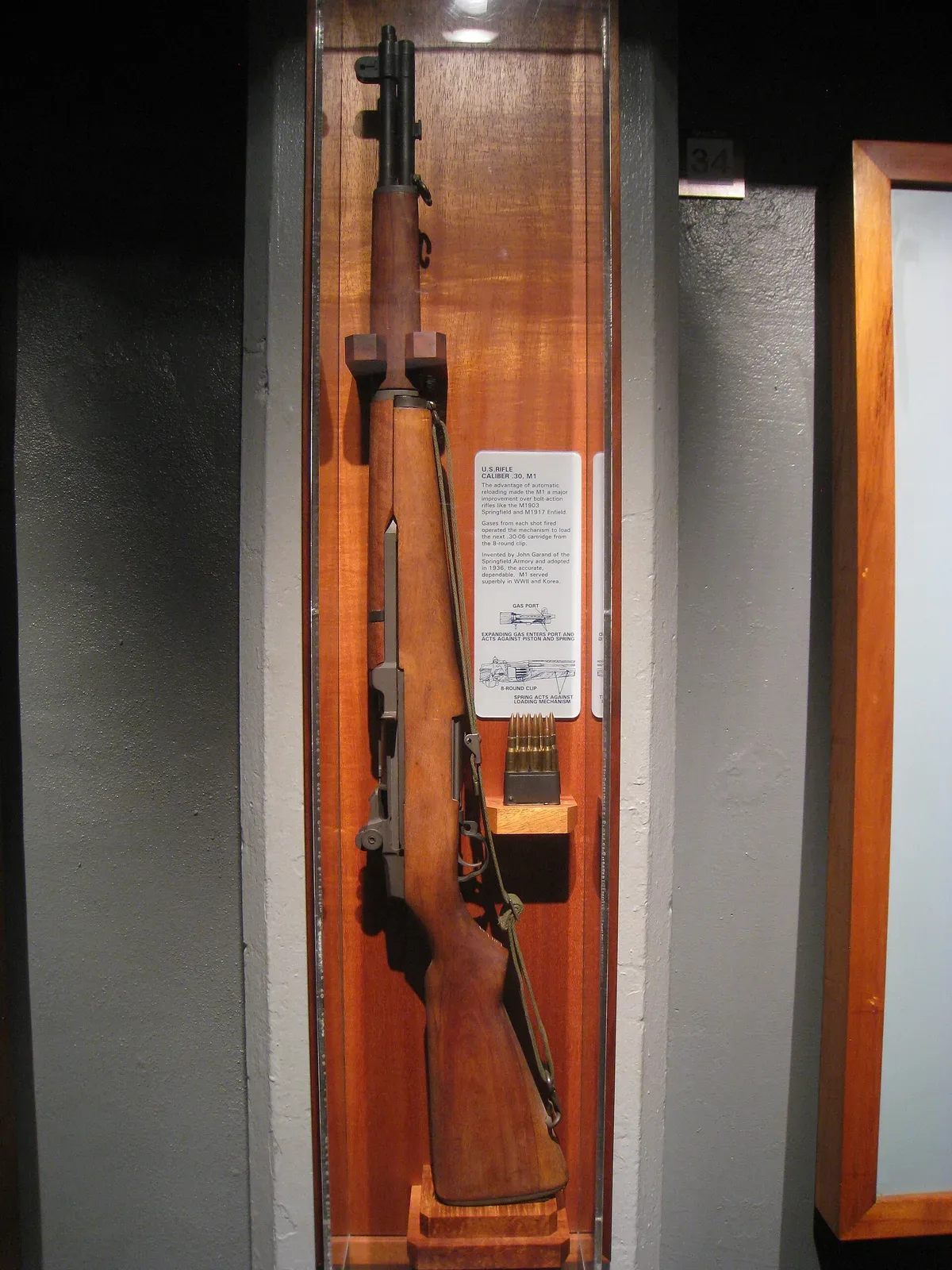
Jean Cantius Garand — known to history as John C. Garand — was a Canadian-American firearms designer whose work at Springfield Armory in Massachusetts produced the United States Rifle, Caliber .30, M1, better known as the M1 Garand. Adopted by the U.S. Army on January 9, 1936, it became the standard infantry rifle through World War II and the Korean War and the first semi-automatic rifle adopted as the primary service weapon by a major military power.
"The greatest battle implement ever devised." — General George S. Patton on the M1 Garand
General George S. Patton called it "the greatest battle implement ever devised." That quote gets repeated so often it risks losing its weight — but consider what Patton was measuring it against.
The M1 Garand gave American infantry a decisive advantage:
- Replaced bolt-action rifles that dominated infantry combat for 50 years
- Put 8 semi-automatic rounds in every American soldier's hands
- Gave Americans firepower advantage when enemies still worked bolts between shots
Garand himself never collected a royalty on any of it. He transferred all rights to the U.S. government in January 1936, worked a government salary his entire career, and died in 1974 in the same city where he'd spent 34 years designing the thing.
Early Life & Backgroundedit
Canadian Roots
Garand was born January 1, 1888, on a farm near St. Rémi, Quebec, Canada, one of twelve children — six boys and six girls. Every one of the boys carried the official first name St. Jean le Baptiste; John was the only one who actually went by his first name. The others used their middle names.
It's a small detail, but it tracks with a man who'd spend his career doing things his own way.
| Year | Age | Milestone |
|---|---|---|
| 1888 | 0 | Born in St. Rémi, Quebec |
| 1899 | 11 | Mother dies, family moves to Connecticut |
| 1900 | 12 | Begins work as bobbin boy in textile mill |
| 1906 | 18 | Patents telescopic screw jack and bobbin winding machine |
| 1909 | 21 | Joins Brown & Sharpe in Providence, RI |
| 1916 | 28 | Moves to NYC, works for toolmaking firm |
| 1920 | 32 | Becomes naturalized U.S. citizen |
Mill Work Foundation
His mother died in 1899, and his father moved the family to Danielson, CT, a mill village. Young John became a bobbin boy in a textile mill by age 12 in Jewett City. That mill work turned out to be the foundation of everything that followed.
He learned forging, welding, steam engineering, and — critically — how machinery actually works from the inside out. Before he turned 18, he had already patented two inventions: a telescopic screw jack and an automatic bobbin winding machine.
That's not the resume of someone who stumbled into firearms design. The aptitude was there from the start.
Early Innovations
He learned to speak English sweeping floors in that textile mill, then sharpened his shooting eye working at a shooting gallery — a combination that sounds almost too on-the-nose in retrospect. By 1909, he had picked up work at Brown & Sharpe in Providence, Rhode Island, a toolmaking company, designing and building gauges.
In 1916, he relocated to New York City, took a job with another toolmaking firm, and kept up his rifle practice at shooting galleries along Broadway. Garand became a naturalized United States citizen in 1920.
Key Contributionsedit
The Path to Springfield
In 1917 — the same year the U.S. entered World War I — the Army put out bids for a light machine gun design. Garand submitted one. The War Department selected it, and Garand was appointed to a position with the United States Bureau of Standards in Washington, D.C., to develop the weapon further.
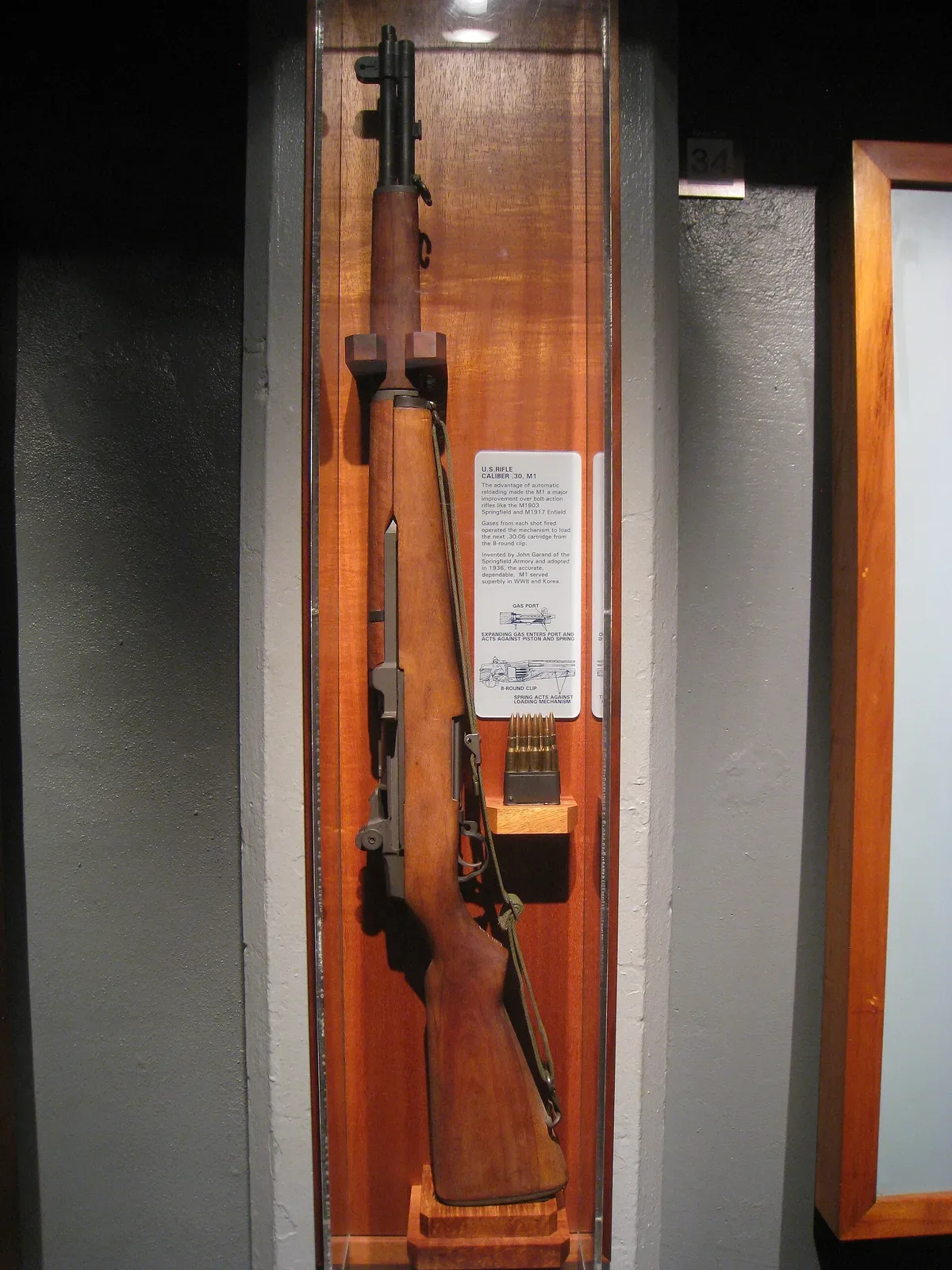
The first model wasn't completed until 1919, after the war had already ended, but the government recognized what it had in Garand. He was hired as a skilled laborer at Springfield Armory on November 4, 1919, starting at $300 a month.
His title and salary climbed steadily from there. By August 1921 he was promoted to Automatic Rifle Designer at $3,600 annually. By October 1942 he held the title of Chief Engineer at $8,000 — which, adjusted for 2024 dollars per American Rifleman, works out to roughly $160,760. The attorney general noted in 1944 that Garand was the highest-paid engineer during his entire tenure at the Armory.
Designing the M1
At Springfield, Garand was tasked with developing a gas-actuated, self-loading infantry rifle — one that could eject a spent cartridge and chamber a new round automatically using expanding propellant gases, without a soldier having to cycle a bolt.
The Army had been chasing a reliable self-loading infantry rifle since the turn of the century — Garand was the first to solve it at scale.
The Army had been chasing this goal since around the turn of the century and had produced nothing that worked reliably at scale. The development process was long and contentious.
Garand's early work at Springfield began with a .30 caliber primer-actuated blowback prototype. Through the 1920s and into the early 1930s, his designs competed in a series of Army trials against rifles from Pedersen, Thompson, Browning, and others. The .276 caliber version of the Garand actually won the 1931 trials outright — but Army Chief of Staff General Douglas MacArthur personally overruled the caliber change, citing the enormous existing stockpiles of .30 M1 ball ammunition. Garand went back to work on the .30 caliber design.
On August 3, 1933, the improved design was formally designated the "semi-automatic rifle, caliber 30, M1." Seventy-five rifles went to field trials in May 1934 — fifty to infantry, twenty-five to cavalry — and the reports came back with problems. Garand revised the design again. It was standardized on January 9, 1936.
| Specification | M1 Garand |
|---|---|
| Overall Length | 43.6 inches |
| Weight | 9.5 pounds |
| Caliber | .30-06 Springfield |
| Capacity | 8 rounds (en bloc clip) |
| Operation | Gas-operated, semi-automatic |
| Rate of Fire | 40-50 rounds/minute |
| Patent Filed | 1932 (U.S. Patent 1,892,141) |
| Adopted | January 9, 1936 |
The first production model was proof-fired and function-tested on July 21, 1937, with machine production beginning at Springfield that month at a rate of ten rifles per day. Within two years, output had reached 100 per day. By January 10, 1941, the line was running 600 per day.
There were early design issues. Garand's original gas system used a muzzle-extension gas trap — a complicated arrangement that was later replaced with a simpler drilled gas port.
Early M1 revisions included:
- Gas-trap system replaced with simpler drilled gas port
- Pre-1939 rifles recalled and retrofitted
- Barrel, gas cylinder, and front sight assembly redesigned
- Gas-trap M1s now rare collector's items
Manufacturing Innovations
What often goes undiscussed is how much of Garand's value to the war effort had nothing to do with the rifle's design and everything to do with how it got built. On July 27, 1943, Springfield Armory superintendent Col. Earl McFarland wrote a detailed letter to the U.S. Civil Service Commission cataloging Garand's production contributions. The list is substantial.
| Component | Original Method | Garand's Innovation | Production Increase |
|---|---|---|---|
| Hammer Profiling | Manual process, 40/hour | 3-spindle, 10-station machine | Eliminated manual fixture work |
| Barrel Threading | $12,000 grinder, 50/hour | Semiautomatic machine, 125/hour | 150% increase |
| Follower Guide Slot | Vertical shaper, 100/day | Curved broaching tool, 750/day | 650% increase |
| Follower Rod | Forged + machining | 3 stampings + riveting | 500% increase |
For hammer contour profiling, Garand designed a three-spindle, ten-station vertical profiling machine that replaced a slow manual process producing roughly 40 pieces per hour — the new machine didn't require operators to manually fasten work to the fixture at all.
For barrel threading, he replaced a $12,000 standard thread grinder handling 50 barrels per hour with a small semiautomatic machine of his own design that ran 125 per hour and threaded concentric to the outer muzzle circumference rather than the bore, solving an accuracy problem in the process.
For the curved follower guide slot — a roughly 2-inch internal slot cut on a curve — the old method produced 100 pieces per eight-hour day on a vertical shaper. Garand believed, against prevailing opinion, that a broaching tool could be bent to cut on an arc. He was right. The resulting machine, built by the Krueger Company to Garand's plans, produced 750 pieces per eight-hour day. Col. McFarland noted it was the first time an internal cut had ever been made on a curve using broaching.
For the follower rod, Garand replaced a forging requiring considerable machining with three stampings assembled by riveting — production increased 500 percent, forging capacity was freed up, material was saved, and a compensator spring was eliminated entirely.
He also developed a spring gauge instrument for measuring helical spring compression accurately — later manufactured by the Federal Products Corporation and, per McFarland's letter, "widely used in industry."
These weren't glamorous contributions. They're the kind of work that wins wars by making sure the rifles actually show up.
Impact on Firearms Developmentedit
Tactical Revolution
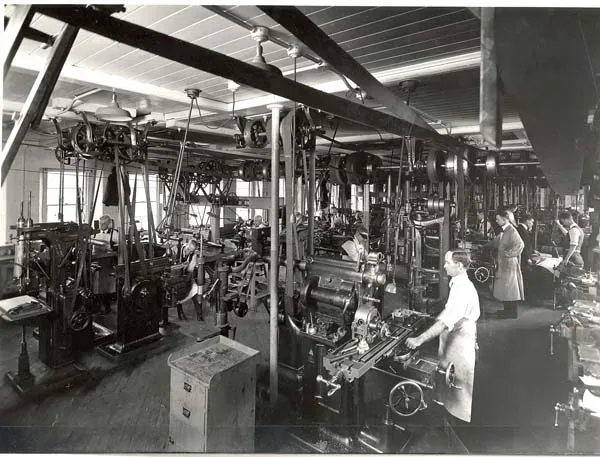
To understand what the M1 Garand meant in 1936, you have to understand what it was replacing. The M1903 Springfield was a bolt-action rifle — a design philosophy that traced directly back to the Mauser actions of the 1890s.
A soldier firing a bolt gun had to lift, pull back, push forward, and close the bolt between every shot, disrupting his sight picture every single time. A trained rifleman could manage 15 aimed shots per minute under ideal conditions. The M1 removed that bottleneck entirely.
During World War II, the semi-automatic operation gave American infantrymen a direct firepower advantage over German and Japanese soldiers whose standard-issue rifles were still bolt-action. The M1's fire rate, combined with its 8-round capacity and the ability to fire without breaking cheek weld or disrupting point of aim, changed the calculus of infantry firefights at the squad level.
According to the DuPage Trading Company's history of the M1 (drawing on military history sources), the impact of faster-firing infantry arms soon pushed both Allied and Axis forces to accelerate their own development and issue of semi- and fully automatic weapons.
Production Scale
Approximately 5.4 million M1s were manufactured during World War II alone, with total production across all manufacturers exceeding six and a half million rifles.
| Manufacturer | Production Period | Quantity Produced |
|---|---|---|
| Springfield Armory | 1937-1957 | ~4.5 million |
| Winchester | 1941-1945 | 65,000 |
| International Harvester | 1953-1956 | 337,623 |
| Harrington & Richardson | 1953-1956 | ~500,000 |
| Beretta | Post-war | Various (Winchester tooling) |
| Total Production | 6.5+ million |
Beyond Springfield Armory, Winchester held a production contract for 65,000 rifles during the war. During 1953–56, International Harvester and Harrington & Richardson both produced M1s under contract; International Harvester alone built 337,623. Beretta produced Garands using Winchester tooling.
The rifle spread further through U.S. military aid to countries including:
- South Korea
- West Germany
- Italy
- Japan
- Denmark
- Greece
- Turkey
- Iran
- South Vietnam
Design Legacy
The M1's influence didn't stop at its own production run. The M14 rifle, which officially replaced the M1 in 1957, is essentially an evolved M1 — chambered for 7.62x51mm NATO, fed from a 20-round detachable magazine, and capable of selective fire, but mechanically a direct descendant. The Ruger Mini-14 is also based on the Garand operating system. The T31 magazine Garand designed for his bullpup prototype became the magazine used in the T44, which became the M14.
The Ping Phenomenon
The en bloc clip system — one of the M1's most criticized features — did produce one genuine tactical curiosity. When the last round fired and the bolt locked open, the empty clip ejected with a distinctive metallic ping.
Reports during World War II suggested German and Japanese soldiers were using this sound to identify an empty M1 and exploit the reload window. The Army took it seriously enough to begin experiments with plastic clips at Aberdeen Proving Ground, though no alternative was ever adopted. Former German soldiers later stated the sound was generally inaudible during engagements and not tactically useful when heard — but American infantry reportedly used the sound offensively, sometimes tossing an empty clip to simulate an empty rifle and draw the enemy out.
Later Life & Legacyedit
Retirement Projects
Garand retired from Springfield Armory in 1953 at age 65. He remained in Springfield, Massachusetts, for the rest of his life and continued visiting the Armory regularly in his retirement years.
His last major design project before retirement was the T31 — a bullpup-configuration select-fire rifle firing the same .30 caliber cartridge as the M1, with a 20-round magazine and a projected cyclic rate of approximately 600 rounds per minute. The T31 was technically ambitious; it used a sealed barrel-surrounding cylinder as both gas system and handguard, intended to reduce muzzle report and recoil by redirecting the muzzle blast. Cooling the handguard and managing carbon buildup were significant problems that were never fully solved. When Garand retired in 1953, a second-generation T31 with a more conventional gas system was reportedly in progress but unfinished. The project was cancelled and the prototype went to the Springfield Armory museum in 1961.
Recognition and Awards
| Award | Year | Significance |
|---|---|---|
| Pynchon Medal | 1939 | Springfield's oldest public service award |
| Meritorious Civilian Service Award | 1941 | Military recognition |
| Medal for Merit | 1944 | First recipient (with Albert Hoyt Taylor) |
| Alexander L. Holley Medal | N/A | American Society of Mechanical Engineers |
| Ordnance Corps Hall of Fame | 1973 | Inducted one year before death |
On the recognition side: the Meritorious Civilian Service Award came in 1941. The Alexander L. Holley Medal from the American Society of Mechanical Engineers followed — the same award previously given to Henry Ford. On March 28, 1944, Garand received the first Medal for Merit, jointly with Albert Hoyt Taylor. In 1939, he received the Pynchon Medal from the Advertising Club of Springfield, that region's oldest public service award. In 1973 — a year before his death — he was inducted into the U.S. Army Ordnance Corps Hall of Fame.
The congressional bill to award him $100,000 (roughly $2.2 million in 2024 dollars, per American Rifleman) was introduced by Rep. Charles Clason (R-MA) on July 9, 1941, and did not pass. Multiple factors likely contributed, including that Garand was already the highest-paid engineer at the Armory and had been among the highest-paid employees there since his early years. He had transferred all rights to his inventions to the U.S. government in January 1936, receiving nothing beyond his government salary in exchange for a design that would be manufactured more than six and a half million times.
Personal Life
Garand married Nellie Bruce Shepard on September 6, 1930, in Albany, New York. She brought two daughters from a previous marriage; they had a son, Richard, and a daughter, Janice, together. He died February 16, 1974, in Springfield, Massachusetts, at age 86, and was buried at Hillcrest Park Cemetery there.
Continuing Service
The M1 Garand remained in active service with the Army Reserve, Army National Guard, and Navy well into the 1970s — long after the M14 had officially replaced it in 1957 and after the M16 had taken over for the active Army in 1965.
Military drill teams still carry the M1 today, including:
- U.S. Marine Corps Silent Drill Team
- United States Air Force Academy Cadet Honor Guard
- U.S. Air Force Auxiliary
- Most ROTC units
- Some JROTC units
The rifle has shown up in conflicts as recent as the Syrian Civil War, Iraq, and Afghanistan — a testament to how many were produced and how durable the design proved to be.
The Civilian Marksmanship Program makes M1 Garands available to eligible American civilians, keeping the rifle in active use on ranges across the country more than eight decades after it first entered service.
The BGC Takeedit
There's a version of John Garand's story that gets told as a tragedy — the immigrant genius who gave the Army a war-winning rifle and never saw a royalty check. And yeah, the optics are rough.
Six and a half million rifles, zero royalties, a $100,000 thank-you that Congress couldn't be bothered to pass. But the fuller picture is more complicated and, honestly, more interesting.
Garand was the highest-paid engineer at Springfield Armory for most of his career. He held a secure government job through the Great Depression when skilled tradesmen all around him were losing everything. He transferred his patent rights voluntarily in January 1936 — and by most accounts, he understood the deal he was making. The Army wasn't stealing from him; he handed it over.
What actually gets undersold in most accounts is the manufacturing work. The M1 rifle is a great design. But Garand's tooling innovations — the profiling machines, the broaching setups, the spring gauges that ended up in industrial use across the country — those contributions kept the production lines running fast enough to matter.
A great design sitting in a bottlenecked factory loses wars. Garand understood both ends of that equation, and that's rarer than people credit.
The bullpup T31 is the other thread worth pulling. By the late 1940s, Garand was already working on a select-fire, magazine-fed, compact design — conceptually ahead of where the Army's thinking had settled. The T31 had real problems, and the program was cancelled, but the magazine it used survived into the M14. That's how engineering actually works: not clean lineage, but pieces of ideas carrying forward into the next thing.
Patton's quote will keep getting repeated as long as people talk about WWII small arms, and it's earned. But the quieter truth is that John Garand spent 34 years at a government armory solving problems nobody else thought were solvable, and a lot of American soldiers came home because of it.
Referencesedit
- https://en.wikipedia.org/wiki/John_Garand
- https://www.nps.gov/spar/learn/historyculture/john-c-garand.htm
- https://www.americanrifleman.org/content/john-c-garand-his-compensation-other-accomplishments/
- https://ammo.com/articles/john-garand-m1-rifle-iconic-inventor-forgotten-history
- https://dupagetrading.com/blog/the-history-of-the-m1-/
- https://www.thearmorylife.com/garand-the-man-behind-the-legend/
Last Updated: February 27, 2026
- Gls Guns(Sumner, IA)
- Bi-mart - Yakima (Fruitvale Ave)(Yakima, WA)
- New Philly Sportsman Specialities(New Philadelphia, OH)
- R&R Sports & Outdoors(Brandon, FL)
Loading comments...