Specifications
M1 Garand

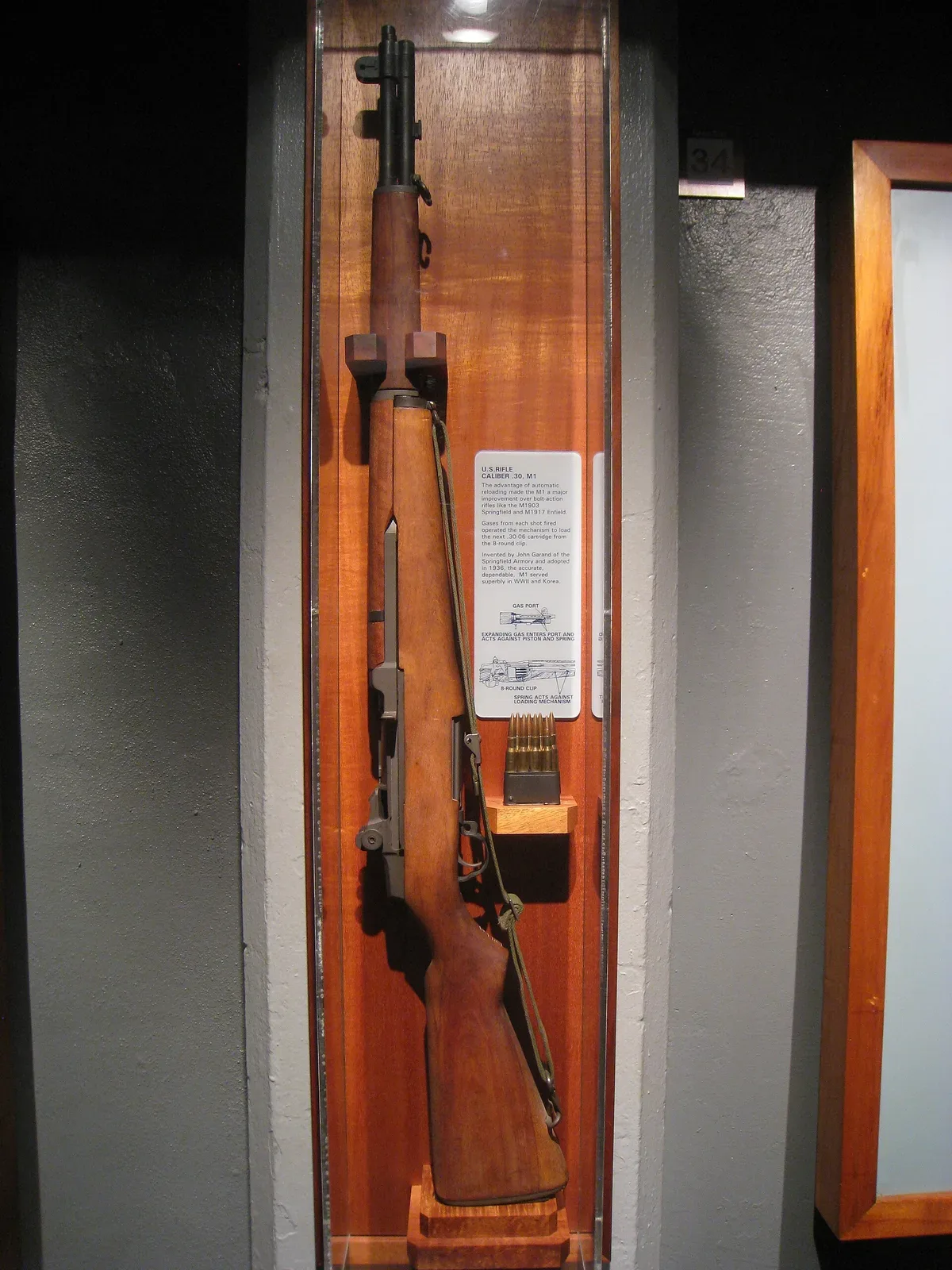
Standard M1 Garand from the US Army Museum of Hawaii — the .30-06 Springfield that saw continuous service from 1936 through the Korean War and beyond.
Daderot (Public domain)
| Manufacturer | |
|---|---|
| Made By | Springfield Armory, Winchester, International Harvester, Harrington & Richardson |
| Designer | John Cantius Garand |
| Origin | United States |
| Specifications | |
| Caliber | .30-06 Springfield |
| Action | semi automatic |
| Weight | 9.5 pounds |
| Production | |
| Designed | 1933 |
| Variants | |
| |
| Service Use | |
United States ArmyUnited States Marine CorpsSouth KoreaWest GermanyItalyJapanDenmarkGreeceTurkeyIranSouth VietnamPhilippines | |
M1 Garand: The Rifle That Defined American Infantry in World War II
Firearms encyclopedia article
From The Boise Gun Club Handbook
U.S. Rifle, Caliber .30, M1
The M1 Garand — officially designated the U.S. Rifle, Caliber .30, M1 — served as the standard infantry rifle of the United States Army from 1936 to 1957. It was the first standard-issue semi-automatic rifle adopted by any nation for general infantry use, a distinction that gave American soldiers a measurable firepower edge over nearly every opponent they faced in World War II.
Chambered in .30-06 Springfield, it fundamentally changed what infantry firepower meant.
General George S. Patton made the rifle's reputation permanent on January 26, 1945, when he wrote in a letter to Major General Levin H. Campbell Jr., Chief of Ordnance:
"In my opinion, the M-1 Rifle is the greatest battle implement ever devised."
That line — written on Third Army letterhead, not delivered from a stage — has followed the Garand ever since. Patton wasn't given to handing out compliments carelessly, which is exactly why the quote stuck.
The M1 replaced the bolt-action M1903 Springfield and was itself replaced by the selective-fire M14 rifle on March 26, 1958. In the twenty-one years between those dates, approximately 5,468,772 M1 rifles were manufactured. They were carried at Normandy, Okinawa, and Inchon — and continued turning up in conflicts well into the twenty-first century.
Specifications
| Spec | Value |
|---|---|
| Designation | U.S. Rifle, Caliber .30, M1 |
| Caliber/Cartridge | .30-06 Springfield |
| Action | Gas-operated, rotating bolt, semi-automatic |
| Weight | 9.5 lbs (unloaded) |
| Overall Length | 43.5 inches |
| Barrel Length | 24 inches |
| Muzzle Velocity | ~2,800 ft/sec |
| Effective Range | 500 yards |
| Feed System | 8-round en bloc clip, fixed internal magazine |
| Sights | Adjustable aperture rear (100–1,200 yds); protected post front |
| Rate of Fire | 40–50 aimed rounds per minute |
| Total Production | 5,468,772 |
| Service Years | 1936–1957 (U.S. standard issue) |
| Designer | John Cantius Garand |
| Manufacturer | Springfield Armory; Winchester; International Harvester; Harrington & Richardson; Beretta; Breda; F.M.A.P. |
Design Historyedit
The Man Behind the Rifle
John Cantius Garand was born January 1, 1888, just outside Montreal in St. Remi, Quebec, Canada. His family moved to Connecticut when he was eleven, and by age twelve he was working as a bobbin boy in a textile mill in Jewett City.
He learned forging, welding, and steam engineering along the way — skills that would later inform how he designed a rifle that used expanding propellant gases the way a steam engine uses expanding steam. Before age eighteen, he had already patented two inventions: a telescopic screw jack and an automatic bobbin winding machine.
In 1916, Garand turned his attention to firearms design, submitting a light machine gun concept to the U.S. Navy two years later. That submission drew enough attention that he was brought to the Bureau of Standards in Washington, D.C., and eventually transferred to Springfield Armory in Massachusetts, where he would remain until his retirement in 1953.
He offered his rifle design to the government royalty-free, transferring all patent rights without compensation beyond his civil service salary. Congress twice considered awarding him $100,000 for his contributions; neither effort succeeded. He received the Medal for Meritorious Service in 1941 and a U.S. Government Medal for Merit in 1944.
John Garand transferred all patent rights for one of the most consequential small arms in history to the U.S. government without compensation beyond his civil service salary. Congress twice tried to cut him a check for $100,000 and couldn't get it done.
Development Timeline
The road from prototype to standardized rifle was long and politically complicated. John Cantius Garand began with a primer-actuated blowback design — the Model 1919 prototype — and by 1924, twenty-four test rifles designated M1922s had been built at Springfield. Through the late 1920s, his designs competed in a series of joint Army, Navy, and Marine Corps trials against rifles from Thompson, Pedersen, Berthier, and others, with no clear winner emerging from most rounds of testing.
| Development Stage | Year | Key Event |
|---|---|---|
| Initial Prototype | 1919 | Model 1919 prototype (primer-actuated blowback) |
| Early Testing | 1924 | 24 test rifles (M1922s) built at Springfield |
| Caliber Decision | 1932 | MacArthur orders halt to .276 work; redesign for .30-06 |
| Formal Designation | Aug 3, 1933 | T1E2 designated as Semi-Automatic Rifle, Caliber 30, M1 |
| Field Trials | May 1934 | 75 rifles tested (50 infantry, 25 cavalry) |
| Standardization | Jan 9, 1936 | M1 Garand officially standardized |
| Production Start | Jul 21, 1937 | First production model proof-fired |
| Gas System Redesign | 1940 | Switch from gas trap to drilled gas port |
By the early 1930s, the Army had essentially settled on Garand's gas-operated .276-caliber design, which had beaten the competing Pedersen T1 rifle convincingly in 1931 trials. A January 1932 meeting recommended adopting the .276 caliber and producing approximately 125 rifles.
The .276 Caliber Decision
Then General Douglas MacArthur, serving as Army Chief of Staff, personally intervened. On February 25, 1932, acting through Adjutant General John B. Shuman, the Secretary of War ordered all work on .276-caliber rifles and ammunition to cease immediately — in large part because of the enormous existing stockpiles of .30 M1 ball ammunition.
Garand redesigned his bolt for the .30-06 cartridge, and on August 3, 1933, the T1E2 was formally designated the Semi-Automatic Rifle, Caliber 30, M1.
Field trials with 75 rifles began in May 1934. Infantry units received 50; cavalry received 25. The reports came back loaded with problems, requiring another round of modifications before the rifle could be cleared for procurement on November 7, 1935, and formally standardized on January 9, 1936. The first production model was proof-fired and function-tested on July 21, 1937. Machine production at Springfield started that September at ten rifles per day — a rate that reached 100 per day within two years.
The Gas Trap Problem and the 1940 Redesign
Even then, the design wasn't finished. The original gas system used a muzzle-mounted gas trap — a complicated arrangement that proved problematic in service. By early 1940, Springfield had redesigned the barrel, gas cylinder, and front sight assembly, switching to a simpler drilled gas port behind the muzzle. Existing gas-trap rifles were recalled and retrofitted.
Pre-1940 gas-trap M1s are accordingly rare today and are valued as collector's pieces. The same pattern of early-production recall and rework had played out with the M1903 Springfield years earlier and would repeat itself with the M16 — suggesting it's less a sign of poor design than an inherent feature of fielding a complex new weapon system under production pressure.
Production Scale-Up
By January 10, 1941, Springfield was producing 600 rifles per day, and the Army was fully equipped by the end of that year. After the war in Europe began, Winchester received an educational production contract for 65,000 rifles, with deliveries beginning in 1943.
| Production Milestone | Date | Daily Output |
|---|---|---|
| Machine Production Start | Sep 1937 | 10 rifles/day |
| Ramp-up Complete | 1939 | 100 rifles/day |
| Full Equipment | Jan 10, 1941 | 600 rifles/day |
| Peak Wartime | 1943-1945 | ~4,000 rifles/day |
| Women Workers | Peak | 43% of workforce |
At peak wartime production, Springfield Armory was completing approximately 4,000 rifles per day — 164 per hour — running three shifts around the clock. Women, organized under the Women Ordnance Workers program, filled 43% of the Springfield Armory workforce at the height of production.
Garand's Legacy
John Garand retired from Springfield Armory's civil service in 1953. He died February 16, 1974, at age 86, and was buried in Springfield's Hillcrest Park Cemetery. In 1973, a year before his death, he was inducted into the U.S. Army Ordnance Corps Hall of Fame.
Technical Characteristicsedit
Operating System Details
The M1 is a gas-operated, rotating-bolt, semi-automatic rifle. It weighs 9.5 pounds unloaded, measures 43.5 inches overall with a 24-inch barrel, and fires the .30-06 Springfield cartridge at a muzzle velocity of approximately 2,800 feet per second. Effective range is rated at 500 yards, though the rifle is mechanically accurate at considerably greater distances. A trained soldier could deliver 40 to 50 aimed shots per minute.
The heart of the operating system is a long-stroke gas piston. When a cartridge fires, propellant gases are diverted through a port drilled into the barrel (after the 1940 redesign) into a gas cylinder beneath the barrel. Those gases drive a piston rearward — the piston is attached to the operating rod, which rotates and unlocks the bolt via two locking lugs, extracts and ejects the spent case, and compresses the operating spring.
The spring then drives everything forward, chambers a fresh round, and locks the bolt. It's a system with fewer moving parts than it sounds, and it field-strips without tools in seconds.
M1 Garand Gas Operating System - How expanding propellant gases cycle the action
The En Bloc System
The en bloc clip is the feature that most defines the M1's shooting experience. Eight rounds of .30-06 are loaded into a stamped steel clip, which is inserted as a unit into the fixed internal magazine from the top. Once the last round fires, the empty clip is automatically ejected by the clip ejector spring — producing the famous metallic ping that has been imitated, romanticized, and debated for eighty years. The bolt locks open simultaneously, signaling the shooter to reload.
Contrary to common belief, partially loaded clips can be ejected early by pressing the clip latch button, and individual rounds can be topped off into a partially loaded clip still in the magazine, though the latter was rarely practical in combat conditions.
The Ping Myth
The ping itself became the subject of wartime concern. U.S. Army Aberdeen Proving Ground reportedly experimented with clips made of various plastics to soften the sound. The worry was that German and Japanese infantry could hear the ejection noise over the din of combat and rush American soldiers during the reload.
Former German soldiers, when asked directly, were consistent in their response: the noise was inaudible during active firefights, and even when heard, offered no useful tactical information.
The rifle's user was part of a squad — other squad members remained loaded and ready.
The ping is better understood as a clear, unmistakable signal to the shooter — an elegant human factors feature — than as a tactical liability.
The Fixed Magazine Tradeoff
Army Ordnance had insisted on a non-protruding fixed magazine for the new rifle, fearing that detachable magazines would be lost by soldiers in the field. Garand's en bloc solution met that requirement while allowing top-loading.
The tradeoff was that the system added weight and complexity compared to a simple detachable box magazine, and it restricted the shooter to loading in multiples of eight rounds (or single-round loading, which requires both hands). That constraint didn't matter much when ammunition supply was well-organized, but it could create awkward tactical situations under sustained fire.
Sights and Controls
The M1's rear sight is an adjustable aperture mounted on the receiver, calibrated in 100-yard increments from 100 to 1,200 yards, with both windage and elevation adjustments in approximately one-MOA increments. The front sight is a post protected by side wings.
The safety is located at the front of the trigger guard — pushed forward to fire, pressed rearward into the guard to safe. Trigger pull on a standard-issue rifle typically ran between 4.5 and 6 pounds in a two-stage configuration.
Maintenance Requirements
The rifle was designed for simple field maintenance. A cleaning kit, oiler, and grease containers were stored in two cylindrical compartments in the buttstock. Proper lubrication required grease — not just oil — particularly on the bolt locking recesses, receiver channels, and the contact point between the operating rod and the barrel. Lubriplate 130-A was adopted as the standard-issue lubricant, and it remains available today.
The M1 is a rifle that rewards correct maintenance and punishes neglect, particularly in the timing relationship between its internal linkages.
Accessories and Bayonets
Accessories included the M7 grenade launcher, the M15 sight for grenade launching, and a series of bayonets:
- M1905 bayonet: 16-inch blade
- M1 bayonet: 10-inch blade
- M5 bayonet: 6.75-inch blade
A winter trigger mechanism, developed during the Korean War, allowed a gloved hand to fire the rifle through a lever just behind the trigger guard.
A Note on the Gas Tube
The M1 was one of the first self-loading rifles to use stainless steel for its gas tube, an effort to prevent corrosion. Because stainless steel couldn't be parkerized using standard processes, the gas tubes were given a stove-blacking finish that wore off with use — occasionally leaving a gleaming muzzle that increased the shooter's visibility to the enemy.
Combat & Field Useedit
World War II Supremacy
The United States entered World War II as the only country with a semi-automatic rifle as standard infantry issue. Every other major combatant fielded bolt-action rifles as their primary infantry weapon.
| Nation | Standard Infantry Rifle | Action Type | Magazine Capacity |
|---|---|---|---|
| United States | M1 Garand | Semi-automatic | 8 rounds (en bloc) |
| Germany | Karabiner 98k | Bolt-action | 5 rounds (stripper clip) |
| Japan | Type 38/99 Arisaka | Bolt-action | 5 rounds (stripper clip) |
| Italy | Carcano M1891 | Bolt-action | 6 rounds (en bloc clip) |
| Soviet Union | Mosin-Nagant | Bolt-action | 5 rounds (stripper clip) |
| Britain | Lee-Enfield No. 4 | Bolt-action | 10 rounds (stripper clip) |
The tactical implication was straightforward: an American infantryman could fire eight aimed rounds as fast as he could pull a trigger without breaking his firing position, while his opponent had to cycle a bolt between shots. That difference in shot-to-shot recovery time wasn't marginal — it was fundamental.
The effect wasn't lost on either side. The firepower advantage demonstrated by semi-automatic and automatic weapons during the war accelerated development and adoption of new infantry firearms across both Allied and Axis forces. Germany's Sturmgewehr 44 and the Soviet Union's postwar AK-47 were both direct responses to lessons learned about infantry firepower density.
Production by Numbers
About 5.4 million M1 Garands were produced during World War II, used by every branch of the U.S. military. Springfield Armory's total production from 1932 through the end of World War II numbered 3,526,922 rifles. Winchester contributed 513,880 between December 1940 and June 1945.
Many M1s were repaired and rebuilt after World War II rather than replaced outright. When the Korean War began, the Department of Defense placed additional production contracts.
| Manufacturer | Production Period | Units Produced |
|---|---|---|
| Springfield Armory | 1932–WWII end | 3,526,922 |
| Winchester | Dec 1940–Jun 1945 | 513,880 |
| International Harvester | 1953–1956 | 337,623 |
| Harrington & Richardson | 1953–1956 | 428,600 |
| Springfield Armory (final lot) | Early 1957 | Remaining to reach total |
| Total (all manufacturers, all years) | 5,468,772 |
The Beretta company in Italy also produced Garands, using Winchester's original tooling shipped from the United States at NATO's direction, designating them "Model 1952" for Italian service. Breda and F.M.A.P. (in Argentina) also manufactured the design.
Specialized Variants
Sniper variants entered service during the war but in limited numbers:
- M1C (formerly M1E7): Scope mount drilled and tapped into the receiver — a process that sometimes reduced accuracy by warping the hardened steel. Adopted as standard Army sniper rifle in June 1944. Adopted by the U.S. Marine Corps as their official sniper rifle in 1951.
- M1D (formerly M1E8): Solved the M1C's accuracy issue by using a single-ring mount attached to the barrel rather than the receiver, allowing scope removal without affecting the receiver.
| Variant | Wartime Production | Korean War Production |
|---|---|---|
| M1C | 7,971 | 4,796 |
| M1D | — | 21,380 |
Post-War Service
The M14 officially replaced the M1 Garand on March 26, 1958, but the changeover dragged on in practice. Some Garands remained in U.S. service as late as 1963, and the complete transition in the active-duty Army wasn't finished until 1965. Army Reserve, Army National Guard, and Navy units continued using the Garand into the early 1970s.
Surplus M1s were distributed widely through U.S. military assistance programs — to South Korea, West Germany, Italy, Japan, Denmark, Greece, Turkey, Iran, South Vietnam, the Philippines, and dozens of other nations. South Korea received over 471,000 additional rifles during the Korean War alone and used them through the Vietnam War until M16A1 replacement began in 1967, with South Korean M1s finally retired from active service in 1978.
The M1's durability and the scale of its distribution meant it continued appearing in conflicts far removed from its original context — including insurgencies in Iraq and Afghanistan in the twenty-first century.
Legacy & Influenceedit
Technical Descendants
The M1 Garand's most direct descendant is the M14 rifle, which the Army described as an improved selective-fire M1 with a modified gas system and a 20-round detachable magazine chambered in 7.62×51mm NATO. John Garand himself contributed to the M14's development before his retirement. The M14 in turn produced the civilian M1A and influenced a long line of American service rifle competition.
Beretta's BM59, developed in the 1950s using Winchester's M1 tooling, was essentially a rechambered M1 fitted with a removable 20-round magazine, folding bipod, and combined flash suppressor and grenade launcher — adding selective-fire capability to the Garand platform. The BM59 was produced under license in Indonesia as the SP-1 series.
The Ruger Mini-14, designed by L. James Sullivan and William B. Ruger, employs a version of the M1/M14 locking mechanism. According to multiple sources, the long-stroke gas piston system that Garand pioneered also reportedly influenced the operating mechanism of the AK-47 — flipped upside down from the M1's configuration but functionally analogous.
The M1 Garand's mechanical DNA in modern firearms
Civilian Market Impact
The influence on American shooting culture has been equally durable. The M1 Garand was the standard for NRA and CMP service rifle competition from the late 1950s through the mid-1960s.
The Civilian Marksmanship Program, chartered by Congress in 1996 and operating under Title 36 of the United States Code (the program's predecessor, the Office of the Director of Civilian Marksmanship, dated to 1903), has sold surplus M1 Garands to qualifying American civilians for decades. In 2018, the CMP reported receiving a shipment of more than 90,000 M1 Garands from the Philippines.
In May 2025, the CMP announced it was working with Heritage Arms USA on a reproduction of the M1 Garand — meaning new-production Garands may re-enter the market for the first time in generations.
Political Controversies
The politics around surplus M1 imports have been contentious. A timeline of key policy events:
| Date | Policy Event | Impact |
|---|---|---|
| 2009 | South Korea seeks to export ~87,000 M1s | Obama admin initially approves |
| Mar 2010 | Obama blocks M1 sales | Cites criminal misuse concerns |
| Jan 2012 | New US-ROK agreement | Authorizes surplus sales |
| Aug 2013 | Executive action | Bans future private import of US surplus |
| 2002 | Federal import marking law | Requires importer marks, reduces collector value |
| 2018 | Philippines shipment | 90,000+ M1s to CMP |
| 2025 | Heritage Arms USA | New production M1 reproductions announced |
The JFK Garand
John F. Kennedy's personal M1 Garand — acquired by Kennedy in 1959 from the Director of Civilian Marksmanship, serial number 6086970 — sold at Rock Island Auction Company in 2015 for $149,500.
Cultural Significance
Military drill teams across the world still carry the M1 Garand in ceremonial roles:
- U.S. Marine Corps Silent Drill Platoon
- United States Air Force Academy Cadet Honor Guard
- Civil Air Patrol
- Most ROTC units
- Norway's King's Guard
- Honor guards in Greece, Turkey, South Korea, Japan, and Taiwan
The Inflection Point
The M1 Garand holds a specific place in the eight-hundred-year story of firearms development — it sits at the precise inflection point where individual infantry firepower became decisive at the squad level.
The M1 Garand sits at the precise inflection point where individual infantry firepower became decisive at the squad level. Before it, bolt-action ruled. After it, the race was on.
Before it, standard-issue military rifles worldwide were still operating on the bolt-action principle that had dominated since the 1880s. After it, the race was on. The selective-fire assault rifle, the detachable high-capacity magazine, the doctrine of suppressive fire as a tactical default — all of those developments trace a direct line back to what happened when American soldiers arrived at Guadalcanal and North Africa with a semi-automatic rifle and their opponents didn't.
The BGC Takeedit
Every firearm in this encyclopedia has a reason to be here. The M1 Garand's reason is about as clear as it gets.
When you look at what Garand actually accomplished — a self-taught mill worker from Quebec, working on a government salary, handing over his patent rights for free — the rifle becomes almost secondary to the story. The man invented one of the most consequential small arms in history and walked away with a pension and a couple of medals. Congress tried twice to cut him a check for $100,000 and couldn't get it done. You'd have a hard time making that up.
The rifle itself gets overhyped in some corners and underappreciated in others. The ping is a range toy legend, the tanker Garand is mostly a marketing myth, and anybody who tells you a rack-grade M1 shoots minute-of-angle with ball ammo has never tried it. But none of that diminishes what the Garand actually was: a reliable, reasonably accurate, semi-automatic battle rifle that worked under conditions that broke other things — in the mud at Peleliu, in the snow at the Chosin Reservoir, in the hands of eighteen-year-olds who'd had six weeks of training.
The accuracy argument misses the point entirely. The M1 wasn't designed to win benchrest competitions. It was designed so that a drafted factory worker from Ohio could pick it up, learn it, and use it to put rounds downrange faster than the man across the field trying to kill him. At that job, it worked. The body of evidence is pretty hard to argue with.
What I find most interesting about the Garand's legacy isn't any of the hardware. It's that the long-stroke gas piston concept Garand developed in the 1930s is still in rifles people carry today — the AK pattern, the Mini-14, indirect descendants in dozens of platforms. The man built something in 1936 that the firearms world is still building variations of ninety years later. That's a hell of a thing to do on a civil service salary.
Referencesedit
- https://en.wikipedia.org/wiki/M1_Garand
- https://www.nps.gov/articles/springfieldarmoryww2.htm
- https://americanhistory.si.edu/collections/nmah_418516
- https://historyguild.org/the-story-of-the-m1-garand-the-iconic-and-influential-world-war-2-weapon/
- https://web.archive.org/web/20251211093442/https://www.highcaliberhistory.com/post/when-the-garand-became-the-greatest-battle-implement
- https://www.dvidshub.net/news/287277/m1-garand-piece-history
- https://www.outdoorlife.com/guns/m1-garand/
Last Updated: February 27, 2026
See Alsoedit
- .30-06 Springfield — The cartridge that defined American military marksmanship for half a century
- M14 Rifle — The M1 Garand's direct descendant, adding selective fire and a 20-round detachable magazine
- M1903 Springfield — The bolt-action rifle the Garand replaced
- Springfield Armory — Where the Garand was born and produced through 1957
- Civilian Marksmanship Program — The federally chartered program still selling surplus M1 Garands to qualified civilians today
- John C. Garand — The man who designed it, on a government salary, for free
- Beretta BM59 — The selective-fire Garand derivative built on Winchester's original tooling
- Ruger Mini-14 — A modern sporting rifle built around the Garand's locking mechanism
- Gls Guns(Sumner, IA)
- Bi-mart - Yakima (Fruitvale Ave)(Yakima, WA)
- New Philly Sportsman Specialities(New Philadelphia, OH)
- R&R Sports & Outdoors(Brandon, FL)
Loading comments...