Legal Details
Legislation

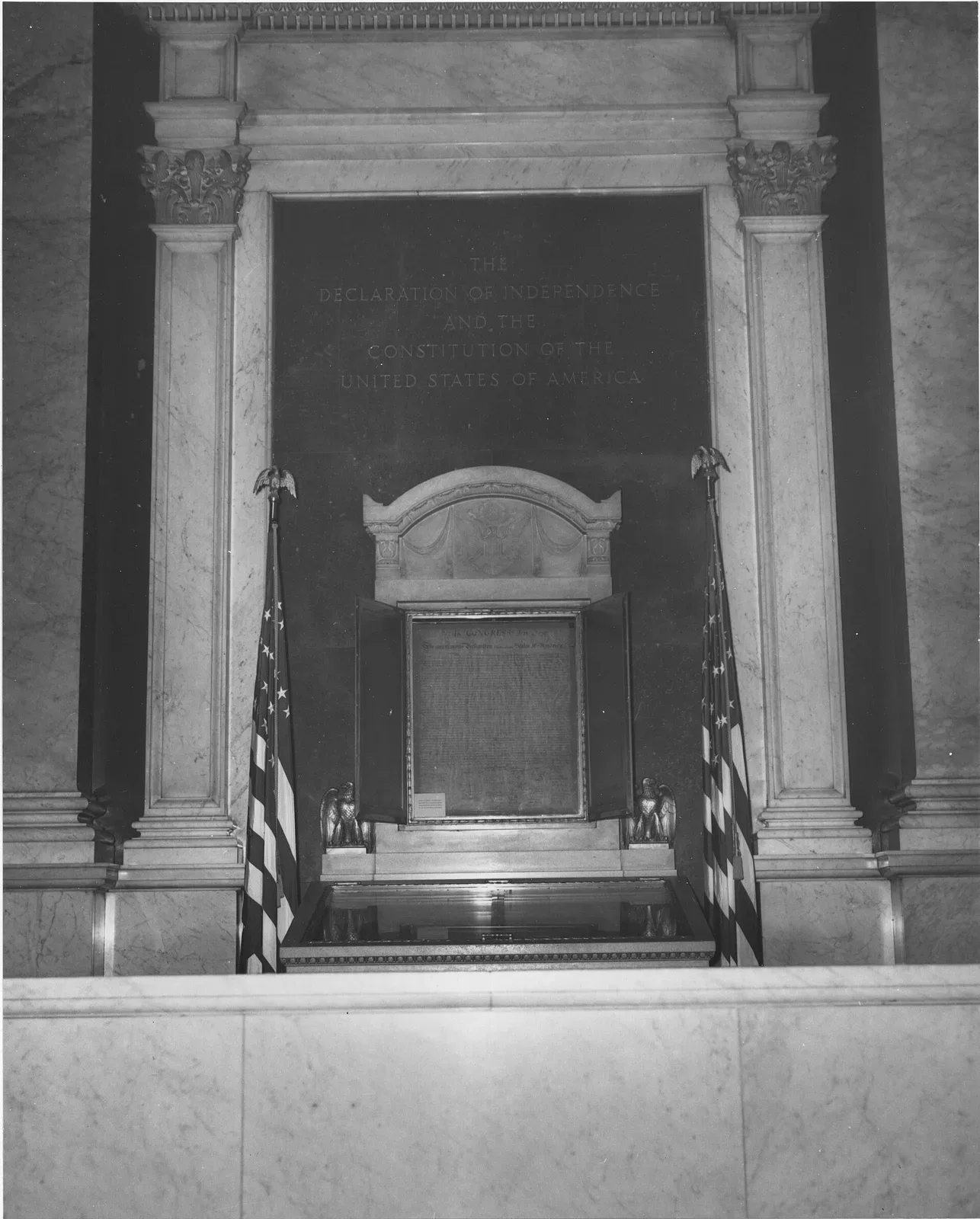
The founding documents on public display—the Constitution, which Madison shepherded through ratification, anchors America's fundamental law alongside the Declaration.
The U.S. National Archives (Public domain)
| Identification | |
|---|---|
| Jurisdiction | |
Territory | Federal |
Related Laws | |
| |
How Madison's Reluctance Gave Us the Second Amendment
The father of the Bill of Rights initially opposed it—until Jefferson convinced him
From The Boise Gun Club Handbook
The guy who wrote the Second Amendment didn't even want to write it -- and understanding his reluctance explains why "shall not be infringed" means what it says.
James Madison worried that listing specific rights might make people think those were the only ones they had. Here's what gets me every time I think about this: we almost didn't get the Bill of Rights at all.
Madison figured the new federal government already had limited powers, so why bother spelling out what they couldn't touch? His logic was solid: "The powers delegated by the proposed Constitution to the federal government are few and defined." Why list what they can't do when they weren't supposed to have that authority anyway?
The legal reality: Madison believed your rights existed before any government showed up to the party. In 1792, he wrote that every person "has a property very dear to him in the safety and liberty of his person" and called conscience "the most sacred of all property."
Thomas Jefferson shared this natural rights philosophy. In 1819, he defined "rightful liberty" as "unobstructed action according to our will within limits drawn around us by the equal rights of others." Notice what he didn't say -- "within the limits of the law." Jefferson explained that "law is often but the tyrant's will."
Jefferson Played the Long Gameedit
The Philosophical Debate
Jefferson understood Madison's principles but also understood politicians. Through their letters back and forth, Jefferson convinced Madison that the Constitution handed serious power to federal lawmakers and bureaucrats -- power that needed formal guardrails.
| Position | Madison's Original View | Jefferson's Counter-Argument |
|---|---|---|
| Federal Power | Limited by design, enumerated powers only | Constitution grants significant power to lawmakers/bureaucrats |
| Rights Protection | Unnecessary - government lacks authority to infringe | Formal guardrails needed against powerful officials |
| Strategy | Rely on structural limitations | "If we cannot secure all our rights, let us secure what we can" |
| Paper Protections | Could imply rights are limited to those listed | "Of great potency always, and rarely inefficacious" |
"If we cannot secure all our rights, let us secure what we can" - Jefferson's pragmatic approach to constitutional protections
Sure, paper protections weren't bulletproof, but they were "of great potency always, and rarely inefficacious."
Madison's Compromise Solution
Madison came around. He proposed 12 amendments, 10 became our Bill of Rights, and one more finally got ratified in 1992 as the Twenty-seventh Amendment. To cover his original concern, Madison included what became the Ninth Amendment -- basically saying "just because we wrote these down doesn't mean these are the only rights you have."
How Jefferson convinced Madison to draft the Bill of Rights despite his philosophical reservations
Mixed Results in the Real Worldedit
Historical Failures of Constitutional Protection
What this means for you: The Bill of Rights has had a rocky track record. We've seen:
- Government censorship during wartime (WWI, WWII)
- Business takeovers and economic interventions
- Japanese American internment camps during WWII
- Politicians consistently resist constitutional rights restrictions on their power
| Right/Freedom | Support Level | Perceived Threat Level | Notable Contradiction |
|---|---|---|---|
| Free Speech | 39% think 1st Amendment "goes too far" (Dems), 48% (GOP) | 78% say under threat | Want restrictions but fear losing it |
| Gun Rights | 64% support 2nd Amendment | 64% say under threat | 58% want stricter laws including bans |
| Press Freedom | Strong theoretical support | 76% say under threat | Polling varies by party/outlet |
| Voting Rights | Universal theoretical support | 58% say under threat | Disputes over election integrity measures |
Modern Public Contradictions
Americans send mixed signals too: Recent polls show 61% of Democrats and 52% of Republicans think the First Amendment "goes too far."
On gun rights: Most Americans support the Second Amendment, but 58% want stricter gun laws, including bans on semiautomatic rifles and standard magazines. The contradiction: Those same restrictions make "shall not be infringed" meaningless.
"Hey, folks! Have you met yourselves?" - On Americans' contradictory attitudes toward their own constitutional rights
Yet the same people tell pollsters that free speech (78%), press freedom (76%), voting rights (58%), and gun rights (64%) are all under threat.
Historical pattern showing how constitutional rights face restriction but tend to reassert themselves over time
The Resilience Factor
Here's what gives me hope: constitutional rights have a way of coming back swinging. World War I censorship sparked what scholars call the "Free Speech Century."
Decades of gun restrictions seemed to treat the Second Amendment like a suggestion until public pushback and legal scholarship brought it back to life. Unlike the watered-down protections you see in other countries, the often absolute language in our Bill of Rights "always retains the potential to reawaken and strike down restrictive laws."
The bottom line: Tim Lynch from the Cato Institute nailed it on Bill of Rights Day 2009 -- the Framers "would not have been surprised by the relentless attempts by government to expand its sphere of control." They knew paper barriers had limits, but as Jefferson concluded, putting safeguards in writing was better than having nothing at all.
The Framers "would not have been surprised by the relentless attempts by government to expand its sphere of control" - Tim Lynch, Cato Institute
That reluctant compromise between Madison and Jefferson gave us the Second Amendment. Not bad for a guy who didn't want to write it in the first place.
- Ace Hardware of Sandusky(Sandusky, MI)
- New Philly Sportsman Specialities(New Philadelphia, OH)
- Atwoods Ranch & Home #46(LACY LAKEVIEW, TX)
- G & P Distributors(McConnellsburg, PA)
This is not legal advice
This guide provides general information about federal and state firearms laws based on publicly available statutes. Laws change frequently and vary significantly by state. Always verify current laws in your jurisdiction. Consult a qualified attorney for legal advice on your specific situation. When in doubt, contact local law enforcement or state police.
Loading comments...