Legal Details
Idaho Open Carry Law

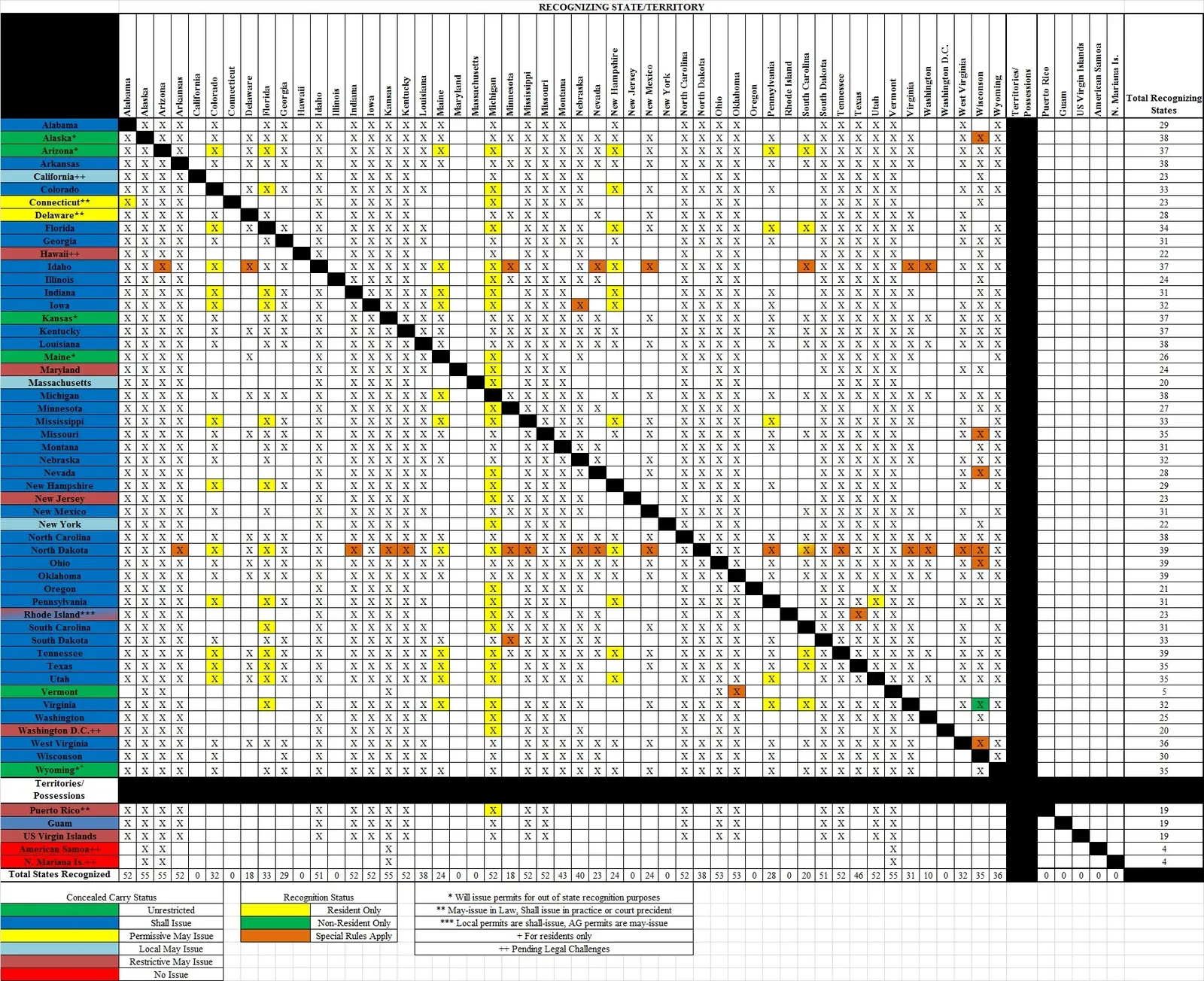
State-by-state CCW reciprocity map — critical for travelers, as permit recognition varies widely even among permitless-carry states.
Smit8678 (James Smith) (CC BY 3.0)
| Identification | |
|---|---|
Citation | Idaho Code § 18-3302 |
| Code Sections |
|
| Jurisdiction | |
Territory | Idaho |
Enacted By | Idaho State Legislature |
Administered By | Idaho State Police |
| Key Provisions | |
| |
| Applicability | |
| Applies To | Any individual aged 18 or older who is legally eligible to possess firearms, including both Idaho residents and non-residents |
| Exemptions |
|
| Penalties | Carrying a firearm in a manner that does not meet the 'plain view' requirement may constitute unlicensed concealed carry. Refusing to leave private property when asked while carrying may result in a trespassing charge. |
Related Laws | |
Idaho Open Carry Laws: Complete 2026 Reference
Legal information and analysis
From The Boise Gun Club Handbook
Updated August 15, 2026. The law moved twice since this article was written. The $200 making and transfer tax on suppressors, SBRs, SBSs and AOWs was eliminated effective January 1, 2026 by the One Big Beautiful Bill Act. Then on August 5, 2026 a federal court in Silencer Shop Foundation v. ATF struck down the NFA registration and approval requirements for those same items, and that injunction took effect August 13. It covers only the plaintiffs, their members and their customers. Living in a plaintiff state does not make you covered. Machine guns and destructive devices are unchanged. Read the current guide: NFA Items in 2026: What Actually Changed.
This is educational information, not legal advice. Laws change. Consult an attorney for your specific situation.
Idaho is one of the most permissive states in the country for carrying firearms — but "permissive" doesn't mean "no rules," and getting caught in the wrong place with a gun you thought was legal can ruin your day fast.
The Constitutional Foundationedit
Article 1, Section 11 of the Idaho Constitution is unusually strong compared to most state RKBA provisions. It reads: "The people have the right to keep and bear arms, which right shall not be abridged; but this provision shall not prevent the passage of laws to govern the carrying of weapons concealed on the person, nor prevent passage of legislation providing minimum sentences for crimes committed while in possession of a firearm, nor prevent passage of legislation providing penalties for the possession of firearms by a convicted felon, nor prevent the passage of legislation punishing the use of a firearm. No law shall impose licensure, registration or special taxation on the ownership or possession of firearms or ammunition. Nor shall any law permit the confiscation of firearms, except those actually used in the commission of a felony."
That last clause about no licensure or registration being allowed for ownership is baked directly into the state constitution — not just statute. That's a meaningful distinction.
Open Carry: The Basicsedit
Idaho is a permitless open carry state. You can carry a handgun, rifle, or shotgun openly in public without any license or permit, provided the firearm is visible. Per Idaho Code Ann. § 18-3302(4)(a) and (b), the concealed weapons statute explicitly excludes "any deadly weapon located in plain view" and "any lawfully possessed shotgun or rifle" from its permit requirements — meaning open carry is legal by operation of the concealed carry law carving it out.
The minimum age for open carry of a handgun is 18. According to Idaho Code Ann. § 18-3302F, it is a crime for anyone under 18 to possess a handgun. Long guns follow a different track — minors under 18 can possess a firearm generally if they have written parental permission or are accompanied by a parent or guardian, per Idaho Code Ann. § 18-3302E.
This applies equally to residents and non-residents. Idaho's permitless carry framework does not draw a residency line for open carry.
Permitless Concealed Carryedit
Open carry is the straightforward part. Concealed carry in Idaho is more layered, and understanding it matters because it affects how you can legally carry in a vehicle and in cities.
Per Idaho Code Ann. § 18-3302(3) and (4)(f), permitless concealed carry is allowed in two main scenarios:
- Outside the limits or confines of any city, for anyone 18 and older who is not disqualified from holding a license
- Anywhere in the state, for anyone 18 and older who is a U.S. citizen or current armed forces member, and not otherwise disqualified
The second provision — effective as of July 1, 2020 — is what makes Idaho a full constitutional carry state. You can carry concealed inside city limits without a permit if you're a U.S. citizen or active military, 18 or older, and not a prohibited person. Non-citizens who are legal residents can still carry openly without a permit but need a permit to carry concealed.
Permitless carry also applies at your home, fixed place of business, any property where you have an ownership or leasehold interest, and on private property where someone with an ownership interest has given you permission to carry concealed. Idaho Code Ann. § 18-3302(3) and (4)(f).
The Idaho Concealed Carry License Systemedit
Just because you don't need a permit doesn't mean the permit isn't worth having — particularly for reciprocity with other states.
Idaho is a "shall issue" jurisdiction. The issuing authority is your county sheriff. There are several license types:
Standard License — Governed by Idaho Code Ann. § 18-3302(7).
- Minimum age: 21
- Idaho residency: not required for a standard license
- Fingerprints: required for initial application
- Processing time: maximum 90 days
- Duration: five years
- Fees: $20 for initial application, $15 for renewal (as of January 1, 2026, per fee schedule changes reported by Idaho News 6). Late renewal between 91-180 days after expiration adds a $10 penalty unless waived by the sheriff.
- Training: The sheriff may require demonstrated familiarity with a firearm and must accept any of the qualifying training forms listed at Idaho Code Ann. § 18-3302(9) — including hunter education, NRA safety courses, law enforcement agency courses, and similar training.
Enhanced License — Governed by Idaho Code Ann. § 18-3302K.
- Minimum age: 21
- Requires a minimum 6-month Idaho residency, unless the applicant already holds a valid carry license from their state of residence
- Requires an 8-hour in-person training course with live-fire, completed within the year before application
- Duration: five years
- Key benefit: Enhanced license holders can carry on public college and university campuses (with exceptions noted below), and the enhanced license is recognized by several states that don't honor Idaho's standard license
Provisional License — Under Idaho Code Ann. § 18-3302(20), sheriffs can issue a license to applicants aged 18–20 who otherwise meet enhanced license requirements. Expires on the holder's 21st birthday, at which point they can apply for an enhanced license via the renewal process.
Temporary Emergency License — Idaho Code Ann. § 18-3302(6) allows the sheriff of the county of residence to issue a temporary license for good cause while a standard license application is pending. Valid for a maximum of 90 days.
Qualified Retired Law Enforcement Officer License — Idaho Code Ann. § 18-3302H authorizes sheriffs to issue carry licenses to qualifying retired law enforcement officers. These are valid for one year. Retired officers can also seek standard or enhanced licenses instead.
Idaho does not distinguish between resident and non-resident licenses — the Idaho Sheriffs' Association has confirmed at their FAQ that non-residents can apply for and receive an Idaho concealed weapons license on the same terms as residents.
Disqualifications and Prohibited Personsedit
Permitless carry is available only to people who are not otherwise disqualified from holding a license. The disqualifiers are listed at Idaho Code Ann. § 18-3302(11) and include:
- Currently charged with or convicted of any crime punishable by imprisonment of more than one year
- Fugitives from justice
- Unlawful users of marijuana or other controlled substances
- Anyone adjudicated as having suffered from specified mental health conditions
- Dishonorably discharged from the armed forces
- Aliens illegally present in the United States
- Anyone subject to certain active protection orders
- Anyone who received probation after being adjudicated guilty of a misdemeanor with an element of intentional use or threatened use of physical force against another person or property (unless probation was successfully completed)
- Anyone otherwise ineligible to possess a firearm under state or federal law
The sheriff cannot consider convictions or mental health adjudications that have been nullified by expungement, pardon, or other comparable procedures that restored the person's firearm rights.
Separately, Idaho Code Ann. § 18-3316 prohibits any person with a felony conviction in any jurisdiction from purchasing, owning, possessing, or having custody or control of a firearm — with the same exception for convictions that have been nullified or had firearm rights restored.
Carrying concealed while intoxicated or under the influence of any intoxicating drink or drug is a crime under Idaho Code Ann. § 18-3302B. If that violation occurs on a college or university campus, it triggers an automatic three-year revocation of any Idaho concealed carry license and ineligibility to obtain or renew one during that period.
Where You Cannot Carryedit
This is where people get tripped up. Idaho's permissive carry laws have real exceptions.
Statutory prohibited locations under Idaho Code Ann. § 18-3302C:
- Courthouses
- Juvenile detention facilities or jails
- Public or private schools
School zones — Idaho Code Ann. § 18-3302D creates a separate offense for possessing a firearm on elementary or secondary school property, in any building or structure on school grounds being used for a school-sponsored activity, or on school-provided transportation. This includes school-sponsored activities held off school property. Exceptions include:
- An adult non-student with a firearm secured and locked in their vehicle in an unobtrusive, nonthreatening manner
- A person lawfully possessing a firearm in a private vehicle while dropping off or picking up children or school employees
- Any person authorized to carry by the school district board of trustees or governing board
Colleges and universities — Idaho Code Ann. § 18-3309 gives the governing boards of public colleges and universities authority to regulate firearms on their property, but that authority cannot extend to people with enhanced carry licenses or qualified retired law enforcement officer licenses. Even enhanced license holders, however, cannot carry:
- Within student dormitories or residence halls
- Within any building of a "public entertainment facility" that is properly posted at each public entry point during a game or event
Private property — Idaho Code Ann. § 18-3302(25) preserves the right of private property owners, private employers, and private businesses to prohibit or restrict firearms on their property. This restriction cannot apply to state or local government property that is normally open to the public and leased or licensed to a private entity — unless the use is for a private by-invitation-only event, a commercial event that charges admission, or any other event with restricted access.
Armed parades and public militia-style activity — Idaho generally prohibits a "body of men" not recognized by state or federal law from parading in public with firearms in any city or town, per Idaho Code Ann. § 46-802. Exceptions include honorably discharged veterans, Sons of Veterans, Boy Scouts on Memorial Day and certain other occasions, and students at schools where military science is taught parading with governor's consent.
Federal law adds another layer regardless of state law: courthouses, post offices, TSA-secured airport areas, and other federal facilities are off-limits for firearms.
Vehicle Carryedit
This is an area where Idaho's law is friendly but requires some attention to detail.
Open carry in a vehicle is legal — a firearm in plain view is open carry and requires no permit. For concealed carry in a vehicle, Idaho's permitless concealed carry law applies the same way it does on foot: U.S. citizens and active military aged 18 and older who are not prohibited persons can carry concealed in a vehicle without a permit anywhere in the state.
If you're a non-citizen legal resident, you can open carry in your vehicle without a permit, but would need a permit for concealed carry.
Self-Defense: Stand Your Groundedit
Idaho has a codified Stand Your Ground law. Idaho Code Ann. § 19-202A(3) states: "In the exercise of the right of self-defense or defense of another, a person need not retreat from any place that person has a right to be. A person may stand his ground and defend himself or another person by the use of all force and means which would appear to be necessary to a reasonable person in a similar situation and with similar knowledge without the benefit of hindsight."
No duty to retreat. That's a meaningful legal protection. But "stand your ground" doesn't mean you can be the initial aggressor or create the confrontation — and the "reasonable person" standard still applies. If you're ever in a self-defense situation in Idaho, consult an attorney immediately. This is exactly the kind of scenario where the details matter enormously.
Preemptionedit
Idaho has strong statewide preemption. Under Idaho Code Ann. § 18-3302J, counties, cities, agencies, boards, and any other political subdivision of the state are prohibited from adopting or enforcing any law, rule, regulation, or ordinance that regulates in any manner the sale, acquisition, transfer, ownership, possession, transportation, carrying, or storage of firearms or any component, including ammunition.
There are limited carve-outs. Counties can adopt ordinances regulating the discharge of firearms within their boundaries, but those ordinances cannot affect:
- Lawful self-defense or defense of property
- Lawful hunting
- A landowner and guests discharging on the landowner's property when it won't endanger anyone
- Discharge at a lawful sport shooting range
- Target shooting on public land when it won't endanger anyone
Cities can regulate discharge within their boundaries but cannot restrict lawful self-defense or discharge at a sport shooting range.
The preemption law does not affect the Idaho Department of Fish and Game's authority to make wildlife management rules, and it preserves county and city authority to regulate the location and construction of sport shooting ranges under chapter 26, title 55, Idaho Code.
The practical upshot: you don't have a patchwork of city-by-city carry ordinances to worry about in Idaho. What the state law says goes, statewide.
Hardware: What Idaho Does and Doesn't Restrictedit
Idaho does not have laws restricting so-called "assault weapons," large-capacity magazines, machine guns, personally made or unserialized firearms, or rate-increasing devices like bump stocks or forced reset triggers, according to NRA-ILA.
Idaho does not require registration of firearms. The state constitution prohibits it — Art. I, § 11 bars licensure, registration, or special taxation on the ownership or possession of firearms or ammunition. A 2023 law (Idaho Code Ann. § 18-3326A(2)) further prohibits any state or local government entity from keeping any list, record, or registry of privately owned firearms or their owners, unless the record is part of an active criminal investigation and prosecution or otherwise required by law.
On ammunition, Idaho does not regulate or restrict ammunition sales or require background checks for ammunition purchases. The one restriction: Idaho Code Ann. § 18-3308 prohibits selling or giving to any minor under 16 any gunpowder or fixed ammunition, except shells for shotguns and .22 caliber or smaller rimfire rifles, without written parental or guardian consent.
NFA items — Suppressors, short-barreled rifles, short-barreled shotguns, and full-auto weapons are legal to own in Idaho if you comply with federal NFA requirements (Form 4 approval, $200 tax stamp, registration with ATF). Idaho imposes no additional state-level restrictions on NFA items beyond federal law. However, Idaho Code Ann. § 18-3302F makes it a crime for anyone under 18 to possess a sawed-off rifle, sawed-off shotgun, or fully automatic weapon.
Purchase and Background Checksedit
Idaho has no permit-to-purchase requirement and no waiting period for firearm purchases. Federal law applies at licensed dealers — that means a National Instant Criminal Background Check System (NICS) check at the point of sale.
Private sales between individuals in Idaho are not required to go through a background check under state law. Idaho does not impose a universal background check requirement.
As of January 1, 2026, Idaho increased fees for fingerprint-based criminal background checks and initial concealed carry licenses, per Idaho News 6. The NRA-ILA source lists the standard license fee at $20 for initial application and $15 for renewal, with the sheriff allowed to collect the actual cost of any additional fees required by state or federal agencies for processing.
Red Flag Laws / ERPOsedit
Idaho does not have a red flag law. There is no Emergency Risk Protective Order (ERPO) mechanism in Idaho statute, and as of the sources available for this article, no such legislation has passed. The NRA-ILA confirms this directly.
Non-Resident Carryedit
Non-residents have the same open carry rights as residents — no permit required for anyone 18 or older who is not a prohibited person.
For concealed carry, non-residents who are U.S. citizens or active military aged 18 and older and not disqualified can carry concealed without a permit under Idaho's permitless carry law, the same as Idaho residents.
Non-residents who have a valid concealed carry license from their home state are also exempt from Idaho's license requirement under Idaho Code Ann. § 18-3302(5)(g), provided they have the license physically on their person. Idaho honors all other states' resident and non-resident concealed carry permits.
Concealed Carry Reciprocityedit
Idaho is a broadly recognized state for reciprocity purposes, but there are distinctions between the standard and enhanced license that matter when traveling.
Per NRA-ILA:
- Delaware, Minnesota, Nevada, Washington State, and Wisconsin recognize Idaho's enhanced permit only
- Colorado, Florida, Maine, Michigan, New Hampshire, and North Dakota recognize Idaho's resident permits only
Idaho recognizes all other states' resident and non-resident permits. Non-residents must carry their valid out-of-state license on their person when carrying concealed in Idaho.
For current reciprocity maps, check the NRA-ILA state page directly — reciprocity agreements change frequently, and the NRA-ILA notes that their own list is subject to frequent change and should not be treated as legal advice for any specific situation.
If you travel and rely on your Idaho permit for reciprocity in other states, the enhanced license is worth getting for the wider recognition it provides.
Right to Carry in Restaurantsedit
Per NRA-ILA, carrying in restaurants is legal in Idaho. Idaho does not have a statute prohibiting carry in establishments that serve alcohol the way some other states do. Private restaurant owners can still post their property and prohibit firearms under Idaho Code Ann. § 18-3302(25) — but the state itself doesn't restrict it.
Recent Legislative Activityedit
The 2026 Idaho legislative session convened on January 12, 2026. According to NRA-ILA, House Bill 621 — a concealed carry clarification bill — was printed and introduced in the House State Affairs Committee as of March 2, 2026. The specifics of that bill and its current status were not detailed in available sources. If you're reading this close to that date, check NRA-ILA's Idaho page for updates.
The 2025 Idaho legislative session adjourned sine die on April 7, 2025, per NRA-ILA. No specific 2025 gun law changes are detailed in the available sources for this article.
Firearms and Minorsedit
Idaho's laws on minors and firearms involve several overlapping statutes:
- Idaho Code Ann. § 18-3302E: It is a misdemeanor for anyone under 18 to possess a firearm without written parental or guardian permission, or unless accompanied by a parent or guardian.
- Idaho Code Ann. § 18-3302F: It is a separate crime for anyone under 18 to possess a handgun, a sawed-off rifle or shotgun, or a fully automatic weapon.
- Idaho Code Ann. § 18-3302A: Selling a firearm to a minor under 18 without written parental consent is a crime.
- Idaho Code Ann. § 18-3308: Selling or giving fixed ammunition (with limited exceptions) or gunpowder to a minor under 16 without written parental consent is a crime.
Gang-Related Provisionsedit
Idaho Code Ann. § 18-8505 makes it a crime to supply, sell, or give possession of a firearm to a person knowing that person is a gang member.
Confidentiality of Carry License Holdersedit
NRA-ILA notes that Idaho has right-to-carry confidentiality provisions enacted — meaning records related to concealed carry licenses are not subject to public disclosure in the same way other government records might be.
The BGC Takeedit
Idaho's framework is about as clean as it gets for a gun owner. Open carry, permitless concealed carry, strong preemption, no magazine restrictions, no registration, no red flag law, and a state constitution with sharper teeth than most. The main practical traps are school zones — the rules there are more nuanced than people think, especially with off-campus school events — and college campuses, where only enhanced license holders have access, and even they have dead zones in dorms and posted entertainment facilities.
If you're a non-resident visiting Idaho, you're largely treated the same as a resident for open carry purposes. Get an enhanced license if you want the broadest reciprocity when you travel out of state — the extra training requirement is modest and the payoff is real.
The bottom line: Idaho lets law-abiding adults carry how they want, where they want, with very few restrictions — know the prohibited locations cold, because that's where the legal exposure actually lives.
Resourcesedit
- https://www.nraila.org/gun-laws/state-gun-laws/idaho/
- https://giffords.org/lawcenter/state-laws/open-carry-in-idaho/
- https://www.battlbox.com/blogs/carry-laws/can-a-non-resident-open-carry-in-idaho-understanding-the-laws-and-regulations
- https://aliengearholsters.com/blogs/news/open-carry-states
- https://www.handgunlaw.us/documents/Permitless_Carry_States.pdf
Last Updated: March 05, 2026
- Ace Hardware of Sandusky(Sandusky, MI)
- New Philly Sportsman Specialities(New Philadelphia, OH)
- Atwoods Ranch & Home #46(LACY LAKEVIEW, TX)
- G & P Distributors(McConnellsburg, PA)
This is not legal advice
This guide provides general information about federal and state firearms laws based on publicly available statutes. Laws change frequently and vary significantly by state. Always verify current laws in your jurisdiction. Consult a qualified attorney for legal advice on your specific situation. When in doubt, contact local law enforcement or state police.
Loading comments...