Legal Details
922(r) Compliance

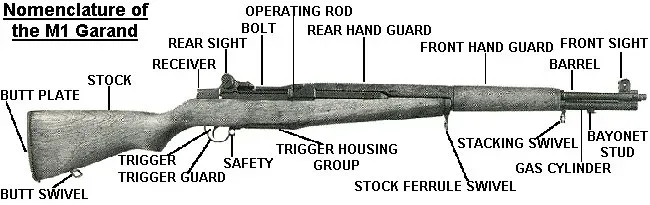
M1 Garand parts breakdown from U.S. Army Field Manual FM 23-5 — the clearest reference for understanding rifle component assembly and part counting.
Department of the Army (Public domain)
| Identification | |
|---|---|
Citation | 18 U.S.C. § 922(r) |
| Code Sections |
|
| Jurisdiction | |
Territory | United States (Federal) |
Enacted By | United States Congress |
Administered By | Bureau of Alcohol, Tobacco, Firearms and Explosives (ATF) |
| Key Provisions | |
| |
| Applicability | |
| Applies To | Individuals assembling or modifying semiautomatic rifles or shotguns using imported parts, including parts kit builders and those converting imported pistols to rifles |
| Exemptions |
|
| Penalties | Up to 10 years federal prison for violation |
Related Laws | |
Imported Firearms and 922(r) Compliance
Legal information and analysis
From The Boise Gun Club Handbook
This article provides educational information only and is not legal advice. Consult a qualified attorney for specific legal questions.
If you're building from a parts kit, converting that imported pistol to an SBR, or swapping parts on your AK or imported rifle, you could be committing a federal felony without even knowing it. 922(r) catches more gun owners off-guard than almost any other federal law.
- The trap: Section 922(r) says you can't assemble a semiautomatic rifle or shotgun with more than 10 foreign parts from a specific list of 20 regulated components
- The reason: Congress wanted to prevent people from dodging import restrictions by bringing in "nonsporting" guns piece by piece
- The reality: Penalties go up to 10 years federal prison for what amounts to a parts-counting mistake
The rule sounds simple--count your foreign parts, stay at 10 or under, or replace enough with U.S. parts to get compliant. But like most federal gun laws, it's the details that'll bite you.
Who This Actually Affectsedit
Three Main Scenarios
You're dealing with 922(r) in three main situations. First, if you're building from a parts kit--that Romanian AK kit needs U.S. compliance parts before you can legally assemble it. Second, if you're modifying an imported rifle by swapping furniture or components, you've just made yourself responsible for the parts count.
Third, if you're converting an imported pistol to an SBR, you're creating a rifle from foreign parts, which brings 922(r) into play.
922(r) compliance decision flowchart
| Situation | 922(r) Applies? | Why |
|---|---|---|
| Stock imported rifle from dealer | No | Importer handled compliance |
| Building from parts kit | Yes | You're assembling foreign parts |
| Modifying imported rifle parts | Yes | You assume compliance responsibility |
| Converting imported pistol to SBR | Yes | Creating rifle from imported components |
| U.S.-made rifle modifications | No | Domestic firearms exempt |
The Good News About Retail Rifles
Here's the good news: if you bought your imported rifle at a gun store and left it stock, you're fine. The importer already handled compliance before it hit the shelf. Start changing parts? Now it becomes your problem.
The Parts List That Actually Mattersedit
Only 20 specific parts count toward your 922(r) total--not every screw and spring in your rifle. The ATF created a shopping list, and that's all you need to worry about.
The Official 20-Part List
| Part Category | Specific Components | Compliance Notes |
|---|---|---|
| Core Components | Receiver, Barrel | Usually foreign on imports |
| Trigger Group | Trigger, Hammer, Sear, Disconnector | Easy compliance wins |
| Furniture | Buttstock, Pistol Grip, Handguards | Cheap to replace |
| Operating Parts | Bolt, Bolt Carrier, Operating Rod | Critical function components |
| Accessories | Muzzle Device, Flash Hider | If installed |
| Feeding | Magazine (fixed designs) | Varies by rifle type |
Focus on What's Actually There
The parts you'll actually encounter on most builds include the receiver and barrel (usually foreign on imported rifles), trigger group components (which make easy compliance wins with U.S. triggers), stock components like the buttstock, pistol grip, and handguards, operating parts like the bolt, bolt carrier, and operating rod, plus muzzle devices if you've got a flash hider or compensator.
I've watched guys stress over every tiny component when only these 20 parts matter for compliance. Get the official ATF list, count what's actually installed on your specific rifle, and do the math. Don't overthink it.
Getting Compliant Without Breaking the Bankedit
You don't need to replace everything--just enough foreign parts to hit 10 or fewer total. Smart builders go after the cheap, easy swaps first and often improve the rifle in the process.
Timeline for typical 922(r) compliance build
Smart Swapping Strategy
| Compliance Strategy | Parts Count Reduction | Typical Cost | Benefits |
|---|---|---|---|
| U.S. Trigger Group | 3-4 parts | $100-200 | Better performance |
| Furniture Set | 3 parts | $75-150 | Customization options |
| Muzzle Device | 1 part | $25-75 | Improved shooting |
| U.S. Magazine | 1 part | $20-40 | Additional capacity |
| Complete Package | 8-10 parts | $200-400 | Full compliance |
Typical Build Components
A typical compliance build might include a U.S. trigger group (covers multiple parts on the list and usually shoots better than the original), American furniture like stock, pistol grip, and handguards, a domestic muzzle device if you're adding one anyway, and a U.S. magazine if it's a fixed magazine design.
Most builds I see need $200-400 in compliance parts to get compliant, depending on what you're starting with. Don't cheap out on critical components like triggers--you're going to live with these parts, so buy once and cry once.
The SBR Conversion Issueedit
The legal reality: Converting imported pistols to SBRs appears to trigger 922(r) based on current ATF interpretation, even though pistols normally don't fall under this law. You're creating a rifle from imported parts, so compliance rules kick in.
Converting imported pistols to SBRs appears to trigger 922(r) based on current ATF interpretation, even though pistols normally don't fall under this law.
This catches a lot of people building Krink clones or other imported pistol conversions. Factor compliance parts into your SBR budget from day one, or you'll be scrambling to fix it later.
What Doesn't Countedit
The feds wrote this law to control major assemblies, not to hassle people over springs and screws. Minor parts like pins, springs, screws, and small hardware don't appear on the regulated parts list, so they don't count toward your foreign total.
Also exempt are:
- Unmodified imports (stock WASR rifles remain compliant)
- Bolt-action rifles (only semiautos regulated)
- Sporting rifles (though definition can be complex)
- Any U.S.-made parts you install
Documentation and Proofedit
Why Documentation Matters
Keep receipts for your U.S. compliance parts. The law doesn't specifically require documentation, but try explaining compliance without proof if ATF ever asks questions. I've seen too many "trust me, it's compliant" builds to recommend flying blind on this.
Buying from Reputable Sources
Buy from suppliers who actually mark their parts as 922(r) compliant and U.S.-made. Some foreign manufacturers stamp "Made in USA" on parts that definitely weren't, and that won't help you if push comes to shove.
922(r) sounds scarier than it actually is once you understand the 20-part list and can do basic math. But the penalties for getting it wrong make it worth taking seriously.
Count twice, buy U.S. parts from reputable suppliers, and keep your paperwork.
Resourcesedit
- 18 U.S.C. § 922(r) — The actual federal statute
- ATF Federal Firearms Regulations Reference Guide — Official ATF guidance on compliance
- ATF Industry Operations Division — Source for technical interpretations and ruling requests
- Licensed firearms attorney — For specific compliance questions and complex situations
- Qualified gunsmith familiar with 922(r) — For practical compliance assistance during modifications
Last Updated: 2026-01-15
See Alsoedit
- Ace Hardware of Sandusky(Sandusky, MI)
- New Philly Sportsman Specialities(New Philadelphia, OH)
- Atwoods Ranch & Home #46(LACY LAKEVIEW, TX)
- G & P Distributors(McConnellsburg, PA)
This is not legal advice
This guide provides general information about federal and state firearms laws based on publicly available statutes. Laws change frequently and vary significantly by state. Always verify current laws in your jurisdiction. Consult a qualified attorney for legal advice on your specific situation. When in doubt, contact local law enforcement or state police.
Loading comments...