Article Info
Marijuana Users: Second Amendment Rights
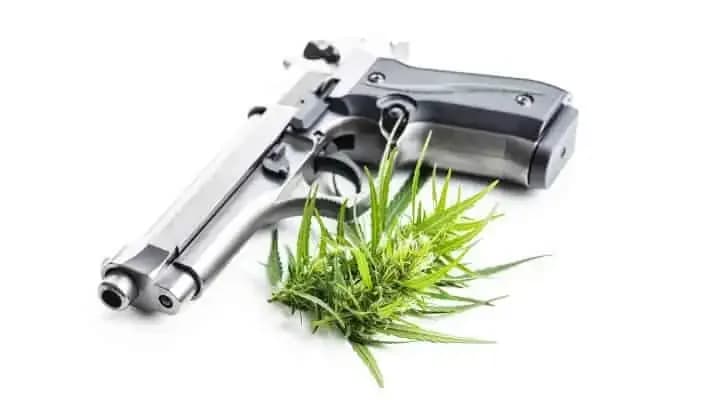
| Scope | |
|---|---|
| Jurisdiction | Federal |
| Impact | national |
| Key Entities | |
| Will hear oral arguments March 2, 2026 | U.S. Supreme Court |
| Filed amicus brief arguing the gun ban is unconstitutional | Liberty Justice Center |
| Asking SCOTUS to uphold the marijuana user gun ban | Trump Administration (DOJ) |
| Ruled the ban unconstitutional in Connelly and Hemani | 5th U.S. Circuit Court of Appeals |
| Defendant; Texas man whose gun charge was dismissed | Ali Hemani |
| Legal Issues | |
| |
| What It Means | |
| |
| Timeline | |
| March 2, 2026 | Oral arguments in United States v. Hemani before SCOTUS |
| January 28, 2026 | Liberty Justice Center amicus brief filed |
| June 23, 2022 | SCOTUS decided NYSRPA v. Bruen, establishing the historical tradition test |
| Related Laws | |
Marijuana Users: Second Amendment Rights
A SCOTUS brief argues disarming 43–62 million cannabis users has no constitutional basis—and the Court hears the case March 2.
From The Boise Gun Club Handbook
The Supreme Court hears arguments March 2 in United States v. Hemani—a case that could strip gun rights from tens of millions of Americans whose only offense is using marijuana.
State of play: Federal law under 18 USC 922(g)(3) makes it a felony for any "unlawful user" of a controlled substance to possess a firearm. Since marijuana remains federally controlled, that applies to somewhere between 43 and 62 million Americans—nearly a quarter of all adults, per 2024 federal survey data. Using cannabis and owning a gun can technically stack up to four separate felonies, carrying up to 50 years in prison.
By the numbers:
- 43–62 million Americans currently affected
- Up to 50 years in prison for combined possession charges
- At least 4 circuit courts—the 3rd, 8th, 10th, and 11th—have reached similar conclusions: marijuana use alone isn't enough to justify disarmament
The case began when the FBI searched Ali Hemani's Texas home and found a Glock 19, about two ounces of marijuana, and less than a gram of cocaine. The gun charge was dismissed at the district level. The 5th Circuit upheld that dismissal, relying on its 2024 ruling in United States v. Connelly, which held that prosecuting a marijuana user "based solely on her habitual or occasional drug use" is inconsistent with the Second Amendment.
The Liberty Justice Center filed a brief urging the Court to strike down the policy under the Supreme Court's own Bruen framework from 2022.
"Treating all cannabis users—nearly one-fifth of the adult population—as presumptively dangerous criminals is incompatible with historical tradition, modern societal norms, and this Court's own framework for Second Amendment analysis." — Liberty Justice Center brief, United States v. Hemani
Reality check: The Trump administration is asking SCOTUS to overturn Connelly and reinstate the charge—putting the administration in the odd position of arguing against gun rights for tens of millions of Americans while Trump himself endorsed a 2024 Florida ballot initiative to legalize recreational marijuana. His administration has also moved to reclassify marijuana under the Controlled Substances Act, but that reclassification does nothing to change the gun disqualification.
The government's best historical analog—laws against carrying while intoxicated—doesn't hold up well under scrutiny. Those old laws were narrow: they targeted public behavior while actively drunk. Section 922(g)(3) disqualifies cannabis users even in private, even when sober, with no individual finding of dangerousness.
The ATF recently proposed tightening the definition of "unlawful user" to exclude isolated or sporadic use—which would restore gun rights for some—but anyone using marijuana regularly, even once a month, would still be prohibited. The LJC points out the obvious contradiction: the government is essentially saying a sporadic user is safe enough to pass a background check, but could still be federally prosecuted for that same purchase.
What Idaho gun owners should know: If you're an Idaho owner who uses marijuana—medically or recreationally—federal law currently treats you as a prohibited person regardless of what state law says. A ruling before the end of the term in June or July won't legalize marijuana. But if the Court sides with the 5th Circuit, the federal government can no longer use cannabis use as a blanket reason to strip someone's Second Amendment rights without evidence they're actually dangerous.
- Phils Custom Handloads(Swartz Creek, MI)
- Gls Guns(Sumner, IA)
- J & L Gunsmithing(Chesapeake, VA)
- Oliver Firearms(Spartanburg, SC)
Loading comments...