Brand Info
Barnes Bullets
Ammunition

Category image: rifle projectiles and cartridges. Not a Barnes Bullets product photo.
Oleg Volk (en:User:Olegvolk) (CC BY 2.5)
| Overview | |
|---|---|
Headquarters | Mona, UT |
| Tagline | Pioneering the world's most effective all-copper hunting bullet. For over 30 years, we've been engineering the most advanced hunting bullets, trusted by the world's best hunters and shooters. |
SAAMI | Member |
Products | |
| Key Products | How They Do It, Performance Reality, Buying Guide, The BGC Take |
Links | |
| www.barnesbullets.com | |
Barnes Bullets
Reference article
From The Boise Gun Club Handbook
Fred Barnes started making precision bullets back when most companies were cranking out mass-market ammunition. He focused on accuracy and terminal performance -- two things that matter when you need the bullet to do its job.
Barnes figured out all-copper bullet technology years before anyone cared about lead-free regulations.
When states started mandating non-lead hunting ammo, Barnes already had a decade of experience while everyone else was scrambling to catch up.
The X-Bullet put them on the map. Problem was, hunters didn't understand why copper bullets performed differently than traditional lead-core projectiles. Takes time to educate people, but near-100% weight retention speaks for itself.
The company changed hands a few times over the years -- there was even a period where they temporarily lost the Barnes name before getting it back after consulting with Fred Barnes. They're a SAAMI member, so they stick to industry standards while staying firmly in the premium ammunition segment.
Product Linesedit
Barnes keeps things organized around what you're actually doing with the ammunition:
| Product Line | Platform | Bullet Type | What It Does |
|---|---|---|---|
| VOR-TX | Centerfire rifle | TTSX (Tipped Triple-Shock X) | Main hunting line, polymer tip improves ballistics |
| Pioneer | Lever-action & revolver | Flat-nose copper | Won't chain-fire in tube magazines |
| TAC-TX | Tactical/LE | Copper HP | Less fouling, punches through barriers |
| Component Bullets | Handloading | TSX, TTSX, LRX | For people who roll their own |
Key Milestones in Barnes Bullet Development
Core Product Categories
The component bullets break down like this -- TSX (Triple-Shock X) has four cutting petals and 100% weight retention. It's the original Barnes copper design. TTSX (Tipped Triple-Shock X) adds a polymer tip for higher ballistic coefficient and more reliable expansion. LRX (Long Range X) stretches the ogive for better aerodynamics at distance. TAC-TX is the tactical version optimized for barrier penetration.
Caliber Coverage
Popular calibers get the most attention:
| Caliber | Bullet Weights | Worth Knowing |
|---|---|---|
| .223 Rem / 5.56 | 55gr, 62gr, 70gr | 70gr TSX needs 1:8 twist or faster |
| .308 Win | 130gr, 150gr, 168gr | Widest selection available |
| .30-06 Springfield | 150gr, 168gr, 180gr | Classic hunting caliber, full coverage |
| .300 Win Mag | 150gr, 165gr, 180gr | Popular with elk hunters |
| 6.5 Creedmoor | 120gr, 127gr | Newer additions, growing demand |
How They Do Itedit
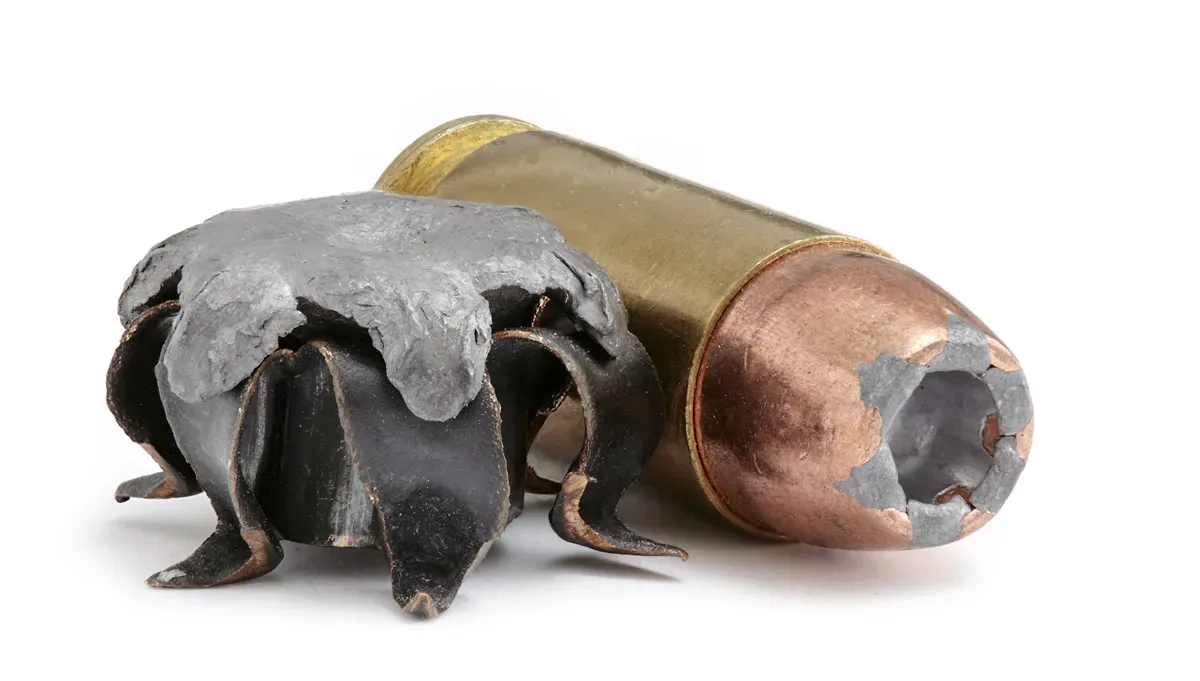
Engineering Approach
The engineering challenge with copper is getting it to expand reliably when lead naturally wants to expand and copper doesn't. Barnes solved this with the Triple-Shock X design -- four cutting petals open on impact, creating large wound channels with virtually 100% weight retention. Compare that to 60-80% for traditional lead-core bullets.
They groove the shank to reduce bearing surface and pressure while maintaining accuracy. Every powder charge gets individually weighed, not volumetrically measured. Each bullet gets inspected. Match-grade accuracy specs across all product lines.
Barnes TTSX Bullet Expansion Process
| Design Feature | Purpose | Benefit |
|---|---|---|
| Four Cutting Petals | Controlled expansion | Large wound channels, reliable opening |
| Grooved Shank | Reduce bearing surface | Lower pressure, maintained accuracy |
| Polymer Tip (TTSX) | Improve ballistics & expansion | Higher BC, consistent opening at lower velocities |
| 100% Copper Construction | Lead-free compliance | Meets regulations, reduced fouling |
Copper bullets require approximately 1,800 fps minimum impact velocity for reliable expansion -- velocity matters more than with traditional lead-core bullets.
Design Trade-offs
Here's the trade-off you need to understand: copper bullets are significantly longer than equivalent-weight lead-core bullets because copper is less dense. A Barnes 70gr TSX measures about 1.037" -- longer than many heavier lead-core bullets. This affects magazine fit and requires faster twist rates.
The TTSX polymer tip was a smart advancement. Adding a tip to the TSX design improved the ballistic coefficient and expansion reliability -- the tip drives into the hollow point on impact, ensuring consistent opening even at lower velocities.
Performance Realityedit
Barnes bullets are built for deep penetration with near-total weight retention. Hunters consistently report complete pass-through shots on game animals with expanded bullets retaining original weight minus only minor copper fragments.
Game Performance
| Scenario | Performance | Recommendation |
|---|---|---|
| Large Game (Elk/Moose) | Excellent penetration, complete pass-throughs | Ideal choice, use heavier bullets |
| Medium Game (Deer/Antelope) | Very good, may over-penetrate | Consider lighter bullets, expect exit wounds |
| Close Range (<150 yards) | High velocity, inconsistent expansion | Verify minimum impact velocity |
| Long Range (>400 yards) | TTSX performs well | Ensure velocity stays above 1,800 fps |
Velocity Requirements
Impact velocity matters with copper bullets. Barnes bullets require sufficient impact velocity to initiate expansion -- approximately 1,800 fps minimum. At extended ranges where velocity drops, the TTSX design with polymer tip expands more reliably than the standard TSX.
Specialty Applications
For competition, the match-grade loading specs appeal to precision rifle competitors:
- Sub-MOA accuracy common from quality rifles
- Higher cost limits high-volume practice adoption
- Match-grade loading specifications throughout product line
Law enforcement likes them for:
- Reduced lead exposure for indoor ranges
- Consistent terminal ballistics
- Reduced barrel fouling compared to traditional bullets
Buying Guideedit
Technical Considerations
Check your twist rate first. Copper bullets are longer than lead-core equivalents and may need faster twists. Barnes publishes a twist rate chart for your caliber -- use it.
Expect premium pricing. Barnes runs 50-100% more than conventional hunting ammo. Worth it for serious hunts, expensive for high-volume practice.
Cost Factors
Verify caliber availability. Popular calibers like .308, .30-06, and .300 Win Mag have the broadest selection. Less common cartridges may have limited options.
For lead-free compliance, Barnes satisfies lead-free hunting requirements in California and other jurisdictions. Verify specific product compliance with local regulations.
Application-Specific Recommendations
| Hunting Scenario | Recommended Load | Rationale |
|---|---|---|
| Elk/Moose | VOR-TX 180gr TTSX (.30 cal) | Deep penetration, weight retention |
| Deer (Lead-free areas) | VOR-TX 130gr TTSX (.308) | Faster expansion on medium game |
| Lever-action | Pioneer series | Tubular magazine safe |
| Handloading | TTSX component bullets | Match-grade consistency, polymer tip |
If you're hunting elk or moose, VOR-TX 180gr TTSX in .30 caliber gives you deep penetration and weight retention for big animals. For deer hunting in lead-free areas, VOR-TX 130gr TTSX in .308 -- lighter bullet with faster expansion on medium game.
Lever-action hunters should look at Pioneer series, designed for tubular magazines. Handloaders wanting accuracy should consider TTSX component bullets for the polymer tip and match-grade consistency.
If you're budget-conscious, consider alternatives. Barnes' premium pricing isn't justified for plinking.
For handloaders: Barnes provides specific loading data -- don't use lead-core load data. Start with reduced charges and work up carefully, as copper bullets generate different pressure curves. Barnes recommends a specific jump to the rifling for optimal accuracy.
The BGC Takeedit
Barnes makes solid ammunition that does what it says it'll do. The engineering is sound, the quality control is there, and they've been perfecting copper bullets longer than anyone else.
The premium pricing is real -- you're paying 50-100% more than conventional hunting ammo. For serious hunting where shot placement and terminal performance matter, it's worth it. For practice and plinking, it's expensive.
The twist rate requirement catches people off guard. That 70gr TSX in .223 needs a 1:8 twist or faster, and many older rifles won't stabilize it. Do your homework before you buy.
If you're in California or another lead-free hunting area, Barnes isn't just an option -- it's often the option that actually works reliably.
They've had years to perfect the formula while other companies are still figuring it out.
- Quail Creek Plantation(Okeechobee, FL)
- 2aHawaii(Honolulu, HI)
- Boston Firearms(Everett, MA)
- Safeshoot(Kingston, NY)
Loading comments...