Legal Details
NYSRPA v. Bruen

George Mason (1725–1792) drafted Virginia's Declaration of Rights (1776), which directly influenced Second Amendment language and framing.
After John Hesselius (Public domain)
| Identification | |
|---|---|
| Jurisdiction | |
Territory | United States (Federal) |
| Timeline | |
Signed | June 23, 2022 |
| Key Provisions | |
| |
| Applicability | |
| Applies To | Law-abiding citizens seeking to carry firearms in public for self-defense; applies to Second Amendment challenges nationwide |
NYSRPA v. Bruen (2022)
Firearms encyclopedia article
From The Boise Gun Club Handbook
Overviewedit
New York State Rifle & Pistol Association, Inc. v. Bruen, decided June 23, 2022, is the most consequential Second Amendment ruling the Supreme Court has issued since District of Columbia v. Heller in 2008. The case ended with a 6-3 judgment reversing the Second Circuit.
- Majority: Justice Thomas (author), Chief Justice Roberts, Justices Alito, Gorsuch, Kavanaugh, Barrett
- Dissent: Justices Breyer (author), Sotomayor, Kagan
| Case Detail | Information |
|---|---|
| Full Case Name | New York State Rifle & Pistol Association, Inc. v. Bruen |
| Docket Number | No. 20-843 |
| Decided | June 23, 2022 |
| Argued | November 3, 2021 |
| Vote | 6-3 |
| Majority Opinion | Justice Clarence Thomas |
| Concurrences | Justice Alito; Justice Kavanaugh (joined by Chief Justice Roberts); Justice Barrett |
| Dissent | Justice Breyer (joined by Justices Sotomayor and Kagan) |
| Lower Court | Second Circuit (818 Fed. Appx. 99) |
The holding has two parts that are inseparable. First, New York's proper cause requirement for an unrestricted concealed-carry license violates the Fourteenth Amendment because it blocks law-abiding citizens with ordinary self-defense needs from exercising their Second Amendment right to carry arms in public. Second — and arguably more far-reaching — the Court threw out the two-step means-end scrutiny framework that every federal Circuit Court of Appeals had been applying to Second Amendment challenges for over a decade, replacing it with a test rooted exclusively in text and historical tradition.
Backgroundedit
New York's Licensing Evolution
New York's licensing scheme traces to the early twentieth century. In 1905, the state made it a misdemeanor to carry a concealed pistol or revolver in any city or village without a written license. In 1911, the Sullivan Law expanded the prohibition to possession of all handguns — concealed or otherwise — without a government-issued license.
| Year | New York Licensing Law Development |
|---|---|
| 1905 | Misdemeanor to carry concealed pistol/revolver without written license |
| 1911 | Sullivan Law: expanded to all handgun possession |
| 1913 | Established "good moral character" and "proper cause" standards |
| 2014-2017 | Nash and Koch applications denied under proper cause requirement |
A 1913 amendment established the substantive standard that survived essentially unchanged into the twenty-first century: a license to carry could issue only upon proof of "good moral character" and proper cause. Per N.Y. Penal Law §400.00(2)(f), New York courts interpreted "proper cause" to mean a demonstrated "special need for self-protection distinguishable from that of the general community" — which required evidence of particular threats, specific attacks, or extraordinary documented danger to personal safety. Living in a high-crime neighborhood was explicitly held insufficient.
New York's Pre-Bruen Licensing Process Flow
Violation carried real consequences. Possessing an unlicensed firearm outside the home or place of business was a felony punishable by up to fifteen years in prison.
The Plaintiffs' Applications
Brandon Koch of Troy, New York, and Robert Nash of Averill Park, New York — both adult, law-abiding residents of Rensselaer County — applied for unrestricted carry licenses on the basis of ordinary self-defense. Nash applied in 2014; his application was denied in early 2015, and he received only a restricted license for hunting and target shooting.
In late 2016, he asked the licensing officer to remove the restrictions after a string of nearby robberies. The officer denied the request, explicitly clarifying that Nash's existing license was "intended to prohibit [Nash] from carrying concealed in ANY LOCATION typically open to and frequented by the general public."
Koch was in the same restricted-license position from 2008 to 2017, when he also sought removal of restrictions, citing extensive safe-handling experience. That request was also denied — though Koch was permitted to "carry to and from work."
| Licensing Regime Type | States/Jurisdictions | Population Affected (2022) |
|---|---|---|
| May-Issue (discretionary) | CA, HI, MD, MA, NJ, NY, DC | ~84.4 million |
| Shall-Issue (objective criteria) | 43 states | ~247 million |
| Constitutional Carry | Subset of shall-issue states | Varies by state |
Legal Proceedings
Koch, Nash, and the New York State Rifle & Pistol Association, Inc. — a public-interest organization defending Second Amendment rights of New Yorkers, of which both Koch and Nash were members — sued the Superintendent of the New York State Police and the relevant New York Supreme Court justice under 42 U.S.C. §1983, seeking declaratory and injunctive relief. The district court dismissed the complaint. The Second Circuit affirmed, relying on its own 2012 decision in Kachalsky v. County of Westchester, 701 F.3d 81, which had upheld New York's proper-cause standard as "substantially related to the achievement of an important governmental interest."
The Supreme Court granted certiorari on April 26, 2021, limiting the question to whether New York's denial of petitioners' license applications violated the Constitution. Oral argument was held November 3, 2021, with Paul D. Clement arguing for petitioners and Barbara D. Underwood, Solicitor General of New York, arguing for respondents. Brian H. Fletcher, Principal Deputy Solicitor General of the United States, argued as amicus curiae for the United States, which sided with New York.
National Context
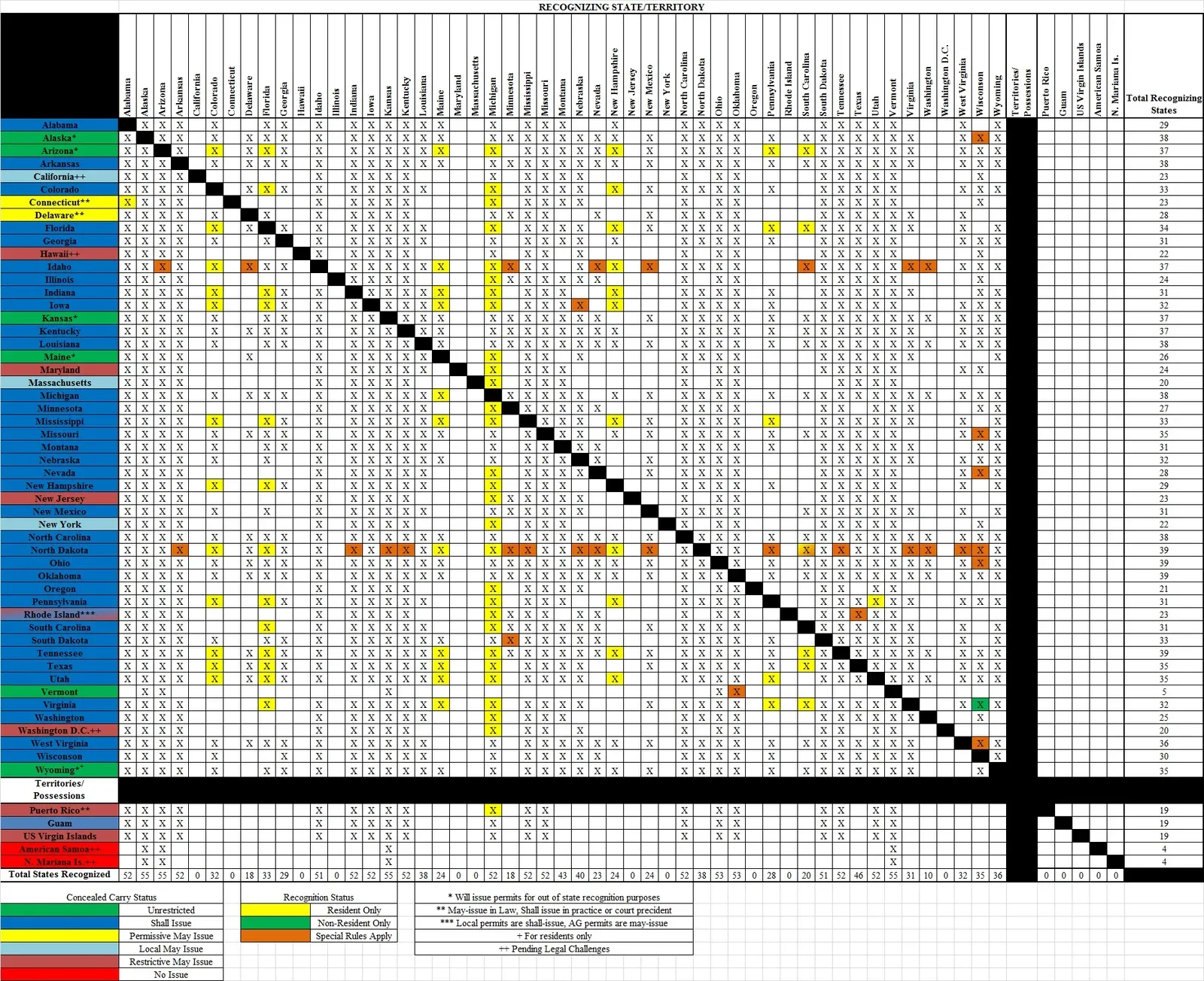
At the time the Court took the case, 43 states operated shall-issue licensing regimes — meaning authorities must issue a carry license whenever an applicant satisfies objective threshold requirements, without discretion to deny based on perceived lack of need. Only six states and the District of Columbia operated may-issue regimes granting discretion to deny licenses even to otherwise-qualified applicants: California, Hawaii, Maryland, Massachusetts, New Jersey, New York, and the District of Columbia. Every federal Circuit Court that had reviewed may-issue analogues had upheld them — with the sole exception of the D.C. Circuit, whose ruling had permanently enjoined D.C.'s standard since 2017.
Key Argumentsedit
Petitioners' Constitutional Claims
Petitioners argued that Heller and McDonald v. Chicago already established the Second Amendment as protecting an individual right to armed self-defense, and that nothing in the text of the Amendment draws a home/public distinction. The word "bear" arms naturally encompasses carrying weapons in public for confrontation — which can occur anywhere. Because Koch and Nash were plainly among "the people" the Second Amendment protects, and because handguns are unquestionably "in common use" for self-defense, New York bore the burden of showing its proper-cause standard was consistent with the Nation's historical tradition of firearm regulation. That tradition, they argued, contained no precedent for requiring ordinary citizens to prove a special need before exercising a constitutional right.
New York's Defense
New York defended the proper-cause requirement under the two-step means-end framework the Circuit Courts had developed post-Heller. The state argued that the scheme was substantially related to compelling interests in public safety and crime prevention — particularly given the density and character of places like New York City. New York also characterized its licensing regime as a "sensitive place" regulation, pointing to the unique public-safety challenges of densely populated urban environments. The United States filed as amicus in support of New York, agreeing that intermediate scrutiny was appropriate where text and history were unclear.
The Methodological Divide
The methodological divide was as significant as the specific dispute over New York's law. The two-step framework used by all eleven Circuits that had weighed in asked, first, whether the regulated conduct fell within the historical scope of the Second Amendment, and second — if it did — whether the government's interest and the law's fit with that interest justified the burden. The second step was essentially means-end scrutiny, calibrated by how close to the "core" the burden fell. New York and the United States argued this was required by constitutional text and consistent with Heller's methodology. The petitioners argued it was one step too many, and that Heller had already rejected interest-balancing as incompatible with an enumerated constitutional right.
The amicus participation was exceptional. Dozens of briefs were filed on both sides, including from:
- 176 members of the House of Representatives (supporting petitioners)
- 26 U.S. Senators (supporting New York)
- Former national security officials
- Major city police chiefs
- American Medical Association and American Bar Association
- Domestic violence prevention groups
- Second Amendment organizations (NAAGA, Gun Owners of America, etc.)
Decision & Rulingedit
Justice Thomas's majority opinion, issued June 23, 2022, reversed and remanded the Second Circuit's judgment.
The Constitutional Holdings
On the scope of the right: The Court held that the Second Amendment's plain text presumptively protects Koch's and Nash's proposed course of conduct — carrying handguns publicly for self-defense. Nothing in the text draws a home/public distinction. "Bear arms" means to carry weapons for offensive or defensive action in case of conflict. Confining "bear" to the home would nullify half the Amendment's operative protections. Confrontation can occur outside the home, and many Americans face greater danger in public than at home.
On the constitutional test: The Court rejected the two-step means-end framework as having "one step too many." Step one — assessing whether regulated conduct falls within the Second Amendment's historical scope — was broadly consistent with Heller. But Heller and McDonald v. Chicago do not support applying means-end scrutiny at step two. Heller's methodology centered on constitutional text and history; it did not invoke strict or intermediate scrutiny and expressly rejected any "interest-balancing inquiry."
The Second Amendment "is the very product of an interest balancing by the people" — a constitutional guarantee subject to judges' case-by-case assessments is no constitutional guarantee at all.
The New Test Framework
The test Bruen announced: When the Second Amendment's plain text covers an individual's conduct, the Constitution presumptively protects that conduct.
The Constitution presumptively protects conduct covered by the Second Amendment's plain text. The government must then demonstrate the regulation is consistent with the Nation's historical tradition of firearm regulation.
This does not require a historical analogue that is an exact match — only a well-established and representative historical analogue. Courts reason by analogy, asking whether modern and historical regulations impose a comparable burden on the right of armed self-defense and whether that burden is comparably justified. The Court confirmed that certain longstanding regulations — prohibitions in sensitive places such as schools and government buildings, laws disqualifying felons and the mentally ill, conditions on commercial sale — remain presumptively lawful, as Heller had indicated.
The Bruen Constitutional Test Framework
Historical Analysis
On New York's historical evidence: The majority conducted an extended survey of Anglo-American history, categorized into five periods:
- Medieval to early modern England: 1328 Statute of Northampton and subsequent interpretations
- Colonies and early Republic: Limited colonial-era restrictions on public carry
- Antebellum America: Common-law affray, concealed carry bans, surety statutes
- Reconstruction: Congressional debates and Fourteenth Amendment protections
- Late 19th/early 20th centuries: Western territorial laws and limited precedents
| Historical Period | New York's Evidence | Court's Analysis |
|---|---|---|
| Medieval England | 1328 Statute of Northampton | Dismissed: 450 years before ratification, predated handguns |
| Colonial Era | MA, NH, East NJ statutes | Insufficient to establish tradition; narrow terror-based restrictions |
| Antebellum | Concealed carry bans, surety laws | Presumed right to open carry; surety laws required specific threat showing |
| Reconstruction | TX cases: English v. State, State v. Duke | Outliers that couldn't overcome contrary evidence |
| Late 1800s West | Territorial carry restrictions | <1% of population, rarely tested, short-lived |
From medieval England, New York pointed primarily to the 1328 Statute of Northampton, which prohibited going or riding armed in fairs, markets, and other public places. The majority dismissed this as having "little bearing on the Second Amendment adopted in 1791" — enacted 450 years before ratification, it predated handguns entirely (which did not appear in Europe until roughly the mid-1500s), and appeared centrally concerned with armor and pole weapons. By the late 1600s, Chief Justice Holt's decision in Sir John Knight's Case (1686) confirmed the Statute had fallen largely into disuse, surviving only as a codification of the common-law offense of going armed "to the terror of the people" — requiring something beyond mere public carry.
From the colonial period, New York identified only three restrictions on public carry — statutes from Massachusetts, New Hampshire, and East New Jersey. The Court found these insufficient to establish a tradition, and analyzed them as prohibiting bearing arms in a way that spread "fear" or "terror" among the people, not as general carry bans. The East New Jersey law restricted only concealed carry of certain small weapons and applied narrowly to planters; it appeared to have lapsed before 1702.
Post-ratification antebellum evidence fell into three categories. Common-law affray offenses imposed limits on carry only when it was likely to terrorize others — not on peaceable public carry generally. Statutory concealed-carry prohibitions were consistently upheld in nineteenth-century courts only on the understanding that open carry remained available — an antebellum consensus that states could not altogether prohibit public carry of constitutionally protected arms. Surety statutes, adopted in Massachusetts in 1836 and spread to nine additional jurisdictions by 1871, required certain individuals to post bond before carrying weapons — but they presumed a right to carry, burdening it only upon a specific showing that the carrier intended injury or breach of the peace. This was the opposite structural logic of New York's regime, which presumed no right without a showing of special need.
From Reconstruction, the majority found that public carry for self-defense remained a central component of the rights the Fourteenth Amendment secured — reflected in congressional debates, Freedmen's Bureau reports, and the Dred Scott opinion's acknowledgment (however unwelcome) that citizenship would entail the right "to keep and carry arms wherever they went." Two Texas cases — English v. State (1871) and State v. Duke (1875) — did support a reasonable-grounds standard analogous to New York's, but the Court treated them as outliers that could not overcome the weight of contrary evidence.
Late nineteenth-century Western Territorial laws were dismissed on multiple grounds: they were localized restrictions covering less than 1% of the American population (per the 1890 census, the relevant territories — Arizona, Idaho, New Mexico, Oklahoma, and Wyoming — had a combined population of roughly 420,000 out of 62 million), they were rarely tested judicially, they were short-lived, and many did not survive a territory's admission to statehood.
The Court concluded: respondents had not met their burden to identify an American tradition justifying New York's proper-cause requirement. New York's proper-cause requirement violates the Fourteenth Amendment by preventing law-abiding citizens with ordinary self-defense needs from exercising their Second Amendment right to keep and bear arms in public.
Concurring Opinions
The concurrences added important limiting principles. Justice Alito wrote separately to underscore that the decision addressed only New York's may-issue regime and said nothing about who may lawfully possess firearms, what weapons may be regulated, or what restrictions Heller and McDonald v. Chicago had already blessed.
Justice Kavanaugh, joined by Chief Justice Roberts, emphasized two points: the ruling does not prohibit licensing requirements for public carry, and 43 states' shall-issue regimes — which may require fingerprinting, background checks, mental health checks, and firearms safety training — remain constitutionally permissible. Those regimes use objective criteria rather than open-ended discretion, and do not require a showing of special need beyond self-defense. The concurrence also reiterated Heller's list of presumptively lawful regulations and stressed the Second Amendment is "neither a regulatory straightjacket nor a regulatory blank check."
Justice Barrett concurred to flag unresolved methodological questions about how much weight post-ratification practice should carry and whether 1791 or 1868 is the appropriate historical baseline — questions the case did not require answering because New York's law lacked support in either period.
The Dissent
The dissent, authored by Justice Breyer and joined by Justices Sotomayor and Kagan, objected on three grounds. First, the Court decided the case on the pleadings without an evidentiary record, leaving open empirical questions about how New York's law actually operated across its diverse counties. Second, the Court's near-exclusive reliance on history was both constitutionally unnecessary and practically unworkable — courts are staffed by lawyers, not historians, and the result would be "a one-way ratchet" that makes it nearly impossible to sustain modern gun regulations. Third, applying the majority's own historical framework, the dissent argued the historical record actually supports New York's law — pointing to a continuous tradition from medieval England through colonial regulations, the founding era, the antebellum period, Reconstruction, and the late nineteenth century of restricting public carry of firearms, often more stringently than New York's regime.
Impact on Gun Rightsedit
Immediate Legal Effects
Bruen's immediate practical consequence was to invalidate the may-issue licensing regimes of New York, California, Hawaii, Maryland, Massachusetts, New Jersey, and the District of Columbia — jurisdictions that together encompassed roughly 84.4 million people, or more than a quarter of the U.S. population at the time. Those states were required to replace special-need standards with objective shall-issue criteria.
The ruling's broader consequence was methodological. By eliminating means-end scrutiny from Second Amendment analysis, Bruen reset the terms on which every firearms regulation would be evaluated going forward. Any challenger to any gun law could now demand that the government trace the law to a historical analogue from around 1791 or 1868 — without the government being able to fall back on arguments about compelling interests or narrow tailoring.
| Statistic | First Year Post-Bruen |
|---|---|
| Total Decisions | 450+ |
| Overall Uphold Rate | ~88% |
| Criminal Case Uphold Rate | ~93% |
| Laws Found Unconstitutional | 31 cases |
| Republican-Appointed Judges | 87% of pro-plaintiff decisions |
| Trump-Appointed Judges | 42% of pro-plaintiff decisions |
Litigation Surge
The immediate aftermath was a wave of litigation. According to an analysis by Second Amendment scholar Jake Charles at Pepperdine University, more than 450 decisions analyzing Bruen in Second Amendment challenges were issued in the first year after the ruling — more than double the approximately 175 decisions that applied Heller in its first year. Courts upheld gun laws in approximately 88% of post-Bruen cases overall, and in approximately 93% of criminal cases.
Courts applying Bruen properly upheld:
- Commercial firearms regulations
- Assault weapon restrictions
- Large-capacity magazine bans
- Ghost gun rules
- Sensitive place laws
- Permitting schemes with objective criteria
A smaller number of decisions went the other way. Through February 2023, federal courts found gun laws unconstitutional in 31 instances — with 87% of those decisions written by Republican-appointed judges, and 42% by judges appointed by former President Trump, according to the Giffords Law Center analysis. Among the most contested post-Bruen decisions was the Fifth Circuit's ruling in United States v. Rahimi, which held that the federal statute barring persons subject to domestic violence restraining orders from possessing firearms violated the Second Amendment — a decision the Supreme Court later took up for review.
The ruling also had a structural effect on how lower courts manage their caseloads. As one district court observed in United States v. Kelly, the Department of Justice filed firearms-related charges in upward of 13,000 criminal cases in fiscal year 2021 alone — every one of which potentially implicated Bruen's methodology, regardless of whether a trial court was well-suited to conduct exhaustive historical analysis.
Doctrinal Significance
Modern Second Amendment Case Law Development
Bruen sits in a direct line of succession from District of Columbia v. Heller (2008), which recognized an individual right to keep arms in the home, and McDonald v. Chicago (2010), which incorporated that right against the states through the Fourteenth Amendment. Together the three cases form the core trilogy of modern Second Amendment jurisprudence — each one expanding the doctrinal territory the Amendment covers and tightening the constraints on how government can justify regulation. The debate those cases opened — over the weight of history, the role of courts versus legislatures in firearms policy, and the practical administrability of text-and-history analysis — remained actively contested in federal courts through 2025 and into 2026.
The BGC Takeedit
Bruen is the ruling that finally answered the question Heller left hanging: yes, the Second Amendment follows you out the front door. That was the right call on the text — "bear" means carry.
If you can only exercise a right inside your own house, it's not much of a right.
The harder question is the test. The historical-tradition framework makes intuitive sense as a principle — constitutional rights mean what they meant when adopted, not what a given judge thinks they should mean today. But the dissent's critique isn't wrong on the practical side: asking trial courts to become competent historians on a 13,000-case-a-year docket is a real problem. The United States v. Rahimi situation — where one panel held that a domestic abuser under a restraining order had an unfettered constitutional right to a firearm — is what happens when the analogy-hunting goes off the rails.
The 88% uphold rate in the year after Bruen suggests the sky didn't fall. Most gun regulations survived because most gun regulations do have some historical footing, and because most judges read the decision as permitting analogical reasoning rather than demanding exact historical twins. The 12% of cases going the other way, though, contained some genuinely alarming outcomes that forced the Court's hand on subsequent review.
For people who carry lawfully, Bruen matters most because it killed the "may-issue" shakedown in the remaining holdout states — the system where a license was a bureaucratic favor granted at a licensing officer's discretion rather than a right exercised upon meeting objective criteria. That's a meaningful win regardless of where you stand on everything else. Whether the historical test the Court built to deliver that win turns out to be administrable over the long run is a separate question — and one that litigation will keep answering for years.
Referencesedit
- https://www.scotusblog.com/cases/case-files/new-york-state-rifle-pistol-association-inc-v-bruen/
- https://www.law.cornell.edu/supremecourt/text/20-843
- https://giffords.org/lawcenter/memo/second-amendment-challenges-following-the-supreme-courts-bruen-decision/
- https://www.bradyunited.org/resources/issues/new-york-state-rifle-pistol-association-inc.-v.-bruen
Last Updated: February 27, 2026
- Gls Guns(Sumner, IA)
- Bi-mart - Yakima (Fruitvale Ave)(Yakima, WA)
- New Philly Sportsman Specialities(New Philadelphia, OH)
- R&R Sports & Outdoors(Brandon, FL)
Loading comments...