Details
Peter Paul von Mauser
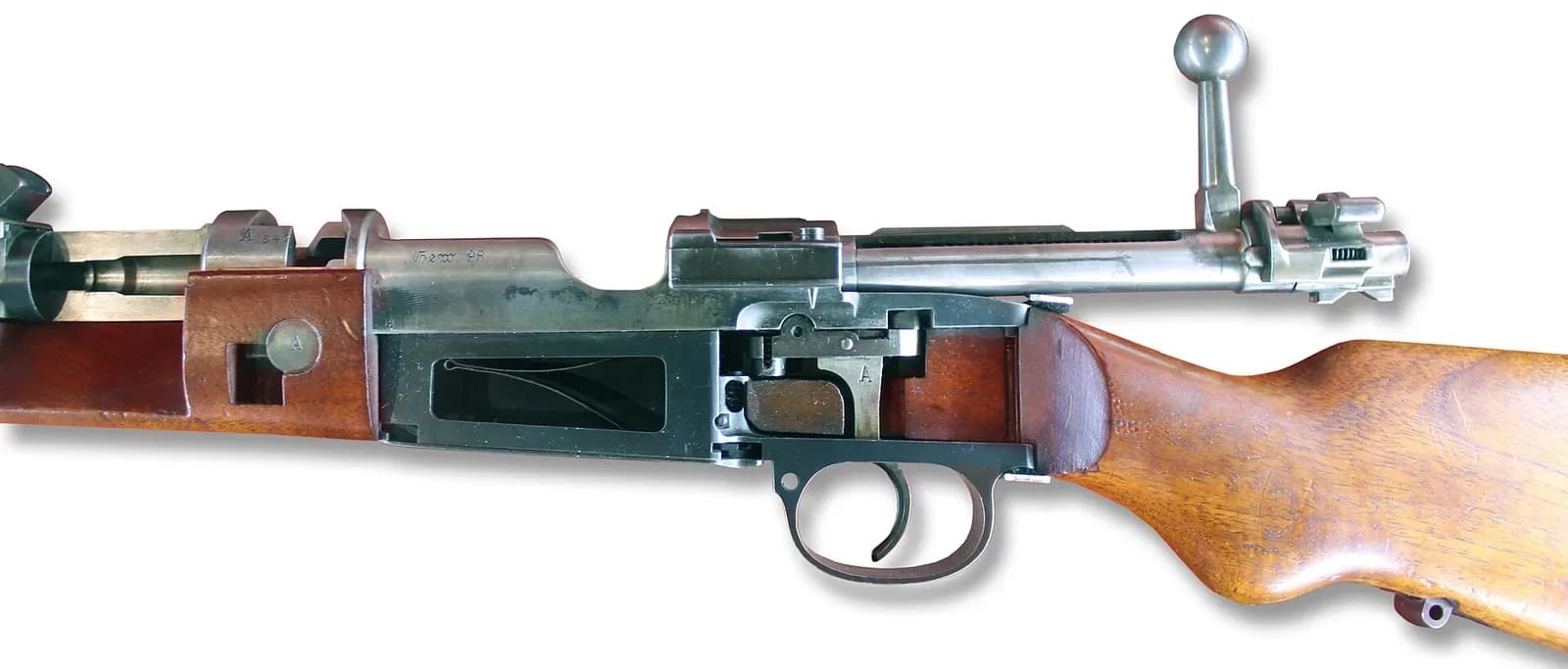
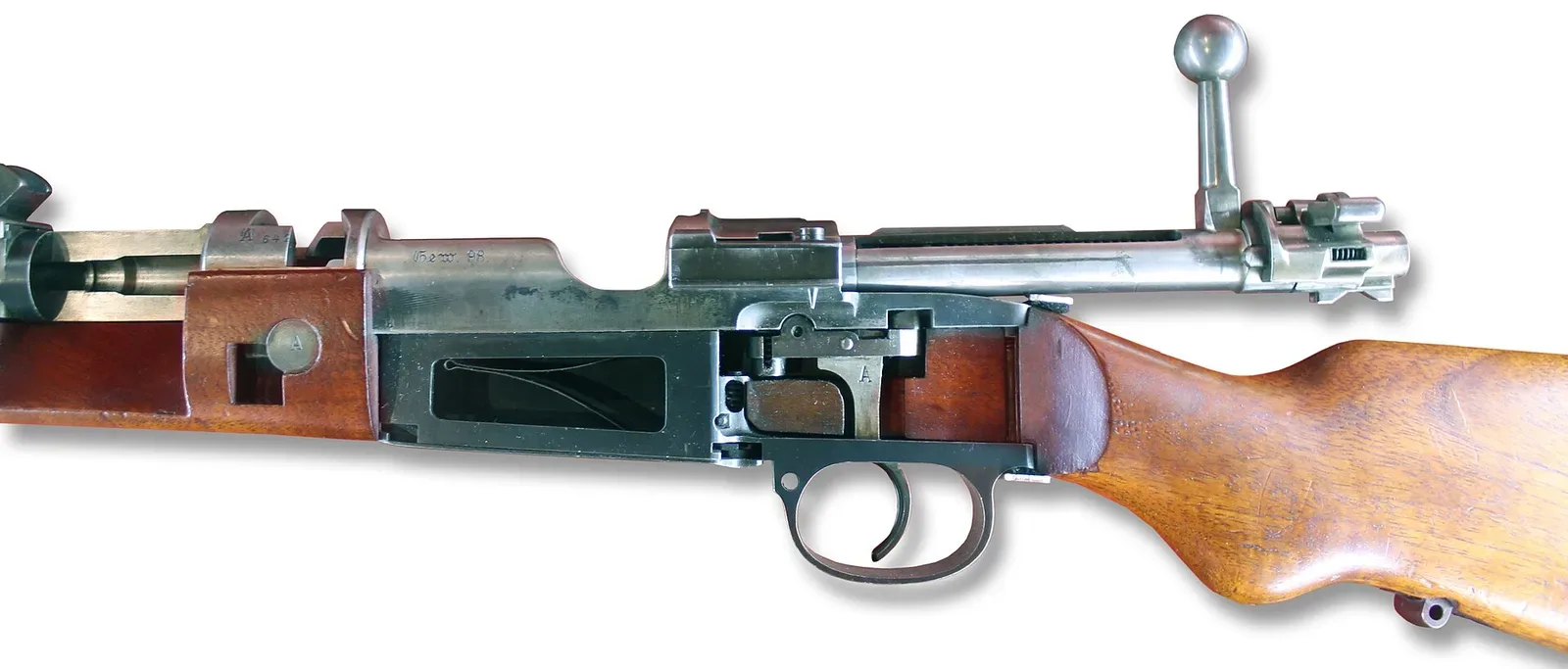
A cutaway Gewehr 98 from the Waffenmuseum Suhl reveals Mauser's bolt-action design — the mechanism that set the standard for military rifles worldwide.
| Biography | |
|---|---|
| Born | June 27, 1838, Oberndorf am Neckar, Kingdom of Württemberg |
| Died | May 29, 1914, Oberndorf |
| Nationality | German |
| Legacy | |
| Known For | Bolt-action rifle design and manufacturing; engineering the Gewehr 98 and M98 system that became the standard for military and sporting bolt-action rifles |
| Key Innovation | Refinement of bolt-action rifle mechanics including the controlled-round-feed claw extractor, three-lug bolt design, and gas-handling systems; design of the Gewehr 98 adopted April 5, 1898 |
Paul Mauser: The Man Who Built the World's Bolt-Action Standard
Firearms encyclopedia article
From The Boise Gun Club Handbook
Overviewedit
Peter Paul von Mauser (June 27, 1838 – May 29, 1914) was a German weapon designer, manufacturer, industrialist, and politician whose bolt-action rifle designs set the mechanical standard against which virtually every military and sporting bolt-action rifle of the 20th century would be measured. Born in Oberndorf am Neckar in the Kingdom of Württemberg, he spent his entire working life in the same town where he was raised, turning a modest government armory into one of the most consequential firearms manufacturing operations the world has ever seen.
Mauser did not invent the bolt-action rifle. What he did — across four decades of incremental, obsessive refinement — was take a fundamentally sound idea and engineer it to the point that it couldn't be meaningfully improved upon.
The Gewehr 98, adopted by the German military on April 5, 1898, was the culmination of that process. Its controlled-round-feed system, three-lug bolt, and gas-handling design influenced the M1903 Springfield, the Winchester Model 70, and essentially every serious bolt-action hunting rifle built since.
The U.S. Army paid $250,000 in royalties to Mauser specifically because the Springfield copied the design so closely that patent infringement was indefensible.
He died on May 29, 1914, two months before the rifle that bore his name was chambered and shouldered in the trenches of France.
Early Life & Backgroundedit
Family Background and Early Training
Franz Andreas von Mauser, Paul's father, came to Oberndorf with the military "Ouvrier Compagnie" and, after his discharge, stayed on to work at the Württemberg Royal Armory. According to one account, he also loaded ammunition at home to supplement the family's income. The Mauser children — Paul was the youngest of thirteen — were well educated for the time, with particular instruction in drawing and geometry, and all were expected to follow their father into the trade. Paul apprenticed at the factory from age 14.
| Year | Event | Significance |
|---|---|---|
| 1838 | Born in Oberndorf am Neckar | Württemberg Royal Armory town |
| 1852 | Began apprenticeship at age 14 | Factory training under father |
| 1859 | Prussian military service | Artillery at Ludwigsburg Arsenal |
| 1859 | Returned to Oberndorf | Began collaboration with Wilhelm |
| 1860s | First breechloading cannon prototype | Paid by King of Württemberg |
Military Service and Technical Development
In 1859, he was called into Prussian military service and assigned as an artilleryman at the Ludwigsburg Arsenal. The NRA Museums account notes that Paul later credited this period as directly influential on his breechloading work — he studied models of breechloading guns closely and began thinking through what a better system might look like. He returned to Oberndorf by the end of 1859.
Back home, Paul and his older brother Wilhelm Mauser began working on new designs during their free time. Wilhelm, four years Paul's senior, handled business and logistics while Paul handled the technical work — a division of labor that would define the Mauser enterprise for the next two decades. Their first collaborative effort was a breechloading cannon, which attracted enough attention that the King of Württemberg paid them for a prototype. But Paul's primary interest was small arms, and that's where the significant work would happen.
Key Contributionsedit
The Model 1871 and the First Generation
The starting point for the Mauser bolt-action was the Dreyse needle gun, then widely used by German military units. Designed by Johann Nikolaus von Dreyse, it used a turning-bolt system — mechanically, not far from an ordinary door latch. Paul recognized the concept was sound but the execution was flawed. Working from that foundation, he developed a system with a self-cocking bolt and a firing pin that struck a rear-primed metallic cartridge rather than piercing through a powder charge to ignite priming compound in a bullet's base.
The brothers pitched the improved rifle repeatedly — to the Württemberg War Ministry, to the Prussians, to Austria — and were turned down each time, usually because the prospective customer had just committed to a different system. Their break came through an unlikely intermediary: Samuel Norris, an American agent for E. Remington & Sons who encountered the Mauser design at the Austrian War Ministry and saw commercial potential. Norris partnered with the brothers in September 1867 to convert the French Chassepot needle gun to metallic cartridges, moving the Mausers to Liège, Belgium, to begin tooling up.
When Norris failed to land a French contract, he walked away from the agreement — and then filed to patent the Mausers' design in the United States in his own name, making a needle gun conversion the first patented rifle bearing the Mauser name on June 2, 1868.
Lacking funds, Paul returned to Oberndorf in December 1869. The brothers regrouped, continued refining the design, and eventually got it in front of the Royal Prussian Military Shooting School. Tests there were successful enough that ordnance officers asked for specific modifications to meet the requirements of the Royal Prussian Rifle Testing Commission. Wilhelm traveled to Spandau near Berlin to work through the changes. On December 2, 1871, the Mauser rifle was chosen to replace the Prussian needle gun. After Paul made a final safety adjustment, the rifle was officially designated Infantry Rifle, Model 71 on February 14, 1872 — the first bolt-action metallic cartridge rifle to enter German military service. It fired an 11mm black-powder cartridge pushing a 385-grain bullet at approximately 1,400 fps.
Prussia's preference was to manufacture the Model 71 at government arsenals rather than pay the Mausers to make it. Instead of the 60,000 Talers they had expected for Prussia's rights to the rifle, the brothers received 8,000 — plus an order for 3,000 rifle sights, which they accepted. Wilhelm's financial management and Paul's engineering kept the operation growing. By the end of 1872, the Oberndorf trade register listed Gebrueder Wilhelm und Paul Mauser. On February 5, 1874, the operation formally became Mauser Bros. and Co., having purchased the Württemberg Royal Armory with backing from the Württemberg Vereinsbank of Stuttgart. By 1884, after Wilhelm's unexpected death in January 1882 at not yet 50 years old, the firm reorganized as a stock company under the name Waffenfabrik Mauser.
The Model 71 was followed by the Model 71/84, which added a nine-round tubular magazine — making it a repeater and earning adoption by the army of Kaiser Wilhelm I on January 31, 1884. It was a reliable arm, but by then the direction of military rifle development was moving toward smaller-bore smokeless powder cartridges, and the 71/84's 11mm bullet was already a step behind.
| Model | Year | Key Innovation | Military Adoption |
|---|---|---|---|
| Model 71 | 1871 | Self-cocking bolt, metallic cartridge | Prussia (Feb 14, 1872) |
| Model 71/84 | 1884 | 9-round tubular magazine | Kaiser Wilhelm I army |
| Model 1889 | 1889 | First smokeless powder design | Belgium |
| Model 1892 | 1892 | Non-rotating claw extractor | Various exports |
| Model 1893 | 1893 | Staggered-column magazine, 7×57mm | Spain |
| Gewehr 98 | 1898 | Three-lug bolt, gas escape system | Germany |
The 1889–1896 Refinement Cycle
France's adoption of the Lebel 7.9mm smokeless cartridge rifle in 1886 forced everyone else to respond. Mauser's answer was the Model 1889, his first successful rifle for smokeless ammunition, which introduced a one-piece bolt with two front lugs and a stripper-clip-fed magazine — and which was adopted by Belgium. Similar designs followed: the Turkish 1890, the Argentine 1891, all chambering the 7.65×53mm Mauser cartridge that Paul had designed in 1889. These rifles shared a narrow, failure-prone extractor and could fire with the bolt out of battery — problems that Paul was already working to fix.
The Model 1892 introduced the long, non-rotating claw extractor that became the most recognized feature of the Mauser system. Attached to the bolt body with a collar, it required the rising case head to slide up into the claw before the cartridge aligned with the barrel — guaranteeing positive control over each round from the moment it left the magazine. The Model 1893, adopted widely and known as the Spanish Mauser, introduced the staggered-column flush magazine that gave the rifle a trimmer profile and a more durable receiver machined from a steel forging. It also introduced the 7×57mm Mauser cartridge, which Paul had designed in 1892 — a round that would prove deadly during the Spanish-American War and become a favorite hunting cartridge in Africa under the name .275 Rigby.
The Model 1895 added a shoulder at the rear of the receiver to engage the bolt handle root as a backup in the event the primary lugs failed. The Model 1896, developed for the Swedish military, added gas-escape holes and an integral guide rib on the bolt body. Each iteration addressed a specific failure mode identified in the previous design. By the mid-1890s, Mauser bolt-actions had become recognized as the standard against which other nations' military rifles were judged — including by the German Army itself, which had lost ground to its own country's export product.
The 27-year evolution from Model 71 to the perfected Gewehr 98 system
The Gewehr 98 and the M98 System
The Gewehr 98 was formally adopted by the German military on April 5, 1898 — a date Kaiser Wilhelm II personally marked by praising the rifle's construction. Its bolt-action design was based on the patent Paul Mauser filed on September 9, 1895.
The M98 system consolidated every lesson from the preceding two decades into one coherent design. The receiver ring was enlarged to 35.8mm diameter compared to previous "small ring" Mauser designs. The bolt featured two large primary locking lugs at the front, plus a third safety lug at the rear — the first time this backup feature appeared in a Mauser design. The non-rotating claw extractor controlled each round from the moment it cleared the magazine lips. Gas-escape ports in the bolt body were routed down the locking lug raceway and out through a thumb-hole cutout on the left side of the receiver, directing any catastrophic case failure away from the shooter's face. The firing pin had shoulders that physically prevented it from contacting a primer unless the bolt was fully locked — eliminating out-of-battery detonation. The three-position flag safety locked the firing pin and bolt in the right position, allowed bolt operation only in the center position (while visually blocking the sights as a reminder), and released everything in the left-fire position.
M98 controlled-round-feed cycle with integrated safety systems
| System Component | Function | Safety Feature |
|---|---|---|
| Claw Extractor | Controls round from magazine to ejection | Prevents double-feeds |
| Three Lugs | Two primary + one safety lug | Backup if primary lugs fail |
| Gas Escape Ports | Routes case failure away from shooter | Protects face and eyes |
| Firing Pin Block | Prevents out-of-battery firing | Physical shoulders on pin |
| Three-Position Safety | Controls firing pin and bolt | Visual sight blocking |
| Total Parts Count | 44 parts total, 29 in action | Simpler than SMLE (67) or M1903 (49) |
The entire Gewehr 98 consisted of 44 parts, with the action itself accounting for 29, and the bolt assembly only nine. By comparison, the SMLE had 67 parts total and the M1903 Springfield had 49. According to American Rifleman technical editor Ludwig Olson, principal improvements over previous Mauser designs included:
- Cocking on opening of the bolt
- Shorter firing pin travel of only half an inch for faster lock time
- Enlarged-diameter receiver ring
- A safety lug
- A bolt sleeve lock
- The shrouded bolt head
At the outbreak of World War I in 1914, the German Army had 2,273,080 Mauser 98-pattern rifles on hand. An additional 7,000,000 were produced during the war. More than 9,000,000 Gewehr 98s were built in total across the production run from 1898 to 1918, manufactured not only by Waffenfabrik Mauser but by Deutsche Waffen und Munitionsfabriken, Haenel, Sauer & Sohn, and the Imperial Arsenals at Amberg, Danzig, Erfurt, Leipzig, and Spandau.
The M1903 Springfield's design borrowed so heavily from the Mauser 98 that the U.S. government settled with Mauser financially rather than fight a patent-infringement claim, paying $250,000 in royalties.
The C96 Pistol and Cartridge Design
Mauser's work was not confined to rifles. In 1896 he developed the C96 pistol — the so-called "Broomhandle" — one of the first semi-automatic pistols in history. He had also designed the C78 revolver earlier in his career. His cartridge contributions were equally significant: the 7.65×53mm Mauser (1889) and the 7×57mm Mauser (1892) were high-performance service cartridges that compared favorably against contemporary smokeless designs like the 8mm Lebel (1886), 8×50mmR Mannlicher (1890), and .303 British (1891).
Entry into Politics
From 1898 to 1903, Paul Mauser served as a member of the German Reichstag for the National Liberal Party, representing the 8th district of Württemberg — covering Freudenstadt, Horb, Oberndorf, and Sulz. He was nominated through an alliance of Conservatives, the Farmers' Federation, and the National Liberals, and joined the Reichstag Group of National Liberals as a guest member.
Impact on Firearms Developmentedit
International Military Adoption
The M98 system's influence extended well beyond the German military. By the time the Gewehr 98 was adopted, Mauser had already supplied rifles or licensed designs to:
- Belgium
- Spain
- Turkey
- Argentina
- Brazil
- Chile
- Sweden
- Peru
- Serbia
- and numerous other nations
The list of countries that eventually built rifles directly derived from or based on the M98 bolt-action system covers most of the industrialized world:
| Country | Model | Year | Based on M98 System |
|---|---|---|---|
| Czechoslovakia | vz. 24 | 1924 | Yes |
| Belgium | FN M1924/M1930 | 1924-1930 | Yes |
| Poland | Karabinek wz. 1929 | 1929 | Yes |
| Yugoslavia | Zastava M48 | 1948 | Yes |
| Spain | M1943 short rifle | 1943 | Yes |
| USA | M1903 Springfield | 1903 | $250,000 royalty paid |
Sporting and Hunting Applications
In 1900, Mauser chose John Rigby & Co. of London as its exclusive agent for sporting rifles. Rigby's relationship with the M98 action extended the design into the dangerous-game hunting world in a way that military procurement never would have. In 1911, Rigby introduced the .416 Rigby cartridge — a round dimensionally large enough that it could only be used in the M98 Magnum action, which John Rigby & Co. had commissioned Mauser to develop.
Rigby's monopoly on Magnum Mauser actions lasted until 1912, after which Westley Richards, W.J. Jeffery, Holland & Holland, and others began building rifles on the same platform.
The Winchester Model 54 and the later Winchester Model 70 — widely considered the benchmark American bolt-action hunting rifle of the 20th century — are both based on the Mauser action design. The Ruger M77 carried significant M98 influence as well. The pre-'64 Winchester Model 70 in particular retained the controlled-round-feed claw extractor that defines the M98 system, and its elimination in Winchester's post-1964 cost-cutting redesign became one of the most controversial production decisions in American sporting rifle history.
Technical Assessment
The M98 action's controlled-round-feed mechanism earned particular reverence among hunters of dangerous game — buffalo, elephant, lion, leopard — where a failure to extract or a double-feed in the wrong moment has consequences the shooter may not survive. Professional hunters working in Africa through much of the 20th century regarded the M98 claw extractor as the functional minimum for a reliable dangerous-game rifle. That reputation was not marketing; it was the accumulated field experience of people for whom rifle failure was not a range inconvenience.
The M98 Mauser is the best, strongest and most foolproof military turnbolt action ever made. — Frank de Haas, American Rifleman
According to the late American Rifleman contributor Frank de Haas, who had extensive hands-on experience across many bolt-action designs, he did note one potential weak point — the thumb notch cut into the left receiver wall — and suggested that a simple round hole in the receiver ring would have more effectively redirected gas in a case failure. But that criticism exists within the context of an otherwise unqualified assessment of the design's soundness.
Later Life & Legacyedit
Personal Tragedy and Final Years
In 1901, three years after the Gewehr 98 was adopted, Paul Mauser lost his left eye when a cartridge exploded during test firing of the C98 self-loading design — a painful irony for the man who had spent years designing gas-handling systems specifically to protect shooters from exactly that kind of failure. The accident did not slow him down meaningfully.
He died on May 29, 1914, at age 75, in Oberndorf — the same town where he was born, raised, apprenticed, and worked his entire life.
World War Impact
An obituary published in Arms and Explosives magazine in London in July 1914 captured something true about the man:
He took his rifles to bed with him, and was often rewarded by inspirations which refused to come at other times. — Arms and Explosives magazine, July 1914
The same obituary noted that he "believed that everybody he met was a good fellow like himself" and that the vast industrial organization that grew around his work "was inspired by him, but not of his building" — a reference to the fact that Wilhelm had handled the business architecture that made Waffenfabrik Mauser viable, and that Paul had been largely insulated from financial concerns throughout his career.
He died two months before the Gewehr 98 went to war. He never saw the First World War, never saw his rifle used at the Somme or Verdun, never saw it become the frontline arm of two German armies across two global conflicts. At the outbreak of WWI in 1914, the German Army had over two million Mauser 98-pattern rifles in inventory. By the war's end, another seven million had been produced.
Post-War Evolution and Modern Production
The Karabiner 98k — a shortened, refined version of the Gewehr 98 adopted in 1935 — served as Germany's standard infantry rifle throughout World War II. The action was essentially unchanged from Paul Mauser's 1895 patent. The K98k's main physical differences were a turned-down bolt handle, a shorter 600mm barrel versus the Gewehr 98's 740mm, and a tangent rear sight replacing the original Lange Visier ramp. It is the same bolt, the same extractor, the same three-lug lockup.
After World War II, Waffenfabrik Mauser was renamed Mauser-Werke and redirected toward the sporting market. Production of new M98-system sporting rifles continued through various ownership changes, and the reconstituted Mauser Jagdwaffen GmbH resumed production of M98 rifles in 1999 based on original drawings. As of 2009, those rifles retailed at approximately €6,800 for the base version. Today, original-condition military surplus Mausers are more likely to end up preserved in collections than sporterized, though custom gunsmiths and firms like John Rigby & Co. continue building rifles on M98 actions — with prices that can easily reach five figures.
Mauser was awarded the Grashof commemorative coin from the Association of German Engineers in 1912, two years before his death. He served in the Reichstag, he ran a major industrial concern, he designed cartridges that are still in production, and he built pistols that collectors still seek out. But his legacy is the bolt-action system — a mechanism so well conceived that more than 125 years of manufacturing innovation has produced refinements and cost reductions, but nothing that has fundamentally displaced the M98 as the reference standard for controlled-round-feed bolt-action reliability.
The BGC Takeedit
Here's what's worth sitting with: Paul Mauser didn't get it right on the first try. He got it right on about the fifteenth try, across 27 years of incremental work from the Model 71 to the Model 98. The non-rotating claw extractor didn't appear until 1892. The staggered-column flush magazine came with the 1893. The third safety lug, the enlarged receiver ring, the gas-escape system, the bolt sleeve lock — all of those showed up in the 1898. Each one solved a specific problem that had shown up in a previous design, often under field conditions where the consequences of failure were real.
That's not how gun design gets discussed in the popular press, where the narrative tends toward sudden genius. What actually happened with the M98 looks more like rigorous engineering iteration — the kind where you keep making the same thing until it stops failing in new ways. Paul Mauser just happened to be obsessive enough, and lived long enough, to finish the job.
The Springfield royalty payment is the most honest endorsement the M98 ever received. The U.S. Army looked at every bolt-action design available, concluded that the Mauser 98 was the one worth copying, copied it closely enough to owe money, and then paid. That's the system working correctly. Credit goes where credit is due, and in bolt-action rifle design, it goes to Oberndorf.
When your life depends on the rifle cycling, you don't pick the action with the most interesting marketing story. You pick the one that works.
The fact that the M98 still shows up in custom dangerous-game rifles — not as nostalgia, but as the functional choice of professional hunters — says more about the design than any review ever could.
Referencesedit
- https://en.wikipedia.org/wiki/Paul_Mauser
- https://en.wikipedia.org/wiki/Gewehr_98
- https://www.nramuseum.org/guns/the-galleries/world-war-i-and-firearms-innovation/case-35-evolution-of-the-bolt-action-rifle/mauser-gewehr-98-bolt-action-rifle.aspx
- https://www.americanrifleman.org/content/the-mauser-model-98-truly-great/
- https://www.americanhunter.org/content/the-mauser-98-still-perfect-for-hunters/
- https://sportingclassicsdaily.com/paul-mauser-the-man-who-repurposed-the-door-latch/
- https://norfolktankmuseum.co.uk/mauser-rifle/
Last Updated: February 27, 2026
- Gls Guns(Sumner, IA)
- Bi-mart - Yakima (Fruitvale Ave)(Yakima, WA)
- New Philly Sportsman Specialities(New Philadelphia, OH)
- R&R Sports & Outdoors(Brandon, FL)
Loading comments...