Specifications
Gewehr 98

A museum cutaway model reveals the Gewehr 98's internal architecture — the bolt-action system that influenced rifle design for decades.
Markscheider (CC BY 3.0)
| Manufacturer | |
|---|---|
| Made By | Waffenfabrik Mauser |
| Designer | Paul Mauser |
| Origin | Germany |
| Specifications | |
| Caliber | 7.92×57mm Mauser |
| Action | bolt action |
| Capacity | 5 rounds |
| Barrel | 29.1 inches |
| Length | 49.2 inches |
| Weight | 9 pounds |
| Feed | Controlled-round-feed, five-round magazine |
| Sights | Open rear sight, front post |
| Performance | |
| Eff. Range | 2,000 yards |
| Muzzle Vel. | 2,880 ft/s |
| Production | |
| Designed | 1895 |
| In Production | 1898 |
| Produced | Estimated over 5 million |
| Variants | |
| |
| Service Use | |
Imperial German ArmyWeimar RepublicNazi GermanyBelgiumSpainTurkeySouth American nations | |
| Cultural Note | |
| The Gewehr 98 established the mechanical benchmark for modern bolt-action rifle design. Its controlled-round-feed system and locking geometry became the standard upon which virtually all subsequent bolt-action rifles, both military and sporting, were based. It served through both World Wars and remains one of the most influential firearm designs in history. | |
| Related Firearms | |
Gewehr 98: The Bolt Action That Built the Modern Rifle
Firearms encyclopedia article
From The Boise Gun Club Handbook
Overviewedit
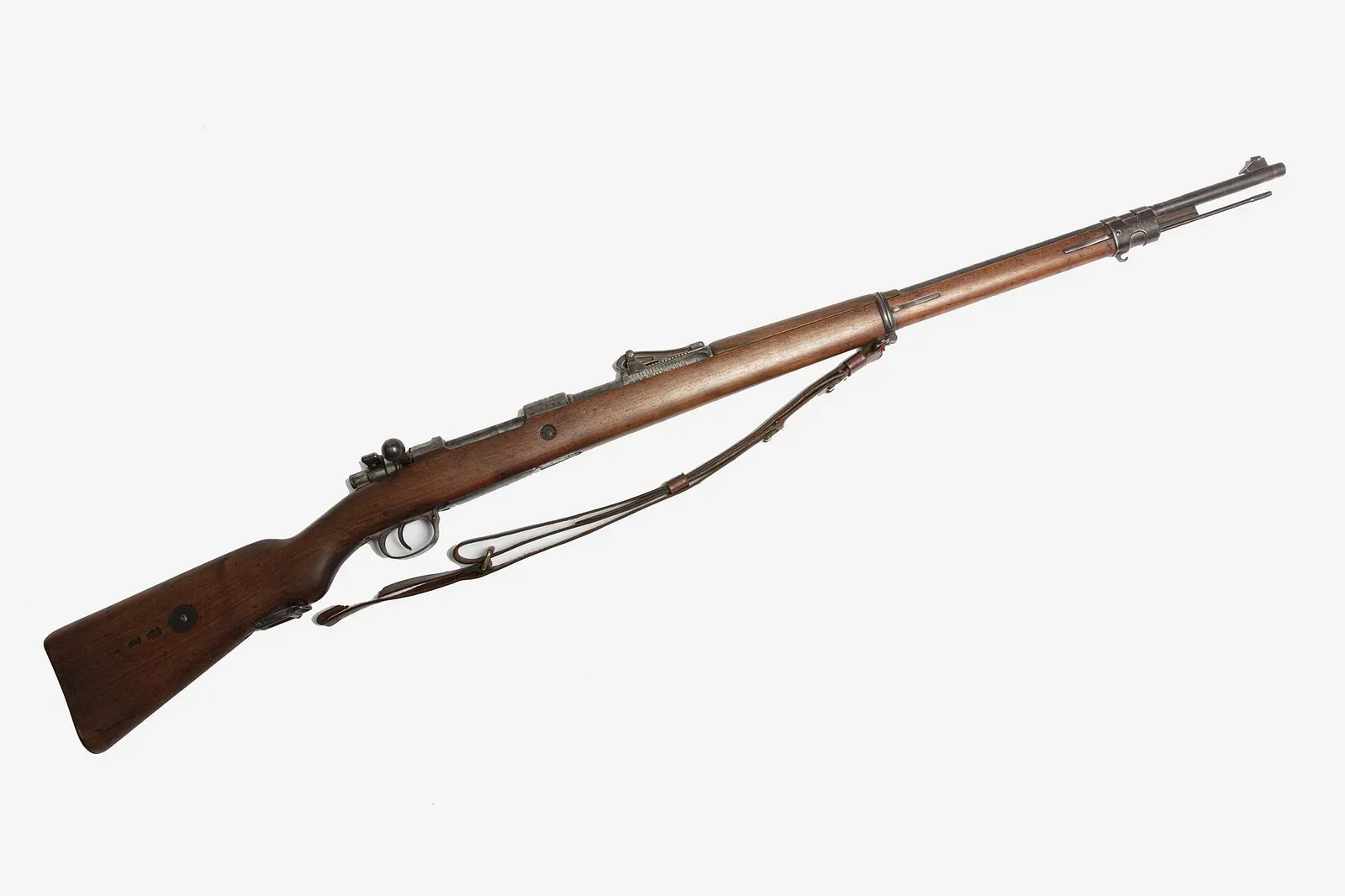
The Gewehr 98—abbreviated Gew. 98 and sometimes called the Mauser 98—is the bolt-action military rifle that became the standard service arm of the Imperial German Army in April 1898. Chambered in 7.92×57mm Mauser, it served through two World Wars and set the mechanical benchmark that virtually every subsequent bolt-action rifle—military or sporting—has been measured against.
If you own a bolt-action hunting rifle today, there is a better-than-even chance its controlled-round-feed system and locking geometry trace directly back to the Gewehr 98.
It was adopted as a replacement for the Model 1888 Commission Rifle, a rifle designed by committee that had proven less than satisfactory in German service. What replaced it was anything but a committee design. The Gew. 98 was the culmination of nearly three decades of systematic work by Paul Mauser, and it showed. According to the NRA Museums, its strength, simplicity, and ease of manufacture made it the workhorse of the German army through both World Wars and earned it adoption by nations around the world.
Design Historyedit
Paul Mauser: The Man Behind the Rifle
To understand the Gewehr 98, you have to go back to the man who built it. Paul Mauser was born on June 27, 1838, in Oberndorf, Germany, the youngest of thirteen children. His father, Andreas Mauser, worked as a master gunsmith at a government firearms factory in the same town—six of his sons, Paul included, were trained in that trade.
Per the NRA Museums, Paul showed an early gift for improving existing methods and designing new tools, and his time as an artilleryman at the arsenal at Ludwigsburg proved formative. He later credited that period as directly influential in his breechloading work for small arms.
By 1859 he had returned to work at the Royal Firearms Factory in Oberndorf, where he and his older brother Wilhelm spent their free time developing new firearms. Wilhelm handled business; Paul handled metal. Their early work focused on improving the Dreyse Needle Gun, then the standard German military arm. The Dreyse used a turning-bolt locking system, and Paul used that as a starting point—developing a cam-actuated action that opened, closed, and cocked the mainspring in a single motion.
Early Development: From Model 71 to 1888
The German military wasn't immediately interested, so the brothers took their rifle to the Austrian ambassador, which brought it to the attention of Charles Norris, a representative of E. Remington & Sons. In 1867, Norris partnered with the Mausers to pursue a French government contract for converting the Chassepot to metallic cartridge—that effort failed, but it generated enough interest at the Royal Prussian Shooting School that the brothers were invited to Spandau to refine their design further.
On December 2, 1871, the Mauser was officially adopted as the Infantry Rifle Model 71, becoming the first bolt-action metallic cartridge rifle in German military service.
| Model | Year Adopted | Key Features | Notes |
|---|---|---|---|
| Model 71 | December 2, 1871 | Single-shot, metallic cartridge | First Mauser military rifle |
| Model 71/84 | January 31, 1884 | Repeating action | Company became Waffenfabrik Mauser |
| Model 1888 | 1888 | Commission design | German stopgap, ultimately disappointing |
| Model 89 | 1889 | 7.65mm smokeless | Belgian adoption, exported widely |
| Gewehr 98 | April 1898 | 7.92×57mm, controlled feed | Paul Mauser's defining work |
From the Model 71, Mauser kept pushing. The Infantry Rifle Model 71/84 followed, adopted on January 31, 1884, as a repeating rifle. In April of that year, the company became Waffenfabrik Mauser. A Turkish contract for 500,000 rifles in 9.5mm occupied much of Paul Mauser's attention through the mid-1880s, which meant he sat out much of the internal German development that produced the ultimately disappointing Model 1888. France's 1886 adoption of the Lebel with its smokeless powder cartridge had forced Germany's hand, and the resulting Commission Rifle was a stopgap at best.
The Road to Gewehr 98
Mauser re-entered the picture with a 7.65mm smokeless design for Belgian military trials in 1888—the Model 89, adopted by Belgium and sold to Spain, Turkey, and several South American countries. He continued refining through the Model 92 and Model 95 before arriving at what would become his defining work. In April 1898, Germany's Gewehr-Prüfungskommission (the Rifle Testing Commission, or G.P.K.) officially adopted the design Mauser had patented in September 1895. It entered German service as the Gewehr 98.
Paul Mauser died in May 1914—just months before the rifle he'd spent his career building toward would be carried into the largest war the world had yet seen.
Timeline of Paul Mauser's career and major rifle developments leading to the Gewehr 98
Technical Characteristicsedit
Physical Specifications
The Gew. 98 is a long rifle in the tradition of early twentieth-century infantry arms—49.2 inches overall, with a 29.1-inch barrel, and a weight of 9 pounds. The stock is full-length walnut on early production rifles, with wartime examples shifting to birch, beech, maple, and elm as materials became scarce. A short handguard covers roughly 7.5 inches from the rear sight to the rear band.
The front band encloses a steel endcap with a large bayonet lug, designed so the bayonet itself requires no muzzle ring—a deliberate choice to reduce accuracy degradation when the bayonet is fixed.
| Specification | Value |
|---|---|
| Overall Length | 49.2 inches |
| Barrel Length | 29.1 inches |
| Weight | 9 pounds |
| Caliber | 7.92×57mm Mauser |
| Magazine Capacity | 5 rounds (internal box) |
| Sight Range | 400-2,000 meters |
| Muzzle Velocity | 2,881 fps (1903 spitzer) |
| Bullet Weight | 154 grains (1903 spitzer) |
The Revolutionary Bolt System
The action is a cock-on-open bolt, meaning the firing mechanism begins cocking as the bolt handle is lifted. The bolt features a long, straight handle that, while slightly less ergonomically convenient than a bent handle, provides greater leverage when the action is fouled or a cartridge case has swollen. That was not a trivial consideration in the mud of the Western Front.
The locking system is where the Gew. 98 distinguished itself from everything that came before it. The bolt engages the receiver with two large forward locking lugs, positioned just behind the bolt head. A third safety lug—located near the bolt handle—provides emergency support if the primary lugs fail, typically in the event of a ruptured cartridge case.
The Gew. 98 was the safest bolt-action in military service anywhere at its introduction, incorporating lessons learned from Paul Mauser's own accident with an earlier design.
Per the NRA Museums, an improved firing pin was also incorporated: even if broken, it cannot travel forward unless the bolt is fully closed. Combined with two gas-escape holes on the bolt body and a large gas shield at the cocking piece, the Gew. 98 was the safest bolt-action action in military service anywhere at its introduction.
According to American Rifleman, Paul Mauser had lost an eye during an accident with one of his own earlier designs. That personal experience drove him to add safety features with each successive rifle until the Model 98 represented the practical limit of what contemporary metallurgy and manufacturing could achieve.
Gewehr 98 bolt action cycle showing controlled round feed and three-lug locking system
Feeding and Sighting Systems
The long claw extractor—one of the Gew. 98's most recognizable and widely copied features—serves dual purposes. It grips the cartridge rim as the round feeds from the magazine into the chamber, a process called controlled-round-feed, and it guides the bolt through its travel. This means the rifle will not strip a second round from the magazine until the first is fully chambered, dramatically reducing the chance of a double-feed malfunction. That feature was directly adopted in the U.S. Springfield Model 1903 and remains a standard of quality on premium bolt-action designs today, including the Winchester Model 70.
The magazine is an internal, staggered-row box holding five rounds, fed by five-round stripper clips that allow all five cartridges to be loaded with a single downward push. A thumb relief cut in the side of the receiver facilitates that loading motion. The stripper clip is automatically ejected when the bolt is closed on the loaded magazine.
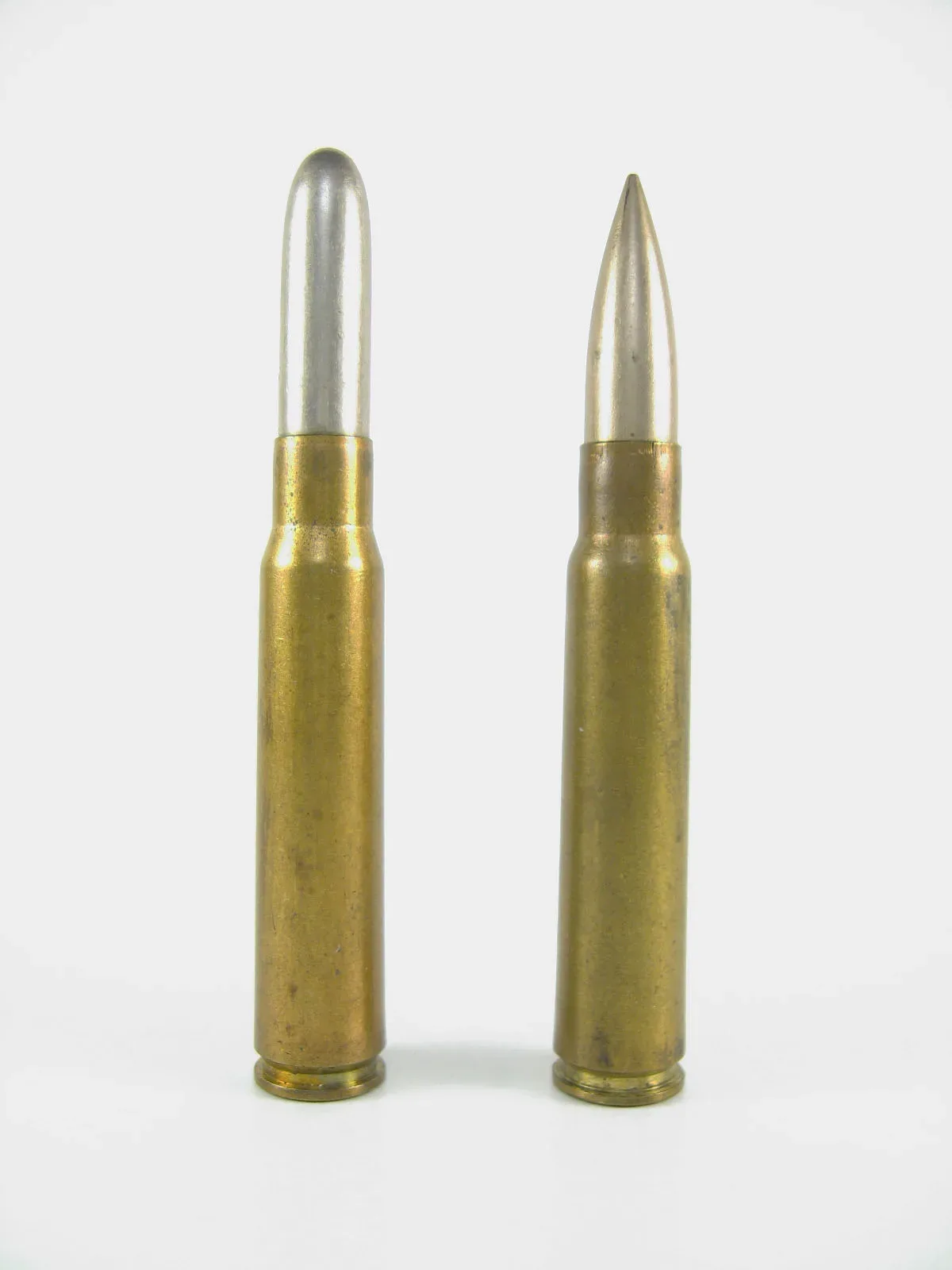
The Lange Visier tangent rear sight—known to American collectors as the "roller coaster" sight—is one of the most visually distinctive features of the Gew. 98. It is adjustable from a 400-meter battle zero out to 2,000 meters. For the rifle's first five years of service, it was paired with a 226-grain, .318-inch round-nose bullet. In 1903, that projectile was replaced by a 154-grain, .323-inch Spitzgeschoss (spitzer) pointed bullet, which the 29.1-inch barrel pushed to a muzzle velocity of 2,881 fps—a significant increase over the old round-nose load. The sight was adjusted to accommodate the new bullet's flatter trajectory, with a shortened Lange Visier and a reduced front sight blade providing the solution that carried the rifle through to the 1918 Armistice.
Production and Manufacturing
Production of the Gew. 98 was carried out at multiple facilities:
- Imperial arsenals: Amberg, Danzig, Erfurt, and Spandau
- Private contractors: Mauser Oberndorf and DWM (Deutsche Waffen und Munitionsfabriken)
- Later wartime production: C.G. Haenel and Simpson Suhl
- Government markings: Imperial crown on receiver ring with arsenal location and year
- Commercial markings: Company name and year of manufacture
Combat & Field Useedit
Early Combat Experience
The Gew. 98's first combat deployment came during the Boxer Rebellion in 1900, where German troops were part of the international force sent to China. Initial performance reports were positive, but cautious German procurement—shaped by having adopted two rifles in rapid succession that quickly became obsolete—meant the rifle replaced the Gewehr 88 slowly. The initial production contract called for just 65,000 rifles.
The Great War Deployment
By the time the Great War began in August 1914, roughly 2.5 million Gewehr 98s were in German inventory, according to American Rifleman. That number was nowhere near sufficient for the scale of conflict that followed. Production accelerated dramatically after 1914, with approximately seven million additional rifles manufactured over the course of the war. The rifle also equipped Austro-Hungarian and Ottoman forces, spreading its presence across every major front—from the trenches of France and Belgium to the frozen Eastern Front, from the African campaigns to Gallipoli and the Sinai Desert.
| Front/Campaign | Key Battles | Performance Notes |
|---|---|---|
| Western Front | Mons, Verdun, Somme | Dust covers added for trench warfare |
| Eastern Front | Tannenberg, Brusilov | Reliable in extreme conditions |
| Middle East | Gallipoli, Sinai | Equipped Ottoman forces |
| Africa | Various campaigns | Widespread deployment |
| Initial Deployment | Boxer Rebellion (1900) | First combat use, positive reports |
On the Western Front it saw action from Mons to Verdun. On the Eastern Front it fought at Tannenberg. In four years of industrial-scale warfare against British Lee-Enfields, French Lebels, and Russian Mosin-Nagants, the Gew. 98 earned a reputation for accuracy, reliability, and robustness that its competitors matched but rarely exceeded.
Trench Warfare Adaptations
The static nature of trench warfare forced several field modifications. The Generalquartiermeister issued a sheet-metal dust cover hinged to fit over the action, helping keep the mechanism clear of the mud that made the Western Front so uniquely miserable. To increase volume of fire, an extended 25-round Grabenmagazin (trench magazine) was developed. German forces also converted some Gew. 98s to accept a detachable monocular optical sight—manufactured by Carl Zeiss—that superimposed a pyramid-shaped aiming point over the target.
Field modifications for improved combat effectiveness:
- Sheet-metal dust cover: Hinged design to protect action from trench mud
- 25-round Grabenmagazin: Extended magazine for increased volume of fire
- Zeiss optical sight: Detachable monocular with pyramid aiming point
- Stoßtruppen modifications: Adaptations for assault troop tactics
A Rifle's War Story
By 1918, the battlefield context had shifted considerably. The Germans had developed their Stoßtruppen (assault troop) tactics and begun fielding the MP.18 submachine gun for trench-raiding operations. But even as that paradigm shifted, the Gew. 98 remained the backbone of German infantry firepower. It was the rifle carried by the infantry during Operation Michael, the massive March 1918 offensive—preceded by an intense bombardment from 6,600 artillery pieces—that aimed to achieve a breakthrough on the Western Front before American forces could tip the balance.
The offensive achieved a breakthrough along a 43-mile front between St. Quentin, Arras, and La Fère, but never reached the rail junction at Amiens, and the channel ports it needed to capture remained in Allied hands. The Gew. 98 was a superb rifle. It could not fix a strategic situation that had passed the point of rescue.
One Gew. 98 from this era has a documented American connection. A 1915-production rifle in the collection of the Smithsonian National Museum of African American History and Culture was found in Germany by Corporal Lawrence McVey of the 369th Infantry Regiment during World War I. The rifle bears manufacturer's markings from Waffenfabrik Mauser A.-G., Oberndorf, dated 1915-16, and serial number 2766. McVey, born in 1897, was an American soldier who served with the 369th—the "Harlem Hellfighters." That single rifle encapsulates a significant slice of the war's history in a piece of steel and walnut.
Legacy & Influenceedit
Post-War Evolution
The Gew. 98 did not simply end when Germany lost the war. The Weimar Republic retained the rifle in service, and during the interwar period—constrained by the Treaty of Versailles restrictions on military rifles—the Germans redesignated modified Gew. 98s as the Kar98b, a workaround that allowed continued service. That evolutionary line continued directly into the Karabiner 98k, a shortened carbine version with a turned-down bolt handle that became Germany's primary service rifle throughout World War II. The K98k is a Gew. 98 with a haircut.
Global Impact on Rifle Design
The influence extended far beyond Germany. The U.S. Springfield Model 1903 was developed incorporating Mauser's patents—close enough that the U.S. government eventually paid royalties to Mauser before the outbreak of WWI made that arrangement inconvenient. The controlled-round-feed system, the three-lug bolt concept, the recessed bolt face, the staggered internal magazine—all of these became standard features in bolt-action design worldwide because of what Paul Mauser worked out in Oberndorf.
| Feature | Adopted By | Modern Examples |
|---|---|---|
| Controlled Round Feed | Springfield M1903, Winchester M70 | Most premium hunting rifles |
| Three-Lug Bolt | Countless military/sporting rifles | Industry standard |
| Long Claw Extractor | Springfield M1903, modern Mausers | Reliability benchmark |
| Gas Protection System | Most subsequent bolt actions | Safety standard |
| Staggered Magazine | Universal adoption | Modern hunting rifles |
Mauser patents served as the platform for sporting and military rifles across dozens of countries and manufacturers. Per the NRA Museums, the Model 98 is still manufactured today. Countless former military Gew. 98s were sporterized in the postwar decades, rebarreled and restocked as hunting rifles—a fate that has made original, unaltered, matching-number examples increasingly scarce and collectible. Per hearmyselftalkhistory.com, original unblued receivers left "in the white" by the factory are rarer still, as many were blued either by German post-war refurbishment or by American GIs who brought them home.
Collector Value and Modern Status
Collector values for Gew. 98s currently run approximately $750 to $1,000 for typical examples, with early production rifles bearing unit-marking disks in the stock commanding additional interest. The rifles are rated as rare in current collector markets.
Paul Mauser did not live to see his rifle's greatest test. He died in May 1914. The company he built continued as Mauser-Werke Oberndorf Waffensysteme GmbH, still manufacturing bolt-action sporting rifles. The Gew. 98 he spent his career building toward remains, more than 125 years after its adoption, the mechanical reference point against which bolt-action designs are compared.
The BGC Takeedit
Here's the thing about the Gewehr 98 that gets glossed over in a lot of the reverent coverage: it was not a perfect rifle for the war it actually fought. The Lange Visier sight system, while ingenious for long-range aimed fire, was bulky enough to obstruct peripheral vision at range. The battle zero problem created by the 1903 switch to spitzer ammunition—where the sight was simply re-marked rather than redesigned, leaving soldiers shooting high at the close ranges that defined trench warfare—is the kind of engineering compromise that gets people killed.
The straight bolt handle, technically superior in terms of leverage on a fouled action, was still slower to operate than the turned-down handles the British had on their Lee-Enfields. German soldiers could not match the rapid-fire volume of trained British riflemen, and that mattered in 1914. None of that diminishes what the Gew. 98 is. The bolt action itself—the locking system, the extractor, the gas protection, the magazine feed—is one of the cleanest mechanical solutions in the history of firearms.
The reason the Mauser action is in your hunting rifle right now, a century and a quarter later, is not tradition or inertia. It's because Paul Mauser got the fundamentals genuinely right, and nobody has substantially improved on them since.
What most modern "improvements" to the Mauser action actually represent is trimming cost and weight by removing safety margins Mauser built in for good reason.
If you want to understand why bolt-action rifles work the way they do, a Gew. 98 in your hands for twenty minutes will teach you more than most books. It is a rifle designed by a man who'd already been hurt by a bad action, and that experience shows in every feature. That's a level of engineering honesty that's harder to find than people think.
Referencesedit
- https://nmaahc.si.edu/object/nmaahc_2019.8
- https://www.nramuseum.org/guns/the-galleries/world-war-i-and-firearms-innovation/case-35-evolution-of-the-bolt-action-rifle/mauser-gewehr-98-bolt-action-rifle.aspx
- https://www.americanrifleman.org/content/this-old-gun-gewehr-98/
- https://www.shootingillustrated.com/content/wwi-battle-rifle-the-upgraded-mauser-gewehr-98-of-1918/
- https://www.forgottenweapons.com/ria-gewehr-1898-germanys-standard-wwi-rifle/
- https://www.hearmyselftalkhistory.com/featured-firearm/gewehr-98
Last Updated: February 27, 2026
- Gls Guns(Sumner, IA)
- Bi-mart - Yakima (Fruitvale Ave)(Yakima, WA)
- New Philly Sportsman Specialities(New Philadelphia, OH)
- R&R Sports & Outdoors(Brandon, FL)
Loading comments...