Specifications
Colt M1911

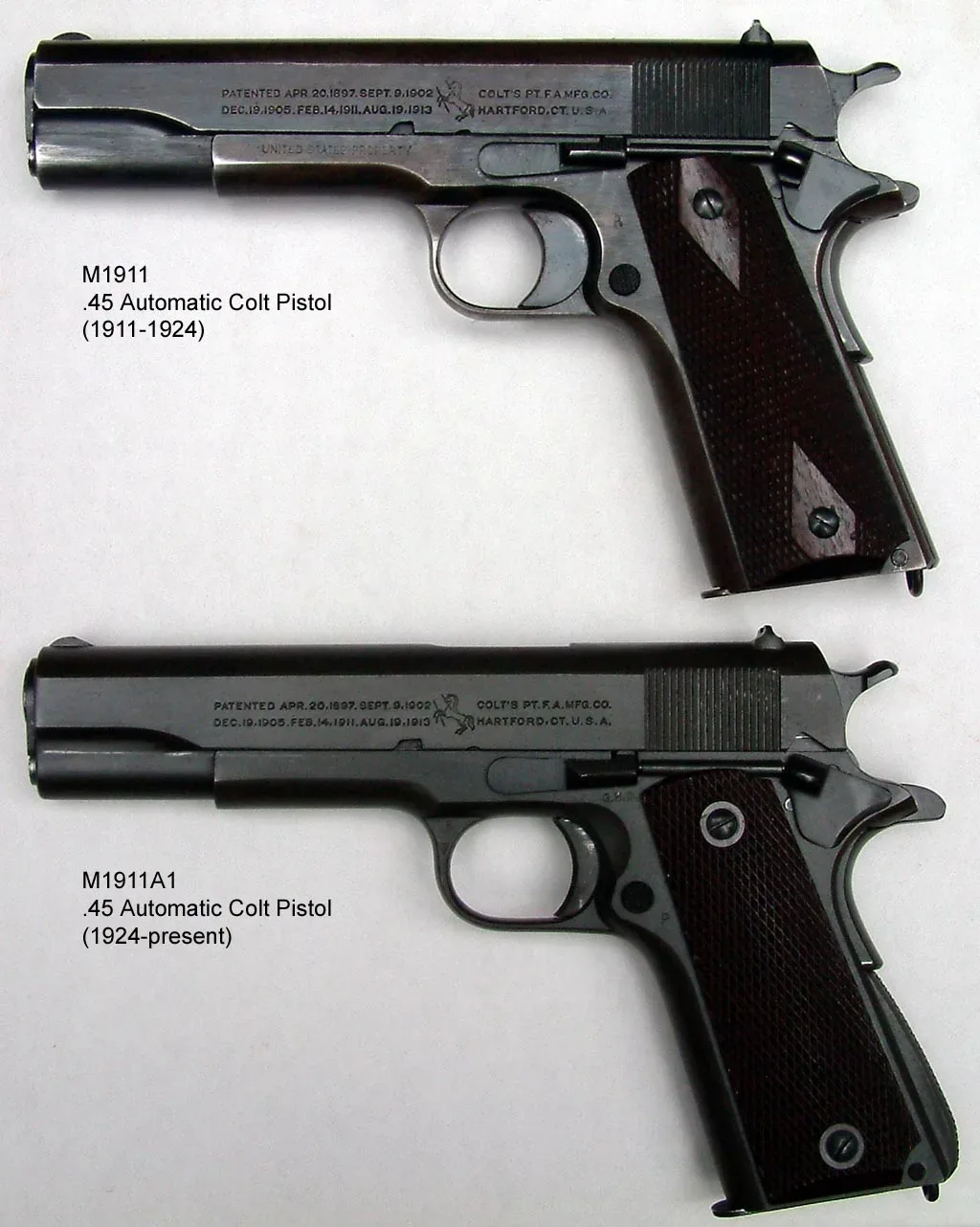
The M1911 (left) and M1911A1 (right) — the 1924 redesign added a shorter trigger, arched mainspring housing, and modified grip safety that became standard for all subsequent military variants.
Dkamm at English Wikipedia (Public domain)
| Manufacturer | |
|---|---|
| Made By | Colt Manufacturing Company (original), multiple modern manufacturers |
| Designer | John Moses Browning |
| Origin | United States |
| Specifications | |
| Caliber | .45 ACPAlso: .38 Super, 9mm Parabellum, 10mm Auto |
| Action | semi automatic |
| Capacity | 7+1 rounds (Government model) |
| Barrel | 5 inches (Government), 4.25 inches (Commander), 3.5 inches (Officer's), 3 inches (Defender) |
| Length | 8.25 inches (Government model) |
| Weight | 39 oz (Government model, unloaded) |
| Feed | Single-stack detachable box magazine |
| Sights | Three-dot system (standard), upgradeable to night sights or red dot compatible |
| Performance | |
| Eff. Range | 50 yards (combat), 100+ yards (match) |
| Muzzle Vel. | 830 fps (230-grain .45 ACP from 5-inch barrel) |
| Production | |
| Designed | 1911 |
| In Production | 1911 |
| Produced | 2.7 million+ (military contracts through WWII and beyond; millions more by civilian manufacturers) |
| Unit Cost | $600-$900 (modern civilian production) |
| Variants | |
| |
| Service Use | |
United States Armed Forces (military sidearm 1911-1985)United States Marine Corps (selected units until 2015)Federal Bureau of InvestigationSecret ServiceLaw enforcement agencies worldwideCompetition shooters (USPSA, IPSC, bullseye)Special operations forces | |
| Cultural Note | |
| The 1911 is an iconic American handgun and cultural symbol of American military tradition. It served as the standard-issue sidearm for the U.S. military for 74 years (1911-1985) and remains deeply embedded in American gun culture, competition shooting, and popular media. | |
| Related Firearms | |
1911 Pistol - America's Legendary .45 ACP Sidearm
Firearms encyclopedia article
From The Boise Gun Club Handbook
The Colt M1911 has been putting holes where they need to be for over a century. John Moses Browning designed this single-action, semi-automatic pistol around the .45 ACP cartridge, and the combination has been dropping targets and stopping threats ever since.
This isn't just another handgun—it's the platform that defined what a fighting pistol should be. Two world wars, countless police departments, and millions of shooters have proven the design works.
You'll find 1911s in gun safes from competition shooters chasing X-rings to everyday carriers who trust their lives to Browning's design. The single-action trigger breaks clean, the .45 ACP hits hard, and the manual of arms feels natural once you learn it.
History & Developmentedit
Philippine Campaign Origins
The 1911 exists because .38 caliber revolvers weren't cutting it in the Philippines. Moro warriors kept fighting after taking multiple hits from the Army's .38s, so the military wanted something with more punch. Browning delivered.
Military Adoption & Testing
His prototype went through a torture test in 1907 that would make modern reliability standards look soft—6,000 rounds without a malfunction while competing designs failed around it. The Army adopted it on March 29, 1911, and gave it the thrilling designation "Automatic Pistol, Caliber .45, M1911."
| Year | Milestone | Details |
|---|---|---|
| 1907 | Torture Test | 6,000 rounds without malfunction in military trials |
| 1911 | Adoption | Army adopts as "Automatic Pistol, Caliber .45, M1911" |
| 1917-1918 | WWI Service | Proven in European trenches by American Doughboys |
| 1924 | M1911A1 | Updated version with shortened trigger, modified grip safety |
| 1941-1945 | WWII Mass Production | Millions produced by multiple manufacturers |
Combat Proven Design
World War I proved the concept in European trenches. Doughboys loved the stopping power and reliability. Between wars, the military made minor tweaks—shorter trigger, modified grip safety, arched mainspring housing—and called it the M1911A1 in 1924.
World War II cemented the legend. From Normandy to Iwo Jima, GIs carried 1911s into every theater. When you needed one shot to end a fight, that big .45 slug delivered. Multiple manufacturers cranked out millions to meet demand.
Evolution of the 1911 Platform from Concept to Modern Day
Technical Specificationsedit
| Specification | Details |
|---|---|
| Action | Single-action, semi-automatic |
| Caliber | .45 ACP (primary), others available |
| Capacity | 7+1 rounds (standard) |
| Barrel Length | 5 inches (Government), 4.25" (Commander), 3.5" (Officer's) |
| Overall Length | 8.25 inches (Government model) |
| Weight | 39 oz (Government, unloaded) |
| Sights | Three-dot system, upgradeable |
| Safety Features | Grip safety, thumb safety, half-cock notch |
The 1911 uses a short-recoil, locked-breech system with a tilting barrel. Fire a round and the barrel and slide travel together for about 0.1 inches before the barrel tilts down, unlocking from the slide. The slide continues back, extracting and ejecting the spent case.
1911 Operating Cycle - Short Recoil, Locked Breech System
The magazine holds seven rounds of .45 ACP in a single-stack configuration. The mag release sits behind the trigger guard on the left side—southpaws can reach it with their trigger finger with practice.
Traditional sights come in several configurations:
- Blade front and notch rear sights (traditional)
- Night sights for low-light conditions
- Red dot mounting systems for modern optics
- Adjustable target sights for competition
The grip safety must be depressed to fire, the thumb safety blocks the trigger when engaged, and the half-cock notch provides an additional safety margin.
Variants & Modelsedit
Frame Size Categories
| Model | Barrel Length | Overall Length | Weight | Primary Use |
|---|---|---|---|---|
| Government | 5 inches | 8.25 inches | 39 oz | Military spec, full-size |
| Commander | 4.25 inches | 7.75 inches | 36 oz | Concealed carry |
| Officer's | 3.5 inches | 7.25 inches | 34 oz | Compact carry |
| Defender | 3 inches | 6.75 inches | 32 oz | Ultra-compact |
| Gold Cup | 5 inches | 8.25 inches | 39 oz | Competition/match |
The Government model with its 5-inch barrel represents the original military spec. The Commander shortens the barrel to 4.25 inches and often uses an aluminum frame to save weight—Colt introduced this in 1950 for concealed carry.
Compact versions keep shrinking. The Officer's model runs a 3.5-inch barrel while Defender variants go down to 3 inches. Both sacrifice some velocity and sight radius for easier concealment.
Competition & Custom Models
Competition shooters gravitate toward Gold Cup models with match-grade barrels, triggers, and sights. These guns can shoot better groups than most people can hold.
Modern variants include rail guns with Picatinny rails for lights and lasers, double-stack versions with higher capacity, and full-race competition guns with extended everything. Series 70 and Series 80 designations refer to different firing pin safety systems—Series 70 omits the firing pin block for a cleaner trigger pull.
Performance Characteristicsedit
Accuracy & Trigger Quality
A quality 1911 will put bullets into 2-inch groups at 25 yards all day long. The single-action trigger breaks clean around 4-5 pounds in military trim, though competition guns can go much lighter. That crisp break helps precision shooting more than any other factor.
Once you've shot a good 1911 trigger, everything else feels like mush.
Reliability depends on maintenance and ammunition selection.
Keep a 1911 clean and lubricated with quality ammo, and it'll run for decades. Let it get dirty or feed it marginal ammunition, and you'll have problems.
The design tolerates abuse better than most modern pistols, but it's not maintenance-free.
Ballistic Performance
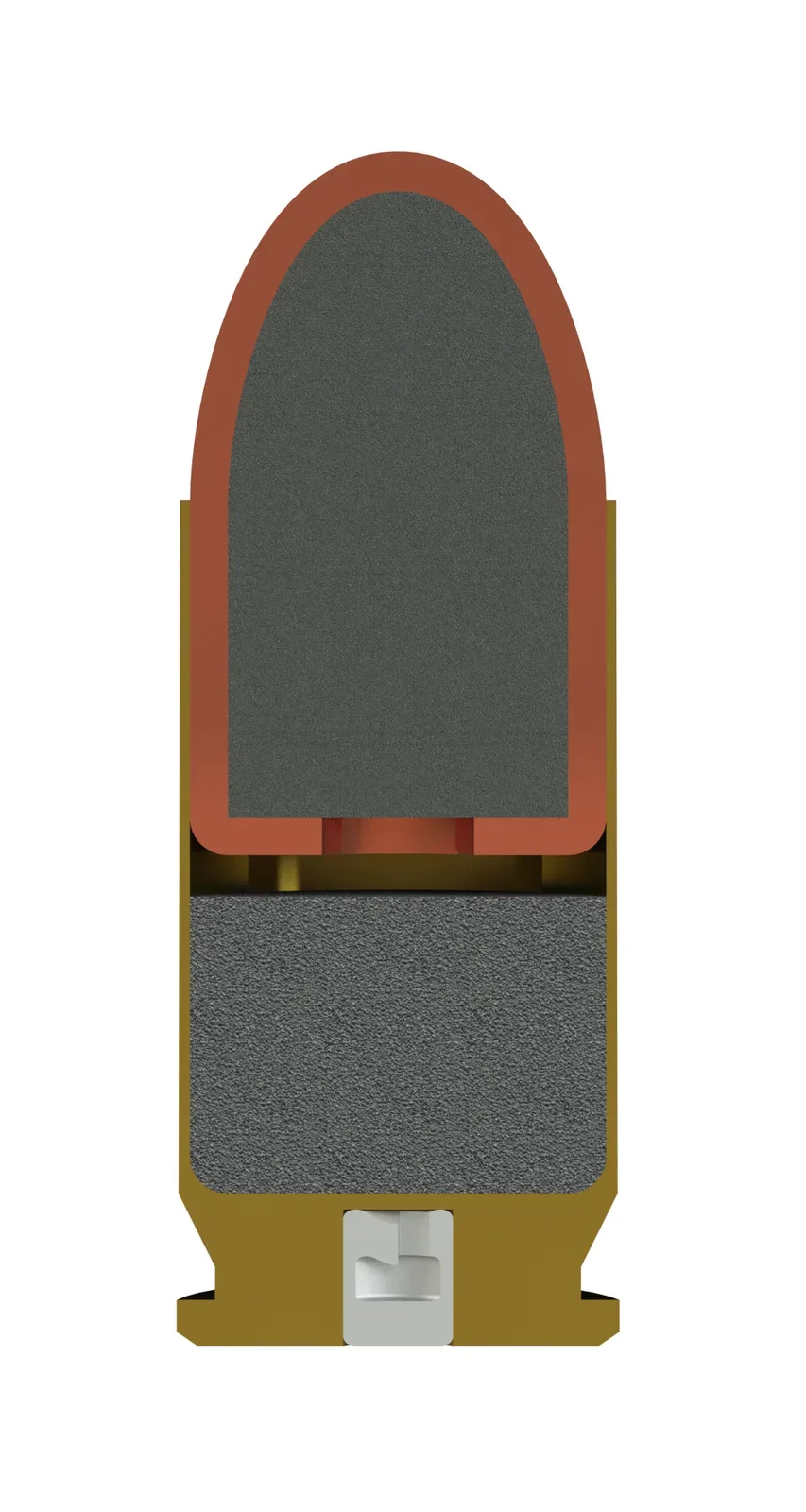
The .45 ACP pushes 230-grain bullets at around 830 fps from a 5-inch barrel. That big, slow slug transfers energy efficiently and creates substantial wound channels. Recoil is manageable thanks to the pistol's weight and low bore axis—muzzle flip stays minimal for faster follow-up shots.
| Metric | Specification | Notes |
|---|---|---|
| Accuracy | 2-inch groups @ 25 yards | Quality examples with match ammunition |
| Trigger Pull | 4-5 lbs (military) | Competition guns can go lighter |
| Muzzle Velocity | 830 fps | 230gr .45 ACP from 5-inch barrel |
| Muzzle Energy | 356 ft-lbs | Standard 230gr load |
| Effective Range | 50 yards | Combat accuracy |
| Service Life | 20,000+ rounds | With proper maintenance |
Most shooters find the grip angle and ergonomics natural. The pistol points instinctively, which explains why it dominated bullseye competition for decades and still shows up in USPSA matches.
Strengthsedit
The trigger sets the standard for what a handgun trigger should feel like. Clean, crisp, consistent—once you've shot a good 1911 trigger, everything else feels like mush. Accuracy potential is outstanding, especially in match-grade variants.
What this means for you: The .45 ACP delivers serious stopping power. One well-placed hit often ends conflicts that might require multiple rounds from smaller calibers. The manual of arms becomes second nature with practice, and the grip safety provides an extra margin of protection during administrative handling.
The aftermarket support is massive. Countless manufacturers make 1911 parts:
- Custom grips in wood, polymer, and exotic materials
- Match-grade triggers and trigger jobs
- Premium sights and optic mounting systems
- Custom barrels for enhanced accuracy
- Specialized holsters and accessories
Quality examples hold their value well, and collector interest keeps certain models appreciating.
Weaknessesedit
Seven rounds plus one in the chamber doesn't compete with modern high-capacity pistols. When Glocks carry 17 rounds standard, that limitation matters for some applications.
The design requires more maintenance than striker-fired alternatives. You'll clean and lubricate a 1911 more often to maintain reliability. The steel construction adds weight—nearly 2.5 pounds loaded compared to polymer competitors under 2 pounds.
The manual of arms intimidates some shooters. Cocked-and-locked carry with the hammer back and safety on requires training and confidence. This requires understanding several manual operations:
- Cocked-and-locked carry requires training
- Manual thumb safety operation
- Grip safety engagement
- Single-action only trigger system
- No second-strike capability
Some 1911s are finicky about ammunition, especially with certain bullet profiles or overall cartridge lengths. Quality costs more upfront compared to budget alternatives, and the learning curve is steeper for shooters starting with striker-fired pistols.
Notable Usersedit
Military & Special Operations
U.S. forces carried 1911s as their primary sidearm from 1911 to 1985, when the M9 Beretta replaced it for general issue. Special operations units still use customized 1911s—the Marines' MEU(SOC) pistols are hand-built for Force Recon and special operations.
| Organization | Model/Period | Notes |
|---|---|---|
| U.S. Military | M1911/M1911A1 (1911-1985) | Primary sidearm for 74 years |
| USMC MEU(SOC) | Custom 1911s (1980s-present) | Hand-built for special operations |
| FBI | Various models | Throughout agency history |
| LAPD SWAT | Custom 1911s | Decades of service |
| Executive Protection | Various premium models | Reliability and stopping power |
Law Enforcement Agencies
FBI agents have carried various 1911 models throughout the agency's history. LAPD SWAT used customized 1911s for decades. Competitive shooters dominate bullseye matches with accurized 1911s and show up regularly in USPSA and IPSC competition.
Law enforcement agencies nationwide still issue 1911s, particularly for specialized units. Executive protection details favor the platform for its reliability and stopping power. The civilian concealed carry and home defense market remains strong.
The BGC Takeedit
The 1911 isn't perfect, but it's proven.
The 1911 isn't perfect, but it's proven. After handling hundreds of them over the years, the good ones are really good—accurate, reliable, and effective. The mediocre ones will frustrate you with jams and poor accuracy.
Buy from established manufacturers with solid reputations. Colt, Springfield Armory, Kimber, and Wilson Combat know how to build them right. Avoid ultra-cheap imports and unknown brands—you'll spend more fixing problems than you saved on the purchase price.
For carry, stick with Government or Commander sizes in .45 ACP. The compact versions lose too much velocity and sight radius. Keep the magazines rotated, use quality ammunition, and practice the manual of arms until it's automatic.
The 1911 rewards competence and punishes neglect.
The 1911 rewards competence and punishes neglect.
Maintain it properly, learn to run it correctly, and you'll understand why this design has survived over a century of attempts to replace it.
- Gls Guns(Sumner, IA)
- Bi-mart - Yakima (Fruitvale Ave)(Yakima, WA)
- New Philly Sportsman Specialities(New Philadelphia, OH)
- R&R Sports & Outdoors(Brandon, FL)
Loading comments...