Details
.45 ACP Cartridge

SAAMI standard drawing for .45 ACP — the official specification that governs ammunition and firearm manufacturing across the U.S. industry.
| Origins | |
|---|---|
| Invented | 1904 |
| Inventor | John Moses Browning |
| Country | United States |
| Timeline | |
| Era | Early 20th century to present |
| Replaced By | 9mm Parabellum (military adoption in 1985) |
| Impact | |
| Significance | A large-bore, low-pressure pistol cartridge designed in response to stopping power failures in the Philippine-American War that remained in continuous production for over 120 years and saw service through two World Wars, Korea, Vietnam, and beyond. |
.45 ACP Cartridge
Firearms encyclopedia article
From The Boise Gun Club Handbook
Overviewedit
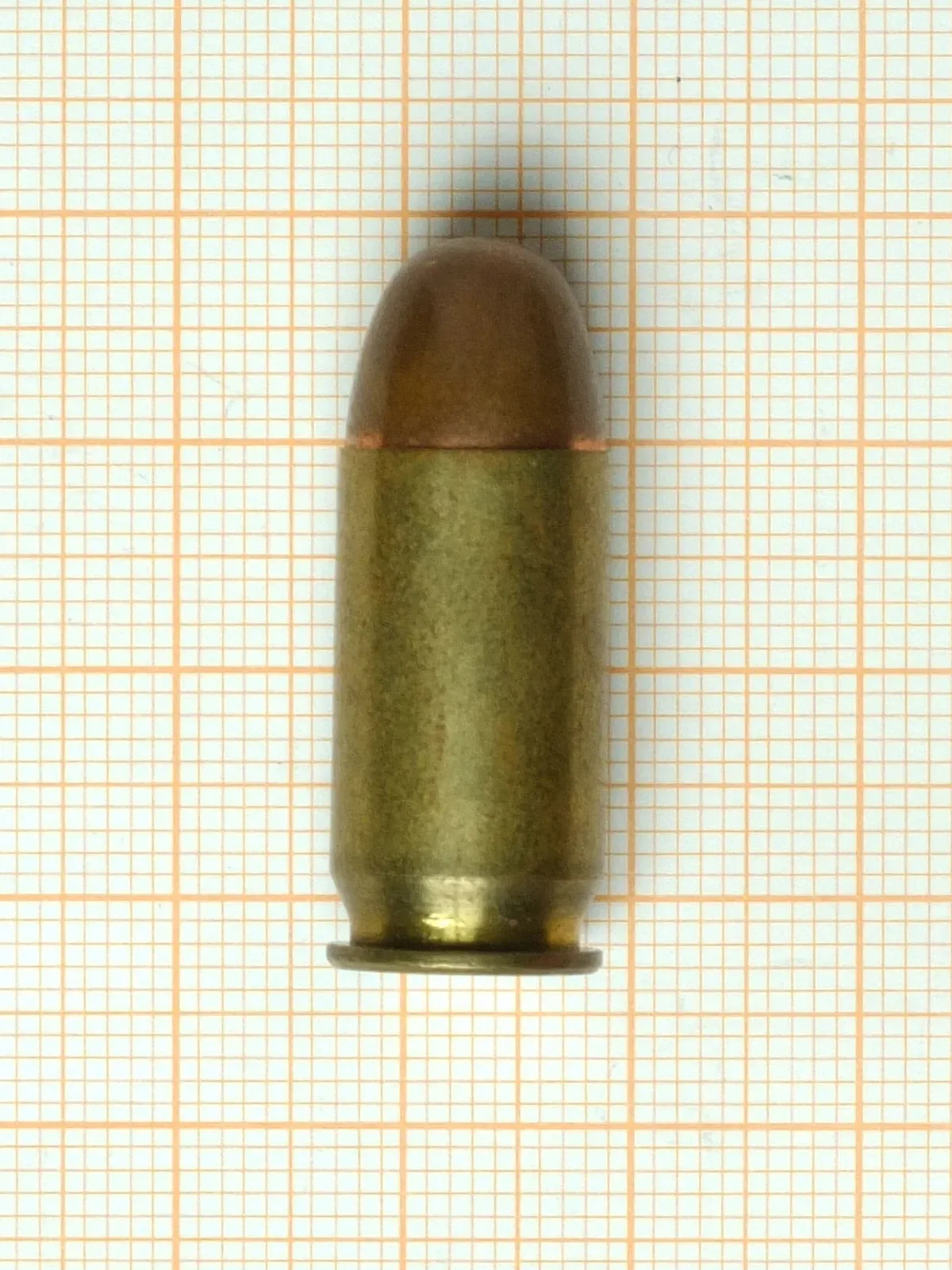
The Automatic Colt Pistol — known as the .45 ACP — is a rimless, straight-walled handgun cartridge designed by John Moses Browning in 1904. Its specifications are straightforward: a .452-inch bullet diameter, a case length of .898 inches, and a standard military loading of a 230-grain full metal jacket bullet traveling at roughly 830 feet per second.
What those numbers don't convey is the history behind them — a cartridge born from battlefield failure, shaped by some of the stranger tests in military history, and then carried through two World Wars, Korea, Vietnam, and a dozen smaller conflicts before the U.S. military finally set it aside in 1985.
| Specification | Value |
|---|---|
| Bullet Diameter | .452 inches |
| Case Length | .898 inches |
| Overall Length | 1.275 inches |
| Standard Bullet Weight | 230 grains |
| Muzzle Velocity | ~830 fps |
| Muzzle Energy | ~350 ft-lbs |
| Maximum Pressure (SAAMI) | 21,000 psi |
| Production Start | 1905 |
Even that retirement didn't stick entirely. Special operations units kept running .45 ACP long after the Beretta 92F became standard issue, and the cartridge remains one of the most widely manufactured pistol rounds in the world today. According to Wikipedia, it has been in continuous production since 1905 — over 120 years without a gap.
To understand why a cartridge designed in 1904 is still relevant in the 2020s, you have to start in the southern Philippines.
Development Historyedit
The Philippines Problem
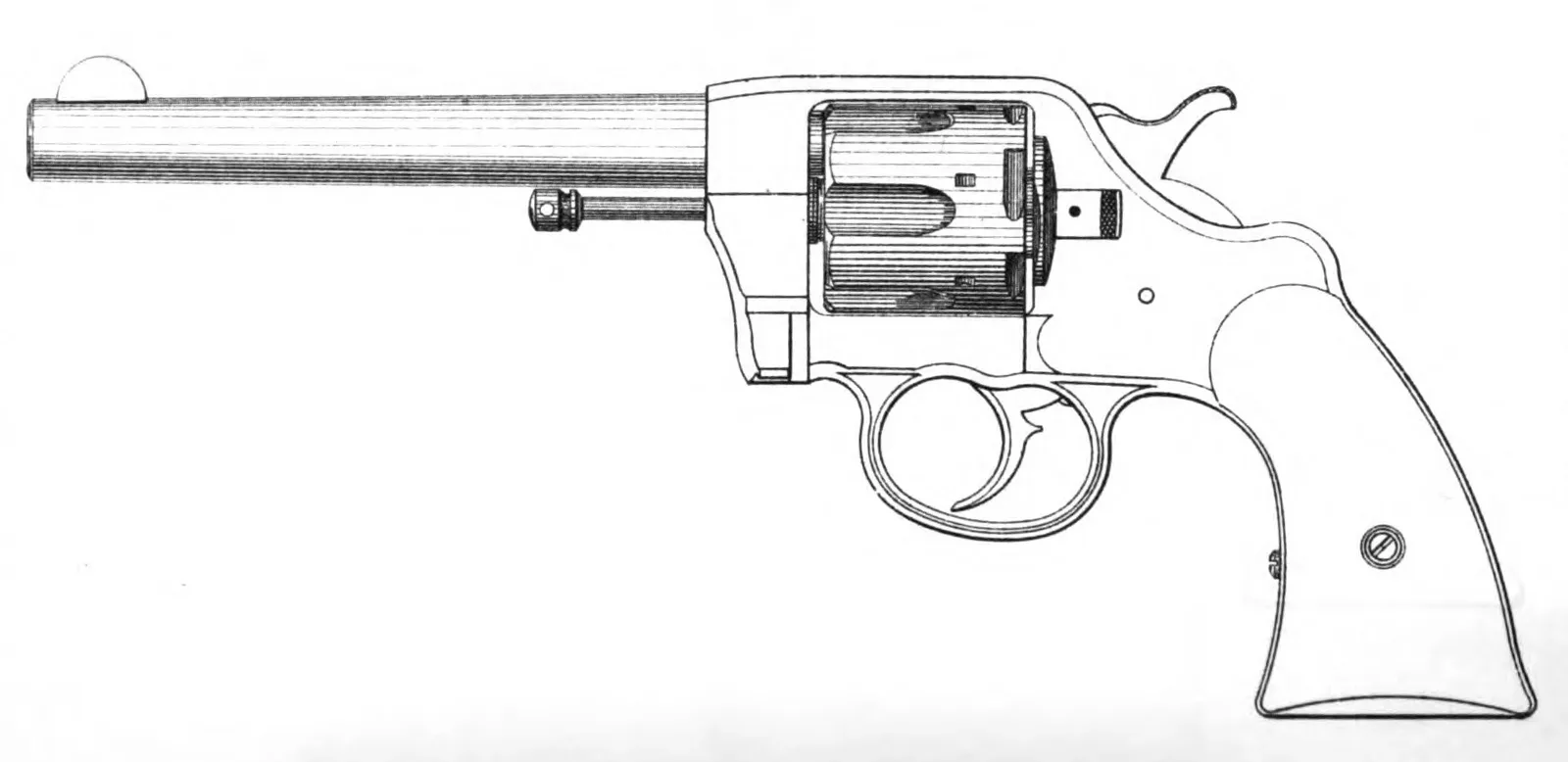
By the late 1890s, the U.S. Army had largely standardized on the .38 Long Colt cartridge, chambered in double-action revolvers. The round was a product of the black powder era — its smokeless powder loading pushed a 150-grain bullet to about 750 feet per second, generating roughly 201 foot-pounds of muzzle energy. As American Rifleman notes, that's approximately the same energy as a modern .380 ACP with a 90-grain bullet.
That became a serious problem during the Philippine-American War (1899–1902), specifically in engagements with Tausūg Moro warriors in the southern islands. The Moros were described in contemporary accounts as binding themselves with vegetation strips to slow blood loss and using locally produced drugs to suppress pain. Officers armed with the Colt Model 1892 revolver found that the .38 Long Colt frequently failed to stop a charging Moro warrior before he could close the distance and use his kris knife. Per the Browning Arms Company's historical account, U.S. troops suffered casualties in close-quarters engagements specifically because their handguns couldn't end a threat quickly enough.
The Army's short-term fix was to pull old .45 Colt Single Action Army revolvers out of storage — some dating back to the Indian Wars campaigns — and reissue them. The heavier bullet performed noticeably better. But a century-old single-action revolver was not a long-term answer. The Army needed a modern cartridge, and it needed it in a semi-automatic platform.
| Cartridge | Bullet Weight | Velocity | Energy | Military Use |
|---|---|---|---|---|
| .38 Long Colt | 150 gr | 750 fps | 201 ft-lbs | 1892-1911 |
| .45 Colt | 255 gr | 860 fps | 420 ft-lbs | Emergency reissue |
| .45 ACP (final) | 230 gr | 850 fps | 370 ft-lbs | 1911-1985 |
The standard rifle of the period, the .30-40 Krag, had also drawn criticism for insufficient stopping power against Moro fighters, which framed the broader conversation: the Army needed to rethink what its small arms could actually do at close range.
Thompson-LaGarde Tests
The Army's formal response was a series of cartridge effectiveness tests in 1904, organized by Colonel John T. Thompson — who would later design the submachine gun bearing his name — and Major Louis Anatole LaGarde of the Medical Corps. The tests were conducted at the Nelson Morris Company Union Stockyards in Chicago, using live cattle, deer, and human cadavers as the test medium.
By modern standards the methodology was rough. But the conclusions were direct: a handgun cartridge intended for military use should have a caliber no smaller than .45. The board's report stated that a bullet providing adequate "shock effect and stopping effect at short ranges necessary for a military pistol or revolver, should have a caliber not less than .45." They added a significant caveat — that soldiers should be "drilled unremittingly in the accuracy of fire," because most of the human body offered little hope of stopping an opponent through shock alone unless a critical area was hit. The tests were about caliber minimums, not magic bullets.
A handgun cartridge intended for military use should have a caliber no smaller than .45, with soldiers drilled unremittingly in the accuracy of fire.
At the time these tests were conducted, Colt and Browning were already developing a .41-caliber cartridge for a prototype semi-automatic pistol. The Thompson-LaGarde results prompted the Ordnance Department to specify .45 caliber instead, and Browning scaled the design up accordingly.
Browning's Solution
According to Wikipedia, Colt modified the pistol design to fire an enlarged version of the prototype .41-caliber round, producing the Colt Model 1905 — the first semi-automatic pistol chambered for the new .45 ACP cartridge. The initial round that passed early testing used a 200-grain bullet at 900 feet per second. That wasn't the final answer.
After a series of revisions involving Winchester Repeating Arms, Frankford Arsenal, and Union Metallic Cartridge, the load settled on a 230-grain bullet at a nominal velocity of 850 feet per second. As Turnbull Restoration notes, the .45 ACP was also notable for its early adoption of full metal jacket (FMJ) bullets — a practical necessity for semi-automatic feeding. Earlier cartridges used externally lubricated soft lead bullets that attracted dirt and caused malfunctions. Smooth copper-jacketed FMJ bullets fed reliably through semi-automatic actions, a critical factor for military use.
Browning designed the cartridge as rimless — headspacing on the case mouth rather than a rim — which allowed reliable feeding from box magazines in semi-automatic pistols, something the older .45 Colt geometry couldn't accommodate.
Key milestones in .45 ACP development from battlefield problem to military adoption
Military Trials
By 1906, the Army had formalized its requirements and solicited bids from six manufacturers. According to Wikipedia, the entrants included Colt, Savage Arms, Bergmann, Deutsche Waffen- und Munitionsfabriken (DWM), Webley, and White-Merrill. DWM submitted two Luger pistols chambered in .45 ACP but withdrew after the first round of testing, for reasons that remain disputed. Three designs were eliminated early, leaving Colt and Savage to compete through a series of field tests from 1907 to 1911.
| Manufacturer | Pistol Model | Test Results | Notes |
|---|---|---|---|
| Colt | Model 1905 prototype | 6,000 rounds, 0 malfunctions | Selected |
| Savage | Model 1907 | 37 stoppages/failures | Eliminated |
| DWM | Luger .45 ACP | Withdrew early | Reasons disputed |
| Bergmann | Unknown model | Eliminated early | - |
| Webley | Unknown model | Eliminated early | - |
| White-Merrill | Unknown model | Eliminated early | - |
The decisive test came in 1910. A single Colt prototype, with Browning present, fired 6,000 rounds over two days. When the pistol grew too hot to handle, it was dunked in a bucket of water to cool it, then returned to firing. The Colt passed without a single reported malfunction. The Savage design suffered 37 stoppages or parts failures during its equivalent test.
On March 29, 1911, Secretary of War Jacob Dickinson formally approved the combination of Browning's pistol and cartridge. The firearm became the M1911; the cartridge was officially designated the "Cal. 45 Automatic Pistol Ball Cartridge, Model of 1911." The first production cartridges came from Frankford Arsenal and were headstamped "F A 8 11" — August 1911. The U.S. Navy and Marine Corps followed with adoption in 1913.
How It Worksedit
Pressure Characteristics
The .45 ACP is a large-bore, low-pressure pistol cartridge — and understanding those two characteristics together explains most of what makes it distinctive.
SAAMI sets the maximum pressure for standard .45 ACP at 21,000 psi. Compare that to 35,000 psi for 9mm Parabellum, 35,000 psi for .40 S&W, 37,500 psi for 10mm Auto, and 40,000 psi for .357 SIG. The .45 ACP runs at roughly 40–60% of the chamber pressure that comparable modern cartridges generate. That low bolt thrust extends the service life of firearms chambered for it, and it's one reason the same basic M1911 design ran reliably for 74 years of military service with relatively modest maintenance.
| Cartridge | Maximum Pressure | Relative to .45 ACP |
|---|---|---|
| .45 ACP | 21,000 psi | Baseline |
| 9mm Parabellum | 35,000 psi | +67% |
| .40 S&W | 35,000 psi | +67% |
| 10mm Auto | 37,500 psi | +79% |
| .357 SIG | 40,000 psi | +90% |
The tradeoff is velocity. The 230-grain standard military load leaves a 5-inch pistol barrel at approximately 830 feet per second — well below the speed of sound. From a Thompson M1A1 submachine gun's longer barrel, that same bullet reaches roughly 950 feet per second. Still subsonic. That inherent subsonic character, rather than being a limitation, became a significant tactical advantage in the suppressor era.
Terminal Ballistics
The .45 ACP's wound ballistics rest on a simple foundation: a large-diameter bullet moving at moderate velocity creates a wide permanent wound channel. The .452-inch bullet diameter is significantly larger than 9mm's .355-inch diameter. In FMJ form, the 230-grain bullet penetrates approximately 26 inches in ballistic gelatin — deep enough to reliably reach vital structures, though that level of penetration raises over-penetration concerns in civilian defensive applications, which is why hollow point ammunition is standard for law enforcement and concealed carry use.
In hollow point form, a 185-grain bullet at 1,050 feet per second expands to approximately .76 inches — a significant permanent wound cavity for a handgun projectile. According to Wikipedia, a 165-grain Federal Hydra-Shok load generates 412 foot-pounds of energy, while a 185-grain JHP +P load from Underwood reaches 592 foot-pounds.
How the .45 ACP's fundamental characteristics create its performance advantages
For suppressed use, the physics are straightforward. A suppressor works by slowing and channeling the gas that exits the muzzle. It cannot act on a subsonic shock wave because that wave is continuously generated throughout the bullet's flight. Since .45 ACP rounds are subsonic from the muzzle, there's no supersonic crack to deal with — only the muzzle report, which the suppressor addresses. The drawback is that the large bore diameter reduces suppressor efficiency compared to smaller calibers. Most .45 ACP suppressors need to be fired "wet" — with oil or water as an ablative medium — to bring sound levels below 140 decibels.
Load Variants
Commercial .45 ACP ammunition spans a wide range. Bullet weights run from 68 grains to 300 grains, with the most common range for defensive and target use falling between 185 and 230 grains. The standard military loading remains 230-grain FMJ. Plus-P (+P) loadings are available at a SAAMI-specified maximum of 23,000 psi, generating meaningfully higher velocity — though not all pistols are rated for +P, and the additional pressure accelerates wear.
| Load Type | Bullet Weight | Velocity | Energy | Application |
|---|---|---|---|---|
| Military Ball | 230 gr | 830 fps | 350 ft-lbs | Combat/Training |
| +P Defensive | 185 gr | 1,050 fps | 412 ft-lbs | Law Enforcement |
| +P Heavy | 185 gr | 1,200 fps | 592 ft-lbs | Personal Defense |
| .45 Super | 230 gr | 950 fps | 460 ft-lbs | Modified pistols |
| .460 Rowland | 230 gr | 1,200 fps | 735 ft-lbs | Heavily modified |
Derivative cartridges built on the .45 ACP case include the .45 Super, which is dimensionally identical but operates at 28,500 psi and requires modified firearms, and the .460 Rowland, which runs at 40,000 psi, has a case 0.057 inches longer than standard to prevent accidental chambering in unmodified guns, and requires significant firearm modification. The Rowland produces approximately 40% greater velocity than .45 ACP +P.
Capacity Limitations
The cartridge's large diameter has always worked against magazine capacity. Standard single-stack magazines for M1911-pattern pistols hold seven or eight rounds. Modern double-stack designs like the Glock 21 increase capacity to 13 rounds, but at the cost of a significantly wider grip — a real consideration for shooters with smaller hands. Drum magazines used in submachine gun applications hold 50 or 100 rounds.
Impact on Warfare & Societyedit
World War I Service
The M1911 and its cartridge entered combat for the first time during General Pershing's Punitive Expedition into Mexico in 1916, chasing Pancho Villa after the Columbus, New Mexico raid. The combination got its real stress test the following year when the United States entered the First World War.
WWI's Western Front was largely trench warfare — tight corridors, close-quarters raids, and engagements at ranges where a pistol was a primary weapon rather than a backup. The .45 ACP performed well in that environment. The most cited example from that conflict is Sergeant Alvin York, who according to Free Range American used a 1911 pistol to stop a charge by six German soldiers with the rounds in his magazine, shooting from back to front to prevent the rear men from scattering. York was awarded the Medal of Honor; his unit captured 132 enemy prisoners during the same engagement.
Demand quickly outran supply. By early 1917, only 68,533 .M1911 pistols had been delivered to U.S. forces. Both Colt and Smith & Wesson shifted large-frame revolvers into production — the Model 1917 — adapted to fire .45 ACP using half-moon clips that held the rimless cases in the cylinder for simultaneous extraction. The arrangement worked but was never elegant. After the war, Peters Cartridge Company addressed the revolver problem by adding a thick rim to the case, creating the .45 Auto Rim — ballistically identical to .45 ACP but with a proper rim that didn't require clips. The surplus market flooded with Model 1917 revolvers, and the Auto Rim cartridge followed them.
World War II Production
The Second World War represented .45 ACP at industrial scale. According to Wikipedia, approximately 1.9 million M1911A1 pistols were procured by the U.S. government during WWII. Total production came from multiple manufacturers:
- Remington Rand (approximately 900,000 units)
- Colt (approximately 400,000 units)
- Ithaca Gun Company (approximately 400,000 units)
- Union Switch & Signal (approximately 50,000 units)
- Singer (limited production)
Total production of M1911-pattern pistols across all manufacturers reached approximately 2.7 million Colt-produced units and over 4.2 million including licensed copies, according to Wikipedia's M1911 article.
| Conflict/Period | Primary Platform | Production Numbers | Notes |
|---|---|---|---|
| WWI (1917-1918) | M1911, M1917 revolvers | 68,533 M1911s delivered | Half-moon clips required |
| WWII (1941-1945) | M1911A1, M3 "Grease Gun" | 1.9M M1911A1s, 4.2M total | Peak production era |
| Korea/Vietnam | M1911A1 | Existing stocks | Suppressed variants |
| Modern SOF | M45 MEU(SOC), M45A1 | 12,000 M45A1s (2012) | Marines until 2022 |
The .45 ACP M3 submachine gun — the "Grease Gun" — entered service as a cheaper, faster-to-produce alternative to the Thompson. According to Free Range American, the M3 remained in service long enough that M1 Abrams tank crews carried them during Desert Storm in the 1990s.
Specialty ammunition was also developed for WWII use. Survival shotshell loads — the M12 and M15 — were packed in USAAF survival kits so downed aircrew could hunt small game with their M1911A1 pistols. The M12 used a wax paper projectile containing 118 pieces of No. 7 birdshot; humidity caused the paper projectile to swell and break apart, so it was replaced by the M15, which used a vermilion cardboard disc to seal the case mouth. Tracer ammunition with a red-tipped bullet was also produced at Frankford Arsenal and by Remington Arms, issued to downed Navy and Marine Corps aircrew for emergency signaling.
The Stopping Power Debate
The Thompson-LaGarde Tests of 1904 opened a debate about terminal ballistics that never fully closed. The core argument — large, slow bullet versus small, fast bullet — has been relitigated with every major military cartridge transition. The .38 Long Colt's failure against the Moros prompted the .45 ACP. Decades later, the 9mm's adoption in 1985 triggered the same argument in reverse.
FBI testing cited in Wikipedia's .45 ACP article found that premium 9mm ammunition achieved nearly identical wound track performance to .40 S&W and .45 ACP, and that .45 ACP handguns ranked last among tested calibers in accuracy and recovery time — largely due to increased recoil. That finding became influential in the subsequent shift toward 9mm across law enforcement and military applications.
The counterargument, made by decades of experienced shooters and documented in source material from SightM1911.com, is that the .45 ACP's large permanent wound channel is consistently effective regardless of bullet design — you don't need expansion to cause significant tissue disruption at .452 inches. Both positions have data behind them. The debate continues.
Competition and Culture
The M1911's long service life created a secondary effect: generations of American servicemen came home knowing how to run the pistol. Post-WWII, surplus M1911s flooded the civilian market, and NRA Bullseye Pistol competition — which required both a centerfire and a .45 phase, easily combined using the 1911 — became a major competitive format. Gunsmiths who had learned the platform in military service began accuracy work that evolved into an entire custom 1911 industry.
Out of that era came Jeff Cooper's Modern Technique of combat pistol shooting, developed in the 1950s. Cooper's method — smooth draw, two-handed grip, eye-level sight alignment, rapid accurate fire — was built around the 1911 and .45 ACP as its ideal instrument. Cooper played a central role in founding the IPSC (International Practical Shooting Confederation) in 1976 and served as its first president, according to the Browning Arms Company's historical account. The IPSC framework, and the IDPA (IDPA) that followed, structured competitive pistol shooting around practical accuracy rather than slow-fire bullseye, and the 1911 in .45 ACP remained the dominant platform for serious competition for decades.
How military adoption of .45 ACP influenced civilian shooting culture
Military Transition
In January 1985, the U.S. Army formally adopted the Beretta 92F in 9mm Parabellum, designated the M9. The transition was driven partly by the desire for ammunition commonality with NATO allies and partly by the 9mm's higher magazine capacity. The M1911A1 had served as the standard U.S. military sidearm for 74 years.
The transition was never complete. Multiple special operations units retained M1911-pattern pistols chambered in .45 ACP throughout the 1990s and 2000s. The USMC Precision Weapon Section began customizing M1911A1s for reconnaissance units in 1986, producing what became designated the M45 MEU(SOC). In July 2012, the Marine Corps awarded Colt a $22.5 million contract for up to 12,000 M45A1 Close Quarters Battle Pistols — a .45 ACP 1911 variant with Picatinny rails, dual recoil spring, and Cerakote finish — issued to Force Reconnaissance, MARSOC, and Special Reaction Teams. The Marines didn't begin replacing the M45A1 with the SIG M18 until 2019, and the replacement wasn't completed until October 2022.
Modern Relevanceedit
Current Applications
The .45 ACP today occupies an interesting position — genuinely outclassed in some measurable categories, genuinely superior in others, and carrying a cultural weight that no ballistic table fully captures.
On the practical side, the cartridge's inherent subsonic character makes it consistently useful for suppressed applications in ways that 9mm cannot match without special ammunition. The large bore diameter produces a wound channel that remains effective regardless of hollow point expansion — relevant in barrier-penetration scenarios where expanding bullets may not perform as designed. For competition shooters in Bullseye Pistol, Wikipedia notes a counterintuitive finding: .45 ACP with light bullets at low velocities can generate less felt recoil than 9mm ammunition of equivalent accuracy, which produces better scores in sustained fire.
On the other side of the ledger, the .45 ACP's case diameter severely limits magazine capacity compared to 9mm in equivalent-sized pistols. Factory ammunition costs meaningfully more per round than 9mm — Free Range American estimates roughly $0.13 to $0.30 per round more for both target and defensive loads — because each round requires more brass, lead, and a larger primer. The FBI's testing found that the recoil characteristics of .45 ACP handguns produced slower recovery times and lower hit rates than 9mm platforms in controlled testing.
Industry Support
The firearms industry has never walked away from the cartridge. Per American Rifleman, current production .45 ACP pistols come from:
- Browning
- Colt
- Heckler & Koch
- Ruger
- SIG Sauer
- Smith & Wesson
- Taurus
- Walther
- Glock
- Springfield Armory
- FN
Revolvers chambered for .45 ACP continue from multiple manufacturers. Carbines and pistol-caliber carbines are chambered for it. The 1911 platform alone — in every configuration from compact Officers models to full-size Government models to double-stack 2011 derivatives — represents one of the largest segments of the U.S. pistol market.
Global Footprint
The cartridge also has a geographic footprint that extends well beyond American borders. According to Wikipedia's M1911 article, current users of M1911-pattern pistols — and by extension .45 ACP — include:
- Brazil
- Chile
- Colombia
- Greece
- Indonesia
- Mexico
- Philippines
- South Korea
- Thailand
- Ukraine
- United States
The French military designation was "11 mm 43"; Norwegian and Argentine designations used "11.25 mm." The cartridge has been chambered in weapons manufactured on at least four continents.
Utah designated the M1911 as its official state firearm on March 18, 2011, explicitly honoring John Browning, who was born and raised in Ogden.
The BGC Takeedit
Here's what actually matters about the .45 ACP from a historical standpoint: it was the cartridge that proved a high-pressure semi-automatic pistol could be both powerful and reliable. That sounds obvious now. It wasn't obvious in 1904, when autoloaders were generally fragile, chambered in weak cartridges, and considered a poor bet against a revolver for serious use.
Browning's achievement wasn't just the bullet diameter — it was designing a cartridge that fed reliably from a box magazine under combat conditions while delivering terminal performance that actually matched what soldiers needed.
The 6,000-round test in 1910 wasn't just a marketing stunt; it was proof of concept for an entire category of firearm. The .45 ACP and M1911 demonstrated that a semi-automatic pistol could be a primary combat weapon, not a technological curiosity.
The 9mm vs. .45 ACP debate is one of those arguments where both sides are partly right and the framing is mostly wrong. Modern premium 9mm ammunition genuinely does approach .45 ACP's terminal performance, the FBI data on this is real, and the capacity advantage is real. But that conclusion depends entirely on what bullet you're shooting. Ball .45 ACP — the military load, the load that's governed by the Hague Convention for uniformed military use — is a fundamentally more effective projectile than ball 9mm. The whole reason the FBI testing matters is because it's comparing modern hollow points. For anyone not covered by international law of armed conflict, hollow points are the correct answer in both calibers, and that narrows the gap considerably.
What I'd push back on is the idea that the .45 ACP is obsolete. It's not the right answer for every application — if you need 17 rounds in a compact carry pistol, 9mm is the obvious choice. But if you're running a suppressed subgun, a competition 1911, or a defensive pistol and you've got normal-sized hands and you practice enough to manage the recoil, there's still nothing wrong with the old round. It's been solving the problem it was designed for since 1905. That's a longer track record than most things we trust with our lives.
Browning designed it because soldiers were dying from inadequate handgun cartridges. That problem — stopping a determined attacker quickly — hasn't changed. His solution is still one of the better answers to it.
Referencesedit
- https://en.wikipedia.org/wiki/.45_ACP
- https://www.browning.com/news/articles/historical/history-1911-pistol.html
- https://inside.safariland.com/blog/the-history-of-45-acp-from-inception-to-modern-day/
- https://www.turnbullrestoration.com/45-acp-history-and-use/
- https://sightm1911.com/Care/45acp.htm
- https://www.americanrifleman.org/content/the-45-acp-history-performance/
- https://freerangeamerican.us/45-acp/
- https://en.wikipedia.org/wiki/M1911_pistol
Last Updated: February 27, 2026
- Gls Guns(Sumner, IA)
- Bi-mart - Yakima (Fruitvale Ave)(Yakima, WA)
- New Philly Sportsman Specialities(New Philadelphia, OH)
- R&R Sports & Outdoors(Brandon, FL)
Loading comments...