Details
3D-Printed Firearms

| Origins | |
|---|---|
| Invented | 2013 |
| Inventor | Cody Wilson (Defense Distributed) |
| Country | United States |
| Timeline | |
| Era | 21st century |
| Impact | |
| Significance | Additive manufacturing technology that enables home production of functional firearms without serial numbers, background checks, or regulatory oversight, fundamentally lowering barriers to private firearm manufacture. |
3D-Printed Firearms: A History of the Technology That Changed Gunmaking
Firearms encyclopedia article
From The Boise Gun Club Handbook
Overviewedit
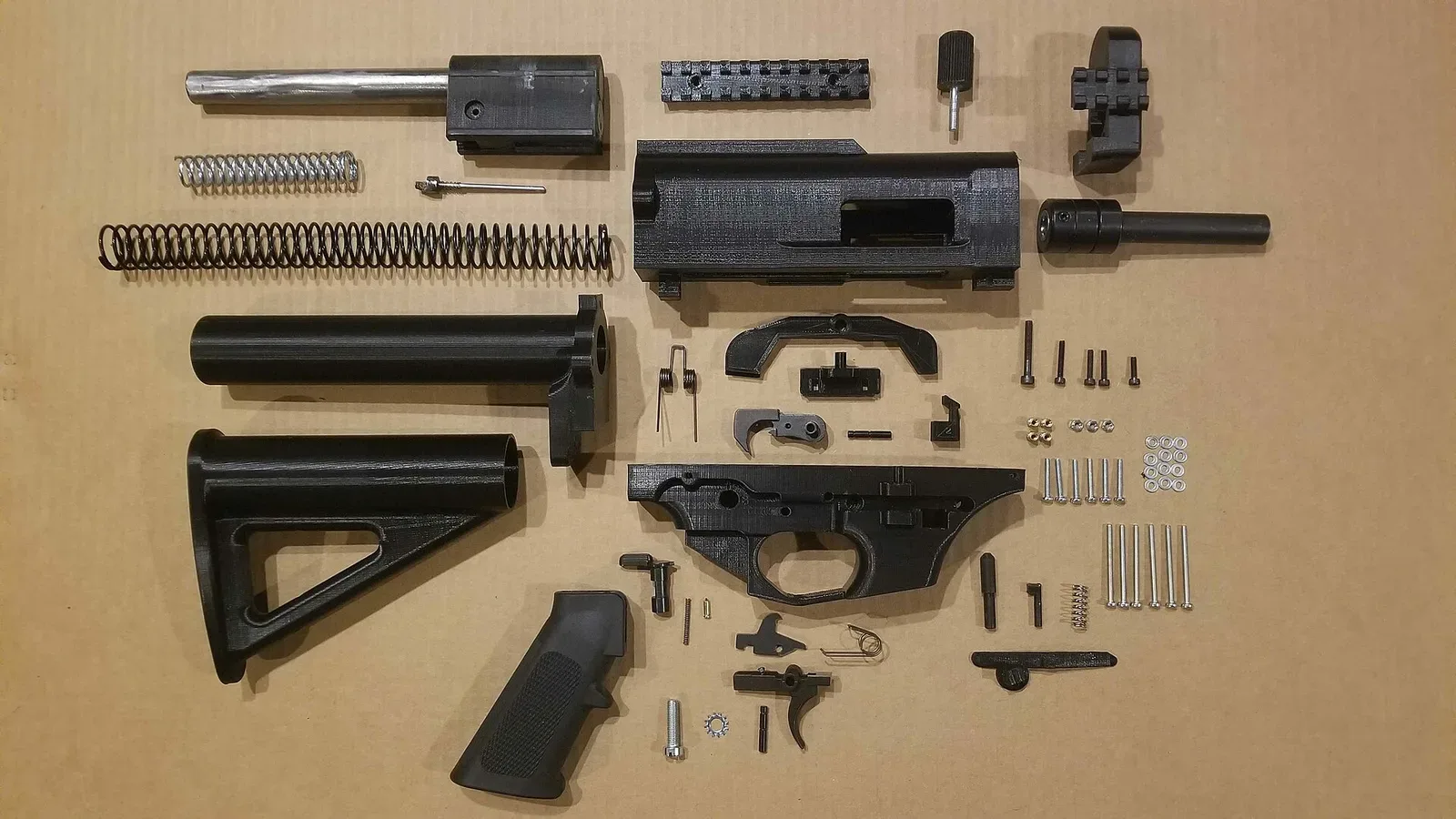
3D-printed firearms (3DPFs) are guns whose components — or entire structures — are produced using desktop additive manufacturing technology. The phrase covers a wide spectrum, from a crude single-shot pistol made almost entirely of thermoplastic to a sophisticated semi-automatic carbine that pairs printed polymer parts with unregulated metal hardware sourced from a hardware store.
What distinguishes them is their accessibility:
- Can be produced at home without serial numbers
- Require no background check or paper trail
- Range from crude single-shot pistols to sophisticated semi-automatic carbines
- Combine printed polymer parts with unregulated metal hardware
That combination is what makes them historically significant. Humans have been making improvised firearms for centuries — resistance fighters in occupied Warsaw, guerrillas in the Philippine jungle, criminals in English cities. The technology was never the hard part. Access to tools and materials was.
What additive manufacturing did, starting around 2013, was collapse the barrier to firearms production almost completely. A $200 printer, a spool of plastic filament, and a digital file can now produce a functional firearm.
This article traces how that happened — from the first commercial 3D printers in the 1980s, through the 2013 release of the Liberator, to the global spread of the FGC-9 and the murder of a corporate executive in New York City in December 2024 with a weapon that cost less than a tank of gas to produce.
Development Historyedit
The Long Runway: 3D Printing Before Firearms
The roots of consumer 3D printing go back further than most people realize. The first patent applications for additive manufacturing were filed in 1980, and by 1987 the first commercially available system — the SLA-1 — had been introduced. It cost approximately $300,000 and was used almost exclusively for industrial prototyping and medical modeling.
For the next two decades, the technology remained locked behind that cost barrier. The shift came gradually through the 2000s and accelerated sharply in the 2010s, when key patents began expiring, driving a proliferation of competing manufacturers and rapid price compression.
| Era | Technology Cost | Access Level | Key Limitation |
|---|---|---|---|
| 1987-2000s | ~$300,000 (SLA-1) | Industrial only | Prohibitive cost barrier |
| 2000s-2010s | Patent expiration period | Gradual decline | Still expensive for consumers |
| 2014 | $349 (M3D Micro) | Consumer market entry | Limited capability |
| Mid-2020s | $200-$250 | Mass consumer access | Minimal barriers remain |
By the time a 2014 Kickstarter project produced the M3D Micro Printer — marketed at $349 and explicitly aimed at consumer beginners — the trajectory was clear. Entry-level machines continued dropping in price and improving in usability throughout the decade. By the mid-2020s, reliable consumer printers with touch screens, automated bed leveling, and beginner-friendly software were available for as little as $200–$250. The global 3D printing market, valued at $4 billion in 2013, had grown to $21.9 billion by 2024, according to the Wohlers Report 2025.
The most common consumer technology is Fused Deposition Modeling (FDM), which melts a thermoplastic filament and deposits it in layers onto a print bed. The user sends a digital file — typically a .STL file created in computer-aided design (CAD) software — to a slicer program, which converts the model into layer-by-layer instructions called G-code. The printer reads that G-code and builds the object from the bottom up. The process for printing a firearm frame is mechanically identical to printing a phone case or a kitchen organizer.
2013: The Liberator and the Opening Shot
On May 6, 2013, Defense Distributed — an open-source nonprofit founded by Cody Wilson, then a University of Texas law student — published digital files for a single-shot .380 ACP pistol called the Liberator. The gun was assembled from 15 printable parts plus a common nail serving as the firing pin. It was made almost entirely of ABS thermoplastic — the same material used to manufacture Legos — and a one-kilogram spool of ABS, sufficient to print the entire pistol, cost approximately $20.
The files were downloaded more than 100,000 times in the first two days. Within a week, two journalists from the British tabloid The Mail on Sunday had purchased a £1,700 CubeX printer, printed the Liberator's 15 components, and carried the assembled parts aboard a Eurostar train departing from London's St Pancras International Station without being stopped by security. The stunt set off immediate alarm among European security officials and generated wall-to-wall media coverage on both sides of the Atlantic.
The practical reality was more modest. The Liberator could fire one shot at a time and typically failed after eight to ten shots. It was less a combat weapon than a proof of concept — a demonstration that the barrier between digital file and functional firearm had been crossed.
The technology will break gun control. People don't like to register their firearms any more. They don't trust the government. - Cody Wilson, 2013
Two days after the files went live, the U.S. Department of State ordered Defense Distributed to remove them from the company's website, DEFCAD, citing the Arms Export Control Act on the grounds that publishing them online constituted an unlicensed export of munitions. The files were already circulating on The Pirate Bay and other file-sharing platforms before the takedown order was even issued — a preview of the enforcement challenges that would define the next decade.
Defense Distributed sued the State Department on First and Second Amendment grounds in 2015. In 2018, the Department of Justice settled, acknowledging the American right to publish instructions for 3D-printed firearms online. A subsequent federal court blocked re-publication that same year, and the legal status of the files continued to evolve through a series of rulings. In January 2020, the Trump Administration moved to transfer administrative authority over the files from the State Department's munitions list to the Commerce Department, a change upheld by the Ninth Circuit Court of Appeals in April 2021. As a result, posting plans for 3D-printed firearms online now requires a license under the Export Administration Regulations issued by the Bureau of Industry and Security — though enforcement of that requirement against anonymous online actors has proven essentially impossible.
In the meantime, legal action against Defense Distributed had a secondary effect its opponents didn't intend: it inspired the creation of decentralized 3D-printed firearm communities dedicated to the principle that the files could never be successfully suppressed. These included FOSSCAD (Free Open Source Software & Computer Aided Design) and, in 2019, Deterrence Dispensed.
The FGC-9: From Proof of Concept to Functional Weapon
The seven years between the Liberator and the next major milestone saw steady but incremental progress — improvements in materials, designs, and community infrastructure. The design ecosystem grew. Files proliferated. But no single design matched the durability and practicality of a commercially manufactured firearm.
| Design | Year | Type | Key Innovation | Durability |
|---|---|---|---|---|
| Liberator | 2013 | F3DP | First viable 3D-printed gun | 8-10 shots |
| Shuty AP-9 | ~2019 | Hybrid | Semi-auto carbine base design | Required factory barrel |
| FGC-9 | 2020 | Hybrid | Hardware store components only | Reliable semi-auto |
| FGC-9 Mark II | 2021 | Hybrid | Improved barrel rifling process | Enhanced reliability |
That changed in spring 2020 with the release of the FGC-9 — formally, the "F**k Gun Control 9mm" — a semi-automatic pistol-caliber carbine designed by Jacob Duygu, a 28-year-old Kurdish German man who operated under the pseudonym JStark1809. The name was a reference to Major General John Stark and his 1809 motto, "Live free or die."
Duygu based the FGC-9 on an earlier design called the Shuty AP-9, engineered by a designer known as "Derwood." The Shuty required factory-made or machined barrel components — a significant barrier in jurisdictions that regulated such parts. Duygu redesigned the weapon from the ground up so that none of its components were legally regulated in Europe. Approximately 80 percent of the design was printed plastic; the remaining metal components — the pressure-bearing parts, including the bolt and barrel — could be fashioned from steel tubing and springs sourced at any hardware store. The barrel itself was rifled using an electrochemical machining process that any builder could perform at home.
The FGC-9 was also explicitly designed for non-American audiences. Its step-by-step instructional guide used metric measurements and was described by participants in the 3D-printed gun community as resembling an IKEA assembly manual in its clarity. Duygu estimated that a novice could build one from scratch in eight days. He released an upgraded Mark II version in April 2021, and according to a prominent collaborator known as Ivan the Troll, the FGC-9 was "the easiest, cheapest, most accessible, and reliable semi-automatic DIY firearm" available.
In October 2021, German police raided Duygu's apartment in Völklingen, finding a 3D printer and electronics but no weapons. He was released. Two days later, he was found dead in a car outside his parents' home in Hannover. An autopsy was unable to determine the cause of death but ruled out foul play and suicide. Within the 3D-printed gun community, he became a martyr figure. The FGC-9 blueprints remained freely available online.
Journalist and researcher Rajan Basra of the International Centre for the Study of Radicalisation later pieced together Duygu's identity through digital forensics — tracking anonymous posts on 4chan, archived social media profiles, and a facial recognition match. That investigation also revealed a significant gap between Duygu's public persona as a universal human rights advocate and his anonymous online comments, which contained misogynistic, xenophobic, racist, and antisemitic content. Duygu had described himself as an incel and made violent statements about women, including praising the perpetrator of the 2014 Isla Vista attack. He expressed a desire for a right-wing movement in Germany with a "body count" and boasted of "contributing big league" — a reference his investigators interpreted as pointing to the FGC-9 design.
The Design Ecosystem Matures
By the early 2020s, three broad categories of 3D-printed firearms had established themselves, a typology developed by Armament Research Services (ARES):
- Fully 3D-printed firearms (F3DP): Nearly all components printed (examples: Liberator, PM522 Washbear, Marvel Revolver)
- Hybrid 3D-printed firearms: Printed parts combined with unregulated hardware-store materials (example: FGC-9)
- Parts-kit completions (PKC): 3D-printed frame assembled with commercially available components
The 3D printing community also began producing legally regulated accessories, including machine gun conversion devices (MCDs) — sometimes called Glock switches — that convert semi-automatic pistols and rifles to fully automatic fire, and suppressors, both of which are heavily regulated under federal law. A drop-in auto sear costs less than $2 in filament and can be printed in under ten minutes on a low-grade consumer printer.
A 2023 academic study documented more than 1,000 unique design files available in over 2,100 locations on the public internet — including mainstream platforms like Google Drive and GitHub. Online records indicated some designs had been downloaded tens of thousands of times. One popular site reported a hybrid semi-automatic pistol design had been downloaded more than 15,000 times; a Glock switch design, more than 11,000 times. The research showed a dramatic acceleration in design sharing beginning in 2019, with a surge in 2021 and 2022, and a clear shift toward more reliable hybrid and PKC designs.
December 2024: The Thompson Murder
The event that brought 3D-printed firearms to sustained mainstream attention in the United States occurred on December 4, 2024, when UnitedHealthcare CEO Brian Thompson was allegedly shot and killed in Midtown Manhattan. The weapon recovered at the scene was identified as a "Chairmanwon V1" — a minor variation of a 2021 Glock design called the "FMDA 19.2," published by Deterrence Dispensed and a community called The Gatalog. The gun was equipped with a 3D-printed silencer. Surveillance footage from the scene showed the firearm malfunctioning mid-attack, which became a widely discussed technical data point in subsequent coverage. The case was the highest-profile use of a 3D-printed firearm in a crime in American history.
How It Worksedit
The mechanical process of 3D-printing a firearm is not meaningfully different from printing anything else. A user downloads or creates a digital model of the desired component — a frame, receiver, grip, or complete structure — and opens it in slicer software. The slicer divides the model into horizontal layers and generates G-code: a set of precise machine instructions specifying nozzle movement, temperature, extrusion rate, and layer thickness. That code is transferred to the printer, which executes the instructions layer by layer, depositing melted thermoplastic filament until the object takes form.
3D-printed firearm manufacturing process from digital file to finished weapon
The material matters. ABS was the original standard, but modern 3D-printed gun designs increasingly specify PLA+, PETG, nylon, and other polymers with higher tensile strength and heat resistance. The choice of filament affects how well the part handles the pressure and heat generated by a firing cycle.
| Material | Properties | Common Use | Advantages |
|---|---|---|---|
| ABS | Original standard | Early designs like Liberator | Readily available |
| PLA+ | Enhanced strength | Modern designs | Better tensile strength |
| PETG | Chemical resistance | Advanced applications | Heat resistance |
| Nylon | High durability | Professional builds | Maximum strength |
For PKC and hybrid designs, the printed component is typically the frame or receiver — the part that, in federal law, constitutes the legal firearm itself. The builder then assembles that frame with commercially sourced metal components: a barrel, slide, trigger group, recoil spring. In a PKC build, those components are standard firearm parts available without a background check because they are not themselves legally defined as firearms. In a hybrid build, the metal components are unregulated hardware — tubes and springs sourced from a plumbing supply or home improvement store — repurposed and machined at home to function as pressure-bearing parts.
Fully printed designs eliminate the commercial component sourcing entirely, at the cost of durability. The earliest designs like the Liberator failed after a handful of shots. More recent fully printed revolvers and pistols perform better, but none match the reliability of a hybrid or PKC design.
Impact on Warfare and Societyedit
A Historical Pattern, Radically Accelerated
Privately manufactured firearms are not new. The historical record is full of them. During World War II, the Polish resistance produced the Błyskawica submachine gun in clandestine Warsaw workshops. Resistance fighters across occupied Europe improvised copies of the British Sten, which was itself designed to be manufacturable with basic tools.
In the Pacific, Philippine fighters built slam-fire shotguns — called Paltik or Sumpak — from two pieces of pipe and an end cap with a nail, a design so simple it remains one of the most common improvised firearms in the world today. The Provisional IRA produced crude revolvers and pen guns during the Troubles. Colombian insurgents built copies of the Swedish Carl Gustaf M/45. Hamas manufactured copies of Soviet rocket-propelled grenades under arms embargo.
The pattern is consistent: when regulated supply chains are cut off, violent non-state actors manufacture their own weapons. The technology was never the limiting factor. Basic firearms are mechanically simple — a barrel, a propellant ignition mechanism, a projectile. What 3D printing changed was not the fundamental possibility of home manufacture but the skill and capital required to do it.
Additive manufacturing has significantly lowered the cost and skill necessary for production, to the point that 3DPFs can rival commercially manufactured firearms in terms of accuracy, durability, and reliability.
Global Proliferation
A 2024 academic study surveyed 186 international law enforcement encounters with 3D-printed firearms from mid-2014 through August 2023, with 110 occurring in North America. The study documented a thirteenfold increase in incidents from 2020 through 2022 compared to the preceding three-year period. In Ontario, Canada, privately made firearms submitted to the province's Firearms Analysis and Tracing Enforcement Program grew from five in 2020 to 213 in 2023 — a 42-fold increase over three years.
| Region | Cases (2014-2023) | Growth Pattern | Key Driver |
|---|---|---|---|
| North America | 110 of 186 total | 13x increase (2020-2022) | Untraceability |
| Ontario, Canada | 5 to 213 (2020-2023) | 42-fold increase | Weapon substitution |
| United Kingdom | Highest extremist concentration | 9 of 35 cases | Strict gun control |
| Global | 18+ countries (FGC-9) | Steady proliferation | Design sharing |
The United Kingdom, with some of the strictest gun control legislation in the developed world — restrictions that accelerated dramatically following the 1987 Hungerford massacre and the 1996 Dunblane school massacre — recorded the highest concentration of documented cases involving 3D-printed firearms and right-wing extremists: nine out of 35 cases in one dataset covering incidents through June 2024. Researchers attribute this partly to a "weapon substitution" dynamic: when legal acquisition of conventional firearms is heavily restricted, individuals seeking weapons turn to manufacture.
In countries with more permissive firearms laws, the calculus is different. In the United States, where most adults can legally purchase firearms through licensed dealers, the primary appeal of 3D-printed firearms to criminal actors is untraceability — the absence of a serial number and the lack of a background check or paper trail. From 2019 to 2021, ATF data showed a 157 percent increase in privately made firearms recovered by law enforcement, rising from 7,517 to 19,344 recoveries.
The 3D-printed gun community is geographically concentrated in the United States but operationally global. Design files created by American hobbyists circulate in European Telegram channels. The FGC-9 was designed explicitly for non-American audiences, using metric measurements, and has been recovered by law enforcement in at least 18 countries. In 2021, anti-junta rebels in Myanmar's civil war adopted the FGC-9 as a primary weapon, using it in hit-and-run ambushes against government forces as a means of capturing higher-quality conventional firearms from downed soldiers. As more conventional weapons became available through other channels, reliance on 3D-printed designs decreased — but the Myanmar case demonstrated, for the first time in a sustained conflict, the military utility of openly published additive manufacturing designs.
Extremism and the GunCAD Community
The ideological roots of the 3D-printed gun movement are inseparable from its technical history. Cody Wilson designed the Liberator as part of what he described as a cryptoanarchist project to make government enforcement of gun laws impossible. He said at the time that he wanted "the technology to break gun control" and later described firearms as "implements of war" useful for "bloodily overthrow[ing] your government." His other ventures included a short-lived crowdfunding platform called Hatreon, described by one expert as "very important to the financial functioning of the white supremacist movement."
The community that formed around 3D-printed gun design — sometimes called GunCAD, a reference to the computer-aided design software used to create the files — spans a wide spectrum. Many participants are straightforward hobbyists, gun rights advocates, and technology enthusiasts operating within the law. But a significant and documented subset of prominent designers and community leaders hold and promote explicitly extremist views, and the community's social infrastructure — Discord servers, Telegram channels, dedicated subreddits — has been used to distribute both firearm designs and extremist content.
The case of Jacob Duygu is the most thoroughly documented example of the overlap. Publicly, he spoke about universal human rights and the need for armed self-defense against tyranny. Anonymously, as documented by researcher Rajan Basra, he expressed xenophobic, racist, and antisemitic views; praised the perpetrator of the 2014 Isla Vista attack; called for a right-wing movement in Germany with a "body count"; and described his FGC-9 design as his contribution to that goal.
The 2019 Halle synagogue attack in Germany is the most consequential case linking 3D-printed firearms to documented political violence. Stephan Balliet, a self-radicalized neo-Nazi, attempted to force entry into a Jewish synagogue on Yom Kippur armed with an arsenal of mostly improvised weapons, several of which incorporated 3D-printed parts. After failing to breach the synagogue's locked gate, he shot and killed two people at nearby locations. He livestreamed the attack and published a manifesto explicitly positioning it as a proof-of-concept for improvised weapon manufacture — his stated goal was to demonstrate that homemade firearms were viable, and to encourage others to replicate his approach. His guns malfunctioned repeatedly during the attack, and he acknowledged the limitations of his weapons in the manifesto itself. More reliable designs have since been published.
Timeline of documented right-wing extremist incidents involving 3D-printed firearms
A dataset of 35 documented incidents involving right-wing extremists and 3D-printed firearms worldwide, covering January 2017 through June 2024, showed one case in 2017, steady growth through 2020, eight cases each in 2021 and 2022, and a peak of eleven cases in 2023. The cases included attempted and completed attacks, illegal manufacturing operations, and possession of design files in jurisdictions where that constitutes a terrorism-related offense. Eleven of the 35 cases involved clear transnational elements — blueprints crossing borders, networks operating across multiple countries, or arrests resulting from intelligence shared by foreign law enforcement services.
The Teen Gunmaker Problem
One dimension of the 3D-printed firearm threat that distinguished it from earlier improvised weapon traditions is the age of some of its practitioners. Law enforcement has documented a pattern of teenagers manufacturing and distributing 3D-printed firearms — in some cases running small sales operations from their bedrooms.
Documented cases from source material include: a 13-year-old in Seattle who obtained a 3D-printed firearm from a 14-year-old operating a manufacturing operation; a 14-year-old in Detroit running a 3DPF business out of his home; a 16-year-old in Des Moines charged with attempted murder after shooting someone with a 3D-printed gun; and a 16-year-old in Utica, New York, discovered to be manufacturing firearms for sale after a 14-year-old was arrested for firing a 3D-printed gun in the area.
In Santa Rosa, California, in February 2024, police executing a search warrant at the home of a 14-year-old high school student found a Creality Ender-3 V2 printer, the partially finished frame of a Glock 19 semi-automatic pistol, and ammunition. The printer retails for under $200. The process the student likely followed — buying the printer, finding files online, downloading them, ordering unregulated metal components, printing and assembling — involves no step at which existing law reliably intervenes.
Modern Relevanceedit
Where the Technology Stands
The trajectory of 3D-printed firearm design has moved consistently in one direction: toward designs that require fewer regulated components, are more reliable, are easier to build, and more closely replicate the performance of commercially manufactured weapons. The FGC-9 Mark II, released in April 2021, improved on the original with enhancements to the electrochemical machining process for the barrel and a printable trigger group. The Urutau — a bullpup hybrid carbine in development as of early 2025 — was described by researchers as significantly easier to build than the FGC-9 and assembled without using any regulated parts. Designs for a simplified bolt assembly called the "Nutty 9" reduced the FGC-9's most technically demanding component to four nuts and two bolts screwed into a printed connector piece.
Accessories have evolved in parallel. Designs for machine gun conversion devices have proliferated: from 2019 to 2023, law enforcement reported a 784 percent increase in MCD recoveries. The ATF reported in February 2023 that Glock-style pistols converted to select-fire were being found "on a weekly basis." Suppressor designs — including one disguised as a decorative vase and one resembling a YETI cup — circulate freely on design repositories.
The Legal Landscape
Federal law in the United States does not prohibit an individual from manufacturing a firearm for personal use, provided the firearm is not produced with the intent to sell or transfer it, and meets certain specifications — including detectability by metal detector, a requirement established by the Undetectable Firearms Act, which has been renewed periodically since 1988. A license is required to manufacture firearms for sale.
The ATF's 2022 rule clarifying that ghost gun kits — unfinished frames sold as components — qualified as "firearms" under federal law and were therefore subject to background check requirements was upheld by the Supreme Court in March 2025 in Bondi v. VanDerStok. That ruling reduced the availability of kit-based ghost guns, and some evidence suggests criminal actors have shifted toward 3D-printed alternatives as a result.
At the state level, the regulatory picture is fragmented:
- Six states explicitly prohibit 3D-printing firearms by unlicensed individuals
- Five states permit self-manufacture but require serialization
- Two states prohibit unlicensed firearms manufacturing generally
- Two states prohibit possession of unserialized frames or receivers
Delaware, New Jersey, and California have gone further, restricting distribution of digital firearm blueprints within their borders.
Uploading 3D-printed firearm design files to any internet site accessible to foreign persons without an export license constitutes a federal felony under the Export Control Reform Act, punishable by up to 20 years in prison. Enforcement against the distributed, often anonymous network of designers and file-sharing sites has been limited.
Emerging Countermeasures
Two categories of technological response have emerged. The first involves detection algorithms capable of identifying 3D-printed firearm design files within the printing workflow — at the slicer software stage, through cloud print management systems, or embedded in printer firmware — and refusing to execute those print jobs. At least one private company was offering this service commercially as of 2024, targeting institutional customers like school districts and libraries that make printers available to the public. Researchers have noted a parallel with the color printing industry's adoption of the EURion constellation and Counterfeit Deterrence System — technologies built into printers and image editing software that prevent reproduction of currency.
In March 2025, the Manhattan District Attorney's Office wrote to Shenzhen Creality 3D Technology — one of the largest consumer printer manufacturers, whose printers had appeared in multiple criminal investigations involving 3D-printed firearms — asking the company to remove gun blueprints from its cloud platform and adopt detection technology in its products.
The second countermeasure category involves forensic techniques to identify and trace 3D-printed firearms after recovery. These include analysis of thermoplastic polymer composition using Direct Analysis in Real Time (DART) mass spectrometry, examination of firing pin impressions, and analysis of toolmarks unique to 3D-printed parts — including deformations from the printer's extruding nozzle and marks from the print bed. These techniques are still developing, and 3D-printed firearms currently remain more difficult to trace than serialized commercial weapons.
The BGC Takeedit
The 3D-printed firearm is the most genuinely novel development in small arms since the metallic cartridge — not because it's better than a Glock, but because it fundamentally changes who can manufacture a weapon and what it costs them to do so.
Every previous era of firearms history had a chokepoint. You needed machinists, tooling, metallurgy, supply chains. Even the most improvised weapons of the 20th century — Sten copies, Błyskawica SMGs, Paltik shotguns — required metalworking skill and physical materials that had to be sourced somewhere. The 3D printer collapses all of that into a $200 appliance and a file.
The Liberator was a curiosity. The FGC-9 is not. It works, people use it in actual gunfights, and the instructional guide reads like a product manual. The gap between "theoretical threat" and "practical weapon" closed in seven years. The gap between the FGC-9 and whatever comes next is going to be shorter.
The policy response has been fragmented and largely reactive. Background check requirements don't reach a printer in someone's basement. Serialization laws don't reach a gun that never touches a dealer. File distribution restrictions are genuinely difficult to enforce against a decentralized global network of anonymous actors who treat "you can't stop the signal" as a founding principle and are not wrong about the practical difficulty of proving them wrong.
The countermeasure that seems most technically grounded — building detection logic into printers at the firmware or slicer level, similar to how color printers block currency reproduction — at least intervenes in the physical production process rather than trying to police the internet. Whether it can be made robust enough to resist circumvention, and whether it can be applied to the existing installed base of millions of printers, are open questions.
What's not really an open question is the trajectory. The technology improves, the prices drop, the community grows, the designs get better. That's been true every year since 2013 and there's no obvious reason it stops. Anyone thinking seriously about firearms policy in the 2020s has to account for the fact that the production of a functional semi-automatic carbine now requires less specialized knowledge than rebuilding a carburetor.
Referencesedit
- Everytown Research & Policy. "Printing Violence: Urgent Policy Actions Are Needed to Combat 3D-Printed Guns." https://everytownresearch.org/report/printing-violence-urgent-policy-actions-are-needed-to-combat-3d-printed-guns/
- Veilleux-Lepage, Yannick. "Printing Terror: An Empirical Overview of the Use of 3D-Printed Firearms by Right-Wing Extremists." CTC Sentinel 17, no. 6 (June 2024). https://ctc.westpoint.edu/printing-terror-an-empirical-overview-of-the-use-of-3d-printed-firearms-by-right-wing-extremists/
- Wikipedia. "3D-printed firearm." https://en.wikipedia.org/wiki/3D-printed_firearm
- Lothe, Stian. "3D-Printed Guns and School Safety: The Evolution of a Technology Threatening School Safety." Middlebury Institute of International Studies, CTEC Publications, December 19, 2024. https://www.middlebury.edu/institute/academics/centers-initiatives/ctec/ctec-publications/3d-printed-guns-and-school-safety-evolution
- Basra, Rajan. "The World's Most Popular 3D-Printed Gun Was Designed by a Man With Extremist Views." Wired, republished from The Conversation. https://www.wired.com/story/3d-printing-guns-fgc9-creator-jacob-dugyu-jstark1809/
Last Updated: February 27, 2026
- Gls Guns(Sumner, IA)
- Bi-mart - Yakima (Fruitvale Ave)(Yakima, WA)
- New Philly Sportsman Specialities(New Philadelphia, OH)
- R&R Sports & Outdoors(Brandon, FL)
Loading comments...