Details
Submachine Gun

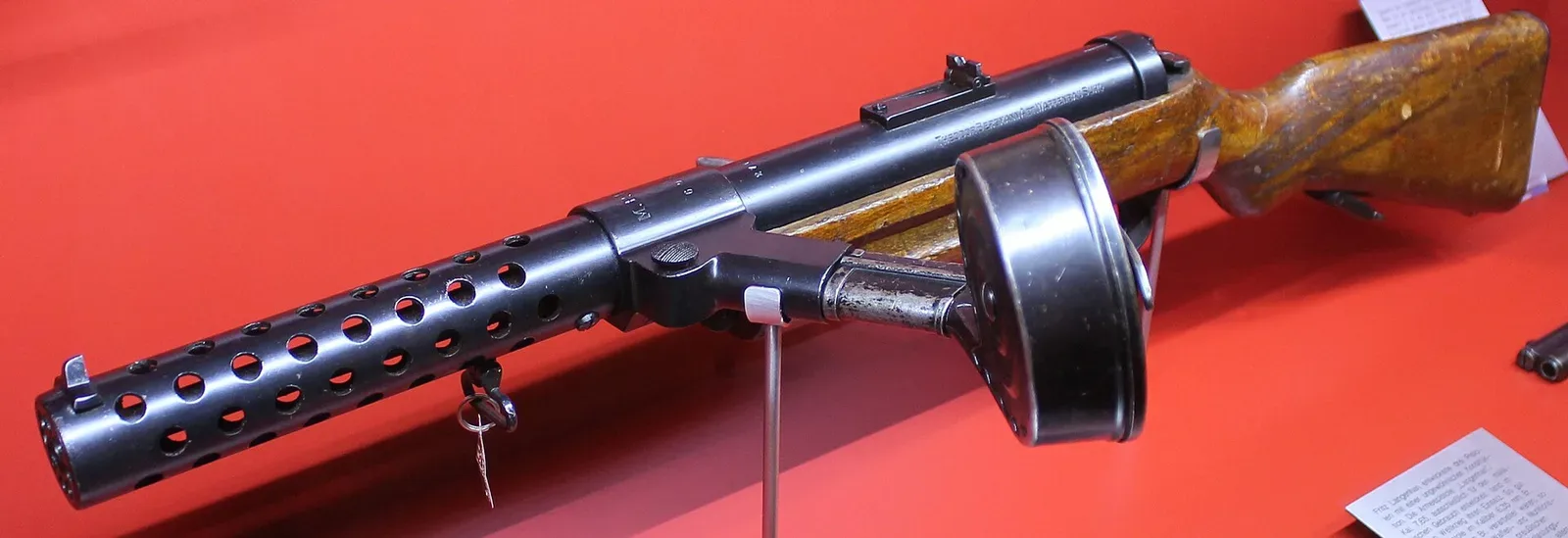
The Bergmann MP 18.1 — the first submachine gun deployed in combat, used by German stormtroopers in the 1918 Spring Offensive.
| Origins | |
|---|---|
| Invented | 1918 |
| Inventor | Hugo Schmeisser |
| Country | Germany |
| Timeline | |
| Era | World War I onwards |
| Replaced By | Assault rifle |
| Impact | |
| Significance | A compact automatic weapon firing pistol-caliber ammunition that filled the tactical gap for close-range combat, reshaped infantry tactics, and influenced firearms legislation. |
Submachine Gun: The Weapon That Rewrote Close-Range War
Firearms encyclopedia article
From The Boise Gun Club Handbook
Overviewedit
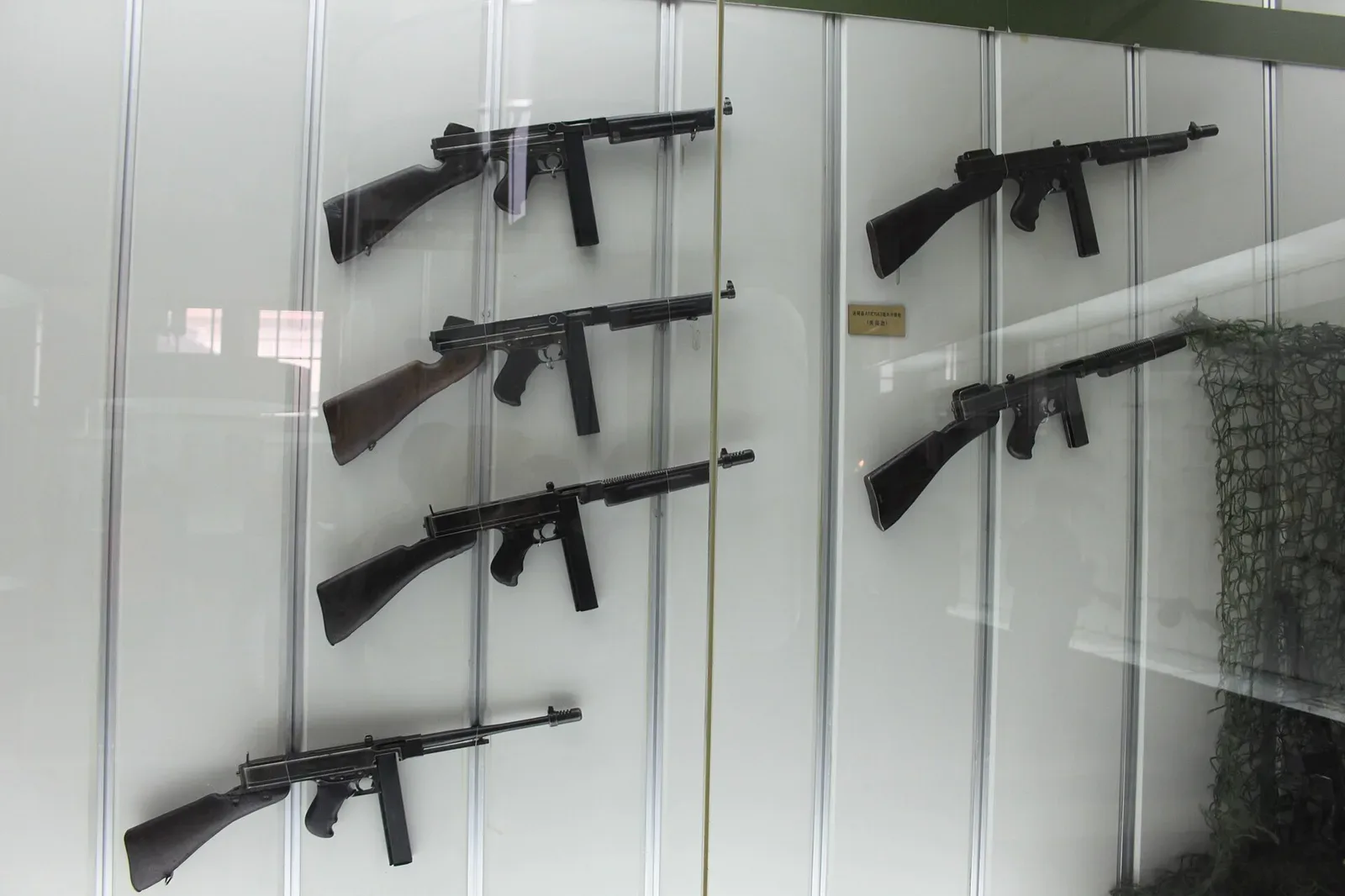
The submachine gun is an automatic or selective-fire, shoulder-fired weapon chambering pistol-caliber ammunition. Compact enough for one soldier to carry and fire, powerful enough to dominate a trench, a building, or a jungle trail — it filled a tactical gap that no previous weapon could.
The concept grew directly out of the misery of World War I. Trench warfare had turned the Western Front into a slaughterhouse of stalemate. When soldiers actually made it to the enemy's trenches, the long bolt-action rifle was nearly useless — too slow, too unwieldy for fighting in a space measured in feet, not yards. What was needed was a weapon that could deliver rapid, automatic fire at close range without requiring the bulk and crew of a machine gun.
The invention of such a compact, highly mobile firearm capable of rapid repeating fire had been sought for nearly 900 years of military history. — Library of Congress
The submachine gun answered that question — and in doing so, it reshaped infantry tactics, influenced organized crime, triggered landmark firearms legislation, and eventually gave way to the assault rifle. It remains in active use today with police and special operations forces worldwide.
Development Historyedit
Early Failed Experiments
The problem before the solution: Early attempts to produce automatic personal weapons resulted in unwieldy multi-barrel designs that were slow to reload and sometimes as dangerous to the user as to the enemy. Multi-shot small arms came into military use beginning in the mid-1600s, according to the Library of Congress, and included pepperbox pistols, volley guns, and double-barreled designs of various configurations. European inventors in Italy, Austria-Hungary, and Germany pushed these concepts toward fully automatic versions of existing semi-automatic pistols.
| Early Automatic Pistol Experiments |
|---|
| Austro-Hungarian Steyr M1912/P16 |
| German Mauser C96 |
| Luger P-08 Artillery |
| Italian Villar Perosa |
The Italian Villar Perosa, a twin-barreled automatic weapon firing 9mm Glisenti pistol ammunition from top-mounted box magazines, is sometimes cited as an early ancestor of the type. Per Modern Firearms, it was compact and fired pistol-caliber ammunition, but its primary tactical role was as a short-range support weapon fired from a mount with machine-gun-type spade grips — not as a rifle-type shoulder weapon. The concept was there; the form factor wasn't yet.
The German Breakthrough
Germany gets there first. In 1915, the German Rifle Testing Commission at Spandau decided to develop a new weapon specifically for trench warfare. An attempt to adapt existing semi-automatic pistols — specifically the Luger and C96 Mauser — for full-auto fire failed immediately. Accurate aimed fire in fully automatic mode was impossible due to their light weight and uncontrollable rates of fire reaching 1,200 rounds per minute. According to the MP 18 Wikipedia article, the commission concluded that a completely new kind of weapon was needed.
Hugo Schmeisser, working for Bergmann Waffenfabrik alongside Theodor Bergmann and a small team of technicians, designed the weapon that answered that requirement. They designated it the Maschinenpistole 18/I — the MP 18.
Full-scale production began in early 1918. The MP 18 was a simple blowback-operated weapon firing from an open bolt, chambered in 9×19mm Parabellum. It used the 32-round TM 08 snail drum magazine developed for the Luger artillery pistol, a choice driven by the testing commission rather than Schmeisser's own preference — he had already designed a conventional 20-round box magazine for it.
The MP 18 was introduced to German Army Sturmtruppen — assault groups specialized in trench combat — as a short-range offensive weapon intended to give individual soldiers firepower well beyond what a pistol could provide. Per the MP 18 Wikipedia article, the first recorded unit to receive the weapon was the 237th Infantry Brigade of the 119th Infantry Division, which received 216 guns for field trials in July 1918 — after the Spring Offensive had already ended. The weapon saw action at the Battle of Amiens, where Canadian troops from the 13th Battalion photographed a captured MP 18 on August 11, 1918. The war ended before the weapon could be deployed at scale, but the concept had been proven.
Fewer than 30,000 MP 18s were produced in total, per the MP 18 Wikipedia article, with estimates of combat-deployed guns running as low as 4,000 based on the serial numbers of Allied-captured examples.
American Parallel Development
On the other side of the Atlantic, Brigadier General John T. Thompson of the U.S. Army ordnance department was working toward the same solution. He envisioned what he called a "one-man, hand-held machine gun" — a "trench broom" that could break the stalemate of the Western Front. Thompson gained financial backing from businessman Thomas F. Ryan and founded the Auto-Ordnance Company in 1916. Development was centered in Cleveland, Ohio, with principal designers Theodore H. Eickhoff, Oscar V. Payne, and George E. Goll.
Thompson came across a patent issued to American inventor John Bell Blish in 1915 for a Blish lock — a locking system based on the supposed adhesion of inclined metal surfaces under pressure. By late 1917, the Blish lock proved to be essentially a manifestation of static friction rather than a true locked breech — and the design was reworked as a friction-delayed blowback. The only cartridge then in service found suitable for this arrangement was the .45 ACP.
The project was titled "Annihilator I." Most design issues were resolved by 1918. The prototypes were not shipped to Europe in time — the war ended two days before they could be sent.
| MP 18 vs Thompson Development Comparison |
|---|
| Aspect |
| Designer |
| Development Start |
| Combat Debut |
| Operating System |
| Caliber |
| Production Run |
At an Auto-Ordnance board meeting in 1919, with the war now over, the weapon was officially renamed the Thompson Submachine Gun — and Thompson became the first person to label and market a weapon under that designation, per the Thompson Wikipedia article. The term "submachine gun" would go on to define the entire class.
Thompson became the first person to label and market a weapon under the 'submachine gun' designation — a term that would define the entire weapon class.
Interwar Evolution and Criminal Adoption
The Thompson entered production as the Model of 1921, manufactured by Colt for Auto-Ordnance in a run of 15,000 units. It was offered to civilians at $200 — roughly $3,610 in 2025 dollars — and saw poor initial sales due to its price and weight. But it found buyers quickly in less conventional markets.
Agents of the Irish Republican Army purchased 653 units in America, though U.S. customs seized 495 of them in New York in June 1921. The remainder reached Ireland by way of Liverpool and saw use in the final month of the Irish War of Independence. Per the Thompson Wikipedia article, the first actual combat use of a Thompson was on June 13, 1921, when West Virginia state troopers fired on striking miners near Lick Creek during what would become the Battle of Blair Mountain.
The 1920s then gave the Thompson its most lasting cultural identity. Prohibition-era gangsters adopted it enthusiastically. It was used in the Saint Valentine's Day Massacre and became the signature weapon of organized crime syndicates throughout the decade — nicknamed the "Tommy gun," the "Chicago Typewriter," and the "Chicago Piano." One researcher, per the Thompson Wikipedia article, called it "the gun that made the twenties roar." This notoriety had consequences: the perceived popularity of the Thompson with violent criminals was among the primary justifications cited for passage of the National Firearms Act by Congress in 1934.
Meanwhile, the weapon was genuinely proving itself in legitimate military use. In Nicaragua, Thompsons deployed by U.S. Marines against guerrillas during the Banana Wars proved so effective as a point-defense weapon against ambushes that they led to the creation of four-man fire teams capable of generating as much firepower as a nine-man rifle squad. The U.S. Navy ordered 500 guns designated the Model of 1928, requesting a reduced rate of fire — down from 800 rpm to 600 rpm — achieved by adding mass to the actuator.
Global Military Acceptance
The Bergmann MP 28 — an improved version of the MP 18 with a selective-fire mechanism and side-mounted box magazine — continued spreading the German design's influence globally through the 1920s and 1930s. According to the MP 18 Wikipedia article, the MP 18's basic design formed the basis of most submachine guns manufactured between 1920 and 1960, including:
- British Lanchester - Direct copy of German MP 28
- Soviet PPSh-41 - Mass-produced Eastern Front weapon
- Finnish Suomi KP/31 - High-quality Nordic design
- Italian Beretta Model 38 - Refined Mediterranean variant
The Library of Congress research guide confirms this lineage explicitly.
By the time the Chaco War, the Spanish Civil War, and the Russo-Finnish Winter War arrived, the submachine gun's viability as a general-issue weapon for fighting troops — not just a specialized assault tool — had been demonstrated conclusively, per Modern Firearms.
How It Worksedit
The submachine gun's mechanical simplicity is central to why it proliferated so rapidly. Most designs, including the MP 18 and the wartime Thompson variants, operate on a blowback principle — specifically, simple or delayed blowback firing from an open bolt.
Open-Bolt Blowback Operation
In an open-bolt, blowback design: when the weapon is cocked, the bolt is held fully rearward by the sear. When the trigger is pulled, the bolt travels forward under spring pressure, strips a round from the magazine, chambers it, and fires — all in a single continuous motion.
The energy of the propellant gases drives the case rearward against the bolt face, pushing the bolt back against the recoil spring, ejecting the spent case, and resetting the system for the next round. So long as the trigger is held, this cycle repeats.
This open-bolt design eliminates the risk of cook-off — the unintended discharge of a chambered round caused by heat buildup in a closed-bolt weapon — which was a meaningful safety consideration in automatic fire. Per the Thompson Wikipedia article, this was a deliberate feature of the Thompson's selective-fire system.
Safety Considerations
The tradeoff is safety in handling. Per the MP 18 Wikipedia article, the open-bolt MP 18 was prone to accidental discharge if the buttstock received a hard knock while the bolt was in the forward position — a collision could drive the bolt rearward enough to pick up and fire a round. German police requested external safeties on their MP 18s specifically because of this. Later designs like the Sten and MP 40 addressed this by allowing the cocking handle to be pushed inward to lock the bolt against the receiver.
The Thompson's M1928 variants added the Blish lock — a bronze H-piece intended to delay blowback through adhesion of inclined surfaces under pressure. By the time the wartime M1 and M1A1 variants were standardized, the Blish lock was eliminated entirely in favor of straight blowback, simplifying production dramatically. The M1A1 went further — the floating firing pin and hammer of the M1 were replaced with a firing pin machined directly to the bolt face, removing additional parts from the equation.
Caliber Choice and Tactical Tradeoffs
Caliber choice is the other defining characteristic. By chambering pistol-caliber ammunition rather than full-power rifle cartridges, submachine guns could be built lighter, with less structural mass required to contain chamber pressures, and soldiers could carry more ammunition. The tradeoff was effective range: the Thompson's .45 ACP round had an effective range of approximately 150 meters, and per the Thompson Wikipedia article, the low-velocity .45 bullet would not penetrate most small-diameter trees or protective armor vests in heavy jungle cover. This wasn't a bug at the design stage — it was a feature for trench and close-quarters fighting. It became a limitation when the tactical environment expanded.
Impact on Warfare & Societyedit
World War II as the submachine gun's defining moment. When Germany invaded Poland in September 1939 and demonstrated Blitzkrieg tactics, the British Expeditionary Force — which had no real infantry submachine gun in service — immediately submitted an urgent request for machine carbines.
The War Office, which had previously dismissed such weapons as "gangster guns" unworthy of proper British soldiers, suddenly ordered 300,000 Thompsons from the United States. Many ended up at the bottom of the Atlantic, sunk by German U-boats targeting supply ships.
Britain's Urgent WWII Response
After Dunkirk, the crisis became acute. Britain needed a submachine gun it could produce domestically, at scale, immediately. The first response was the Lanchester — a direct copy of the German MP 28, described by the National Interest as "an outright copy to the point that the British weapon could use the magazine and even the bolt assembly from the German gun." Headed by engineer George Herbert Lanchester at Sterling Armaments Company, the Lanchester was rugged, reliable, and featured a brass magazine well that made it impervious to saltwater corrosion — which is why the Royal Navy adopted it over the Sten Gun and kept it in service into the 1970s. Fewer than 100,000 were produced, per the National Interest source.
The second response was far more consequential. Designers at the Royal Small Arms Factory at Enfield studied captured German MP 38 examples and found that much of the weapon was made from stamped sheet metal rather than machined steel. They built the Sten around that principle. "Sten" was a contraction of designers Shepherd and Turpin, and Enfield. Per the Sten article source, the Mark II Sten could be manufactured in six man-hours and cost roughly £2 — about $10 — compared to the Thompson's cost of fifteen times as much.
The British Army built approximately 4.5 million Stens across all marks. Most of the components were contracted to hundreds of small workshops and garages across the UK, allowing light industry to contribute to the war effort without displacing heavy industrial capacity.
Mass Production Revolution
The Sten's crude appearance earned it nicknames like the "Plumber's Nightmare" and the "Woolworth Gun" from the troops who carried it. It had real reliability issues — the selector had no safety position, the magazine lips were prone to damage, and a strong jolt could cause accidental discharge. But it was light, it fired the same 9mm ammunition as the German MP 40 with interchangeable magazines, and it could be air-dropped in pieces to resistance organizations across occupied Europe.
| WWII Submachine Gun Production Comparison |
|---|
| Weapon |
| Sten Gun |
| Thompson M1/M1A1 |
| PPSh-41 |
| MP 40 |
Eastern Front Mass Adoption
On the Eastern Front, the Soviet approach was different and more extreme. According to Modern Firearms, the Red Army issued PPSh-41 submachine guns as primary weapons to entire companies and battalions — a level of mass infantry adoption unmatched by any other major power. The PPSh-41 traced its lineage, through the Finnish Suomi KP/31 and the Soviet PPD-34, back to the MP 18 design.
The Thompson itself served on virtually every front of World War II. The U.S. military adopted it formally in 1938, and over 1.5 million military Thompsons were produced during the war — more than twice as many as the M3 Grease Gun that was intended to replace it. It went to Allied scouts, NCOs, patrol leaders, paratroopers, Rangers, commandos, and tank crews. The British Army used it extensively in North Africa and Italy; Australian forces relied on it almost exclusively during the 1942 Kokoda Track campaign in New Guinea, where soldiers routinely picked up Thompsons dropped by killed or wounded comrades rather than leave them behind.
Per the Thompson Wikipedia article, the weapon's weight of ammunition and supply difficulties eventually led Australian units to replace it with domestically produced weapons — the Owen and Austen — in 1943.
The Thompson's production cost dropped from $209 per unit in 1939 to $45 per unit by February 1944 — demonstrating the relentless pressure of wartime economics on weapon design.
The M1A1's production cost had dropped dramatically, demonstrating the pressure wartime production placed on design teams to simplify and economize. The M3 Grease Gun, essentially an American Sten built from stamped sheet metal, entered production in 1943 as a cheaper replacement — but due to unforeseen production delays and modification requests, it never fully replaced the Thompson. At war's end, Thompsons in service outnumbered M3/M3A1s by nearly three to one.
Political and Legislative Consequences
In the United States, the submachine gun's association with Prohibition-era violence had already produced the National Firearms Act of 1934, which required owners of fully automatic firearms to register them with federal authorities and placed restrictions on their possession, transfer, and transport. The Thompson's gangster-era notoriety was explicitly cited as one of the primary reasons for the NFA's passage, per the Thompson Wikipedia article.
The Assault Rifle Transition
The German Sturmgewehr 44, designed by Hugo Schmeisser — the same man who had designed the MP 18 — and the Soviet AK-47 changed the equation permanently. A weapon that was only slightly heavier than a submachine gun but had an effective range several times greater rendered the submachine gun obsolete as a primary infantry weapon. Per Modern Firearms, the appearance of the assault rifle put an abrupt end to submachine gun use by Soviet infantry. The proliferation of light-caliber assault rifles through the 1960s marked the final phase of the submachine gun as a general-issue weapon.
Modern Relevanceedit
The submachine gun didn't disappear — it found new roles that the assault rifle couldn't fill as cleanly.
Specialized Law Enforcement Roles
Police and security applications expanded significantly in the latter half of the 20th century. Per Modern Firearms, the proliferation of international terrorism, drug trafficking, and organized criminal violence forced many police forces to adopt submachine guns for special units. Compact designs from the 1960s and 1970s were rapidly adopted by VIP protection teams and counterterrorism units because they combined concealability with high-volume short-range firepower:
- Uzi - Israeli compact design, global VIP protection standard
- HK MP5 - German precision engineering, counterterrorism favorite
- MAC-10 - American ultra-compact design
- HK MP5K - Ultra-short variant for concealed carry
| Modern Submachine Gun Applications |
|---|
| Role |
| Police SWAT |
| VIP Protection |
| Special Operations |
| Vehicle/Aircraft Crews |
The suppressor compatibility of pistol-caliber submachine guns also matters in ways it didn't in open-field infantry combat. Per Modern Firearms, submachine guns can be silenced more easily than rifle-caliber weapons, making them valuable for special operations forces where noise signature management is a tactical priority.
Historical Persistence and Legacy
The Thompson specifically survived in scattered military and law enforcement use long past its intended service life. South Vietnamese Army units carried Thompsons during the Vietnam War. The Viet Cong used captured models and manufactured their own copies in jungle workshops. The FBI didn't declare the Thompson obsolete and order its weapons destroyed until the early 1970s. The U.S. Navy reportedly had Thompsons aboard ships into the 1970s.
Yugoslav Army units received 34,000 M1A1 Thompsons during the 1950s and some of those weapons surfaced during the Yugoslav Wars of the 1990s. The Irish Republican Army relied on the Thompson as a key part of its arsenal until well into the 1970s, when it was superseded by the Armalite and the AK-47, per historian Peter Hart as cited in the Thompson Wikipedia article.
As of 2024, original Colt Model 1921 and 1928 fully automatic Thompsons sell for $25,000 to $45,000 or more in the U.S. collector market, per the Thompson Wikipedia article. The semi-automatic civilian variants continue to be produced by Auto-Ordnance, now under Kahr Arms, in configurations that comply with current federal law.
The MP 18's influence, meanwhile, has never really stopped. Every blowback-operated pistol-caliber firearm that came after it — from the Sten to the PPSh-41 to the MP5 — carries some of Schmeisser's 1917 design logic forward. Per the MP 18 Wikipedia article, the basic design directly influenced later submachine gun development and showed its superiority over the regular infantry rifle in urban, mobile, and guerrilla warfare — a statement that held true through the 20th century and into the 21st.
The BGC Takeedit
This section reflects editorial opinion based on the historical record above.
What strikes me about the submachine gun's history is how many times the same lesson had to be learned by people who should have already known it.
The British War Office dismissed the entire weapon class as a "gangster gun" unworthy of proper soldiers — right up until their soldiers were evacuating from Dunkirk with nothing to shoot back with. The U.S. military built a beautiful, expensive, hand-fitted Thompson and then spent the entire war figuring out how to make it cheaper. The Thompson started at $200 retail in 1921, dropped to $70 per unit with simplifications by spring 1942, and hit $45 by February 1944. That price trajectory tells the whole story of WWII small arms procurement.
The MP 18 is the ancestor almost nobody talks about, and it deserves better. Hugo Schmeisser built something in 1917 that established the mechanical template for nearly every pistol-caliber automatic weapon manufactured over the next four decades. The Thompson gets the movies and the museum cases. The MP 18 gets a footnote. That's backwards.
The submachine gun's persistence in police, counterterrorism, and special operations roles says something important: the problem it was designed to solve in 1918 never went away. The tactical environment just moved from the trenches to the hallway.
The submachine gun's decline as an infantry weapon was inevitable once the assault rifle arrived — a weapon that weighed nearly the same but could reach out three or four times as far isn't a tradeoff, it's a replacement. But the submachine gun's persistence in police, counterterrorism, and special operations roles says something important: the problem it was designed to solve in 1918 — compact, high-volume, short-range automatic fire — never went away. The tactical environment just moved from the trenches to the hallway.
If you want to understand why firearms development looks the way it does — why we have pistol-caliber carbines, why suppressors work better on some guns than others, why certain military units carry different weapons than the infantry beside them — the submachine gun's 100-year run is where you start.
Referencesedit
- https://en.wikipedia.org/wiki/Thompson_submachine_gun
- https://guides.loc.gov/submachine-gun-to-the-assault-rifle
- https://www.recoilweb.com/thompson-submachine-gun-tommy-boy-122668.html
- https://en.wikipedia.org/wiki/MP_18
- https://nationalinterest.org/blog/buzz/during-world-war-ii-british-copied-old-german-machine-gun-design-163662
- https://sergeanttombstoneshistory.wordpress.com/2017/04/21/the-sten-machine-carbine-the-gun-that-almost-never-was/
- https://modernfirearms.net/en/submachine-guns-history-development-technical/
Last Updated: February 27, 2026
- Gls Guns(Sumner, IA)
- Bi-mart - Yakima (Fruitvale Ave)(Yakima, WA)
- New Philly Sportsman Specialities(New Philadelphia, OH)
- R&R Sports & Outdoors(Brandon, FL)
Loading comments...