Details
.50 BMG Cartridge

The .50 BMG family includes multiple variants: ball, tracer, and armor-piercing rounds—each designed for different operational requirements in machine gun and anti-materiel rifle applications.
| Origins | |
|---|---|
| Invented | 1917-1918 |
| Inventor | John Moses Browning, Winchester Repeating Arms Company, Frankford Arsenal |
| Country | United States |
| Timeline | |
| Era | World War I to present |
| Impact | |
| Significance | A .50-caliber cartridge developed for the M2 Browning machine gun that entered U.S. military service in 1921 and has remained in continuous use for over a century across every major conflict from World War II to present. |
.50 BMG Cartridge
Firearms encyclopedia article
From The Boise Gun Club Handbook
Overviewedit
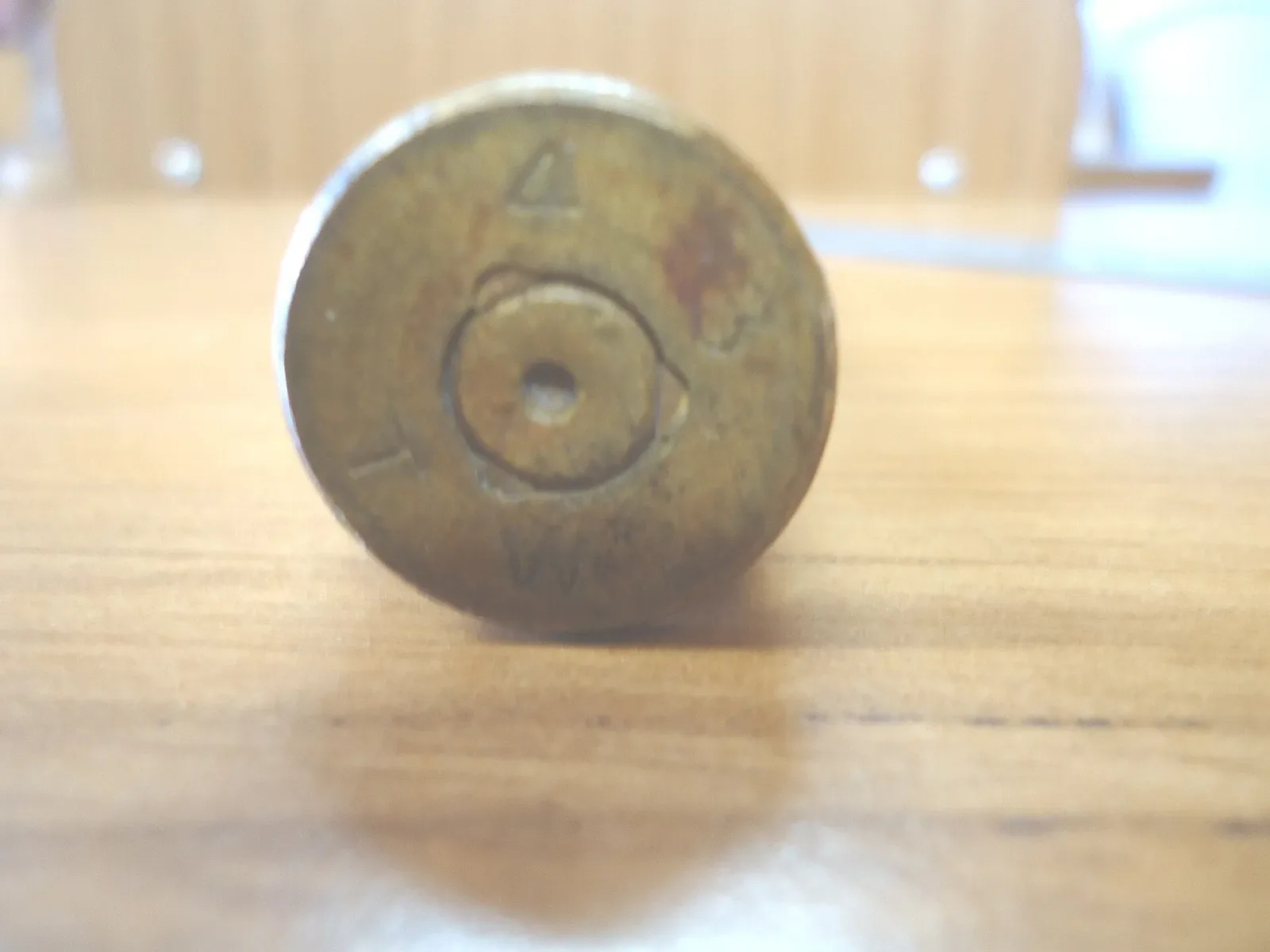
The .50 BMG — formally designated 12.7×99mm NATO and standardized under STANAG 4383 — is a .50-caliber (12.7mm) cartridge developed for the M2 Browning heavy machine gun in the late 1910s. It entered official U.S. military service in 1921 and has never left. That's over a century of front-line use across every major conflict from World War II through the current war in Ukraine, which puts it in extremely rare company among military cartridges.
Technical Specifications
| Specification | Value |
|---|---|
| Formal Designation | 12.7×99mm NATO (STANAG 4383) |
| Case Type | Rimless, bottlenecked |
| Case Length | 3.910 inches (99.31mm) |
| Overall Length | 5.450 inches (138.43mm) |
| Bullet Diameter | 0.511 inches (12.98mm) |
| Powder Capacity | 290+ grains |
| Bullet Weight Range | 647-800 grains |
| Muzzle Energy | 10,000-15,000 ft-lbs |
| Service Entry | 1921 |
| NATO Standard | STANAG 4383 |
The round's performance envelope puts it in a different category entirely. Muzzle energy runs between 10,000 and 15,000 foot-pounds — for reference, the .30-06 Springfield that armed American soldiers through two world wars tops out around 3,000 foot-pounds. That's not a marginal improvement; it's a completely different weapon system.
NATO Standardization
Under STANAG 4383, the .50 BMG is a standard service cartridge for NATO forces. It's manufactured in an extensive range of variants:
- Ball ammunition for general purpose use
- Tracer rounds for fire observation
- Armor-piercing variants for hard targets
- Armor-piercing incendiary combinations
- Saboted sub-caliber penetrators
- High-explosive incendiary armor-piercing rounds
When loaded for machine gun use, cartridges are assembled into continuous belts using metallic links.
Development Historyedit
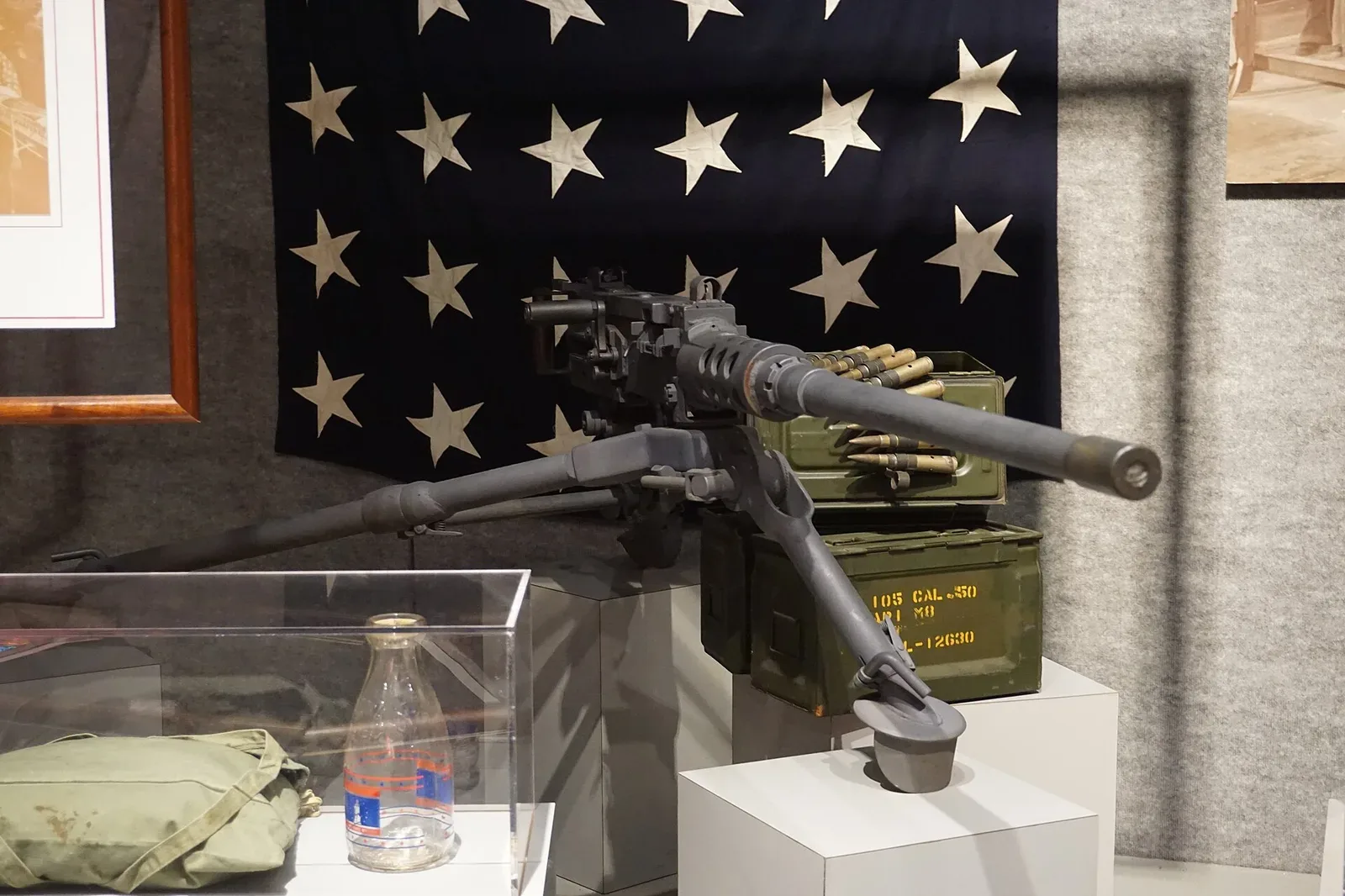
WWI Origins
The .50 BMG exists because World War I broke the assumptions that had governed small arms design for decades. When armored vehicles and purpose-built ground-attack aircraft appeared on the Western Front, rifle-caliber machine guns — chambered in cartridges like the .30-06 — could no longer reliably disable them.
General John J. Pershing, the American Expeditionary Force's commander, went to the Army Ordnance Department with a specific requirement: a machine gun of at least .50-inch caliber delivering a muzzle velocity of at least 2,700 feet per second.
The Army turned to John Moses Browning. He had already designed the .30-06 M1917 Browning machine gun, and the approach for the new weapon was conceptually straightforward — scale it up.
Figure: Key milestones in .50 BMG development from WWI requirement to M2 production
Browning began redesigning the M1917 for a larger cartridge around July 1917. The problem was that the cartridge didn't yet exist.
Winchester and Frankford Arsenal
Winchester Repeating Arms Company got the contract to develop it. Winchester's initial design added a rim, intending the round for an anti-tank rifle role, but Pershing insisted the cartridge be rimless. Frankford Arsenal eventually took over from Winchester and produced the final 12.7×99mm configuration.
According to American Rifleman, Browning's response when Army Ordnance described what they needed was characteristically direct. His son John recalled him saying:
Well, the cartridge sounds pretty good to start. You make up some cartridges and we'll do some shooting. — John Moses Browning's response to Army Ordnance requirements
Browning, working with Colt, completed prototypes ready for testing by November 11, 1918 — the exact date of the Armistice. The Great War ended before a single round fired in anger from an American .50 caliber machine gun.
German Competition
The development timeline ran alongside what German engineers were doing independently. Germany had fielded the 13.2mm TuF cartridge in 1918 for the Tankgewehr M1918 anti-tank rifle, intended for the MG 18 TuF heavy machine gun that never reached the front in time.
Captured German 13.2mm ammunition — with its 800-grain bullet, 2,700 ft/s muzzle velocity, and 1-inch armor penetration at 250 yards — gave Winchester a performance benchmark to meet. They hit it. The final .50 BMG achieved a muzzle velocity of approximately 2,750 ft/s.
| Development Timeline | Event |
|---|---|
| 1917 | General Pershing requests .50-cal machine gun |
| July 1917 | Browning begins M1917 redesign |
| 1918 | Germany fields 13.2mm TuF cartridge |
| Oct 15, 1918 | First .50-cal machine gun test |
| Nov 11, 1918 | Armistice signed; prototypes ready |
| 1921 | M1921 Browning enters service |
| 1926 | John Browning dies |
| 1927-1932 | S.H. Green refines design |
| 1933 | First M2 prototypes manufactured |
Post-War Refinement
The first .50-caliber machine gun test on October 15, 1918 had exposed real problems: rate of fire below 500 rounds per minute, muzzle velocity of only 2,300 ft/s, and a weapon too heavy and slow-firing for the anti-personnel role but not powerful enough for serious anti-armor work. Cartridge improvements addressed the ballistic deficiencies, and Browning continued refining the gun in the immediate postwar years.
The result was the M1921 Browning machine gun — a water-cooled design that formed the direct ancestor of the M2. After Browning's death in 1926, engineer S.H. Green studied the M1921's design problems from 1927 to 1932, arriving at a single receiver architecture that could be configured into seven different variants using different jackets, barrels, and components.
Colt manufactured the first M2 prototypes in 1933, and FN Herstal has produced the gun since the 1930s as well. The water-cooled version worked well in fixed ground mounts and shipboard installations, but infantry needed something lighter — which produced the M2 HB (Heavy Barrel), an air-cooled variant weighing 84 pounds versus 121 pounds for the water-cooled model.
How It Worksedit
Operating Mechanism
The .50 BMG is a short-recoil operated cartridge — the barrel and bolt recoil together a short distance after firing, unlocking and cycling the action. In the M2 Browning, this mechanism runs from a closed bolt, which gave it an important secondary capability: synchronization with aircraft propellers during the early years of World War II.
Figure: Short-recoil operation cycle of the .50 BMG in the M2 Browning system
The cartridge's case uses a long taper specifically to facilitate reliable feeding and extraction across the wide range of weapon systems it's used in. The common rifling twist rate is 1-in-15 inches, with eight lands and grooves.
Primers are Boxer type (single centralized ignition point) in U.S. and NATO production; some other nations use Berdan primers with two flash holes. Maximum chamber pressure per the U.S. Army's TM43-0001-27 runs 54,923 psi, with proof/test pressure at 65,000 psi.
Ballistic Performance
The cartridge's high ballistic coefficient is worth understanding — it's the physical reason the round retains energy and resists wind drift better than lighter, faster projectiles at extreme range. A .50 BMG bullet remains supersonic well past 1,500 meters. The M1022 match cartridge is specifically designed to stay supersonic from 1,640 to 1,750 yards, and its trajectory is matched to the Raufoss Mk 211 for training purposes.
Ammunition Family
The ammunition family covers an extensive spectrum of terminal effects:
| Ammunition Variants | Designation | Tip Color | Purpose |
|---|---|---|---|
| Ball | M33 | None | General purpose |
| Armor-Piercing | M2 AP | Black | Hardened steel core |
| AP Incendiary | M8 API | Silver | AP + incendiary |
| AP Incendiary Tracer | M20 API-T | Silver/Red | AP + incendiary + tracer |
| Tracer | M17 | Red | Fire observation |
| SLAP | M903 | Green | 355-360gr tungsten at 4,000 ft/s |
| SLAP Tracer | M962 | Green/Red | SLAP + tracer |
| HEIAP | Raufoss Mk 211 | Green/Gray ring | Multi-effect penetrator |
| Polymer Case | Mk 323 Mod 0 | Gray | 25% weight reduction |
The armor-piercing designation in U.S. service carries a specific performance standard: all .50 ammunition marked AP must completely perforate 0.875 inches of hardened steel armor plate at 100 yards and 0.75 inches at 547 yards.
Belt Systems
Three distinct and non-compatible link systems exist for belt feeding. The M2 and M9 links are pull-out designs used in the Browning M2 and M3 machine guns. The M15-series push-through links were used in the M85 machine gun. Pull-out cloth belts were used earlier but became obsolete in 1945.
Impact on Warfare & Societyedit
World War II Deployment
The .50 BMG's combat debut came in World War II, where it was deployed essentially everywhere. Aircraft, ships, armored vehicles, ground infantry mounts — the round was ubiquitous.
Nearly 2,000,000 M2 Browning machine guns of all variants were produced during the war, built by manufacturers ranging from the obvious — Colt, Savage Arms, Springfield Armory — to the unlikely: AC Spark Plug, Frigidaire, and Guide Lamp. The manufacturing scale was staggering, and the ammunition consumed measured in the billions of rounds.
Air Superiority Weapon
In the air war, the .50 BMG gave American aircraft a decisive advantage. The AN/M2 light-barrel aircraft version of the Browning armed virtually every U.S. fighter of the war — the P-51 Mustang, P-47 Thunderbolt, P-38 Lightning, F6F Hellcat, and F4U Corsair among them, typically carrying four to eight guns per aircraft. Heavy bombers like the B-17 Flying Fortress and B-24 Liberator mounted them defensively in multiple turret positions, with some configurations reaching twelve or more guns per aircraft.
| WWII Aircraft | Guns | Configuration |
|---|---|---|
| P-51 Mustang | 6 × .50 BMG | Wing-mounted |
| P-47 Thunderbolt | 8 × .50 BMG | Wing-mounted |
| F6F Hellcat | 6 × .50 BMG | Wing-mounted |
| F4U Corsair | 6 × .50 BMG | Wing-mounted |
| B-17 Flying Fortress | 12+ × .50 BMG | Multiple turrets |
| B-24 Liberator | 10+ × .50 BMG | Multiple turrets |
General Henry "Hap" Arnold, commanding the U.S. Army Air Forces, declared the Browning "the outstanding aircraft gun of the Second World War" in 1943.
The outstanding aircraft gun of the Second World War. — General Henry 'Hap' Arnold on the Browning .50-caliber
Field Marshal Hermann Göring, commanding the German Luftwaffe, reportedly stated that if Germany had possessed the Browning .50, the Battle of Britain would have ended differently.
Ground Combat Role
On the ground, the M2 HB proved its worth in anti-personnel, anti-vehicle, and point-denial roles. The .50 BMG AP and API rounds could penetrate the engine blocks and fuel tanks of German fighters attacking at low altitude, punch through the hull plates of half-tracks and light armored cars, and — in the right firing angle — penetrate the sides and rear of Panzer I through Panzer IV tanks.
German forces reportedly dreaded the sound of the M2 in ground engagements, and numerous accounts document the weapon breaking up infantry assaults and ambushes.
Figure: Evolution of .50 BMG tactical roles across major conflicts
Sniper Evolution
Among the most recognized individual actions with the M2 in World War II: on January 26, 1945, near Holtzwihr, France, 19-year-old Second Lieutenant Audie Murphy climbed onto a burning tank destroyer and manned the .50 caliber machine gun against an advancing company of German infantry. Wounded in one leg, he continued firing until he ran dry, then returned to his platoon to organize a counterattack. Murphy received the Medal of Honor for the action.
The Korean War extended both the .50 BMG's combat record and its role in long-range precision fire. American soldiers began using scoped M2 Browning machine guns in a dedicated sniper role — a practice that reached its most famous expression during Vietnam. U.S. Marine Corps sniper Carlos Hathcock, using a telescopic sight mounted with a bracket of his own design on a tripod-mounted M2, used the weapon's traversing-and-elevating mechanism to achieve semi-automatic precision fire. When firing this way, Hathcock hit man-sized targets beyond 1,800 meters. His confirmed long-range kill of 2,250 meters (2,460 yards) — approximately 1.4 miles — set a record that stood from 1967 until 2002, when Canadian Army sniper Arron Perry broke it in Afghanistan.
The .50 BMG's transition from machine gun cartridge to dedicated sniper and anti-materiel rifle cartridge came in the 1980s with the development of the Barrett M82. Designed by Ronnie Barrett, the semi-automatic rifle gave a single operator the capability to engage targets — vehicles, parked aircraft, radar installations, fuel tanks — at ranges previously requiring crew-served weapons or artillery. The military sniper's role expanded accordingly, moving beyond personnel engagement into what doctrine now calls "hard-target interdiction."
Legal Controversies
On the legal battlefront, the .50 BMG's power has made it a recurring political target. California's .50 Caliber BMG Regulation Act of 2004 prohibited private purchase of rifles chambered in the cartridge; Connecticut specifically banned the Barrett 82A1 by name. Washington, D.C. disallows registration entirely, effectively prohibiting civilian possession. Illinois restricts ownership to rifles acquired before January 10, 2023, and registered with state police by January 1, 2024.
Despite these restrictions, a persistent legal misconception deserves direct correction: a 1999 Justice Department Office of Special Investigations briefing identified several instances of .50 BMG involvement in criminal activity, but none of the cited cases confirmed domestic violent criminal use — the majority were possession charges.
A separate misconception has circulated within the military itself: that using the .50 BMG directly against enemy personnel is prohibited by the laws of war. Major W. Hays Parks, writing in the Marine Corps Gazette in January 1988, addressed this directly — no treaty language exists prohibiting such use, and its widespread antipersonnel employment represents customary practice among nations. Parks concluded the misconception likely originated from tactical doctrine restricting the M8C spotting rifle (a .50-caliber aiming aid integrated into the M40 recoilless rifle) to concealment purposes, which some troops mistakenly generalized to all .50-caliber weapons.
Modern Relevanceedit
M2A1 Upgrades
The .50 BMG has not aged out of relevance — it has deepened its footprint. The M2A1, type-classified by the U.S. Army on October 15, 2010, addressed the M2's most persistent operational frustration: headspace and timing had to be manually set each time the barrel was changed, and improper adjustment risked weapon damage and user injury.
| M2A1 Improvements | Feature | Benefit |
|---|---|---|
| Quick-Change Barrel | Fixed headspace/timing | No manual adjustment |
| Slotted Flash Suppressor | 95% flash reduction | Improved concealment |
| Manual Trigger Block | Physical safety | Enhanced user safety |
| Fielded by 2012 | 8,300 units | Army upgrade program |
| Total Program | 54,000+ guns | Complete inventory upgrade |
The M2A1 incorporated a quick-change barrel with fixed headspace and timing, a slotted flash suppressor reducing muzzle flash by 95 percent, and a manual trigger block safety. By November 30, 2012, the Army had fielded 8,300 built or converted M2A1s, with an upgrade program covering more than 54,000 guns in the inventory. The Marine Corps completed its first phase of M2A1 conversions in March 2017.
Civilian Market
The cartridge's civilian market has grown substantially alongside its military profile. The Fifty Caliber Shooters Association holds sanctioned .50 BMG shooting matches, and a wide range of bolt-action and semi-automatic platforms — from the Barrett M95 and M99 to the ArmaLite AR-50, McMillan TAC-50, and Desert Tech HTI — make the round accessible to civilian long-range shooters. Match-grade ammunition, including the military's XM1022 and commercial equivalents, has pushed precision performance at extreme ranges beyond what the cartridge's machine gun origins would suggest.
Law Enforcement Applications
Law enforcement has adopted .50 BMG weapons for specific roles — the New York City Police Department and Pittsburgh Police have both adopted them, primarily for the cartridge's ability to disable vehicles by penetrating engine blocks. The U.S. Coast Guard uses .50 BMG rifles aboard armed helicopters for engine interdiction on suspect vessels during drug interdiction operations. The military uses the round to detonate unexploded ordnance from safe distances.
Future Development
DARPA's EXACTO program — Extreme Accuracy Tasked Ordnance — contracted with Teledyne Scientific Company to develop a guided .50-caliber bullet capable of diverting in flight to strike moving targets. Published DARPA videos from 2015 show the system demonstrating repeatable performance against moving targets. The fundamental projectile, more than a century old, is now a platform for active guidance research.
At the heavy end of current production, the GAU-19 rotary machine gun delivers .50 BMG at up to 2,000 rounds per minute. The M3M and M3P variants serve on helicopters across multiple services and allied nations. The Mk 323 Mod 0 polymer-cased variant, developed by the Naval Surface Warfare Center Crane Division, provides a 25% weight savings over brass-cased ammunition — allowing 40% more rounds carried for the same load weight — without changing performance.
The M2 Browning itself set an unusual longevity record when the U.S. military retired serial number 324 in 2015 — after 94 years in service. An armorer at Anniston Army Depot noted that the receiver "gauges better than most of the other weapons" despite its age. That is probably the most concise summary of this cartridge system's staying power available.
The BGC Takeedit
The .50 BMG is one of those rare cases where the history genuinely earns the superlatives that usually get thrown around carelessly. A cartridge conceived during one world war, refined between them, and then deployed decisively in the next — that's a development arc spanning two generations before the thing even hit its peak influence.
What makes the story worth sitting with is the chicken-and-egg problem at its center. Browning was simultaneously designing both the gun and the cartridge, working against a specification that called for ammunition that didn't exist yet. Winchester got the first contract on the cartridge, Frankford Arsenal finished the job, and Browning partnered with Colt on the gun — all of it coordinated under wartime pressure.
That's not how development programs are supposed to work. It worked anyway, and the result outlasted every piece of military equipment that was supposed to replace it.
The Barrett M82 chapter is worth more attention than it typically gets.
One private citizen developed a semi-automatic rifle around a cartridge that had been exclusively crew-served for sixty years, and fundamentally changed what a single shooter could accomplish at range.
Ronnie Barrett developed a semi-automatic rifle around a cartridge that had been exclusively crew-served for sixty years, and in doing so fundamentally changed what a single shooter could accomplish at range. The military bought them. Then other militaries bought them. The cartridge that started in a water-cooled ground mount ended up as the standard for a whole category of long-range anti-materiel precision systems.
The legal controversies are mostly political theater. The 1999 Justice Department report found no confirmed domestic violent criminal use of .50 BMG firearms among the cases it reviewed. What the bans actually do is restrict sport shooters and collectors in those states while doing nothing measurable about crime — the round costs several dollars per shot and requires a firearm the size of a surfboard. Nobody is doing drive-bys with this thing.
The bigger takeaway from the .50 BMG's history is what it demonstrates about genuine military utility versus specifications-on-paper. Dozens of programs have tried to replace it — lighter, faster-firing alternatives that looked better on engineering drawings. The XM312 and XM806 lightweight .50-caliber prototypes both failed to replace the M2. The cartridge and the gun it was built for simply keep working well enough that the replacement cost never pencils out. Over a century of that reality is not a coincidence.
Referencesedit
- https://en.wikipedia.org/wiki/.50_BMG
- https://www.guns.com/news/browning-50-bmg-cal-bullet-history
- https://www.virtusammo.com/50-bmg-history/
- https://www.browning.com/news/articles/historical/50-caliber-machine-gun-won-ww2.html
- https://en.wikipedia.org/wiki/M2_Browning
- https://gunmagwarehouse.com/blog/the-50-bmg-the-ultimate-boomer/
Last Updated: February 27, 2026
- Gls Guns(Sumner, IA)
- Bi-mart - Yakima (Fruitvale Ave)(Yakima, WA)
- New Philly Sportsman Specialities(New Philadelphia, OH)
- R&R Sports & Outdoors(Brandon, FL)
Loading comments...