Details
Berdan Primer

| Origins | |
|---|---|
| Invented | 1866 |
| Inventor | Colonel Hiram Berdan |
| Country | United States |
| Timeline | |
| Era | 1860s-Present |
| Replaced By | Boxer primer (in United States) |
| Impact | |
| Significance | One of two foundational primer systems for modern centerfire ammunition, widely adopted by military forces worldwide but largely abandoned in the United States due to reloading disadvantages. |
Berdan Primer: The American Invention That Conquered the World (Except America)
Firearms encyclopedia article
From The Boise Gun Club Handbook
Overviewedit
There is a persistent irony baked into every spam can of surplus 7.62x39 that lands on an American range table: the primer igniting that round was invented by an American, adopted enthusiastically by the rest of the world, and largely abandoned in its country of origin. The Berdan primer — named for Colonel Hiram Berdan of the U.S. Army — is one of the two foundational primer systems that define modern centerfire ammunition. Its competitor, the Boxer primer, was invented by an Englishman and became the American standard. History has a sense of humor.
The Berdan primer design is mechanically simple to manufacture and mechanically awkward to reload. Both statements have been true simultaneously for over 150 years.
The Berdan design is mechanically simple to manufacture and mechanically awkward to reload. That single trade-off explains almost everything about where it thrived and where it faded.
For military arsenals running high-volume production with no expectation that soldiers would be hand-loading in the field, it was a practical choice. For American civilian shooters who built a culture around reusing brass, it was a dead end.
Development Historyedit
Pre-Primer Era
To understand where the Berdan primer fits, you have to start a few decades earlier. The firearms that fought the Napoleonic Wars used flintlock mechanisms — a piece of flint striking steel to throw sparks into an external powder pan. It worked, mostly, until it rained. The next step was the percussion cap, developed in the early 19th century: a small metal cup filled with fulminate of mercury placed over a nipple on the breech. When the hammer fell, the cap fired and sent a flame through the nipple to ignite the main charge. It was faster, more reliable in wet weather, and self-contained enough to make the flintlock obsolete within a generation.
But the percussion cap had its own problems, particularly for military use. It was a separate component that had to be manually placed on the nipple before each shot. In the field, under stress, that extra step cost lives. The logical solution was to integrate the priming compound directly into the cartridge itself — which is exactly what several inventors were working on simultaneously in the 1850s and 1860s.
The Invention Question
Hiram Berdan was born on September 6, 1824, in Phelps, New York. He trained as an engineer and developed a keen interest in firearms, eventually reaching the rank of Major General in the Union Army. By the early 1850s he was experimenting with ignition systems, and according to American Rifleman, he patented what would become the Berdan primer in March 1866.
The authorship question, however, is murkier than most sources acknowledge. Alexander Rose, in American Rifle: A Biography, suggests Berdan may have drawn his inspiration from a prototype being developed at Frankford Arsenal. Philip B. Sharpe, in The Rifle in America, states flatly that Berdan was not the original inventor, citing official government records without specifying them. Perhaps most directly, Roy Marcot, in Hiram Berdan: Military Commander and Firearms Inventor, includes a statement by Major Treadwell alleging that Berdan essentially copied a primer and pocket designed by Colonel S.V. Benet, who was Frankford Arsenal's Commanding Officer at the time.
Author Colin Greenwood further complicates the picture by arguing that Berdan's 1866 patent was specifically for the primer pocket — the case modification — rather than the primer itself.
History has nonetheless credited Berdan with the invention, and the commercial record supports his involvement. Marcellus Hartley and Alfred C. Hobbs of the Union Metallic Cartridge Company used Berdan's primer pocket patent in production of UMC's centerfire cartridges beginning in 1867. The design was in the market.
What Berdan's system actually looked like in its earliest form is worth noting. According to George Hoyem's The History and Development of Small Arms Ammunition, the anvil on the earliest Berdan-primed ammunition was offset to one side of the primer pocket. The improved version — with the anvil centered — is the configuration still in use today.
Commercial Development
On the other side of the Atlantic, Colonel Edward M. Boxer of the Royal Artillery, who served as Superintendent of the Government Ammunition Factory at Woolwich, patented his competing design in 1866 as well. The Boxer primer moved the anvil from the cartridge case into the primer cup itself, creating a fully self-contained unit with a single central flash hole in the case. Boxer's design made the spent primer easy to push out with a simple decapping pin — a feature that would prove decisive for reloaders.
Here too, the sole-inventor narrative gets complicated. Today's Boxer primers are largely the result of John Gardner making improvements to the original Boxer design while employed in the cartridge shop at Winchester Repeating Arms Company. Most sources still credit Boxer, which creates parallel ambiguity for both primer systems.
| Timeline | Event | Key Figure |
|---|---|---|
| 1824 | Hiram Berdan born in Phelps, New York | Hiram Berdan |
| 1850s | Early primer experimentation begins | Berdan, Benet |
| March 1866 | Berdan primer patent filed | Hiram Berdan |
| 1866 | Boxer primer patent filed | Edward M. Boxer |
| 1867 | UMC begins commercial production | Hartley & Hobbs |
Geographic Adoption
The two designs diverged geographically almost immediately. Boxer primers were adopted by the British military for cartridges including the .577/450 Martini-Henry, and the United States adopted Boxer primers for military ammunition in cartridges such as the .45 Colt and .45-70 Government. Berdan-primed cases, meanwhile, became the standard across European military arsenals and spread from there to virtually every country outside North America.
How It Worksedit
Basic Firing Sequence
Both primer systems solve the same problem — reliably igniting the powder charge — but they solve it in structurally different ways, and those differences ripple through every downstream consideration.
In any centerfire cartridge, the firing sequence runs like this: the firing pin strikes the base of the cartridge, compressing the priming compound between the metal primer cup and a hard piece of metal called the anvil. The sudden pressure detonates the compound, and the resulting hot gas and incandescent particles jet through one or more flash holes into the powder space, igniting the propellant.
Centerfire cartridge ignition sequence common to both primer systems
Berdan Design
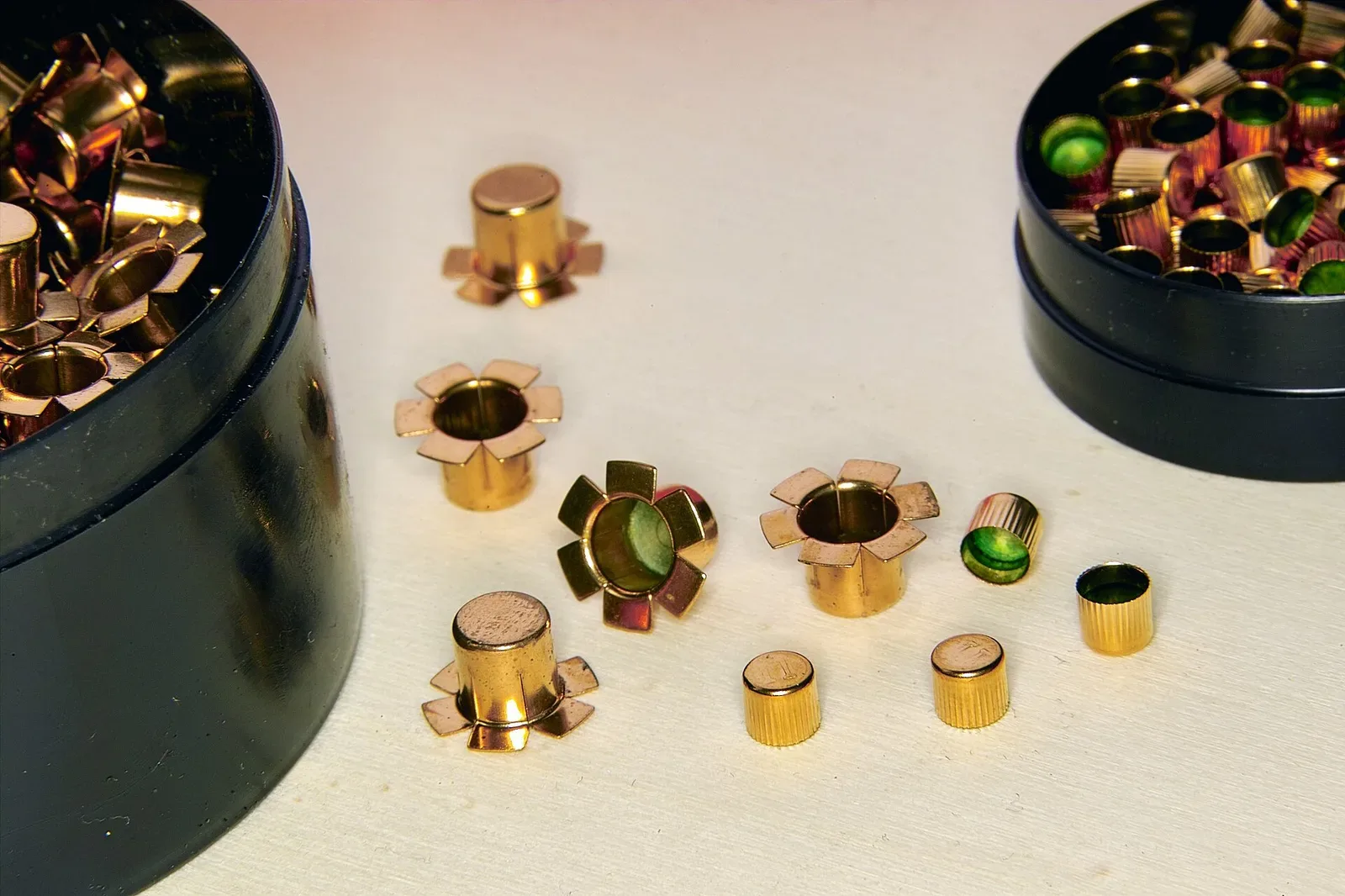
The Berdan design makes the anvil a permanent part of the cartridge case — a small protrusion rising from the floor of the primer pocket, which looks, for practical purposes, like a pimple in the center of the primer pocket. Around this fixed anvil, two or sometimes three small flash holes are punched in a symmetrical pattern. The primer cup itself is simply a small metal cylinder — no anvil, no complex internal geometry. It can be stamped out of sheet metal and filled with priming compound. That manufacturing simplicity is the system's core advantage.
Boxer Design
The Boxer design inverts this. The anvil lives inside the primer cup, which makes each primer a self-contained assembly: cup, anvil, priming compound, and a foil or paper seal. The cartridge case has a single central flash hole with a flat primer pocket floor. Manufacturing the primer is more complex, but handling and replacing it is dramatically simpler — you push a pin through the single central flash hole and the spent primer falls out.
| Feature | Berdan Primer | Boxer Primer |
|---|---|---|
| Anvil Location | Fixed in case | Inside primer cup |
| Flash Holes | 2-3 offset holes | 1 central hole |
| Manufacturing Cost | Lower | Higher |
| Reloading Difficulty | High | Low |
| Decapping Method | Specialized tools | Standard pin |
| Standardization | Multiple sizes | 4 standard sizes |
Reloading Implications
For a shooter who never reloads, the distinction is invisible. Ballistic performance — velocity, energy, accuracy — is determined by the powder charge, bullet weight, and barrel length. The primer's job is simply to reliably initiate combustion, and both systems do that job. Performance is essentially a push between the two designs when all other variables are held constant.
For a reloader, the distinction is everything. Decapping a Boxer-primed case takes a standard decapping die and about two seconds. Decapping a Berdan-primed case requires working around two or three off-center flash holes with no central channel to guide a pin. Specialized tools exist — the RCBS Berdan decapping tool is a two-rod system that hooks the rim of the primer and levers it out — but the process is slow and the tools are not universally available. Breakage is common enough that RCBS offers a lifetime guarantee on its decapping pins.
Adding to the complexity is the lack of standardization. Boxer primers come in four standardized sizes, covering the full range of pistol and rifle applications. Berdan primers exist in far more sizes with little cross-manufacturer standardization, meaning a reloader working with Berdan-primed brass needs to measure each batch of primer pockets with calipers before ordering components.
Impact on Warfare and Societyedit
Military Adoption
Berdan himself understood the military application before anyone else did. He had already demonstrated his grasp of precision shooting by organizing and commanding Berdan's Sharpshooters — a Union Army unit built around long-range marksmanship that became one of the more effective specialized infantry formations of the American Civil War. The U.S. Army recognized the advantages of his primer design and adopted it for the Model 1861 Springfield rifle musket, which was the standard-issue firearm for Union troops during the war. The primers offered better water resistance and more consistent ignition than the percussion caps they replaced, which mattered considerably in the muddy, wet conditions of a 19th-century campaign.
Chemical Evolution
The chemistry of those early primers, however, created problems that took decades to fully resolve. Mercury fulminate — the priming compound used in both Berdan and Boxer primers during the Civil War era — degraded in storage, losing thermal energy over time to the point where it could cause hang fires (delayed ignition) or complete misfires. Worse, residual mercury inside fired brass cases attacked the cartridge walls, making them brittle and prone to splitting on reload.
This ruled out reuse of mercury-fulminate-primed cases almost entirely.
| Primer Chemistry | Era | Characteristics | Issues |
|---|---|---|---|
| Mercury Fulminate | Civil War - 1900s | Early standard | Brass degradation, hang fires |
| Potassium Chlorate | 1900s - 1950s | Stable storage | Corrosive residue |
| PA-101 (Modern) | 1952 - Present | Non-corrosive | Current standard |
The next generation of primer chemistry addressed storage stability but introduced a new problem. Frankford Arsenal's FA-70 primer used potassium chlorate as a primary component. Potassium chlorate is hygroscopic — it attracts moisture — and the residue left in the bore after firing would draw water from the air and cause rapid rusting. These became known as corrosive primers, and they remained standard in U.S. military ammunition well past the point when non-corrosive alternatives existed. American ammunition manufacturers began offering non-corrosive primers to the civilian market in the 1920s, but the U.S. military continued using corrosive primers through the Korean War due to reliability concerns with the early non-corrosive formulations.
The shift came with the adoption of the 7.62x51mm NATO cartridge in the 1950s. Picatinny Arsenal developed the PA-101 primer, which established a non-corrosive standard that has governed both military and civilian primer production since. It is safe to assume that any American-made ammunition produced after 1952 uses non-corrosive primers.
Global Standardization
The geographic split in primer adoption had long-term logistical consequences. European military arsenals that had standardized on Berdan primers continued producing them at scale through two world wars and the Cold War, which is why Berdan-primed surplus ammunition from that era remains widely available today. The design's thicker case heads — a structural consequence of the integrated anvil pocket — also contributed to case durability under the high chamber pressures of military rifles, an advantage in harsh field conditions.
The Berdan system's dominance outside the United States also reflects a practical reality: the culture of civilian hand-loading that developed in America never took hold to the same degree elsewhere. When shooters have no expectation of reloading their brass, the manufacturing simplicity of the Berdan primer — an inexpensive cup that can be produced anywhere with basic metalworking capacity — is a genuine advantage. It could be and was produced in virtually every country with any industrial capacity, which meant military forces worldwide could source primers without dependence on a single supplier.
Key milestones in centerfire primer evolution
Geographic divergence of primer systems from common origin
Modern Relevanceedit
Current Market Reality
The Berdan primer is not going anywhere, even if it continues to recede from American shelves. The vast majority of surplus military ammunition that reaches the U.S. market — Eastern European 7.62x39, older NATO-surplus, ammunition from the Middle East, Africa, and Southeast Asia — is Berdan-primed. That includes most of the steel-cased and aluminum-cased budget ammunition that budget-conscious shooters use for high-volume range work.
CCI used Berdan primers in their Blazer line of aluminum-cased handgun ammunition for exactly this reason: aluminum cases are not intended to be reloaded, so the reloading disadvantage is irrelevant, and the lower manufacturing cost of the primer cup passes through to the retail price.
Corrosion Considerations
The corrosion question still matters for anyone shooting older surplus. Treat ammunition as corrosive and clean the bore immediately and thoroughly after shooting if:
- Ammunition came from a spam can with unreadable markings
- It was produced in Southeast Asia, the Middle East, or Africa
- It predates 1952
Modern Berdan-primed ammunition from current manufacturers is non-corrosive, but the surplus market contains decades of production from arsenals that were still running chlorate-based formulations long after American manufacturers had moved on.
Reloading Practicalities
For reloaders who find themselves holding a batch of quality Berdan-primed brass — perhaps Portuguese military 7.62 NATO or Austrian commercial cases — the work is doable. It requires the right decapping tools, careful measurement of primer pocket dimensions, and patience with sourcing. RWS once offered Berdan primers in the United States in nine different sizes, and the primer pockets cleaned exceptionally well — leaving a thin film of ash rather than the stubborn residue common to Boxer primers. RWS no longer appears to be importing them, and no current U.S. importer has been identified.
The four standardized Boxer primer sizes cover the full range of modern reloading needs:
| Primer Size | Diameter | Applications |
|---|---|---|
| Small | 0.175" (4.45mm) | .38 Special, .223 Remington |
| Shotgun | 0.209" (5.31mm) | 12/20 gauge, muzzleloaders |
| Large | 0.210" (5.33mm) | .308 Winchester, large pistol |
| Magnum | 0.315" (8mm) | .50 BMG, large capacity |
Berdan primer sizing, by contrast, is non-standardized across manufacturers, which means American reloaders working with Berdan brass are essentially operating without a catalog — measuring each batch and sourcing accordingly.
Specialized Applications
There is one niche where Berdan primers may have a structural advantage that doesn't get discussed much: firearms with angled firing pins or actions that cannot strike a primer dead center. The geometry of a Berdan case with its offset flash holes and integrated anvil may actually be better suited to certain single-shot designs where the firing pin does not impact the primer perpendicularly.
The geometry of a Berdan case with its offset flash holes and integrated anvil may actually be better suited to certain single-shot designs where the firing pin does not impact the primer perpendicularly.
It's a narrow application, but it illustrates that the design is not simply an inferior version of the Boxer system. It is a different approach with different strengths.
The BGC Takeedit
The Berdan primer's story is worth understanding precisely because it's counterintuitive. An American invented it. An American military adopted it during the Civil War. An American ammunition company commercialized it. And then America quietly walked away from it while the rest of the world kept running.
That's not a failure of the technology. It's a reflection of how civilian shooting culture shapes the entire supply chain.
That's not a failure of the technology. It's a reflection of how civilian shooting culture shapes the entire supply chain.
American reloaders drove demand for Boxer-compatible brass, which drove manufacturers to standardize on Boxer primers, which made Berdan primers progressively harder to source, which made reloaders more dependent on Boxer. The feedback loop reinforced itself over decades until Berdan primers became foreign by association even though they're domestically originated.
From a pure manufacturing standpoint, the Berdan design is elegant. A simple cup, no internal assembly, tunable to any size. For a government arsenal running millions of rounds, that matters. For someone at a bench with a set of Lee dies, it's a headache.
The corrosive ammunition issue clouds the picture for a lot of shooters who associate Berdan with old spam cans and rust. That's not a Berdan problem — it's a primer chemistry problem that afflicted both systems before non-corrosive compounds were perfected and adopted. Modern Berdan-primed commercial ammunition is non-corrosive. The surplus stuff deserves the suspicion, but the design itself doesn't.
If you shoot steel-cased or aluminum-cased budget ammunition, you're already shooting Berdan primers. You just may not have known it. They work fine. Clean your gun.
Referencesedit
- https://gunmagwarehouse.com/blog/berdan-vs-boxer-primer-a-history-of-the-modern-primer/
- https://ammo.com/primer-type/berdan
- https://www.ammunitiontogo.com/lodge/boxer-vs-berdan-primers/
- https://forum.cartridgecollectors.org/t/umc-use-of-berdan-primers/10314
- http://www.allaboutguns.net/Berdan-Primers.html
- https://oldmanmontgomery.wordpress.com/2019/11/02/curiosity-of-early-berdan-case-manufacture/
- https://hi-luxoptics.com/blogs/leatherwood-hi-lux/the-primer
- https://www.powdervalley.com/reloading-basics/boxer-vs-berdan-primers/
- https://www.americanrifleman.org/content/back-to-basics-primers/
Last Updated: February 27, 2026
- Gls Guns(Sumner, IA)
- Bi-mart - Yakima (Fruitvale Ave)(Yakima, WA)
- New Philly Sportsman Specialities(New Philadelphia, OH)
- R&R Sports & Outdoors(Brandon, FL)
Loading comments...