Organization Info
Winchester Repeating Arms Company

| Overview | |
|---|---|
Founded | 1866 |
Headquarters | New Haven |
Disciplines | Firearms manufacturing, including rifles, shotguns, and ammunition |
Winchester Repeating Arms Company
Firearms encyclopedia article
From The Boise Gun Club Handbook
Overviewedit
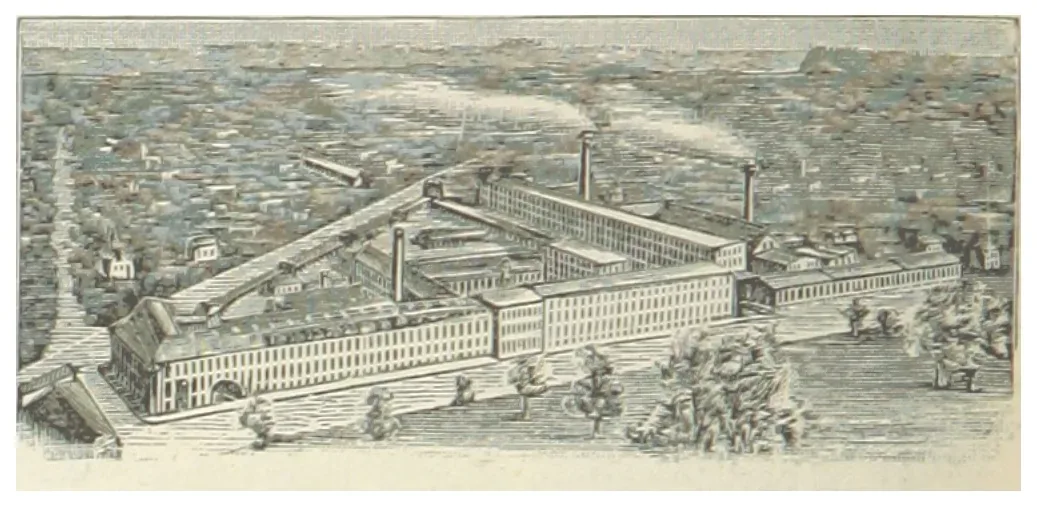
Winchester Repeating Arms Company sits at the center of American firearms history the way few manufacturers ever have. Its rifles crossed the frontier, fought in two World Wars, filled Hollywood Westerns, and put meat on the table for generations of hunters. The name became so synonymous with lever-action rifles that gun writer Ned Crossman wrote in the early 20th century that the Model 1873 "put the name Winchester on the map of the West, trotting along with the equally formidable Colt gun at the belt of the frontiersman."
"The Model 1873 put the name Winchester on the map of the West, trotting along with the equally formidable Colt gun at the belt of the frontiersman." — Ned Crossman, early 20th century gun writer
But Winchester didn't arrive fully formed. The company is the product of roughly three decades of accumulated tinkering, failed ventures, patent sales, and corporate reorganizations — involving men whose names you already know from other corners of firearms history. Understanding where Winchester came from is the only way to understand why its rifles mattered.
History & Foundingedit
The Long Road to New Haven
The direct technological lineage of the Winchester rifle begins in 1848–1849, when Walter Hunt of New York patented his "Volition Repeating Rifle." Hunt's design introduced the two features that would define Winchester rifles for the next century and a half: a tubular magazine under the barrel and a lever that cycled the action.
His ammunition — the "Rocket Ball," a hollow-base bullet with the powder charge contained inside — was an early stab at what we'd now recognize as a self-contained cartridge. The rifle itself was fragile and never went into production; the only known example is a prototype.
Hunt sold his patents, and in 1849 Lewis Jennings purchased them from Robbins & Lawrence of Windsor, Vermont, who had acquired the design. Jennings produced meaningful improvements and managed to sell approximately a thousand rifles before interest collapsed around 1851–1852. His rifle could hold an impressive 24 rounds, though the underpowered rocket ball ammunition remained the system's fundamental weakness.
| Year | Developer | Innovation | Key Features | Outcome |
|---|---|---|---|---|
| 1848-49 | Walter Hunt | Volition Repeating Rifle | Tubular magazine, lever action, "Rocket Ball" ammo | Prototype only, never produced |
| 1849-52 | Lewis Jennings | Improved Hunt design | 24-round capacity | ~1,000 rifles sold |
| 1854 | Smith & Wesson | Volcanic Repeating Arms | Recognizable lever action, rimfire cartridge | Company failed, founders left |
| 1857 | Oliver Winchester | New Haven Arms Company | Purchased bankrupt Volcanic assets | Foundation for Winchester |
| 1860 | Benjamin Tyler Henry | Henry rifle | .44 Henry rimfire, 16-round magazine | Civil War success |
Horace Smith and Daniel Wesson — yes, those two — saw something worth saving in the Jennings design. In 1854 they formed the Volcanic Repeating Arms Company, which introduced the recognizable lever action that would define the Winchester. The Volcanic was offered as both a pistol and a rifle, but the rocket ball still couldn't deliver enough energy to make the system competitive with conventional arms of the day. Smith and Wesson departed, eventually to build the revolver company that bears their name, and Oliver Winchester — the company's largest stockholder — purchased the bankrupt firm's assets and reorganized it as the New Haven Arms Company in April 1857.
Smith had made a critical contribution before all this reshuffling: he added a primer charge to Hunt's Rocket Ball, producing one of the first fixed metallic cartridges. He then went further, adding a cylindrical copper case with a rim-mounted primer — the rimfire cartridge. His .22 Short would be introduced commercially in 1857 with the Smith & Wesson Model 1 revolver and is still manufactured today. That development set the stage for everything that followed.
Benjamin Tyler Henry and the Civil War
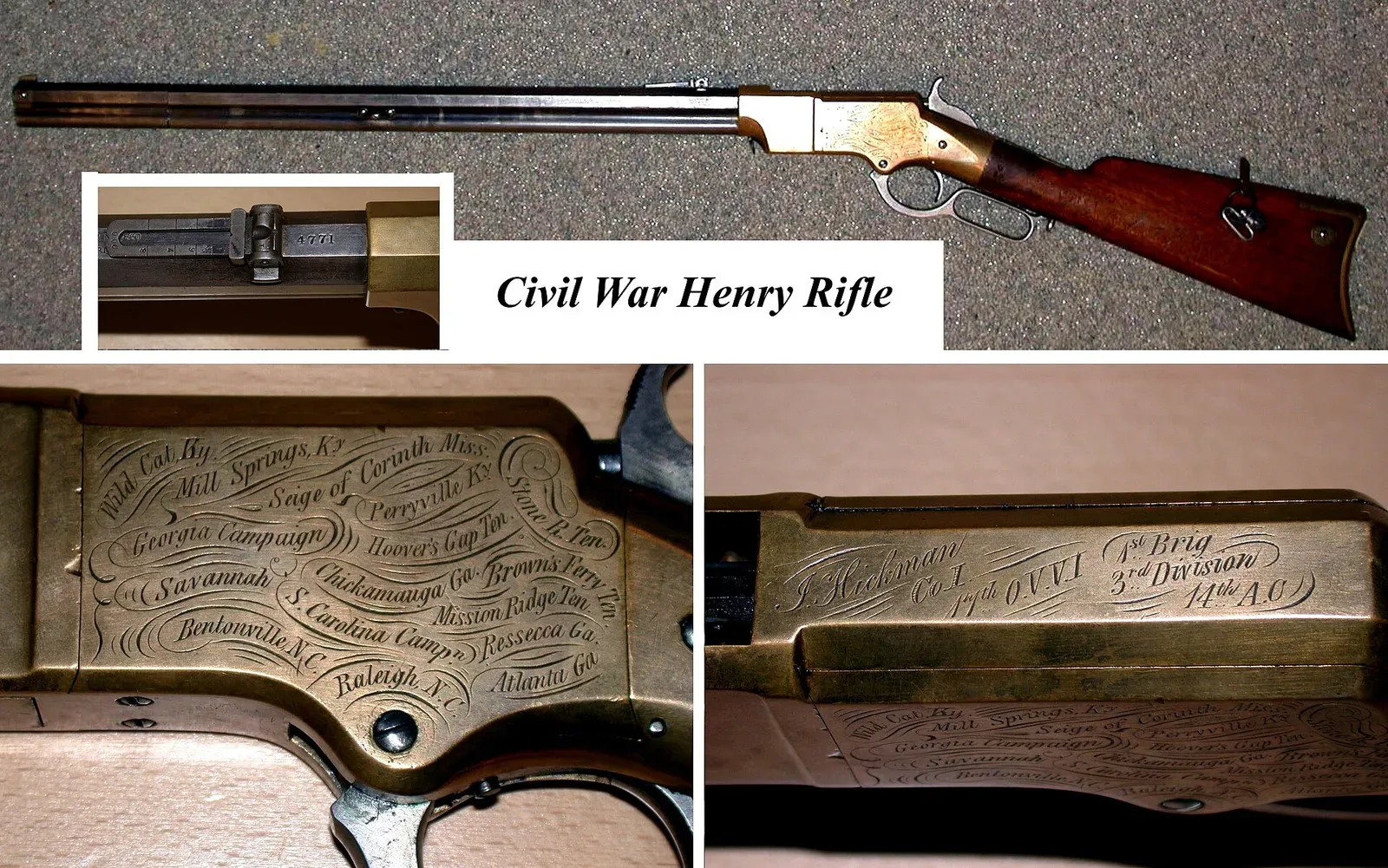
At the New Haven Arms Company, Oliver Winchester hired Benjamin Tyler Henry as factory foreman. Henry had worked at Robbins & Lawrence alongside Jennings and understood the system's shortcomings better than anyone. He abandoned the rocket ball entirely and redesigned the rifle around a much more powerful ".44 Henry rimfire" cartridge, earning a patent for his improvements in October 1860.
Timing mattered. The Henry rifle arrived just as the Civil War broke out, and it found buyers on both sides. The Union Army officially purchased 1,731 Henry rifles at $36.95 each — a small number compared to the 94,196 Spencer repeaters procured — but an estimated 9,000 more were privately purchased by soldiers who wanted the firepower.
The Henry's 16-round tubular magazine, compared to the Spencer's 7-round capacity, earned it the Confederate nickname:
"That damned Yankee rifle that they load on Sunday and shoot all week." — Confederate nickname for the 16-round Henry rifle
Confederate President Jefferson Davis reportedly armed his bodyguards with captured Henrys.
In 1865, at the Battle of Allatoona Pass, a single company of 52 men from the 7th Illinois, armed with Henry rifles, defeated an attacking Confederate battalion — a concrete demonstration of what sustained repeating fire could accomplish against troops armed with muzzle-loaders.
Winchester Repeating Arms Company: 1866 Onward
After the war, Oliver Winchester renamed New Haven Arms after himself. The Winchester Repeating Arms Company was born, and its first product was the Model 1866 — the first rifle to bear the Winchester name. Factory superintendent Nelson King addressed the Henry's key weaknesses: he added a loading gate on the side of the receiver so the rifle no longer had to be loaded from the muzzle, and he enclosed the magazine in a sealed tube partially covered by a wooden forestock. The Model 1866 retained the .44 Henry rimfire cartridge and its bronze/brass receiver, earning the nickname "Yellow Boy." It would remain in production until 1899.
The 1866 found military customers almost immediately. France purchased 6,000 rifles and 4.5 million rounds for the Franco-Prussian War. The Ottoman Empire bought 45,000 rifles and 5,000 carbines in 1870 and 1871. When those Turkish troops used their Winchesters at the Siege of Plevna during the Russo-Turkish War of 1877–78, outnumbered Ottoman soldiers inflicted casualties on Russian troops armed with single-shot Krnka and Berdan rifles at a ratio that shocked European military observers. The engagement triggered a serious reassessment of repeating rifles across the continent. Switzerland initially selected the Model 1866 to replace its Milbank-Amsler rifles before political pressure pushed it toward the domestically designed Vetterli — which borrowed the Winchester's tubular magazine concept.
In 1873, Winchester introduced the steel-framed Model 1873, chambered for the new ".44-40" centerfire cartridge — the first centerfire cartridge Winchester manufactured. The steel frame was lighter and more durable than the brass of its predecessor. A sliding dust cover shielded the action from the elements. The upgrade from a 28-grain rimfire powder charge to a 40-grain centerfire load improved muzzle velocity meaningfully, and centerfire primers were more reliable and easier to reload than rimfire cases. The 1873 would define Winchester's public identity for the next half-century.
| Model | Year | Frame Material | Cartridge | Key Innovation | Production End |
|---|---|---|---|---|---|
| Model 1866 | 1866 | Bronze/brass | .44 Henry rimfire | Side loading gate, enclosed magazine | 1899 |
| Model 1873 | 1873 | Steel | .44-40 centerfire | First Winchester centerfire, dust cover | 1919 |
| Model 1876 | 1876 | Heavy steel | .45-75, .50-95 Express | Centennial model, big game hunting | 1897 |
Mission & Activitiesedit
Building the Model 1873's Market
Winchester understood from early on that a rifle's reputation was as important as its mechanics. The company actively cultivated endorsements. Buffalo Bill Cody wrote to Winchester in 1875 praising the Model 1873, and Winchester reprinted his letter in its catalog that same year. Cody described using eleven rounds of his Winchester to stop a charging bear in the Black Hills — practical advertising that frontier customers could actually believe. Buffalo Bill's increasingly popular Wild West Show amplified the rifle's fame further.
To drive premium sales, Winchester established the "One of One Thousand" grade in 1875. Barrels producing unusually tight groups during test-firing were fitted with set triggers and special finishes, marked accordingly, and sold for $100 — roughly $3,000 in 2024 dollars. A second tier, "One of One Hundred," sold for $20 over standard list price. In total, approximately 136 "One of One Thousand" Model 1873s and only eight "One of One Hundred" rifles were sold. Both grades became crown jewels of Winchester collecting, and a 1950 Western starring James Stewart — Winchester '73 — was based around the coveted grade, sending collectors hunting for surviving examples.
The slogan "The Gun That Won the West" didn't emerge officially until early 20th century advertising campaigns. According to Rock Island Auction, the phrase was coined by Edwin Pugsley, a Winchester engineer who had worked on the BAR and championed the Model 21 shotgun. The sentiment predated the slogan by decades, but Pugsley formalized it as marketing language.
The Browning Partnership
The Model 1873's toggle-link action had a hard ceiling. As ammunition became more powerful through the 1880s, the toggle lock couldn't handle the pressures that big-game hunters and military customers were demanding. The Model 1876 (Centennial Model), introduced to mark the American Centennial Exposition, attempted to bridge the gap with a heavier frame chambered for cartridges like .45-75 Winchester and .50-95 Express — the latter being the only repeater known to have been in widespread use by professional buffalo hunters, according to Wikipedia. But the 1876's toggle-link receiver was still too short for the most popular high-powered rounds, and production ended in 1897.
The solution came from outside. In 1883, John Moses Browning began a partnership with Winchester that would last into the early 1900s and reshape the company's product line entirely. Browning's Model 1886 introduced a vertically sliding locking-block action that replaced the weak toggle lock — strong enough to handle the .45-70 Government, .45-90, and the massive .50-110 Express buffalo cartridges. It was a genuine engineering leap. William Mason made additional improvements to Browning's original design.
Browning followed the 1886 with the Model 1892, a scaled-down version of the same action chambered for the lower-pressure cartridges the 1873 had used — directly competing with Marlin's offerings in that space. The Model 1892 ultimately sold 1,004,675 units before Winchester stopped production in 1941. Then came the Model 1894, perhaps Browning's most consequential rifle design.
Winchester was the first manufacturer to produce a civilian rifle chambered for smokeless propellants, and although the ".30-30" cartridge didn't appear on shelves until 1895, it became the first commercially available smokeless powder round for North American consumers. The Model 1894 became the first sporting rifle to sell over one million units, eventually reaching more than seven million before U.S. production was discontinued in 2006. The Winchester ".30-30" configuration is, practically speaking, synonymous with "deer rifle" in the United States.
| Model | Year | Designer | Action Type | Key Innovation | Units Sold |
|---|---|---|---|---|---|
| Model 1886 | 1886 | John M. Browning | Locking-block | Handled .45-70, .50-110 Express | N/A |
| Model 1892 | 1892 | John M. Browning | Scaled locking-block | Competed with Marlin | 1,004,675 |
| Model 1894 | 1894 | John M. Browning | Locking-block | First smokeless civilian rifle | 7+ million |
| Model 1895 | 1895 | John M. Browning | Box magazine | Spitzer bullets, military cartridges | N/A |
Browning also designed the Model 1895 — the first Winchester lever-action to use an internal box magazine instead of a tube magazine, which allowed it to chamber military cartridges with pointed spitzer bullets. The Model 1895 served the armed forces of the United States, Great Britain, and Imperial Russia, and in 1908 became the first commercially produced sporting rifle chambered in .30-06. Theodore Roosevelt used a Model 1895 in .405 Winchester on African safaris, calling it his "medicine gun" for lions.
In addition to lever-action rifles, Browning's Winchester work produced the lever-action Model 1887/1901 shotgun, the pump-action Model 1890 rifle, and the pump-action Model 1893 and Model 1897 shotguns.
Military Production
Winchester contributed substantially to both World Wars despite the U.S. military never formally adopting the lever-action Winchester as a standard infantry arm. During World War I, Winchester was a major producer of the Pattern 1914 Enfield rifle for the British and the M1917 Enfield for the United States. Winchester also sold 300,000 Model 1895 rifles to Imperial Russia for use on the Eastern Front against Germany — these box-magazine rifles could even be loaded using charger clips, a feature found on no other lever-action.
During World War II, Winchester designed the M1 carbine and produced the M1 Garand rifle. According to the Library of Congress research guide, the M1 carbine's basic design configuration is credited to Winchester.
Beyond Firearms
The Library of Congress notes that from 1886 to 1929, the Winchester Repeating Arms Company put its name on products far beyond guns — garden tools, washing machines, fishing tackle, sporting goods, and pocket knives — promoting those products as being as reliable as the gun. The brand had enough equity to carry across categories in a way that few manufacturers managed.
Impact on Firearmsedit
Winchester's contribution to firearms development runs in two directions: mechanical and cultural.
On the mechanical side, the company's lineage — Hunt to Jennings to Smith & Wesson to Henry to Winchester — traces the development of:
- Development of self-contained metallic cartridge
- Tubular magazine system refinement
- Lever action mechanism evolution
- Centerfire ammunition standardization
- Browning's locking-block action template
- Transition from black powder to smokeless propellants
- Box magazine integration for military cartridges
The Model 1873's adoption of centerfire ammunition helped establish that standard's dominance over rimfire for center-caliber rifles.
Browning's locking-block action, developed at Winchester's request, became the template for strong lever-action designs that followed and freed the lever-action from the pressure limitations of the toggle-lock era.
The Model 1894 specifically marks the transition from black powder to smokeless propellants in commercial American sporting rifles — a shift with consequences for ballistics, barrel design, and cartridge development that are still felt today. The ".30-30" Winchester Smokeless, introduced in 1895, went on to become the most widely produced lever-action cartridge ever, according to Rock Island Auction.
The Model 1895's box magazine design, meanwhile, demonstrated that lever-action rifles could accommodate military spitzer ammunition — bridging the gap between the lever gun's cultural appeal and the practical requirements of modern military cartridges.
On the cultural side, the Winchester became inseparable from the American frontier narrative. The Model 1873 was carried by:
- Billy the Kid (photographed with Winchester '73 carbine)
- Frank James and other outlaws
- Lakota, Northern Cheyenne, and Arapaho warriors at Little Bighorn
- North-West Mounted Police (750 Model 1876s purchased 1883)
- Geronimo (Model 1876 at surrender)
- Theodore Roosevelt (engraved Model 1876 for western hunting)
Archaeological evidence confirms at least eight Model 1873s among the Native American forces at the Battle of the Little Bighorn. The North-West Mounted Police carried the Model 1876 in .45-75 as a standard long arm. Geronimo had a Model 1876 at his surrender in 1886. Theodore Roosevelt used an engraved Model 1876 during his early western hunting expeditions.
The pairing of the Winchester 1873 with the Colt Single Action Army — particularly after Colt introduced the "Frontier Six-Shooter" in 1877 chambered in .44-40 — gave frontier users a rifle and revolver that shared ammunition. Frank James, when asked why he favored those two guns specifically, explained it directly:
"The cartridges of one filled the chambers of the other. There is no confusion of ammunition here." — Frank James, explaining why he favored the Winchester 1873 and Colt SAA combination
In 2014, a weathered Model 1873 was discovered leaning against a juniper tree in Great Basin National Park, generating significant media attention. The rifle — which became known as the "Forgotten Winchester" — remains a mystery; no one has established who left it there or why they never returned for it.
Current Statusedit
Corporate Evolution
Winchester's 20th-century corporate history is considerably less romantic than its 19th-century product history. The company faced financial collapse in 1930. According to the Library of Congress, in December 1980, Olin Corporation retained Winchester's ammunition business but sold the New Haven plant to its employees, who incorporated it as the U.S. Repeating Arms Company under license to manufacture Winchester Arms.
After that company's 1989 bankruptcy, Belgian arms maker FN Herstal — which also owns Browning — acquired it. The company continues to manufacture under the Winchester Repeating Arms brand.
Modern Production
Classic models have returned to production through licensing and international manufacturing. The Model 1873 was reintroduced in 2013, manufactured under license from Olin by the Miroku Corporation in Kōchi Prefecture, Japan — joining the Model 1892 and Model 1894, which Miroku had already been producing for FN/Browning.
| Model | Current Manufacturer | Location | Available Calibers | Barrel Options |
|---|---|---|---|---|
| Model 1873 | Miroku Corporation | Kōchi, Japan | .357 Mag/.38 Spl, .44-40, .45 Colt | 20", 24" (round/octagonal) |
| Model 1892 | Miroku Corporation | Kōchi, Japan | Various | Multiple configurations |
| Model 1894 | Miroku Corporation | Kōchi, Japan | .30-30, others | Traditional profiles |
| Reproductions | Uberti | Italy | Period-correct calibers | Authentic specifications |
The reintroduced 1873 is available with 20- or 24-inch barrels in round or octagonal profiles, chambered in .357 Magnum/.38 Special, .44-40 Winchester, or .45 Colt. It closely follows the original design — including the trigger disconnect safety, sliding dustcover, and crescent buttplate — with two safety additions: a firing pin block and a modified cartridge carrier that ejects cases away from the shooter.
The cowboy action shooting community has driven consistent demand for the 1873 platform, and Italian manufacturer Uberti has been producing high-quality reproductions under Olin license. Winchester ammunition remains a major commercial operation independent of the firearms manufacturing side.
The Winchester Arms Collectors Association (WACA) is a non-profit organization dedicated to the preservation of Winchester-produced items and related material — an indication of how seriously the collector community takes the brand's history.
The BGC Takeedit
What Winchester actually represents, stripped of the mythology, is what happens when accumulated mechanical progress meets exactly the right market moment. The 1873 wasn't the most powerful rifle available in its era — buffalo hunters preferred Sharps and Remington single-shots with far more potent cartridges. The military never formally adopted it. But none of that mattered on the frontier, where reloading speed, shared pistol ammunition, and mechanical reliability under field conditions beat raw power on most days that counted.
The Browning partnership is where Winchester's engineering legacy really lives.
The Model 1894 alone — in .30-30, in the woods, in the hands of deer hunters across North America for over a century — is an argument that a well-designed rifle chambered for the right cartridge can outlast entire generations of "improvements."
The fact that it crossed seven million units before U.S. production stopped in 2006 is not a marketing claim. That's just what happened.
The corporate collapse story — bankruptcy, employee buyout, second bankruptcy, acquisition by a Belgian company — is worth sitting with. Winchester's manufacturing history ended in New Haven not because the rifles weren't good, but because 20th-century industrial economics don't care much about 19th-century legends. The brand survives. Whether that's the same thing as the company surviving is a question worth asking.
Referencesedit
- https://en.wikipedia.org/wiki/Winchester_rifle
- https://www.rockislandauction.com/riac-blog/the-rifle-that-won-the-west-winchester-model-1873
- https://www.popularmechanics.com/military/weapons/a23149/winchester-rifle/
- https://guides.loc.gov/american-firearms/gunmakers/winchester
- https://hi-luxoptics.com/blogs/history/the-gun-that-won-the-west
- https://www.winchesterguns.com/products/rifles/model-1873.html
Last Updated: February 27, 2026
- Gls Guns(Sumner, IA)
- Bi-mart - Yakima (Fruitvale Ave)(Yakima, WA)
- New Philly Sportsman Specialities(New Philadelphia, OH)
- R&R Sports & Outdoors(Brandon, FL)
Loading comments...