Details
Alexander John Forsyth
Percussion caps in 4.5mm and 6.0mm sizes — Forsyth's innovation replaced the flintlock's unreliable spark with a reliable impact-sensitive explosive compound.
| Biography | |
|---|---|
| Born | 28 December 1768, Belhelvie, Aberdeenshire |
| Died | 11 June 1843, Belhelvie, Aberdeenshire |
| Nationality | Scottish |
| Occupation | Church of Scotland minister, firearms inventor |
| Legacy | |
| Known For | Inventing the percussion ignition system, ending the flintlock era |
| Key Innovation | Percussion lock using fulminating compounds struck by hammer blow to ignite main powder charge, patented 1807 (British Patent No. 3032) |
Alexander John Forsyth: The Minister Who Ended the Flintlock Era
Firearms encyclopedia article
From The Boise Gun Club Handbook
Overviewedit
Alexander John Forsyth (28 December 1768 – 11 June 1843) was a Church of Scotland minister from Belhelvie, Aberdeenshire who, in his spare time between sermons and parish visits, dismantled two centuries of firearms technology and replaced it with something better. His percussion ignition system — patented in 1807 — eliminated the flintlock's exposed priming pan, its vulnerability to rain, and the visible flash that gave game birds just enough warning to be somewhere else by the time the shot arrived. The Metropolitan Museum of Art calls it "the most consequential firearm invention since the flintlock." That framing holds up.
The most consequential firearm invention since the flintlock. — Metropolitan Museum of Art
What Forsyth actually built was a bridge. His scent-bottle lock and the various percussion systems it inspired led directly to the copper percussion cap, which led directly to the self-contained metallic cartridge, which is what feeds every modern firearm on the planet. The man never left his parish permanently, never got rich from the invention, and died weeks before a government reward check arrived. His story sits at one of the genuine hinge points in the 800-year history of firearms.
Early Life & Backgroundedit
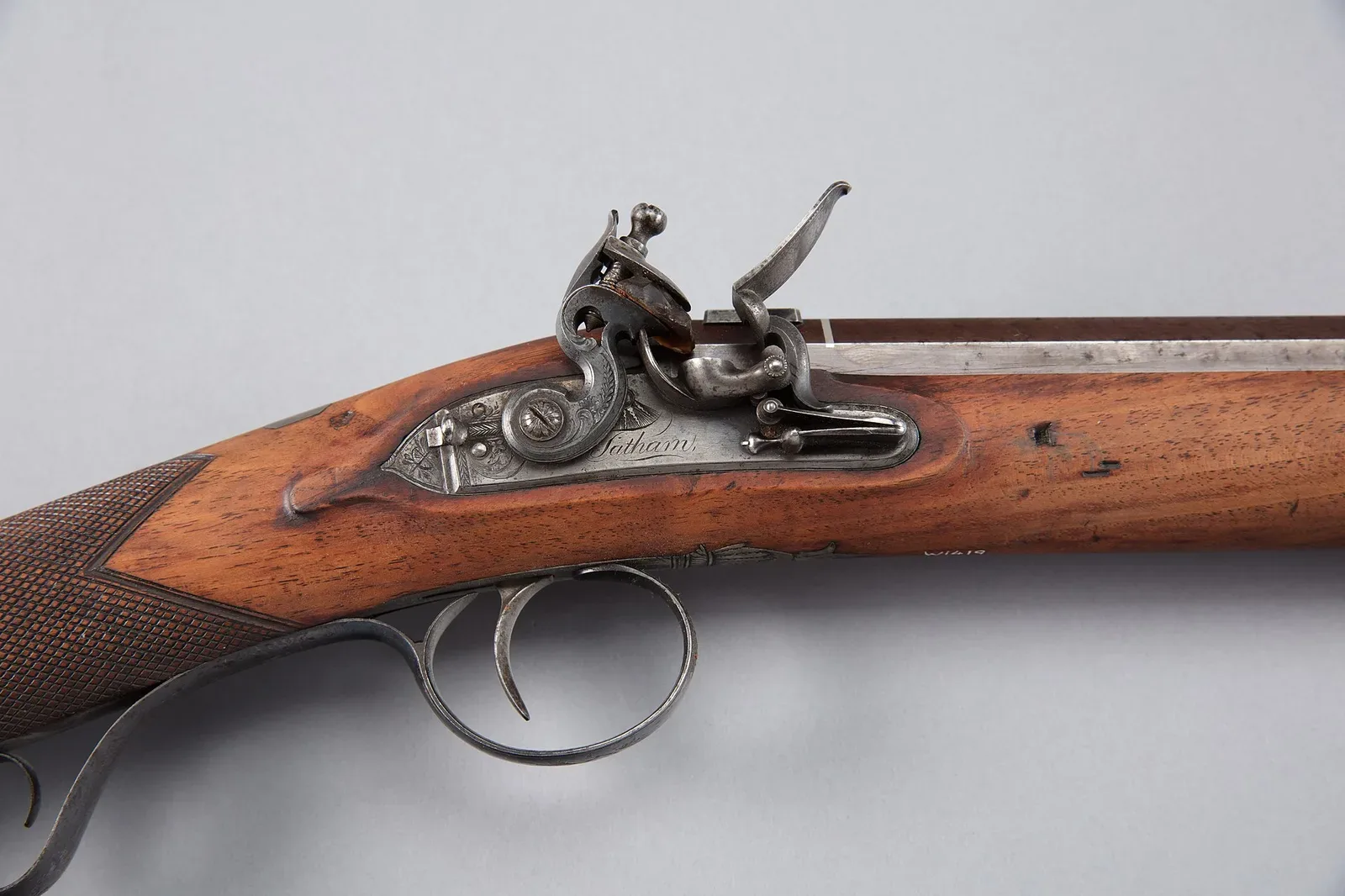
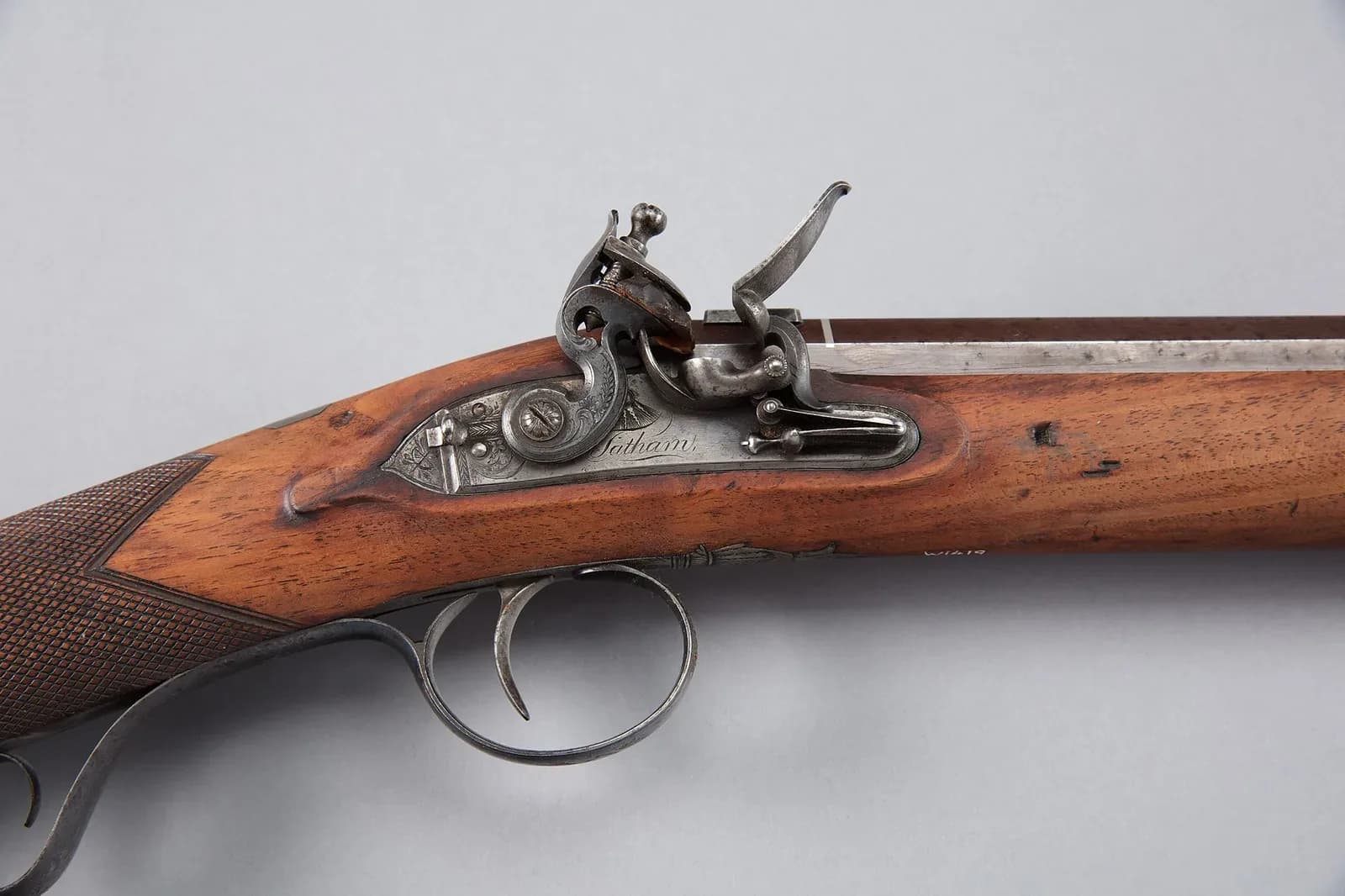
Forsyth was born into a clerical household at the manse in Belhelvie — his father, Rev. James Forsyth, was the parish minister, and his maternal grandfather, Rev. Walter Syme, held the same office at Tullynessle. The Church of Scotland ran deep in both sides of the family. He attended King's College, Aberdeen from 1782 to 1786, earning a Master of Arts degree through a curriculum that covered divinity, classics, and natural philosophy.
The intellectual environment of the Scottish Enlightenment was present at King's College in those years — James Beattie, professor of moral philosophy, was among the faculty — and it shaped the way Forsyth would later approach chemistry and mechanics: as problems worth solving, not as threats to theological order.
Education and Ordination
When his father died suddenly in December 1790, the crown presented young Alexander to the Belhelvie parish. He was licensed to preach by the presbytery of Aberdeen on 13 October 1790 and ordained as minister on 24 August 1791 at age 23. He would hold that post for the remaining 52 years of his life. He later received an LL.D. from the University of Aberdeen in 1834.
The Flintlock Problem
The Aberdeenshire coast gave Forsyth his motivation. He was an avid wildfowl hunter, and the flintlock fowling piece frustrated him for a specific, concrete reason: lock time. The delay between trigger pull and ignition was long enough that a duck could hear the flint strike, register the noise, and begin evasive action before the shot charge reached it. In damp Scottish weather, the flintlock's priming powder also absorbed moisture and misfired with annoying regularity. He began tinkering with ignition alternatives in his garden smithy around 1793, drawing on contemporary chemical work — Claude Berthollet's experiments with potassium chlorate in 1788 and Edward Howard's 1800 paper on fulminate of mercury, the man who had famously blown up his own laboratory in the process of studying it.
Key Contributionsedit
The Core Innovation
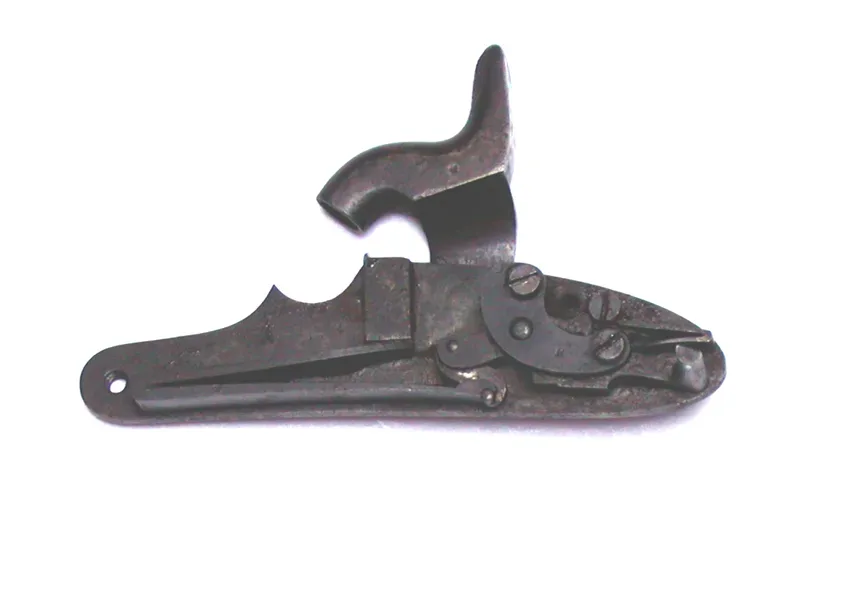
Forsyth's core insight was the one that changed everything: instead of trying to use fulminating compounds as propellants — which blew up laboratories — use them only as primers. A tiny quantity, struck by a hammer blow, could reliably ignite a main powder charge without the open pan, the exposed spark, or the weather dependency of the flintlock. He began working toward this in earnest after 1800, conducting experiments with volatile compounds in the smithy behind his manse, accepting the personal hazard that came with handling materials that could detonate from friction or impact.
Instead of trying to use fulminating compounds as propellants — which blew up laboratories — use them only as primers.
In the spring of 1805, Forsyth produced his first working percussion lock and field-tested it through a full season of game shooting. According to positiveshooting.com, it worked well — ignition was more reliable than flint and steel, and the speed improvement made wing shooting noticeably easier.
Tower of London Development
He went to London in 1806 to find official backing. Lord Moira, then Master General of the Ordnance, was impressed enough to set Forsyth up in a workshop at the Tower of London with instructions to develop the system into a weatherproof lock suitable for military use on both firearms and cannon.
Forsyth worked there for close to a year. The arrangement ended when John Pitt, Earl of Chatham — brother of William Pitt — replaced Moira as Master General. Chatham was not persuaded. He ordered Forsyth out of the Tower of London and told him to take his "rubbish" with him.
Patent and Commercial Production
Forsyth sought patent protection in 1807 with his friend James Watt — of steam engine fame — acting as adviser on the language. The result was British Patent No. 3032, granted April 11, 1807. The patent text was deliberately broad, covering the principle of using detonating compounds struck by sudden pressure to fire a charge through a sealed vent — not just one specific mechanism. That breadth would prove critical in litigation. The patent granted a 14-year monopoly, expiring in 1821.
The "scent bottle" was Forsyth's signature implementation. A small steel magazine rotated at the breech end of the barrel, dispensing a measured charge of fulminating compound — primarily mercury fulminate, sometimes mixed with potassium chlorate — into a flash chamber aligned with the barrel's vent. A hammer strike detonated it, the flash traveled through a central channel into the main powder charge, and the gun fired. The system worked in wet conditions where a flintlock would not, and the ignition speed eliminated the lag that gave game birds their warning.
On the commercial side, Forsyth partnered with James Purdey — who had previously worked for Joseph Manton — and opened Forsyth & Co. at 10 Piccadilly in 1808, with backing from his barrister cousin James Brougham.
- Approximately 4,000 firearms produced
- High-quality sporting rifles, shotguns, and pistols
- Operations at 10 Piccadilly, later Leicester Street
- Partnership with James Purdey until ~1819
The guns were expensive and the mechanism required some care, which limited mass military adoption, but among serious sporting hunters they found an audience.
Forsyth also reportedly turned down a £20,000 offer from Napoleon Bonaparte to develop the system in France. The French gunsmith Jean Lepage developed a similar ignition system in 1807 based on Forsyth's design, but it was not pursued.
Impact on Firearms Developmentedit
Patent Litigation
The patent fight was a major part of Forsyth's post-1807 life. Competitors worked constantly to get around his broad claims, and Forsyth pursued them in court. Joseph Manton was sued in 1816 over a pellet lock that Forsyth argued infringed his patent — and the court agreed. By 1819, the patent had been validated in litigation, though the financial returns remained modest. The patent's expiration in 1821 unleashed the field entirely.
Military Adoption Timeline
Within a year of expiration, Joshua Shaw — an English gunsmith working in the United States — patented the copper percussion cap in the U.S. in 1822. Shaw had reportedly been making iron caps as early as 1814 and copper examples by 1816, but Forsyth's patent coverage in Britain had blocked him from filing there. Shaw later wrote that he had been manufacturing and selling caps at a rate of two million annually. The copper cap solved the handling problem that had made Forsyth's bulk-detonating systems impractical for mass military use: the compound was pre-measured, sealed, and safe to handle until struck.
| Country | Adoption Year | Key Firearm | Notes |
|---|---|---|---|
| United States | 1833 | Model 1833 Hall carbine | Dragoon regiments, 3,000+ units by 1836 |
| Austria | 1838 | — | Early military adoption |
| France | 1840 | — | 0.3% misfire rate vs 6.8% flintlock |
| Britain | 1840 | Brunswick rifle | Pattern 1851 for line infantry |
| Prussia | 1841 | — | Last major European power |
Evolution from Forsyth's percussion system to modern ammunition
Technical Legacy
The longer arc runs further. Forsyth's fulminating primer became the copper percussion cap, which became the integrated primer in the self-contained metallic cartridge — both the Berdan and Boxer primer systems that emerged by the late 1860s built directly on what Forsyth established in 1807. The centerfire cartridge that loads into every modern rifle, pistol, and shotgun traces its ignition chemistry back to a parish minister shooting ducks on the Aberdeenshire coast and getting annoyed at the delay between trigger pull and shot.
The American Society of Arms Collectors has described Forsyth's gunlocks as "the big initial step from the old sparking flintlocks to the cap lock in its best-known form." The positiveshooting.com account puts it plainly: "It is hard to over emphasise the importance of Forsyth's invention — it was certainly of no less import than his friend Watt's famous engine."
Later Life & Legacyedit
Forsyth returned to Belhelvie around 1819 as the company wound down. He never married and had no children. He continued his ministry — delivering sermons, administering sacraments, organizing smallpox inoculations for his parishioners after corresponding with Dr. Edward Jenner, and contributing detailed observations on parish life and education to the New Statistical Account of Scotland (written January 1840, published 1845). His account noted that the parish church held 519 legal sittings but regularly accommodated 600–700 people, and that the absence of free seats was deterring the poor from regular attendance — a practical concern delivered in the measured tone of a man who had spent decades paying attention to his community.
He spent his later years making knives from local ironstone and shooting wildfowl. The chemistry experiments appear to have wound down after the business closed. Public advocacy eventually secured him a £200 gratuity in 1842. The British government approved a £1,000 grant in June 1843 as formal recognition of the percussion lock invention. The news arrived after he died on 11 June 1843 at the manse in Belhelvie, at age 74. The grant was distributed among three relatives by December 1843. His estate was valued at £572 10s. 5d.
He was buried in Belhelvie Kirkyard. The gravestone, placed in 1844 by relatives William, Elizabeth, and Mary Reid, reads: "In Memory of Rev. Alexander John Forsyth LLD, for 52 years minister of this parish. He was born 28 Dec 1768, died 11 Jun 1843." Memorials to him exist at the Tower of London — where he did much of his development work — and at King's College, Aberdeen, where he studied. A memorial plaque was established at Belhelvie Church honoring both his ministry and his scientific contributions.
The Forsyth & Co. name continued operating in London until around 1852, outliving its founder by nearly a decade.
The BGC Takeedit
Forsyth is one of the cleaner cases in firearms history where you can point to a single person and say: the technology before him, the technology after him, and the gap between those two things is almost entirely his doing. He didn't just improve the flintlock — he broke the conceptual framework it operated in. The flintlock world thought about ignition as a spark problem. Forsyth reframed it as a chemistry problem, and once you do that, you're on a path that leads straight to the modern centerfire cartridge.
What I find worth sitting with is the setting. This wasn't a government weapons program or a London workshop full of specialized talent. It was a country minister with a garden smithy, working with compounds that could take his hand off, in between Sunday services and parish visits. The Tower of London episode ending with him being told to take his "rubbish" and leave is one of those moments that belongs in any honest account of how military institutions relate to new technology — badly and slowly, until someone else proves the point for them.
The financial story is grimly predictable. He spent years in litigation protecting a patent that should have made him comfortable, wound up back in his parish living on a church stipend, and died weeks before the government got around to paying him what they owed. The £1,000 grant going to his relatives rather than to him is a small but accurate symbol of how the 19th century treated inventors who weren't also businessmen.
None of that changes what he actually built. Every time a centerfire cartridge fires — in a competition pistol, a hunting rifle, a military service weapon — the ignition chemistry at the base of that brass case is Forsyth's idea, refined and miniaturized and packaged by everyone who came after him. That's a legacy that doesn't need any embellishment.
Referencesedit
- https://www.britannica.com/biography/Alexander-John-Forsyth
- https://thisday.pcahistory.org/2020/12/december-28-alexander-john-forsyth/
- https://en.wikipedia.org/wiki/Alexander_John_Forsyth
- https://www.undiscoveredscotland.co.uk/usbiography/f/alexanderjohnforsyth.html
- http://www.positiveshooting.com/CatridgeHistoryTeaser.html
- https://www.metmuseum.org/art/collection/search/33345
- https://americansocietyofarmscollectors.org/wp-content/uploads/2022/04/1969-B19-The-Forsythe-Percussion-System.pdf
Last Updated: February 27, 2026
- Gls Guns(Sumner, IA)
- Bi-mart - Yakima (Fruitvale Ave)(Yakima, WA)
- New Philly Sportsman Specialities(New Philadelphia, OH)
- R&R Sports & Outdoors(Brandon, FL)
Loading comments...