Details
Percussion Cap

Percussion caps in standard sizes: 4.5mm and 6.0mm. The smaller cap became dominant after the 1850s despite initial preference for larger variants.
| Origins | |
|---|---|
| Invented | Early 1820s |
| Country | Britain, France, and America |
| Timeline | |
| Era | 1820s-1870s |
| Replaced By | Self-contained metallic cartridge |
| Impact | |
| Significance | Solved the flintlock's vulnerability to weather and misfires, enabling reliable military firearms, practical revolvers, and ultimately modern ammunition. |
Percussion Cap
Firearms encyclopedia article
From The Boise Gun Club Handbook
Overviewedit
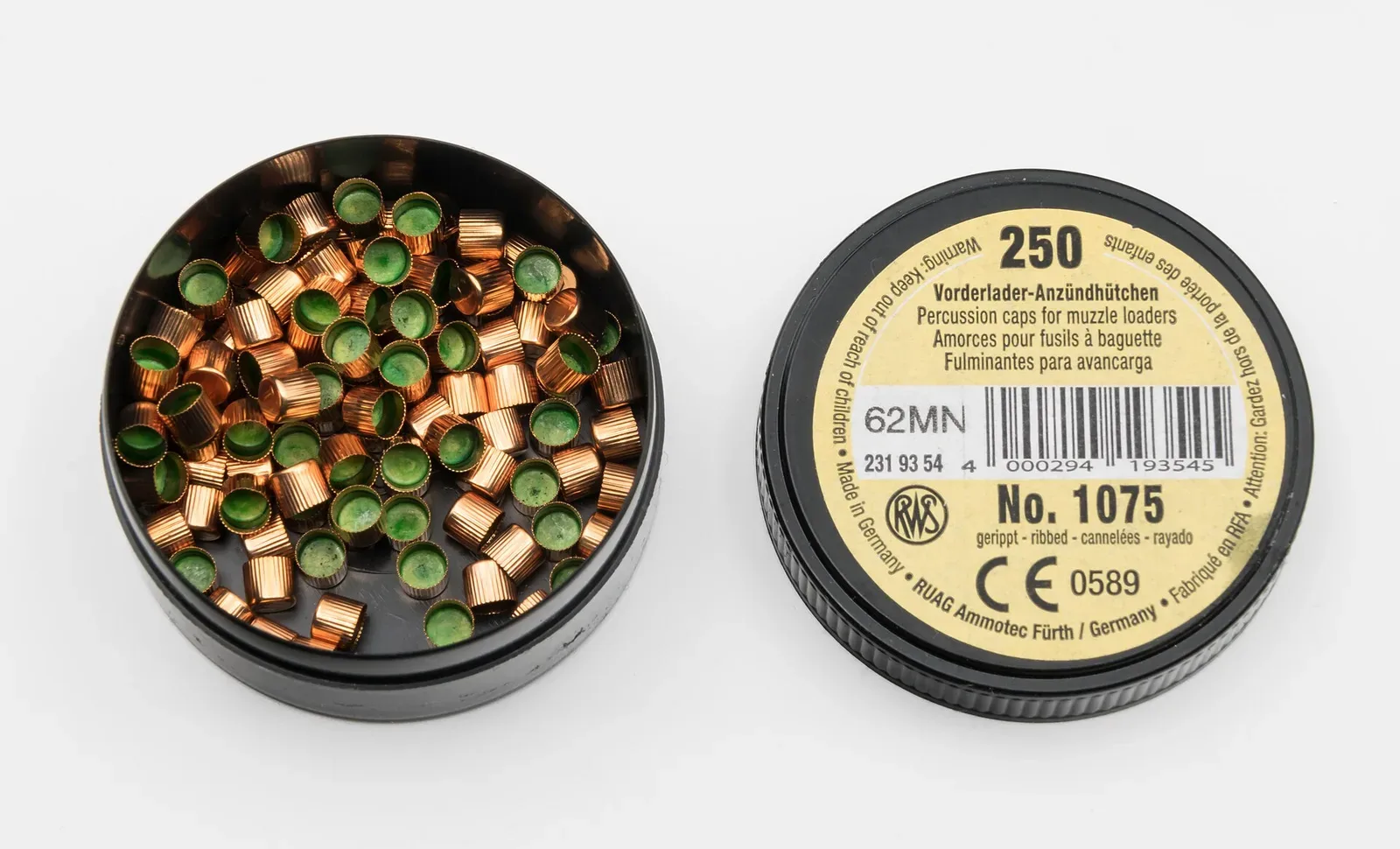
The percussion cap — also called a caplock or percussion primer — is a small copper cylinder, closed at one end, containing a shock-sensitive explosive compound. Place it over a hollow nipple on a firearm, pull the trigger, and the hammer crushes it against the nipple. The resulting flash travels down the nipple's bore into the barrel and ignites the main powder charge. Simple. Reliable. Weatherproof.
That simplicity was revolutionary in consequence, even if the path to it was anything but simple. Introduced in the early 1820s after roughly a decade of competing experiments across Britain, France, and America, the percussion cap solved the most persistent problem in 400 years of firearms development: the flintlock's vulnerability to weather and its maddening tendency to misfire at the worst possible moment. What followed was a cascade:
- Reliable military firearms that could function in all weather
- Practical multi-shot revolvers with compact ignition systems
- Self-contained metallic cartridges that define modern firearms
Everything from your centerfire rifle primer to the percussion fuze in a military grenade traces a direct line back to this small copper cup.
Development Historyedit
To understand why the percussion cap mattered so much, you have to understand what came before it and how badly those systems failed.
The matchlock — the first true individual firearm — required the soldier to hold a lit match while simultaneously pouring powder down a barrel. Wet weather extinguished the match. The wheel lock was more reliable but so mechanically complex and expensive that it was essentially a nobleman's toy, unsuited to arming large forces. The flintlock, which dominated from the early 18th century through the 1840s, was a genuine improvement: the frizzen combined the pan cover and striking anvil into one piece, giving soldiers a weapon that was ready to fire without a burning match. The French issued their first true flintlock military arms in 1717 and kept that basic pattern until 1842. But the flintlock still had an exposed powder pan, and rain, wind, and mud all had votes in whether it fired.
| System | Period | Advantages | Fatal Flaws |
|---|---|---|---|
| Matchlock | 1400s-1600s | First true individual firearm | Required lit match, useless when wet |
| Wheel Lock | 1500s-1700s | More reliable than matchlock | Mechanically complex, expensive |
| Flintlock | 1717-1840s | Ready to fire, no burning match | Exposed powder pan, weather vulnerable |
| Percussion Cap | 1820s-1870s | Weather-resistant, reliable ignition | Small caps difficult to handle quickly |
The Chemical Foundation
The chemical breakthrough that made the percussion cap possible came from Edward Charles Howard, a British chemist who published his discoveries about mercury fulminate in the Philosophical Transactions of the Royal Society of London on January 1, 1800. Howard found that treating mercury with nitric acid and alcohol produced a crystalline powder that could be detonated by a sharp blow or an electric current. He tested it in a firearm at the Royal Arsenal at Woolwich and destroyed several cannon in the process.
Howard concluded that mercury fulminate was far too violent to use as a propellant — but using it to ignite a conventional powder charge was another question entirely, one he chose not to pursue.
Forsyth's Breakthrough
The Reverend Alexander John Forsyth of Belhelvie, Aberdeenshire — a Scottish Presbyterian minister, avid duck hunter, and amateur chemist born December 28, 1768 — picked up where Howard left off. According to the NIJ Firearms Examiner Training archive, Forsyth began experimenting as early as 1793 with fulminate pellets placed on a tube that a hammer could strike. His practical motivation was embarrassingly mundane: his flintlock shotgun produced a visible puff of smoke from the powder pan before the shot left the barrel, giving ducks just enough warning to dive. He wanted to eliminate that delay.
Forsyth eventually developed a detonating lock that dispensed a mixture of mercury fulminate, potassium chlorate, sulphur, and charcoal from a small rotating magazine — shaped like a perfume bottle, which earned it the name Forsyth's Scent-bottle lock. He patented it in 1807.
Forsyth's system worked. During the Napoleonic Wars he worked on the design at the Tower of London armories, though he was eventually dismissed when a new Master General of Ordnance grew nervous about having volatile fulminate experiments conducted inside Britain's main arsenal. Napoleon Bonaparte reportedly offered Forsyth £20,000 to bring the invention to France. Forsyth declined. His patent held until 1821, and the legal threat it represented may well have suppressed open experimentation with fulminate-based ignition in Britain during those critical years.
Key Milestones in Percussion Cap Adoption
The Race to the Cap
The gap between Forsyth's bottle lock and the discrete percussion cap — the small, self-contained copper cup that everyone eventually settled on — is where the historical record turns murky and contentious.
Joseph Manton, the noted London gunmaker, patented a pill lock in 1816 using fulminate pellets, and a tube lock in 1818 that confined fulminate in a short copper tube crushed by the hammer. The tube lock was particularly popular with waterfowlers for its strong ignition in wet conditions. In France, a Paris gunmaker named François Prélat filed a patent on July 20, 1818 for a hollow cock and conical nipple — the earliest known patent anywhere that specifically describes a percussion cap and nipple arrangement. Wikipedia notes that Prélat had a reputation for copying English patents, and the mode of operation he describes is considered flawed. A second French patent was granted in 1820 to Deboubert for a cylindrical copper cap charged with fulminate of silver.
| Inventor/Claimant | Date | System | Patent Status | Notes |
|---|---|---|---|---|
| Edward Charles Howard | 1800 | Mercury fulminate discovery | Published research | Chemical breakthrough only |
| Rev. Alexander Forsyth | 1807 | "Scent-bottle" lock | British patent | First practical fulminate system |
| François Prélat | 1818 | Cap and nipple arrangement | French patent | Earliest known cap patent |
| Joseph Manton | 1816-1818 | Pill lock and tube lock | British patents | Popular with waterfowlers |
| Joshua Shaw | 1822 | Copper percussion cap | U.S. patent (invalidated 1833) | Congressional award $25,000 |
| Joseph Egg | ~1817 | Copper cap from penny | None claimed | Historian's preferred candidate |
The most persistent — and most contested — claim comes from Joshua Shaw, an English-born artist who emigrated to Philadelphia around 1817. Shaw told the British author Henry Wilkinson that in 1814 he invented a steel cap (intended to be reprimed and reused), that in 1815 he made a disposable pewter cap, and that by 1816 he had arrived at a copper cap identical to those in common use. Shaw did not file a U.S. patent until June 19, 1822. His explanation was that Forsyth's active patent made filing in Britain impossible, and he chose to wait.
A congressional investigation culminating in House Report No. 1375 from the 53rd Congress ultimately concluded that Shaw was "the original and bona fide inventor," and Congress awarded his heirs $25,000 in compensation for the Army's use of his system. According to Wikipedia, that conclusion was later disputed by historian Lewis Winant, who argued Congress had overlooked the two French patents and prior British use.
Shaw's 1822 patent was invalidated in 1833 by the U.S. Supreme Court in Shaw v. Cooper, 32 U.S. 292. The court ruled that because Shaw had allowed his invention to enter public use without immediately asserting his patent rights, he was not entitled to protection.
Other claimants entered the picture as well. Colonel Peter Hawker, the prominent British sportsman, simultaneously claimed and denied credit in 1830, writing that he "did not wish to say" he was the inventor, then immediately recounting how he had sketched out a cap-and-nipple arrangement around 1816 and presented the drawing to a reluctant Joseph Manton. By the 1838 edition of his Instructions to Young Sportsmen, Hawker was attributing the invention to Manton outright. By the 1850s, his advertisements were claiming the credit for himself again. The London gunmaker Joseph Egg claimed to have made the first copper cap from an old penny-piece. Historian S. James Gooding concluded that Joseph Egg — nephew of Durs Egg — was the most likely inventor, placing the date around 1817.
The short version: nobody knows for certain.
"The jury is still out as the competing claims are based on personal accounts and have little or no independently verifiable evidence." — Wikipedia on percussion cap invention
Rapid Commercial Adoption
What the record does show clearly is the pace of adoption. By 1820, some form of percussion ignition was known across Europe. By 1823, British sporting writer T.B. Johnson had used copper cap guns for three seasons and declared they would "unquestionably become general." A November 1824 committee report from the Franklin Institute stated that Shaw's percussion primers had "given almost universal satisfaction" among experienced American shooters.
Advertisements in newspapers from Rhode Island, Virginia, Boston, New York, Pittsburgh, and rural Pennsylvania through the mid-1820s show percussion caps being sold alongside — and increasingly in place of — flints. An 1828 advertisement in the Rhode-Island Republican references "20,000 percussion caps," confirming mass production was underway. By 1830, sporting writer Hawker noted that copper caps were "in general use" in Britain, and a January 1830 letter from Fairfax County, Virginia described percussion guns as "getting into general use, to the rejection of the flint."
The gunsmith William Border of Bedford County, Pennsylvania recorded his first percussion conversion on June 15, 1832. Historian John Dillin estimated that approximately 80% of all flintlock rifles and shotguns in America were ultimately converted to percussion, with most of those conversions happening between 1835 and 1855.
How It Worksedit
The caplock mechanism has three components that work together: the nipple, the hammer, and the cap itself.
Percussion Cap Firing Sequence
The Three Components
The nipple is a small tapered metal tube threaded into a drum or bolster that connects to the rear of the barrel. Its taper allows the copper cap to seat snugly — snug enough to stay in place during handling, but not so tight that the spent cap can't be removed. The hollow bore of the nipple is the fire channel: when the cap fires, its flash travels down through the nipple and into the main powder charge.
The hammer replaces the flintlock's cock. Instead of holding a piece of flint, it has a concave nose shaped to fit over the nipple. When the trigger releases the hammer, it drives down onto the cap, crushing the fulminate compound between the hammer face and the nipple's crown. The nipple acts as the anvil. Some hammer designs incorporated a surrounding skirt that contained cap fragments on detonation, reducing the risk of flying copper shards injuring the shooter's face.
The cap itself — according to the NIJ Firearms Examiner Training material — started as small soft iron cups with fulminate in the bottom, evolving through pewter and settling on copper as the material of choice. Copper was soft enough to crush reliably, malleable enough to seat tightly on the nipple, and resistant enough to moisture to protect the fulminate compound inside. Shaw's composition, per Wikipedia, consisted of three parts potassium chlorate, two parts mercury fulminate, and one part powdered glass. Later formulations replaced corrosive compounds — modern percussion caps use non-corrosive compounds such as lead styphnate.
Flintlock Conversion Process
Converting a flintlock to percussion was straightforward enough that it became a common gunsmith service throughout the 1820s and 1830s:
- Remove the powder pan and frizzen from the flintlock
- Install a drum or bolster with nipple near the old vent hole
- Replace the flint-holding cock with a percussion hammer
- Test fire and adjust nipple positioning as needed
Thousands of existing flintlock military muskets were converted this way rather than scrapped.
Alternative Auto-Priming Systems
The cap's one practical drawback in military use was its size — small copper cups are difficult to handle quickly under stress, especially on horseback. This drove several alternative auto-priming systems, including Edward Maynard's tape primer (patented September 22, 1845), which used a roll of paper caps similar to modern toy cap guns, and Christian Sharps's pellet primer (patented October 5, 1852), which used a tube magazine of fulminate disks advanced automatically by the hammer. Both saw use in the Civil War era, but both also proved mechanically finicky.
The Ordnance Department's eventual preference for the simple percussion cap over these automated systems was driven by reliability and manufacturing simplicity — a jammed tape primer turned a rifle into a club, while dropping a few loose caps was a recoverable problem.
Impact on Warfare & Societyedit
Military Trial Results
The numbers tell the story plainly. A large-scale French military trial reported in the Phenix Gazette on August 30, 1833 pitted percussion muskets against flintlock muskets, each type firing 27,000 rounds. The flintlocks produced 1,826 failures. The percussion muskets produced 93. That's a failure rate roughly 5% that of the flintlock. A separate American trial reported in the Army and Navy Chronicle on May 16, 1839 showed 892 misfires for flintlocks versus 17 for percussion arms — percussion muskets failing at about 1.9% the rate of their predecessors.
| Trial | Year | Flintlock Failures | Percussion Failures | Improvement Factor |
|---|---|---|---|---|
| French Military Trial | 1833 | 1,826 of 27,000 (6.8%) | 93 of 27,000 (0.3%) | 20x more reliable |
| American Military Trial | 1839 | 892 failures | 17 failures | 52x more reliable |
Those aren't marginal improvements. They're the difference between an army and a mob.
Slow Military Adoption
The London Saturday Journal captured it more bluntly in February 1842, describing an engagement where:
"A detached company of our troops, armed with flint muskets, was surrounded by the enemy in great numbers, and unable to fire a shot in their defence, from their flint locks being rendered entirely useless by the rain. They were at length relieved by a party of their comrades, supplied with percussion arms. That settles the question of Flint versus Copper-cap." — London Saturday Journal, February 1842
Military adoption, despite the obvious test results, was slow by modern standards. The U.S. War Department formally decided in February 1841 to convert all small arms to percussion locks. Britain applied caplocks to the Brown Bess in 1842 — more than two decades after the invention had proven itself in sporting use. The first percussion firearm produced for the U.S. military was a percussion carbine version of the M1819 Hall rifle, produced around 1833.
| Nation | Military Adoption | Key Firearm | Notes |
|---|---|---|---|
| United States | 1841 | M1819 Hall rifle (percussion variant, 1833) | First official percussion military arm |
| Britain | 1842 | Brown Bess (percussion conversion) | 20+ years after civilian adoption |
| Prussia | 1841 | Dreyse needle gun | Paper cartridge system, precursor to metallic |
| Japan | 1850s+ | Converted matchlocks | Based on existing designs |
The Revolver Connection
The percussion system also enabled the practical revolver. Samuel Colt's February 25, 1836 patent for his "Revolving Gun" — U.S. Patent 9430X — illustrates a percussion system firearm. The caplock's compact, reliable ignition made it feasible to build a handgun with multiple chambers all served by a single hammer. Earlier attempts at multi-shot firearms had struggled precisely because older ignition systems were too bulky and unreliable to integrate cleanly into a rotating cylinder design.
The first caplock handguns with two barrels evolved into pepper-box revolvers during the 1830s, and from there the lineage runs straight to the Colt Dragoon and Remington percussion revolvers that defined the Civil War era and the American West.
Global Military Impact
Wikipedia notes that American forces equipped with breech-loading caplock Hall rifles, muzzle-loading rifled muskets, and Colt Dragoon revolvers held a meaningful advantage over Santa Anna's troops — armed with smoothbore flintlock Brown Bess muskets — during the Mexican War.
In Japan, matchlock pistols and muskets were converted to percussion from the 1850s onward, with new guns based on existing designs manufactured as caplocks. The Dreyse needle gun, adopted by Prussia in 1841, used a long needle to strike a percussion cap fastened to the base of the bullet inside a paper cartridge — an arrangement that pointed directly toward the self-contained metallic cartridge. That needle gun was a significant factor in the 1866 Austro-Prussian War, and by the Franco-Prussian War its paper cartridge had evolved into modern brass ammunition.
Civilian and Economic Effects
The percussion cap's broader social impact was subtler but real. By making firearms more reliable and easier to operate in adverse conditions, it accelerated their adoption among civilian populations for hunting and self-defense. The conversion industry alone — gunsmiths advertising flintlock-to-percussion alterations from Virginia to Pittsburgh to rural Pennsylvania through the late 1820s and 1830s — represents a significant economic and technological diffusion event.
Ramsay Crooks of the American Fur Company, writing in 1830 about procuring rifles for remote service, still preferred waterproof flintlocks for field reliability — a reminder that adoption was never uniform and that practical men had legitimate concerns about depending on a supply of manufactured caps in the wilderness.
Modern Relevanceedit
The Metallic Cartridge Transition
The standalone percussion cap as a primary ignition system was effectively obsolete by the 1860s and 1870s, displaced by the breech-loading metallic cartridge it had helped create. After the Civil War, Britain, France, and America began converting existing caplock muskets and rifles to accept brass rimfire and centerfire cartridges. For muskets like the 1853 Enfield and 1861 Springfield, the conversion involved installing a firing pin in place of the nipple and adding a trapdoor breech. Caplock revolvers like the Colt Navy and Remington were converted by replacing cylinders.
The primer compound that had lived in a copper cap now lived at the base of a brass cartridge case — centerfire for most calibers, rimfire for small-bore ammunition like the .22.
Rollin White's April 3, 1855 patent for a bored-through cylinder — U.S. Patent No. 12,648 — enabled the Smith & Wesson Model One .22 rimfire revolver, production of which began in 1857. B. Tyler Henry's .44 rimfire lever-action rifle, patented October 16, 1860, was used during the Civil War and became the forerunner of the Winchester line. Christopher Spencer's metallic cartridge lever-action repeating rifle, patented March 6, 1860, saw production of over 200,000 units between 1860 and 1869 according to the Library of Congress.
The percussion cap era ended not with a bang but with a replacement it had made inevitable.
Contemporary Sporting Use
Today, reproduction percussion firearms remain popular with muzzleloader enthusiasts, black powder competitors, and hunters in states with dedicated muzzleloader seasons. Percussion caps remain commercially available, though some modern muzzleloaders use shotshell primers instead.
The compound inside has changed — modern caps use non-corrosive lead styphnate rather than mercury fulminate — but the function is identical to what Joshua Shaw, or Joseph Egg, or whoever actually built the first one, put into production in the 1810s.
Military Applications Today
The percussion cap also lives on in military hardware far removed from sporting firearms. The spring-loaded firing pin striking a percussion cap connected to a detonator remains a standard component in purpose-built military systems:
- Grenade fuzes and rocket-propelled grenades
- Military rescue flares and emergency signaling devices
- Land mine fuzes and purpose-built booby-trap systems
- Spring-loaded firing pin mechanisms in military ordnance
| Modern Application | Function | Compound Used |
|---|---|---|
| Sporting Muzzleloaders | Recreation/hunting | Lead styphnate (non-corrosive) |
| Grenade Fuzes | Military ordnance | Various percussion compounds |
| RPG Systems | Anti-armor weapons | Military grade primers |
| Rescue Flares | Emergency signaling | Percussion-initiated pyrotechnics |
| Land Mine Fuzes | Military/EOD | Percussion-sensitive initiators |
The same basic mechanism Forsyth patented in 1807 — a blow igniting a fulminate compound to initiate a larger charge — is still doing that job in the 21st century.
The BGC Takeedit
The percussion cap doesn't get the attention it deserves in popular firearms history. Everyone knows the flintlock. Everyone knows the AR-15. The little copper cup that bridged them tends to get one paragraph in survey histories before the author rushes on to talk about the Civil War.
That's backwards.
The percussion cap is the hinge. Everything before it was fundamentally a system for delivering a spark to an exposed powder charge. Everything after it depends on a reliable, sealed, self-contained ignition event.
The invention dispute is genuinely interesting rather than just tedious academic squabbling, because it reflects something real: this was an idea whose time had come, and multiple smart people arrived at roughly the same place within a few years of each other. Forsyth got the chemistry right first but built a complicated, expensive magazine system. Manton and Egg and probably others simplified it toward the discrete cap. Shaw — whatever the exact truth of his timeline — got the American patent and the American market. None of them "won" in the way that, say, Browning owned the tilting-barrel locked-breech pistol. The percussion cap emerged from a scrum.
What strikes me most is the military adoption lag. The test data from 1833 and 1839 was unambiguous — percussion arms failed at a small fraction of the rate of flintlocks. And yet the U.S. Army didn't formally commit to the conversion until 1841, and the British didn't get caplocks on the Brown Bess until 1842. Nearly a decade passed between definitive proof and institutional action. That pattern — clear evidence, slow bureaucratic response — shows up again and again in military procurement history. It's not unique to the 19th century.
The other thing worth noting: the percussion cap era was genuinely short. From roughly 1820 to roughly 1870 — fifty years — it was the dominant ignition system. By the time the Civil War ended, the metallic cartridge had already made it obsolete. For something that changed the course of military history and enabled the modern firearm, it had a remarkably brief run at the top.
Referencesedit
- History of the percussion cap ignition system — Korns.org
- Percussion cap — Wikipedia
- Ignition Systems — NIJ Firearms Examiner Training (Archived)
- The Copper Cap — Vintage Guns
- Carbine Advancements: Priming Systems — Men, Machine and the Carbine
- Percussion cap — Britannica
- Alexander John Forsyth — PCA History
Last Updated: February 27, 2026
- Gls Guns(Sumner, IA)
- Bi-mart - Yakima (Fruitvale Ave)(Yakima, WA)
- New Philly Sportsman Specialities(New Philadelphia, OH)
- R&R Sports & Outdoors(Brandon, FL)
Loading comments...