Details
History of Firearms
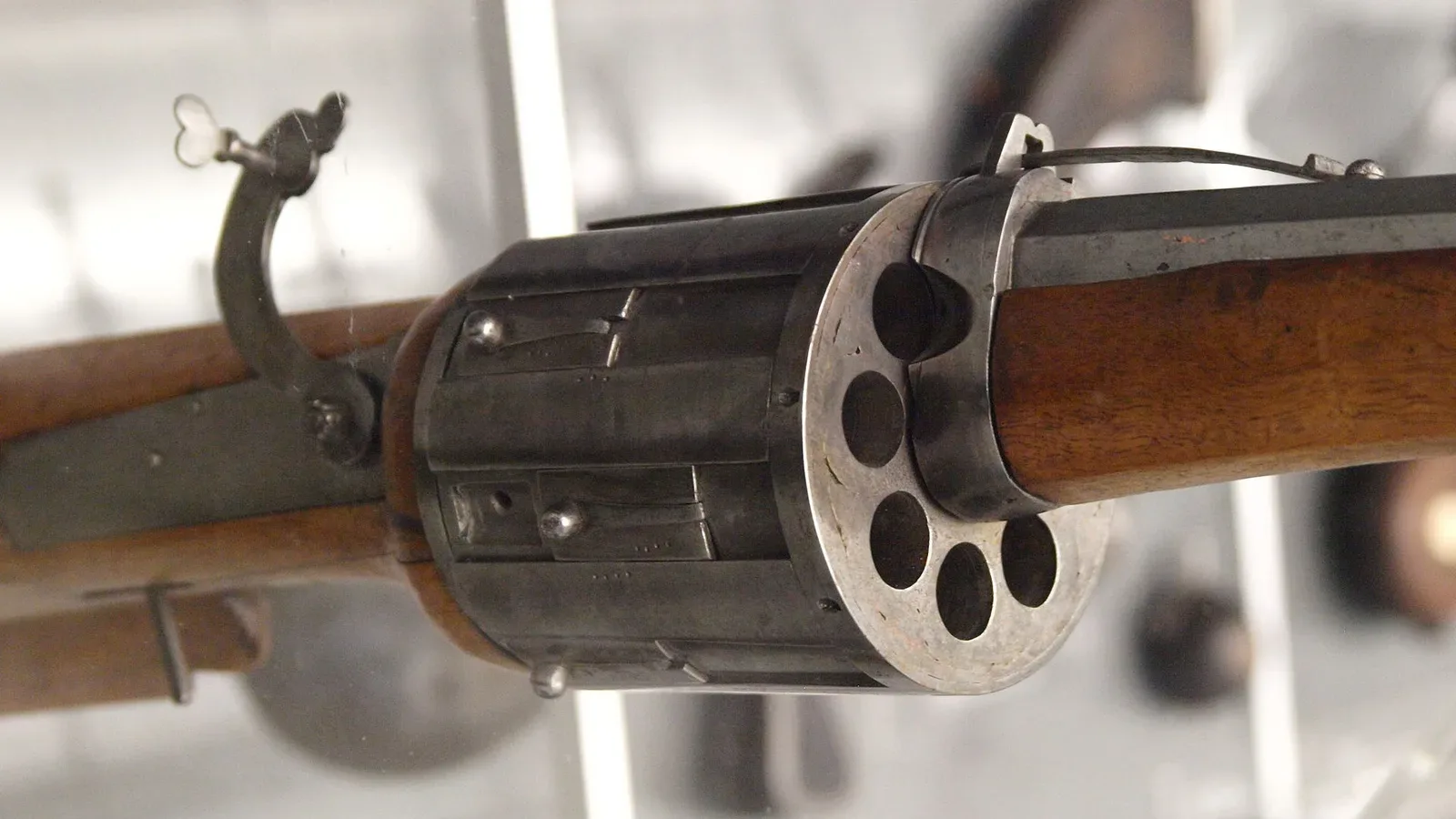
A Nuremberg Drehling (revolver) from circa 1580 — early experiment in multi-shot matchlock design, predating practical revolvers by centuries.
| Period | c. 950 CE – Present |
|---|---|
| Eras Covered | 7 |
| Key Innovations | 47 milestones |
| Scope | Global |
| Related Articles | 29 deep dives |
History of Firearms
800 Years of Innovation — From Chinese Fire Lances to 3D-Printed Receivers
From The Boise Gun Club Handbook
The history of firearms is an 800-year arc of chemistry, metallurgy, manufacturing, and law — from Chinese alchemists accidentally discovering gunpowder while searching for the elixir of immortality, to desktop CNC mills producing functional receivers from digital files.
This article traces that arc through seven eras, each defined by a breakthrough that made everything before it obsolete. Every section links to detailed articles on the specific weapons, inventors, battles, and legal decisions that shaped each period.
For the full immersive experience — 47 key moments with historical images, animated connections, and causal links showing how each innovation made the next possible — explore the interactive scrolling timeline.
The Age of Black Powder (1200s–1400s)edit
For most of human history, killing at distance meant throwing something or launching it with tension — a spear, a sling stone, an arrow. Gunpowder changed the physics. A chemical reaction replaced muscle power, and the monopoly of the trained warrior class began to crack.
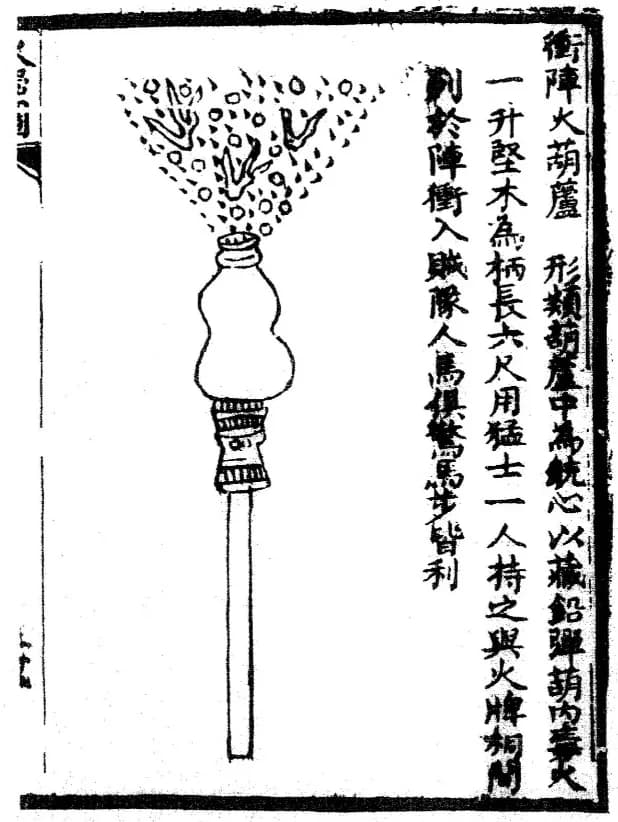
The fire lance — a bamboo tube packed with gunpowder and shrapnel, lashed to a spear — emerged from Chinese alchemy around 950 CE. It was not elegant, but it did not need to be. It needed to terrify, and it did. By 1259, Chinese weaponsmiths had refined the concept into tubes that launched actual projectiles.
The formula spread along trade routes and behind Mongol cavalry, reaching Europe by the mid-13th century. European metalworkers, already skilled in bell-casting and armor-making, adapted the invention into iron-barreled hand cannons — the oldest surviving example, the Heilongjiang hand cannon, dates to 1288 and bears evidence of organized military production. Within two centuries, the Hussite Wars proved that disciplined formations of gunners behind wagon fortifications could break mounted knights. Jan Zizka's peasant armies, armed with crude firearms called pistaly, repeatedly defeated the Holy Roman Empire's armored cavalry.
By the 1420s, two quiet innovations sealed the deal: corned powder (roughly 30% more powerful than serpentine dust, safer to transport, and more consistent) and the slow match (a treated cord that smoldered reliably). The hand cannon was still a crude tube, but it was a crude tube that worked.
The Lock Revolution (1400s–1600s)edit
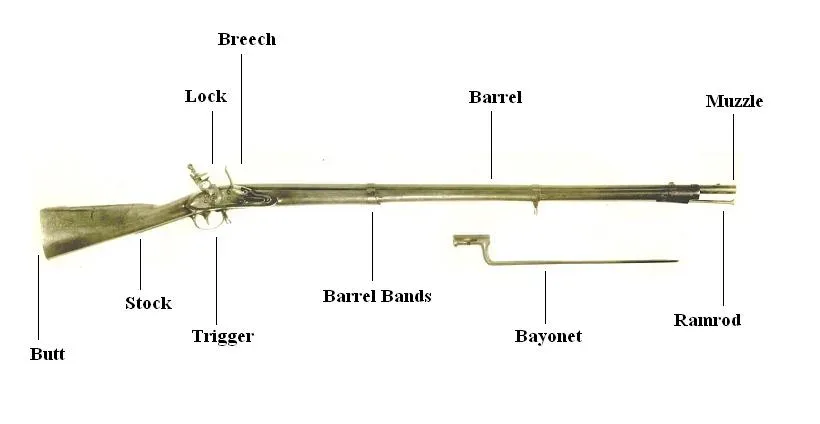
The hand cannon had a fundamental problem: ignition required a free hand. The lock mechanism — a mechanical device that held and applied the ignition source — freed both hands and transformed the firearm from tube to tool.
The matchlock clamped a smoldering slow match in a serpentine lever. Pull the trigger, the arm dips, the match touches the priming powder. For the first time, a soldier could aim with both hands. This enabled the arquebus — the first true shoulder-fired weapon. At the Battle of Cerignola in 1503, Spanish arquebusiers proved that a peasant with three months of drill could kill an armored knight at fifty yards. The Battle of Nagashino in 1575 showed what happened when disciplined matchlock formations met cavalry: Oda Nobunaga's three thousand gunners destroyed the Takeda clan's legendary mounted samurai.
The wheellock used a spring-wound steel wheel striking against pyrite — expensive and complex, but it fired instantly without a lit cord. Emperor Maximilian I banned wheellocks in 1517, creating the first known firearms prohibition in history. Through various transitional designs — the snaphaunce, the snaplock, the miquelet — European gunsmiths iterated toward the ideal.
The flintlock, perfected by Marin le Bourgeoys around 1610, simplified everything: a piece of flint strikes a steel frizzen, sparks fall into the priming pan, and the gun fires. The design included a half-cock safety. It was reliable, fast, weatherproof, and cheap enough to mass produce. Britain standardized the mechanism in the Brown Bess musket in 1722 — a .75 caliber smoothbore that served 116 years, saw production of over three million units, and armed an empire that spanned the globe. The flintlock would reign for over two centuries.
The Industrial Age (1700s–1860s)edit
Two revolutions collided in the late 18th century. Steam-powered machinery made precision manufacturing possible at scale. New chemistry produced the percussion cap — a small copper cup filled with fulminate of mercury that detonated on impact, replacing the open priming pan entirely. Reverend Alexander Forsyth, a Scottish Presbyterian minister tired of flintlock sparks startling his ducks, patented the concept in 1807. Misfire rates dropped from one in fifteen to one in two hundred.
The Kentucky long rifle, developed by German and Swiss immigrants in Pennsylvania, demonstrated what rifled barrels could do — accurate at 200 yards when muskets were lucky to hit at 50. At the Siege of Saratoga in 1777, rifle-armed colonists picked off British officers at ranges the redcoats considered impossible.
Interchangeable parts, pioneered at Springfield Armory and Harpers Ferry, meant a broken musket could be repaired with parts from any other musket of the same model. Eli Whitney promised the concept in 1798; John Hall actually achieved it in the 1820s using precision gauges and machine tools. The American System of Manufacturing would make the gun industry drive the Industrial Revolution.
Samuel Colt patented the first practical revolving firearm at age 21. His Paterson revolver was a commercial disaster — his company went bankrupt in 1842. Then the Texas Rangers discovered it was devastating against Comanche horsemen. Captain Samuel Walker collaborated on the massive .44 caliber Walker Colt of 1847, and Colt's Hartford factory became a temple of industrial production.
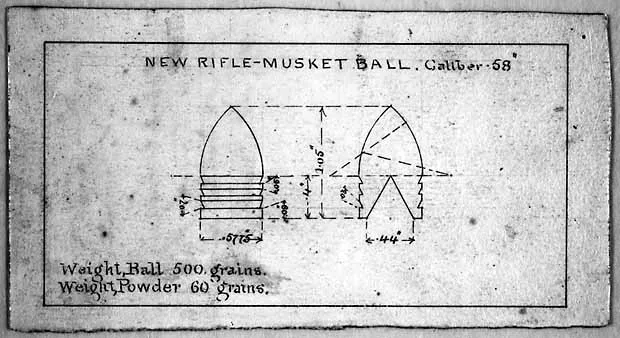
The Minie ball solved the ancient problem of rifle loading. Claude-Etienne Minie's conical bullet with a hollow base expanded on firing to grip rifling grooves — loading as fast as a smoothbore but shooting four times as far. By the American Civil War, these innovations had outpaced military doctrine. Generals still ordered massed infantry charges against defenders armed with rifled muskets accurate to 500 yards. The Gatling gun added mechanized firepower. The resulting slaughter — over 600,000 dead — was the first industrial war.
The Metallic Cartridge Era (1860s–1900s)edit
The self-contained metallic cartridge solved the last great reliability problem: a brass case holding powder, projectile, and primer in a single waterproof, drop-safe unit. Louis-Nicolas Flobert created the first rimfire cartridge in 1845 — so modest it contained no powder at all, with the primer alone propelling the bullet. Quiet enough for indoor parlor shooting galleries. The cartridge was a toy. The principle would devour the world.
This single innovation enabled everything that followed. The Henry rifle's 16-round tubular magazine proved a single soldier could produce squad-level firepower — Confederate soldiers called it "that damned Yankee rifle you load on Sunday and shoot all week." Centerfire designs followed in 1866, with Colonel Edward Boxer (British) and Colonel Hiram Berdan (American) developing the two primer systems still in use today.
The Winchester Model 1873 became "The Gun That Won the West." Chambered in .44-40 WCF — the same cartridge as the Colt Single Action Army revolver — it was a deliberate marketing strategy: a frontiersman could carry one caliber for both rifle and pistol. Winchester sold over 720,000 units. Not the most powerful or accurate, but the most American.
Then smokeless powder arrived in 1884 and changed the math again. Paul Vieille developed Poudre B for the French military — three times the energy of black powder in less volume, almost no smoke. France fielded it first in the Lebel Model 1886 and triggered an arms race. Germany, Britain, Austria-Hungary, and Russia all adopted smokeless powder within five years. The Mauser Gewehr 98, introduced in 1898, set a bolt-action standard so refined that modern hunting rifles are still recognizably its descendants. The U.S. paid Mauser royalties for the 1903 Springfield — while fighting Germany in World War I.
World Wars and Modern Combat (1900–1960)edit
The 20th century's two world wars compressed a century of firearms evolution into five decades. Hiram Maxim's machine gun — recoil-operated, firing 600 rounds per minute — demonstrated at the Somme what automatic fire meant against massed infantry. At that battle in 1916, German machine guns helped kill 19,240 British soldiers in a single day. The machine gun made frontal infantry assault suicidal and forced the invention of the tank, the aircraft, and the creeping barrage.
John Moses Browning designed both the .45 ACP cartridge and the M1911 pistol built around it, developed specifically after the Army's experience with underpowered .38 caliber revolvers in the Philippines. The 1911 served as the standard American sidearm for 74 years through two world wars, Korea, and Vietnam. The submachine gun emerged from the trenches — first the MP18 for German Sturmtruppen, then the Thompson that became the weapon of gangsters, G-men, and GIs alike. The Treaty of Versailles specifically banned Germany from manufacturing them.
The M1 Garand gave the United States the first semi-automatic service rifle adopted by any major military. Eight rounds of .30-06, fed from an en bloc clip, with a rate of aimed fire that doubled what any bolt-action could manage. The U.S. was the only nation to equip its entire infantry with a semi-automatic rifle in World War II. General Patton called it "the greatest battle implement ever devised."
Germany answered with the StG 44, which invented the assault rifle concept: an intermediate cartridge fired from a select-fire weapon with a detachable box magazine. Hitler initially opposed the program, so developers disguised it as "Maschinenpistole 43." When he saw enthusiastic soldiers asking for "more of these new rifles," he relented and personally named it "Sturmgewehr" — storm rifle. A young Soviet tank sergeant named Mikhail Kalashnikov studied captured examples and designed the AK-47 — not the most accurate or ergonomic, but it worked. In mud, sand, arctic cold, jungle humidity — it worked. Over 100 million manufactured. By 1960, every category of modern firearm had been defined and fielded in combat.
The Modern Platform (1960–2000)edit
Eugene Stoner's AR-15 did something no previous firearm had achieved: it separated the weapon into a modular system of interchangeable components. Upper receiver, lower receiver, barrel, handguard, stock, trigger group — each replaceable, upgradeable, and customizable independently. The military adopted it as the M16. Early deployment in Vietnam was a catastrophe — soldiers issued rifles without cleaning kits, told the weapon was "self-cleaning," while the Army switched powder to cut costs, dramatically increasing fouling. Men died with jammed rifles. Congressional hearings led to the redesigned M16A1 with chrome-lined barrel and forward assist. Half a century later, the AR-15 is the most popular rifle in America — not because it's military, but because it's modular. It is a platform.
Gaston Glock, an Austrian engineer whose prior expertise was manufacturing curtain rods and knife scabbards, won a military pistol trial with a polymer-framed, striker-fired 9mm that held 17 rounds. The firearms industry laughed. Then police departments adopted it. Then militaries. The Glock proved a handgun could be light, reliable, high-capacity, and inexpensive — and killed the double-action revolver as a duty weapon. The Beretta M9 won the U.S. military pistol contract in 1985 by proving a 9mm with a 15-round magazine was more practical than a .45 with seven. The debate between 9mm and .45 ACP has never truly ended — it just moved to internet forums.
Florida became the first major state to pass a "shall-issue" concealed carry law in 1987. Before this, carrying concealed was effectively prohibited in most of America. Within two decades, the vast majority of states followed. The concealed carry movement drove a revolution in compact pistol design and permanently changed the relationship between Americans and their firearms.
The Picatinny rail standard (MIL-STD-1913), adopted in 1995, completed the transformation. Any optic, light, laser, or accessory from any manufacturer could mount on any weapon with a compatible rail. The firearm was no longer a finished product — it was a platform.
The Digital Frontier (2000–Present)edit
The 21st century introduced a question no previous era had to answer: what happens when anyone can manufacture a firearm at home? Cody Wilson of Defense Distributed published the first fully 3D-printable pistol design in 2013. The Liberator was crude — a single-shot .380 ACP that might survive a few firings. But its significance was conceptual: a firearm design could be distributed as a digital file. By 2024, designs like the FGC-9, a 9mm semi-automatic requiring no regulated parts, had evolved far beyond those origins, with over 300 seizures in the UK alone. The full story of 3D-printed firearms is still being written.
Digital technology reshaped what firearms could do at the point of use. TrackingPoint introduced precision guided firearms with built-in ballistic computers — a novice could make shots that took a trained marksman years to master. Smart optics now calculate solutions in real time, integrating laser rangefinders, atmospheric sensors, and ballistic algorithms. The U.S. Army's Next Generation Squad Weapon program adopted a 6.8x51mm cartridge with chamber pressures that would have been impossible to manage without modern metallurgy and computer-aided design — the first infantry caliber change since 1964.
The legal framework is scrambling to keep up. District of Columbia v. Heller (2008) confirmed in a 5-4 decision that the Second Amendment protects an individual right to possess a firearm unconnected to militia service. Justice Scalia's majority opinion became the foundational text of modern firearms law. New York State Rifle v. Bruen (2022) struck down may-issue concealed carry licensing and required gun regulations to be consistent with historical tradition — reshaping Second Amendment jurisprudence overnight. The ongoing debates over forced reset triggers, pistol braces, and unserialized home-builds have created a regulatory landscape that shifts faster than the technology itself.
Explore the Full Timelineedit
This article provides the overview. For the full immersive experience with all 47 key moments, historical images from Wikimedia Commons and the Metropolitan Museum of Art, and animated causal connections showing how each innovation made the next possible, explore the interactive scrolling timeline.
- Gls Guns(Sumner, IA)
- Bi-mart - Yakima (Fruitvale Ave)(Yakima, WA)
- New Philly Sportsman Specialities(New Philadelphia, OH)
- R&R Sports & Outdoors(Brandon, FL)
Loading comments...