Details
Benjamin Tyler Henry

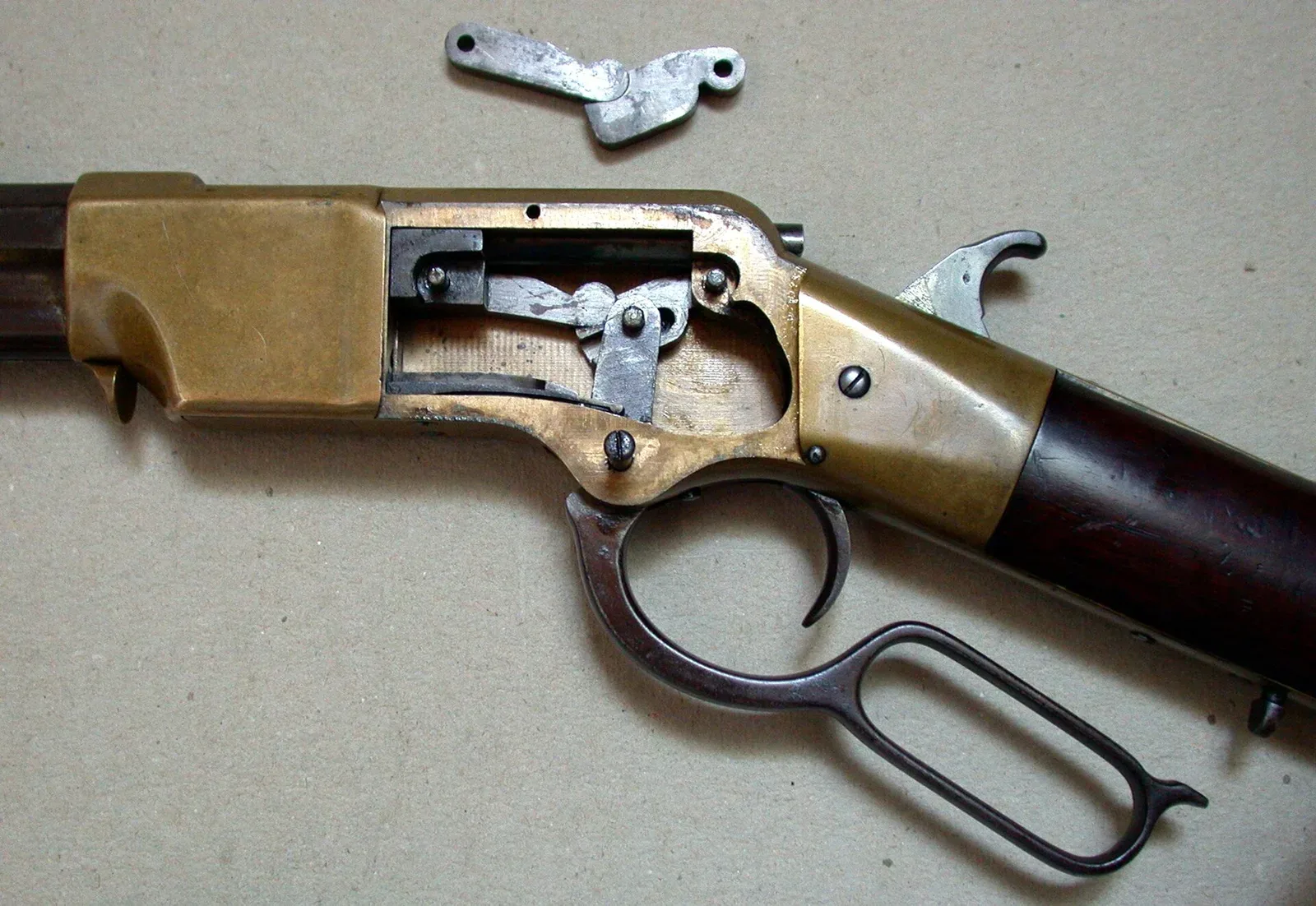
The Henry's toggle-joint lever mechanism — an ingenious design that made rapid, reliable repeating fire possible during the Civil War.
| Biography | |
|---|---|
| Born | March 22, 1821, Claremont, New Hampshire |
| Died | June 8, 1898, age 77 |
| Nationality | American |
| Legacy | |
| Known For | Development of the first practical, reliable lever-action repeating rifle and the .44 caliber rimfire cartridge |
| Key Innovation | Henry rifle (Patent No. 30,446, issued October 16, 1860) - a sixteen-shot, .44 caliber rimfire, breech-loading, lever-action repeating rifle capable of 16 shots without reloading |
Benjamin Tyler Henry: The Man Who Made Repeating Fire Work
Firearms encyclopedia article
From The Boise Gun Club Handbook
Overviewedit
Benjamin Tyler Henry was an American gunsmith and inventor whose work in the late 1850s produced the first practical, reliable lever-action repeating rifle. Born on March 22, 1821, in Claremont, New Hampshire, and dying on June 8, 1898, Henry spent his entire working life in the firearms trade — as apprentice, shop foreman, plant superintendent, and finally as the designer whose name ended up on one of the most consequential rifles in American history.
His patent, filed as Patent No. 30,446 and granted on October 16, 1860, covered a .44 caliber rimfire rifle capable of 16 shots without reloading. At a moment when the standard infantry arm was a muzzle-loading musket demanding a fresh charge after every shot, that was a staggering leap.
| Specification | Details |
|---|---|
| Patent Number | No. 30,446 |
| Patent Date | October 16, 1860 |
| Caliber | .44 rimfire |
| Capacity | 16 rounds |
| Action Type | Lever-action repeating |
| Birth | March 22, 1821, Claremont, NH |
| Death | June 8, 1898 (age 77) |
| Production | ~15,000 rifles (Civil War era) |
The rifle arrived just in time for the Civil War, shaped the course of the Indian Wars that followed, and provided the mechanical DNA for the Winchester lever-action rifles that came to define the American West.
The gap between the magnitude of what Henry built and the obscurity in which he lived it out is the central tension of his story.
And yet Henry himself walked away from it all without a fortune, without a company bearing his name, and without the household recognition his invention deserved.
Early Life & Backgroundedit
Engineering Heritage
The Henry family of Claremont was not a family that lacked for ambition or ingenuity. Henry's grandfather, Colonel Benjamin Tyler, had come to Claremont from Connecticut in 1767 and became the town's first millwright, founding several successful mills and inventing the wry-fly water wheel. Another of the Colonel's grandsons, James Tyler, refined that water wheel design further and helped fuel the town's growth through the early Industrial Revolution, enabling textile and paper mills to harness the river's power at scale.
- Colonel Benjamin Tyler - first millwright (1767), invented wry-fly water wheel
- James Tyler - refined water wheel design, enabled textile and paper mills
- Family tradition of engineering innovation through Industrial Revolution
Benjamin Tyler Henry grew up with that engineering tradition running through the family. He did not follow it into mills and water wheels. He went into guns.
The Robbins & Lawrence Years
Henry served his apprenticeship with local gunsmiths identified in sources as J.B. and R.B. Ripley, and according to one source completed the requirements to become a master mechanic at the Springfield Armory in 1842. He then moved to Windsor, Vermont, to work for the Robbins & Lawrence Arms Company — at the time the largest non-government arms manufacturer in the United States — where he rose to the role of shop foreman.
That position put him at the center of one of the most productive concentrations of firearms talent in 19th-century America. The Robbins & Lawrence plant was where the Jennings rifle was being manufactured under contract, and it was where Henry first worked alongside Horace Smith and Daniel B. Wesson. Smith had been posted there by investor Courtlandt C. Palmer to supervise the Jennings production; Wesson was on site inspecting percussion pepperbox pistol parts contracted to the plant.
Henry, as shop foreman, was directly responsible for making improvements to the Jennings mechanism. He was present at the beginning of the entire lineage that would eventually bear his name.
Key Contributionsedit
The Long Road to the Henry Rifle
To understand what Henry actually accomplished, you have to understand what came before him and why it kept failing.
The lever-action concept didn't start with Henry. It started with Walter Hunt, a New York mechanic and inventor who developed the "rocket ball" projectile, a tubular magazine, and a lever-operated rifle he called the Volition Repeater in the 1840s. Hunt also contributed the "Hunt Magazine" — a tube running parallel beneath the barrel holding approximately twelve balls under a compressed spring. Hunt was a prolific inventor who had a habit of not patenting his work; his designs passed to Lewis Jennings, who made independent improvements and had the rifle manufactured at Robbins & Lawrence, where Henry was shop foreman.
The Jennings rifle failed. Despite being able to fire a naked ball twenty times per minute, it fouled the bore so badly — leading building up to the point where a .50 caliber bore became barely .25 caliber after twenty shots — that it was functionally useless. The Ordnance Department called it too complicated, and the underlying rocket ball cartridge simply couldn't generate enough power.
| Developer | Innovation | Years Active | Key Problem |
|---|---|---|---|
| Walter Hunt | Rocket ball, tubular magazine, Volition Repeater | 1840s | Didn't patent designs |
| Lewis Jennings | Jennings rifle (Hunt improvements) | 1840s-50s | Severe bore fouling, underpowered |
| Horace Smith | Toggle-joint action, pivot-front mechanism | 1850s | Cartridge power insufficient |
| Smith & Wesson | Volcanic Repeating Arms | 1855-1856 | Company bankruptcy |
| Benjamin Tyler Henry | .44 rimfire cartridge, complete rifle system | 1857-1860 | Solved all previous issues |
Evolution of the lever-action repeating rifle from concept to Henry's breakthrough
Horace Smith was then tasked by Palmer to fix the Jennings. Smith reworked the action significantly, replacing the rack-and-pinion mechanism with a pivot-front action more recognizable to modern shooters, and introduced what would become the toggle-joint action — a watershed mechanical improvement that appeared in nearly every lever-action rifle that followed. According to Rock Island Auction Company's history of the lever action, no one knows with certainty whether Smith invented the toggle joint himself, whether Henry contributed to it, or whether Smith encountered it at the Great Exhibition in London in 1851.
What is documented is that Henry was working in the same building and was deeply familiar with all these design iterations.
Smith and Wesson eventually partnered formally, incorporated as the Volcanic Repeating Arms Company in 1855 with new investors — including a New Haven shirt manufacturer named Oliver Winchester who purchased 80 shares and joined the board as Vice President — and continued developing the repeating firearm concept. Henry was employed, likely as shop superintendent, during this period. The Volcanic company lasted roughly a year before design flaws, persistent cartridge problems, and exhausted finances brought it down.
Winchester, through the death of Volcanic's president and by paying off its debtors, acquired all company assets including the accumulated patent assignments from Hunt, Jennings, Smith, and Wesson. The other stockholders received nothing. Winchester then organized the New Haven Arms Company, sold Volcanic's physical assets to it while retaining the underlying patents himself, and set New Haven to manufacturing Volcanic-pattern arms under license. He recognized that the actions developed by Smith and others were mechanically sound — the cartridge was the persistent failure point — and he knew exactly who to put on the problem.
According to Rock Island Auction's history, even before Volcanic's insolvency was finalized in February 1857, Henry had begun experimenting with an enlarged version of the .22 caliber rimfire cartridge that Wesson had developed. By the end of 1858, he had produced a .44 caliber cartridge capable of approximately 1,200 feet per second muzzle velocity — more than double the roughly 500 fps generated by Smith & Wesson's earlier Volcanic cartridges.
That cartridge, adapted from the rimfire cartridge priming concept that Smith had learned about from French inventor Louis Nicholas Auguste Flobert during the London exhibition, became the foundation for everything that followed. Henry had also adopted and refined Flobert's self-primed cartridge concept, developing the rimfire cartridge that per the Edubilla source was the predecessor of today's .22 caliber rimfire.
With the cartridge solved, Henry spent the next year redesigning the entire rifle to handle it: enlarging the frame, adapting the barrel, adding independent firing pins at the bolt face, and developing a functional ejection system. In early 1860 the work was done.
What the Patent Actually Covered
Patent No. 30,446 was issued on October 16, 1860.
The Henry rifle was a sixteen-shot, .44 caliber rimfire, breech-loading, lever-action repeating rifle. The tubular magazine ran beneath the barrel — a direct descendant of Hunt's original magazine concept — and the lever mechanism cycled the action, ejected the spent case, and chambered a fresh round in a single motion. A trained user could keep up a rate of fire that contemporary muzzle-loader armed soldiers simply could not match.
Within a year of the patent, the New Haven Arms Company had put the Henry Repeater into production.
Impact on Firearms Developmentedit
The Civil War
The Henry rifle reached battlefield use in 1862. The contrast with standard-issue arms was stark: a practiced soldier with a Springfield Model 1861 muzzle-loader could fire several rounds per minute. The Henry put 16 shots downrange before any reloading was required.
| Weapon System | Rate of Fire | Reload Time | Capacity | Cost Comparison |
|---|---|---|---|---|
| Springfield Model 1861 (standard) | 3-4 rounds/minute | After each shot | Single shot | ~50% of Henry cost |
| Henry Rifle | 16 rounds continuous | Every 16 shots | 16 rounds | Premium pricing |
| Psychological Impact | Suppressive fire capability | Sustained engagement | Force multiplier | Limited by procurement cost |
Major William Ludlow later credited the Henry directly with saving his command at the Battle of Allatoona Pass:
What saved us that day was the fact that we had a number of Henry rifles.
According to the Henry USA source, a company of 16 shooters armed with Henrys took the parapet and held it; the psychological effect was sufficient that no further assault was attempted.
Key milestones in Henry rifle development and Winchester's commercial success
The rifle's adoption was constrained by price. Muskets like the Springfield could be had for less than half the cost of a Henry, which kept widespread military procurement from materializing. Civilian sales filled much of the gap — particularly in the border states of Kentucky, Illinois, Missouri, and Indiana, areas that were simultaneously contested Civil War territory and what still qualified as frontier. All told, approximately 15,000 Henry rifles were produced.
The Cartridge Legacy
Separate from the rifle itself, Henry's development of a practical, self-contained .44 rimfire metallic cartridge was a foundational contribution to ammunition technology. The rimfire cartridge priming system he refined — drawing on Flobert's original concept and scaling it up to rifle-appropriate power levels — established a design principle that persists in .22 rimfire ammunition to this day. The 1,200 fps muzzle velocity of his .44 cartridge wasn't just an improvement over Volcanic-era performance; it crossed the threshold into genuine military and hunting utility.
Winchester and the Model 1866
By 1864, Henry's relationship with New Haven Arms and Oliver Winchester had deteriorated. He believed he was not being adequately compensated for the design that was generating the company's revenue. He petitioned the Connecticut State Legislature directly for ownership of New Haven Arms — a move that prompted Winchester to return quickly from Europe and outmaneuver him by reorganizing the company as the Winchester Repeating Arms Company before any legislative action could take effect.
Winchester then modified Henry's original design — adding a wooden forestock and a side-loading gate that addressed the original rifle's awkward muzzle-loading magazine system — and released it as the Winchester Model 1866. That rifle, built directly on Henry's mechanical foundation, became the dominant repeating rifle of the post-Civil War era and launched Winchester as the defining American firearms manufacturer of the 19th century.
The lever-action repeating rifle is now recognized, per the Henry USA source, as perhaps America's most significant contribution to world firearms design. The man who made it work did not profit from that recognition.
The Broader Lineage
Trace the lever-action back far enough and the chain runs: Hunt → Jennings → Smith-Jennings → Volcanic → Henry. Henry was not working in isolation — he inherited and stood on top of two decades of prior development by Hunt, Jennings, Smith, and Wesson.
- Hunt → Jennings: Basic concept and magazine system
- Smith-Jennings → Volcanic: Toggle-joint action development
- Volcanic → Henry: Cartridge power and extraction solutions
- Henry → Winchester: Commercial refinement and market success
What distinguished him was the ability to solve the problems that had defeated all of them: the cartridge power deficit, the fouling, the extraction failures, and the frame strength necessary to contain a genuinely usable rifle charge. He was the one who closed the loop.
Later Life & Legacyedit
Return to the Bench
After leaving the Winchester Repeating Arms Company, Henry returned to what he had always been at heart: a working gunsmith. According to the Henry USA source, he spent the rest of his days as a lone gunsmith and was by all accounts content with that arrangement. It gave him the hands-on design work that the foreman and superintendent roles had denied him.
He made no recorded effort to start a competing firearms company or to exploit his reputation commercially. He died on June 8, 1898, at age 77.
| Legacy Element | Henry's Era | Modern Status |
|---|---|---|
| Corporate Control | Lost to Winchester reorganization | No direct lineage to modern Henry Repeating Arms |
| Design Patents | Filed Patent No. 30,446 | Mechanical principles still used today |
| Financial Benefit | Minimal personal profit | Posthumous fame exceeds lifetime recognition |
| Rifle Survival | Quality manufacturing | Collector pieces, brass patina highly valued |
| Name Recognition | Overshadowed by Winchester brand | Henry name on major modern manufacturer |
Henry Repeating Arms Company, the modern manufacturer that carries his name, was founded and operates under Anthony Imperato and has no direct corporate lineage to Benjamin Tyler Henry himself. The Henry USA source is explicit on this point. The name is a tribute, not a succession.
The Irony of Posthumous Fame
The original Henry rifles that survive — and many do, a testament to the quality of the manufacturing — are collector pieces. The patinaed brass, per multiple sources, ages in a way that collectors find particularly appealing. Their value as artifacts now far exceeds their value as firearms.
The irony of Henry's story is that his name is on the patent, on the rifles, and now on a major American manufacturer — and he died having profited very little from any of it. Winchester got the company. The Model 1866 got the sales volume. Henry got the satisfaction of knowing he solved a problem that nobody else could crack, and then went back to his bench.
For a man who, per the Henry USA source, never sought fame or fortune through firearms, he accumulated an unusual amount of both posthumously.
The BGC Takeedit
Henry is one of those figures where the further you dig, the more you realize how much of the official story got assigned to someone else. Winchester is a household name. Henry is a trivia answer. And yet the mechanical problem Henry solved — making a self-contained metallic cartridge powerful enough for a rifle, then building an action that could reliably chamber and extract it — was the actual hard part.
Everyone before him had a version of a lever gun. Nobody before him had a lever gun that worked well enough to matter.
The patent fight with Winchester is also worth sitting with. Henry wasn't wrong about what he was owed. He developed the rifle that was generating the company's revenue, under terms that left him as a salaried employee rather than a stakeholder. His move to petition the Connecticut legislature was a long shot that didn't work, but it wasn't unreasonable. Winchester was simply better at business than Henry was, and in the 19th century firearms industry, that counted for more than being right.
What I find most interesting is that Henry apparently made his peace with all of it. He went back to gunsmithing, worked until he died, and didn't spend his last decades bitter about what Winchester took from him. Whether that's admirable equanimity or just a man who knew he'd already done the thing that mattered most is hard to say. Probably both.
If you want to understand why the lever action became America's rifle, you start with Henry. Everything Winchester built on top of it was refinement and marketing. The bones were Henry's.
Referencesedit
- https://www.henryusa.com/the-henry-repeater/the-forgotten-history-of-the-inventor-of-the-legendary-henry-rifle/
- https://edubilla.com/inventor/benjamin-tyler-henry/
- https://www.henryusa.com/the-henry-repeater/who-was-benjamin-tyler-henry/
- https://www.rockislandauction.com/riac-blog/lever-action-progression-that-damned-yankee
- https://44henryrepeatingrifle.weebly.com/about-the-inventor.html
Last Updated: February 27, 2026
- Gls Guns(Sumner, IA)
- Bi-mart - Yakima (Fruitvale Ave)(Yakima, WA)
- New Philly Sportsman Specialities(New Philadelphia, OH)
- R&R Sports & Outdoors(Brandon, FL)
Loading comments...