Specifications
Springfield Model 1861

The Colt Model 1861 Special Musket — one of the primary contractors' variants, produced alongside Springfield Armory originals during the Civil War.
The Smithsonian Institution (Public domain)
| Manufacturer | |
|---|---|
| Made By | Springfield Armory, Colt's Patent Firearms Manufacturing Company, Providence Tool Company, Amoskeag Manufacturing Company, Lamson Goodnow & Yale, Eagle Manufacturing Company, Alfred Jenkins & Sons, Starr Arms Company, Manton, German manufacturers |
| Designer | U.S. Army Ordnance Department |
| Origin | United States |
| Specifications | |
| Caliber | .58 (14.73 mm) |
| Action | percussion cap |
| Weight | 9 lb unloaded; 9.75 lb with bayonet |
| Production | |
| Designed | 1861 |
| Variants | |
| |
| Service Use | |
United States Army | |
Springfield Model 1861: The Rifle That Defined the Civil War
Firearms encyclopedia article
From The Boise Gun Club Handbook
Overviewedit
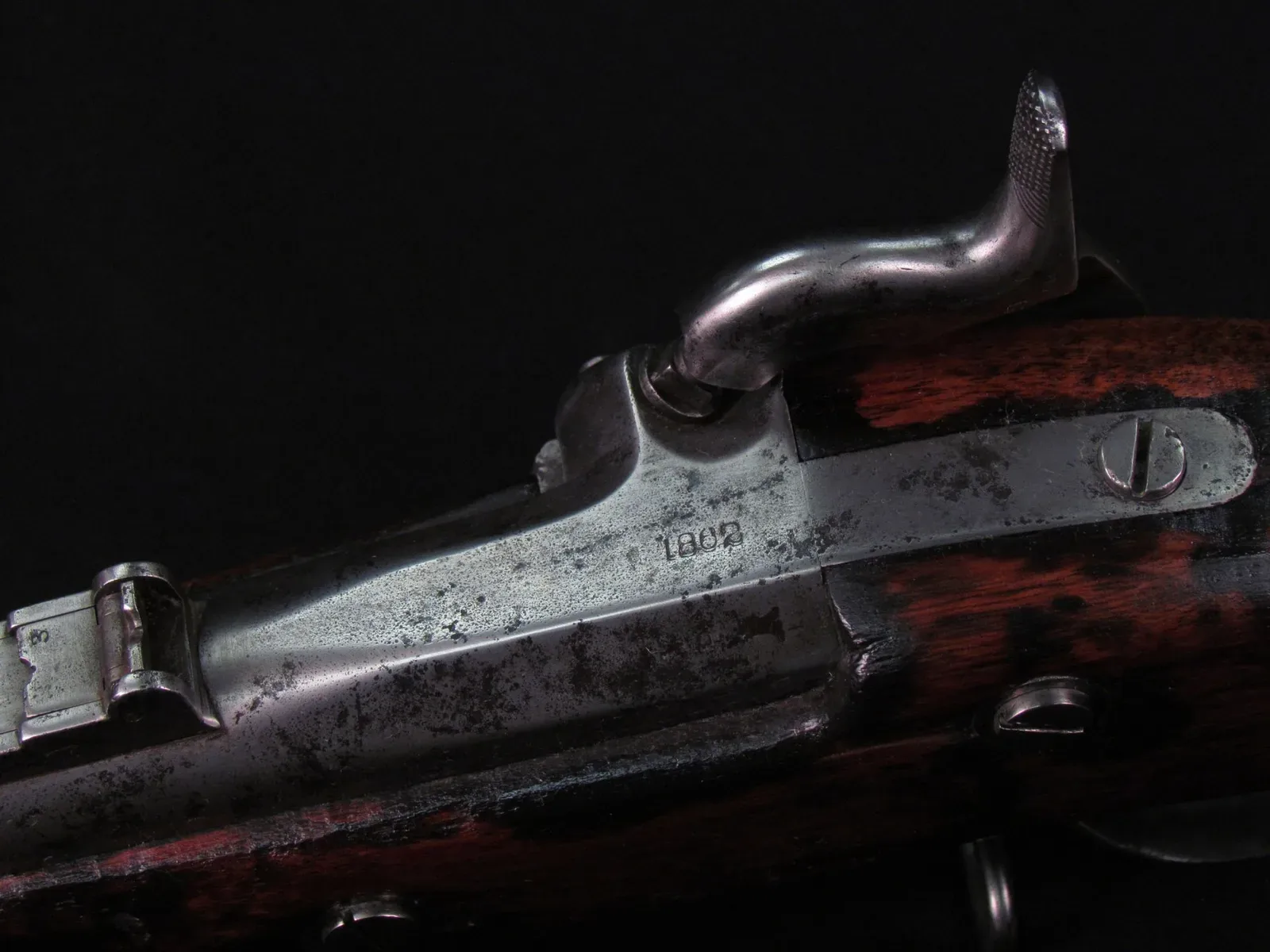
The Springfield Model 1861 was a .58-caliber rifled musket produced for the United States Army during the American Civil War. It was the most widely used Union shoulder weapon of that conflict — a muzzle-loading, percussion-cap arm firing a Minié ball that gave infantrymen an effective range they had never before held in their hands.
Over one million were produced between 1861 and 1865, manufactured at the Springfield Armory in Springfield, Massachusetts and contracted out to more than twenty private firms across the Union.
Production Scale and Distribution
Named for the armory where it originated, the "Springfield" became so synonymous with the Union infantryman that the two were essentially inseparable. If you have a Civil War musket in a collection today, there's a strong chance it's a Springfield of this model or a close variant — the Model 1863 or 1864 — which were, practically speaking, the same rifle with minor incremental changes.
The Springfield Model 1861 sat at a specific and consequential hinge point in firearms history. It was the first rifled shoulder weapon adopted and widely issued as the primary infantry arm of the U.S. military — not handed to a specialist rifleman corps, but put in the hands of every foot soldier. That shift had real consequences on how the Civil War was fought, how casualties mounted, and how military tactics would eventually have to evolve.
Design Historyedit
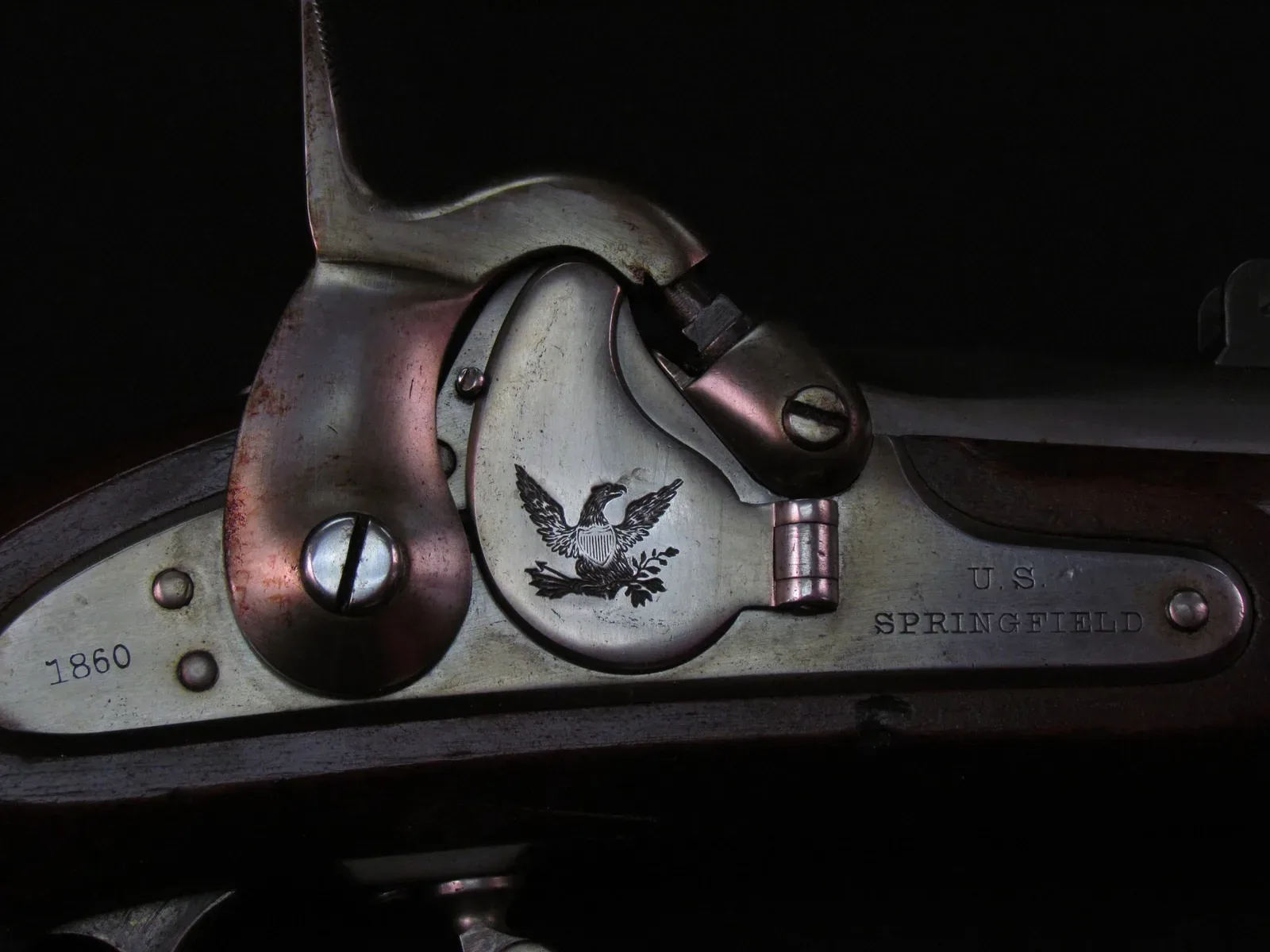
From Model 1855 to 1861
The Model 1861 did not appear from nowhere. It was the direct descendant of the Model 1855, which introduced rifling and the Minié ball system to the standard U.S. infantry arm. The Model 1855's central problem was its Maynard tape primer — a self-feeding priming mechanism similar in concept to a roll of cap-gun caps. The idea was to speed loading, but the Maynard system was temperamental in damp conditions and expensive and time-consuming to manufacture. By 1861, the Army had seen enough. The new model stripped the Maynard system out entirely and returned to a simple, manually seated percussion cap on a cone-shaped nipple.
That was the defining change — not a dramatic leap forward in technology, but a pragmatic step back from overcomplicated engineering toward something that worked in the rain, in the mud, and in the hands of a recruit who had been soldiering for three weeks. The Model 1861 was also never produced in the two-banded rifle configuration that the Model 1855 had offered, further simplifying the design and the supply chain behind it.
Industrial Production Network
The U.S. Army Ordnance Department designed the rifle, and production fell to the Springfield Armory as the primary manufacturer. But by 1861 the scale of the war's demand made it immediately clear that a single government facility — no matter how capable — could not arm an army growing at the rate the Union required. The Armory opened its weapon patterns to outside contractors, eventually licensing production to more than twenty firms.
- Colt's Patent Firearms Manufacturing Company - produced the Colt Special variant
- Providence Tool Company - major contractor for standard pattern
- Amoskeag Manufacturing Company - significant production volumes
- Lamson, Goodnow & Yale - licensed manufacturer
- Eagle Manufacturing Company - contracted producer
- Alfred Jenkins & Sons - private contractor
- Starr Arms Company - licensed manufacturer
- Manton (England) - foreign production
- German manufacturers - international contractors
| Major Contractors | Notable Features |
|---|---|
| Colt's Patent Firearms | "Colt Special" variant with redesigned barrel bands, revised hammer, redesigned bolster |
| Providence Tool Company | Standard Model 1861 pattern |
| Amoskeag Manufacturing | Standard Model 1861 pattern |
| Lamson, Goodnow & Yale | Standard Model 1861 pattern |
| Eagle Manufacturing | Standard Model 1861 pattern |
| Alfred Jenkins & Sons | Standard Model 1861 pattern |
| Starr Arms Company | Standard Model 1861 pattern |
| Manton (England) | Foreign production to Model 1861 pattern |
| German manufacturers | Foreign production to Model 1861 pattern |
The Colt Special rifled musket earned its own designation as Colt's contract version. Colt's engineers made several modest but meaningful changes: redesigned barrel bands, a revised hammer, and a redesigned bolster. These weren't cosmetic differences. Some of them proved superior enough that the Ordnance Department adopted them into the successor Model 1863. That's a noteworthy outcome — a private contractor improving on a government design to the point where the government folded those improvements into the next official model.
According to College Hill Arsenal, Springfield Armory produced only 33,572 Model 1861s in the rifle's first year of production — 1861 — out of the Armory's total run of 265,129. The war's industrial demands took time to ramp up, which is part of why early-war troops were often still carrying older arms.
Technical Characteristicsedit
Core Specifications
| Specification | Value |
|---|---|
| Caliber | .58 (14.73 mm) |
| Barrel Length | 40 inches |
| Overall Length | 56 inches (58.5 inches per HistoryNet) |
| Weight | 9 lb unloaded; 9.75 lb with bayonet |
| Rifling | 3 grooves, 0.3" wide, 1 turn in 6 feet |
| Cartridge | Paper cartridge with .58-cal 500-grain Minié ball |
| Muzzle Velocity | 950-1,000 fps (up to 1,400 fps) |
| Effective Range | 200-400 yards (500 yards for marksmen) |
| Maximum Range | 800-1,000 yards |
| Rate of Fire | 2-3 aimed rounds per minute |
| Unit Cost (1861) | $14.93 |
| Total Parts | 84, all interchangeable |
The Minié Ball System
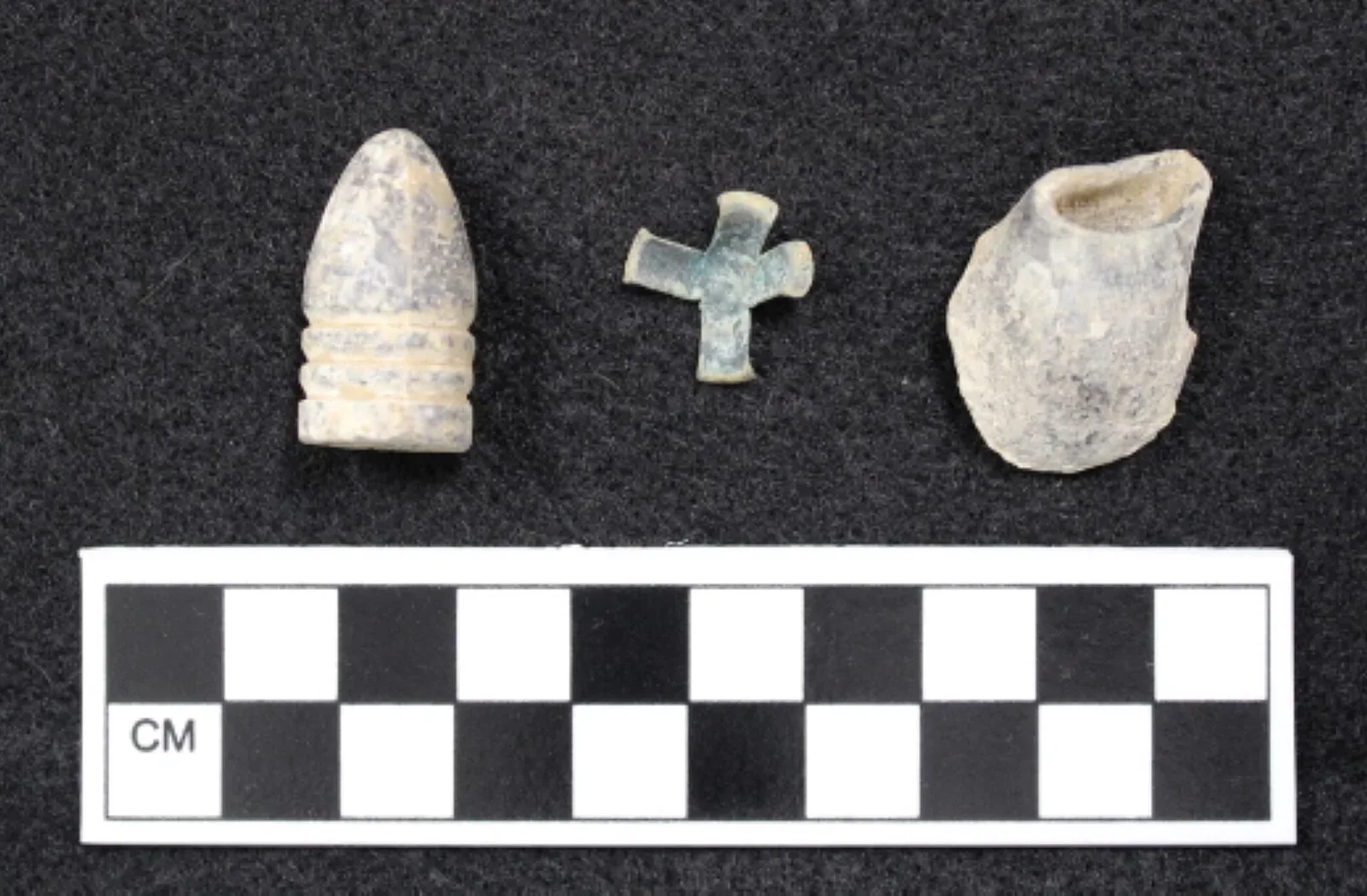
The Minié ball deserves a word here because the ammunition and the rifling are inseparable from what made this weapon significant. The bullet was undersized relative to the bore, allowing fast muzzle-loading even as powder fouling accumulated in the barrel over repeated shots. When fired, the soft lead base of the bullet expanded under gas pressure to engage the rifling grooves — spinning the projectile and giving it dramatically better accuracy and range than a smoothbore musket firing a tight-fitting ball. It was a system that made rifling practical for a muzzle-loader in a way it simply hadn't been before.
Sighting and Manufacturing Details
The sighting system used flip-up leaf iron sights with two leaves: one set for 300 yards and one for 500 yards, with both leaves down giving a 100-yard zero. This was simpler and more rugged than the ladder-sight system on the British Enfield Pattern 1853 — the Confederate military's preferred import — which offered finer adjustments at the cost of more complexity. The Enfield's sights extended to 900 yards versus the Springfield's 500-yard maximum setting, but as the Wikipedia source notes, hitting anything past 600 yards with either weapon was mostly luck for an average infantryman.
The rifle's 40-inch barrel gave it the long silhouette that became iconic in Civil War photography. It was also the source of one persistent tactical headache: the barrels were kept polished bright per Army regulation, which made for a striking appearance on parade and a shining beacon in combat. Confederate officers specifically cited the reflected light from Union musket barrels as intelligence — at Fredericksburg, the moonlight on the barrels revealed Burnside's movement into position; at Second Bull Run, the glint came through the dust; at Petersburg, the light above moving columns gave away Union flanking movements before the troops themselves were visible. Even when blued Enfield muskets were issued to Federal soldiers, some regimental commanders had their men polish the bluing off with emery cloth.
The 84-part count and full parts interchangeability represented the state of American industrial manufacturing. Every component produced at Springfield or at any of the licensed contractors was built to the same pattern — a ramrod from a Providence Tool Company rifle would fit a Springfield Armory receiver. That standardization was not accidental; it was the product of decades of development in what historians call the American System of manufacturing, and the Model 1861 was one of its largest-scale applications.
Combat & Field Useedit
Early War Deployment
The Model 1861 was relatively scarce in the war's earliest engagements. Many Union regiments mobilized in 1861 still carried older arms — Springfield Model 1842 smoothbore muskets in .69 caliber and even Springfield Model 1816 flintlocks that had been converted to percussion cap ignition. According to Wikipedia, it is unlikely any Model 1861s were available for the First Battle of Bull Run. The rifle reached troops more quickly in the Eastern Theater than in the West, reflecting both the distribution priorities of the Ordnance Department and the logistical realities of moving equipment across the country. By the end of 1863, most Federal infantrymen were armed with the Model 1861 or one of its close variants.
Soldier Experience and Personalization
Soldiers who received the rifle took it seriously. On November 23, 1862, a corporal in the 52nd Massachusetts Volunteers wrote home describing his newly issued Springfield:
"Our guns were issued to us the other day, beautiful pieces; of the most improved pattern — the Springfield rifled musket.... barrel, long and glistening — bound into its bed by gleaming rings — long and straight and so bright that when I present arms, and bring it before my face, I can see the nose and spectacles and the heavy beard on lip and chin." — Corporal, 52nd Massachusetts Volunteers, November 23, 1862
Veteran regiments were characterized, per HistoryNet, by shot-torn colors and shining muskets — the rifle was among the last things a seasoned soldier would let deteriorate.
Many soldiers also personalized their weapons in ways that went well beyond regulation. The Springfield Armory National Historic Site preserves several examples: a Model 1861 manufactured in 1862 with its battle history painted on the butt stock — Green Briar, Buffalo Mountain, Shiloh, Corinth, Murfreesboro, Chickamauga, Lookout Mountain, Mission Ridge — and another with an inscription carved and filled with red sealing wax reading "The Avenger of Emmey Summers who was murdered by the Hessians in St. Louis May 10, '61 C.S.A." These weren't isolated acts. Civil War infantrymen treated the musket as personal property in a way that regulation could discourage but not eliminate.
Combat Performance Reality
The rifle's performance in combat was real, but its impact has been contested. Historians have argued — as Wikipedia notes — that the rifled musket's tactical influence on the Civil War has been overstated. Several factors limited what the rifle's superior accuracy could actually accomplish on a battlefield:
- Most Civil War firefights used massed-fire tactics emphasizing volume over precision
- The .58-caliber Minié ball's parabolic trajectory caused soldiers to shoot over enemies' heads
- Most soldiers received limited marksmanship training focused on rate of fire, not precision
Accounts of overshooting are numerous in the early battles, and troops were routinely instructed to aim low.
Loading Problems Under Fire
The Gettysburg aftermath made the loading problem concrete in numbers. Of 27,574 muskets collected from that battlefield, 24,000 were still loaded. Twelve thousand of those contained two unfired charges.
| Gettysburg Battlefield Musket Analysis | Count | Percentage |
|---|---|---|
| Total muskets collected | 27,574 | 100% |
| Still loaded | 24,000 | 87% |
| Two unfired charges | 12,000 | 43.5% |
| 3-10 stacked loads | 6,000+ | 20%+ |
| Maximum charges found | 23 | - |
| Improperly loaded (ball first) | Multiple cases | - |
More than 6,000 — over 20 percent — contained between three and ten stacked loads. One musket had 23 charges loaded in sequence, in correct order. In a number of cases, soldiers had loaded the ball first and poured powder on top of it afterward. This wasn't carelessness — it was what happened to muzzle-loading drill under the cognitive pressure of combat.
To partially offset the slow rate of fire, soldiers sometimes loaded two bullets simultaneously. At 200 yards with a standard powder charge, those two bullets would separate approximately four feet from each other — a crude form of spread fire.
The Model 1861 also saw use beyond the Civil War's main theaters. It was carried during the American Indian Wars, appeared in the Paraguayan War, and was used by the Fenian Brotherhood during the Fenian Raids — the Irish-American paramilitary incursions into Canada in the late 1860s.
Legacy & Influenceedit
Post-War Conversion Programs
The Model 1861's production run ended in 1865, but its material life did not. With the introduction of modern brass cartridge ammunition after the war, the Army faced a practical problem: it had more than a million muzzle-loading rifle muskets in inventory and a technology shift that rendered them all obsolescent overnight. The solution was conversion. The Model 1861 and its successor, the Model 1863, became the physical starting point for a series of breechloader conversions as the Ordnance Department worked through different approaches to adapting existing stocks.
That process culminated in the Model 1873 — the Trapdoor Springfield — which served as the standard U.S. military rifle through the Indian Wars and every U.S. military action through the end of the 19th century. The 1861 didn't just fight the Civil War; it provided the raw material for what came after it.
Technological Endpoint
The Model 1861 represents the full maturation of the percussion muzzle-loader — the endpoint of a technology rather than a beginning.
In the longer arc of firearms development, the Model 1861 represents the full maturation of the percussion muzzle-loader — the endpoint of a technology rather than a beginning. Flintlock ignition had been giving way to percussion caps since the 1820s and 1830s, and the last U.S. flintlock musket, the Springfield Model 1840, had already been superseded before the Civil War began. The Model 1861 took the percussion cap system in its most refined and reliable form, combined it with the Minié ball and practical rifling, and produced it at industrial scale. It was the best possible version of a technology that was already being replaced. The Model 1873 that followed it operated on an entirely different principle — a hinged breechblock accepting a self-contained metallic cartridge — and the leap between the two represents one of the most significant transitions in the history of infantry arms.
The question of what the Model 1861 actually did to Civil War tactics remains genuinely open. The rifle gave infantrymen effective range that their smoothbore predecessors couldn't approach. Whether commanders used that range — whether tactics evolved fast enough to exploit it — is a separate question, and the evidence suggests they mostly didn't, at least not until later in the war. The massed frontal assault didn't disappear with the introduction of the rifled musket. What changed, more than tactics, was the casualty rate.
The rifle remains popular today among Civil War reenactors and collectors. Original antique Springfields command significant prices, and manufacturers including Davide Pedersoli & C., Chiappa Firearms (Armi Sport), and Euro Arms produce modern reproductions to fill the demand. The scarcity of originals — particularly early 1861-dated production runs — reflects both the attrition of 160-plus years and the collector appetite for a rifle that carried more of the Civil War than any other single arm.
The BGC Takeedit
The Springfield Model 1861 is one of those firearms that gets simplified into a symbol before people actually look at what it was and how it was used. The narrative version is: Union gets the rifle, Union gets the range advantage, rifled muskets make Civil War tactics catastrophically obsolete overnight. That's a clean story. It's also not quite right.
What the Model 1861 actually was is more interesting than the myth. It was a pragmatic, well-engineered solution to the problem of arming hundreds of thousands of men in a hurry, built on decades of American industrial development, priced at under $15 a copy, with 84 interchangeable parts that could be sourced from more than twenty different contractors. The fact that a soldier's Springfield from Colt's factory and one from the Providence Tool Company were dimensionally identical and parts-compatible — that's not a small thing. That's the American System of manufacturing working at a scale and a speed that no other country could match at the time.
The polished-barrel problem is the detail that sticks with me. Here you have a weapon that could hit a man at 400 yards, in the hands of troops being told to keep the barrel mirror-bright per regulation, and Confederate officers are tracking Union movements at night by the moonlight on the barrels. Some regimental commanders then had their men polish the bluing off Enfield muskets when those showed up, because regulations said shiny. That's the gap between what a weapon can do on paper and what actually happens when you hand it to an institution.
The rifle was better than how it was used. That's worth sitting with.
The conversion legacy is underappreciated. A million-plus Model 1861s didn't become museum pieces the day the war ended — they became the raw material for the next generation of American military rifles. The Trapdoor Springfield that fought the Indian Wars was built from these things. The 1861 has a longer service life than most people realize, just not always in the form it started in.
Referencesedit
- https://en.wikipedia.org/wiki/Springfield_Model_1861
- https://historynet.com/61-springfield-rifle-musket/
- https://www.nps.gov/spar/learn/historyculture/personalized-weapons.htm
- https://collegehillarsenal.com/us-m-1861-springfield-1861-dated
- https://www.muzzleloadingforum.com/threads/why-are-1861s-are-hard-to-find.139011/
Last Updated: February 27, 2026
- Gls Guns(Sumner, IA)
- Bi-mart - Yakima (Fruitvale Ave)(Yakima, WA)
- New Philly Sportsman Specialities(New Philadelphia, OH)
- R&R Sports & Outdoors(Brandon, FL)
Loading comments...