Details
Claude-Étienne Minié

The Minié ball's distinctive hollow base expanded when fired, engaging rifling grooves — a breakthrough that made rifled muskets practical for infantry combat.
| Biography | |
|---|---|
| Born | 13 February 1804, Paris |
| Died | 14 December 1879, Paris |
| Nationality | French |
| Military Rank | Colonel |
| Legacy | |
| Known For | Development of the Minié ball, a cylindrical hollow-based bullet that revolutionized infantry combat by solving the loading problem of rifled firearms |
| Key Innovation | The Minié ball (1849) - a conical soft-lead bullet with a hollow base containing an iron plug, designed to expand under firing pressure to grip rifling grooves while loading easily |
Claude-Étienne Minié: The Man Who Changed How Wars Were Fought
Firearms encyclopedia article
From The Boise Gun Club Handbook
Overviewedit
Claude-Étienne Minié (13 February 1804 – 14 December 1879) was a French military officer and inventor whose 1849 solution to a decades-old loading problem reshaped infantry combat more thoroughly than almost any other single development in firearms history. The Minié ball — a cylindrical, hollow-based bullet that expanded upon firing to grip a rifled barrel's spiral grooves — did not require shooters to force a tight-fitting projectile down a fouled bore.
It loaded fast, it shot straight, and it hit hard.
The practical consequences of that combination were staggering. Within a decade of its introduction, the Minié ball had proven itself on Crimean battlefields. Within fifteen years, it was accounting for an estimated 90 percent of the casualties in the deadliest war in American history.
The Minié ball loaded fast, shot straight, and hit hard — a combination that reshaped infantry combat more than almost any other single firearms development.
Minié himself did not orchestrate those outcomes — he was a captain solving a tactical problem for French troops in Algeria — but the technology he refined and codified with Henri-Gustave Delvigne in 1849 cascaded forward in ways neither man could have anticipated.
His career after the invention followed an unusual arc: a French Army colonelcy, a posting as military instructor to the khedive of Egypt, and ultimately a management role at the Remington Arms Company in the United States — the country where his bullet had done its most consequential work.
Early Life & Backgroundedit
Minié was born in Paris on 13 February 1804. The sources available say little about his childhood or early education, but his career path was military from the start. He served in a number of African campaigns with the Chasseurs — French light infantry — and rose through the ranks to captain.
Military Service in Africa
It was this field experience, specifically the problem of French troops being outranged by Algerian fighters carrying longer rifles, that gave his later invention its urgency. This was not an engineer in a workshop solving a theoretical puzzle. It was a soldier watching his men lose firefights because their weapons could not keep up.
| Weapon Type | Effective Range | Loading Speed | Accuracy | Main Limitation |
|---|---|---|---|---|
| Smoothbore Musket | 50-100 yards | Fast (volley fire capable) | Poor | Short range, inaccurate |
| Traditional Rifle | 200+ yards | Very slow | Excellent | Fouling, difficult loading |
| Minié Ball Rifle | 200-300 yards | Fast (3 rounds/min) | Excellent | None (solved both problems) |
The Rifle vs. Smoothbore Problem
The firearms landscape Minié inherited when he began working on the problem was one of frustrating half-measures. Rifles — barrels with spiral grooves that spun a bullet for accuracy — had existed for centuries, but they were slow to load under the best conditions and nearly impossible to reload quickly in combat. The rifling grooves required a tight-fitting ball to work, which meant ramming the bullet down the barrel by force, sometimes with a mallet.
As powder residue fouled the bore after repeated shots, this process became worse. Armies defaulted to smoothbore muskets because they were fast enough to support volley fire, even though their effective range topped out around 50 to 100 yards.
The tension between the rifle's accuracy and the smoothbore's practicality had been the central unsolved problem of infantry small arms for generations before Minié picked it up.
Key Contributionsedit
Previous Attempts and Failures
Minié was not working from a blank slate. Captain John Norton of the British 34th Regiment had proposed a cylindrical bullet with a hollow base as early as 1832, drawing on his observation of blowgun darts used by tribes in India — the dart's pith base expanded against the tube walls to create a seal. William Greener, a London gunsmith, refined Norton's concept in 1836 with an oval bullet featuring a drilled cavity and a conical plug. Britain's Ordnance Department rejected both designs despite a successful field test by the 60th Rifles in August 1836.
| Developer | Year | Design Features | Outcome |
|---|---|---|---|
| Captain John Norton | 1832 | Cylindrical bullet, hollow base | Rejected by British Ordnance |
| William Greener | 1836 | Oval bullet, drilled cavity, conical plug | Rejected despite successful field test |
| Minié & Delvigne | 1849 | Conical lead bullet, 4 exterior rings, iron plug | French: 20,000 francs; British: 20,000 pounds |
| James H. Burton | 1855 | Eliminated iron plug, deep conical cavity | U.S. Army standard adoption |
The 1849 Breakthrough
Minié and Delvigne advanced the concept further in 1849, producing a conical soft-lead bullet with four exterior rings and a cone-shaped hollow in its base containing a small iron plug. The lead skirting at the base was designed to expand under the pressure of the powder charge, obturating — sealing — against the rifling grooves.
How the Minié Ball's expanding base mechanism worked
This gave the bullet two critical properties simultaneously:
- Small enough to slide easily down a dirty barrel before firing
- Large enough after expansion to grip the rifling and spin accurately
- Effective range of 200-250 yards (compared to 100 yards for smoothbore)
- Rate of fire comparable to smoothbore muskets (up to 3 rounds per minute)
The effective range of a Minié-loaded rifle was 200 to 250 yards according to History.com's account, with the Pritzker Military Museum citing an effective lethal range extending to 300 yards — compared to a maximum of around 100 yards for a smoothbore musket in practical combat conditions. The rate-of-fire problem that had made rifles impractical for infantry was eliminated. A soldier could load a Minié-charged rifle nearly as fast as a smoothbore, and Civil War troops were trained to fire as many as three rounds per minute.
International Recognition and Controversy
Minié paired this bullet with a rifle specifically designed around it — the Minié rifle — introduced alongside the ball in 1849. The French government rewarded him with 20,000 francs and installed him on the staff at the Vincennes military school.
The British War Ministry, having passed on Norton and Greener, was sufficiently impressed this time to pay Minié a royalty of 20,000 pounds in 1852. Their decision triggered a legal dispute: William Greener contested that the British government had paid him only 1,000 pounds in belated recognition of his prior work while paying Minié twenty times that amount for a refinement of the same principle. The London Times, covering the Crimean War, would later call the Minié "the king of weapons."
The French Army — the institution that employed Minié and funded his work — never formally adopted his bullet.
Impact on Firearms Developmentedit
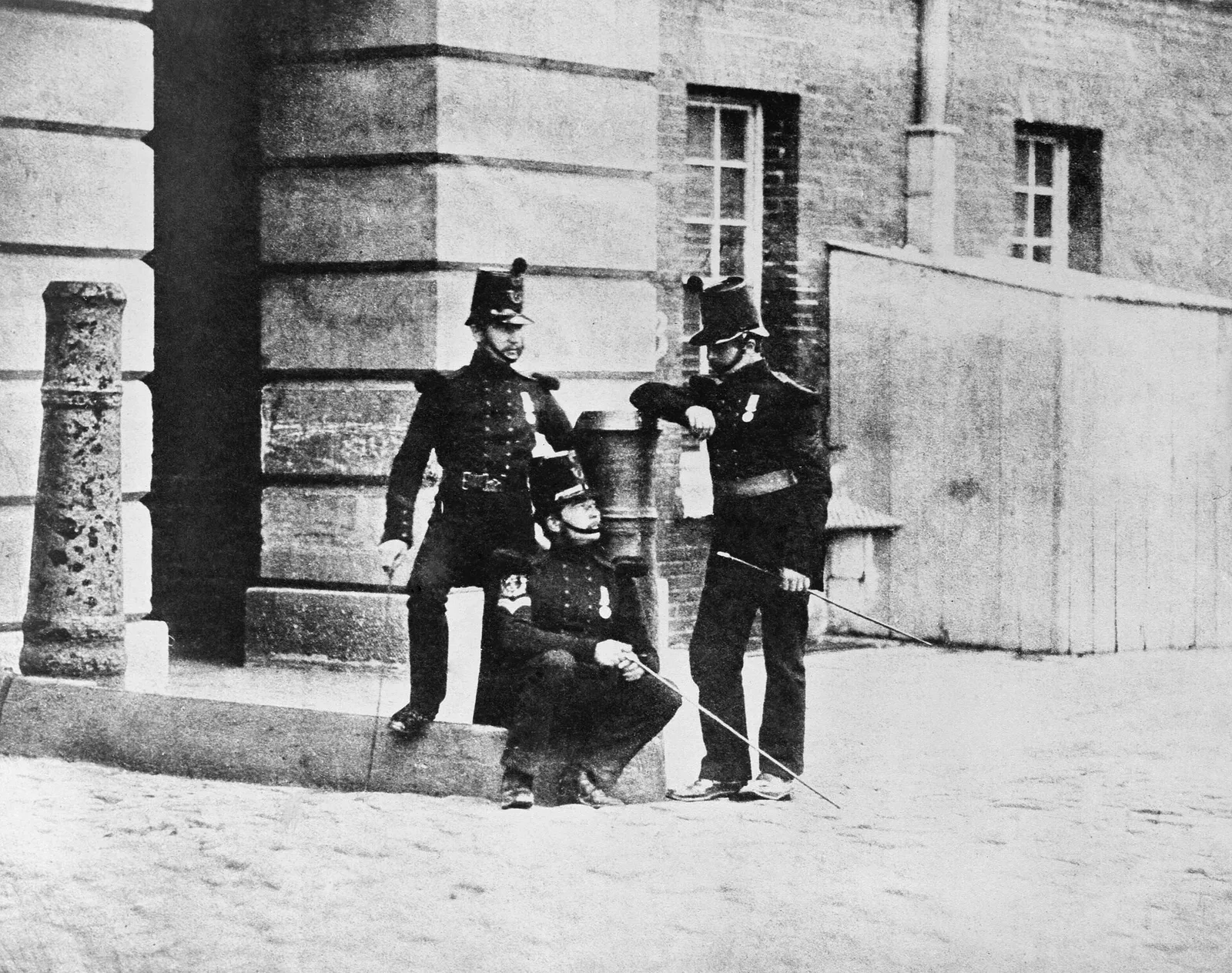
American Improvements: The Burton Modification
The Minié ball's path to American battlefields ran through James H. Burton, an armorer at the U.S. Arsenal in Harpers Ferry, Virginia. In the early 1850s, Burton improved on Minié's design by eliminating the iron plug entirely, relying instead on a deep conical cavity that filled with expanding gas directly upon firing. This was mechanically simpler, cheaper to manufacture, and actually more efficient — a higher proportion of the explosive force drove the bullet forward rather than being consumed expanding the skirt against the plug. Burton's version weighed 1.14 ounces (500 grains in the .58 caliber configuration from Harpers Ferry Armory).
The evolution and adoption of the Minié ball across three decades
The U.S. Army adopted this modified design in 1855 under Secretary of War Jefferson Davis — who would, six years later, lead the Confederacy against the army he had just re-armed.
Mass Production and Deployment
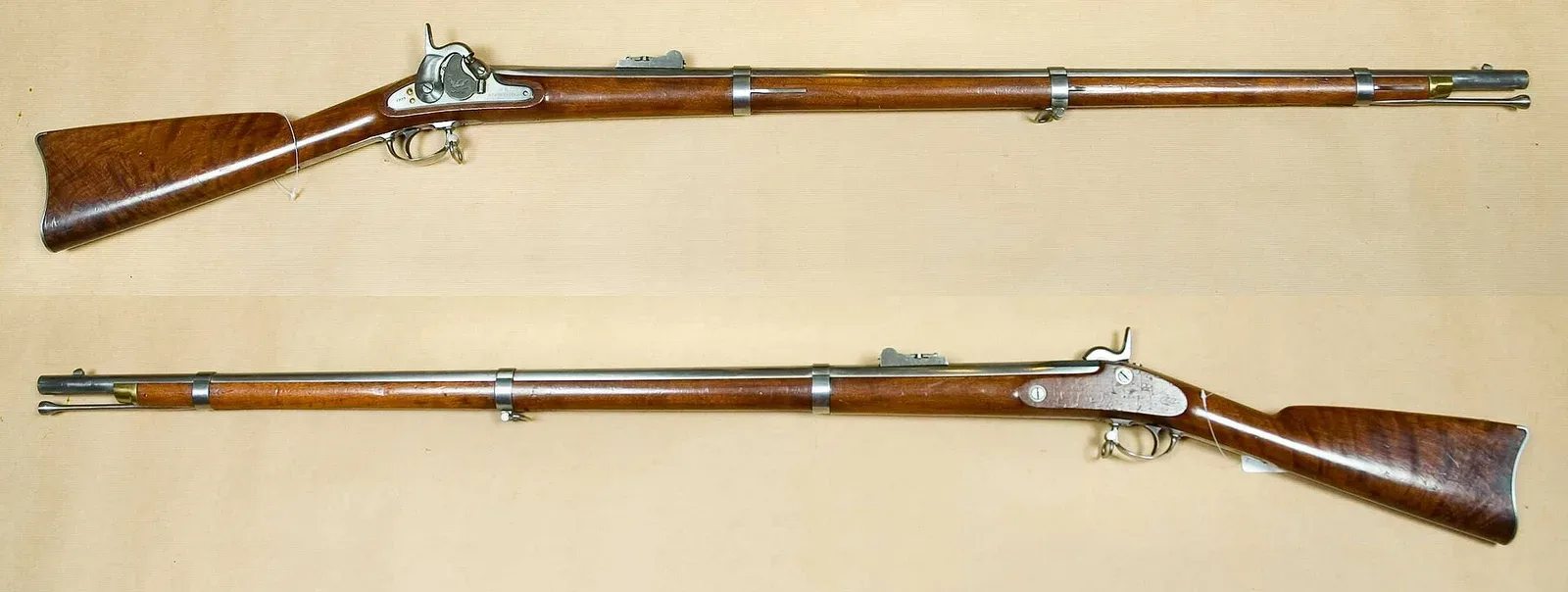
Two rifle-musket calibers saw widespread use: the Harpers Ferry rifle chambered a .69 caliber round, while the Springfield Model 1861 used .58 caliber. Both the Springfield and the British Pattern 1853 Enfield — the two most common rifles on Civil War battlefields — were built around the Minié ball. According to History.com, some 2 million Springfield rifles were produced during the war.
| Rifle Model | Caliber | Weight (grains) | Production Numbers | Primary User |
|---|---|---|---|---|
| Harpers Ferry Rifle | .69 caliber | ~500 grains | Limited | U.S. Army (early) |
| Springfield Model 1861 | .58 caliber | 500 grains | ~2 million | Union Army |
| Pattern 1853 Enfield | .577 caliber | ~530 grains | Extensive | British Army, Confederacy |
Battlefield Consequences
The tactical consequences were not subtle. A smoothbore musket's effective range of 50 yards meant that an attacker could absorb one or two volleys during a charge and still close to bayonet distance with enough men to carry a position. With rifled muskets and Minié balls pushing effective range to 300 yards, defenders could inflict serious casualties on an approaching column throughout the entire length of its advance.
The new defensive firepower created cascading tactical changes:
- Defenders could inflict casualties throughout a 300-yard advance
- Artillery crews found themselves within infantry rifle range
- Bayonet charges became nearly obsolete
- Cavalry charges against infantry became suicidal
Military communications, however, had not kept pace with firepower. Flags, bugles, and drums still required troops to fight in dense formations for command and control. Commanders trained on Napoleonic tactics, where massed bayonet charges had worked because smoothbore range was short, continued ordering those charges into defenders now armed with weapons that could kill at ten times the distance.
The result was industrial-scale slaughter.
| Civil War Impact | Statistics |
|---|---|
| Total Killed | 200,000+ soldiers |
| Total Wounded | 400,000+ soldiers |
| Minié Ball Casualties | ~90% of all casualties |
| Amputation Rate | 75% of all surgeries |
| Springfield Production | 2 million rifles |
According to History.com, the rifle-musket and Minié ball are estimated to account for roughly 90 percent of the more than 200,000 soldiers killed and more than 400,000 wounded during the Civil War.
The rifle-musket and Minié ball account for roughly 90 percent of Civil War casualties — turning battlefield medicine into an amputation assembly line.
Medical Impact
Per NRA Family's account, amputations made up approximately three-quarters of all surgeries performed on Civil War casualties — a direct consequence of how the Minié ball interacted with human bone. Unlike the round balls fired by smoothbores, which tended to lodge in flesh or deviate around dense tissue, the heavier, faster Minié ball cut a straight path and shattered whatever bone it struck. The resulting compound fractures, under field conditions with no antibiotics and overwhelmed surgical teams, left amputation as the only viable option.
Some soldiers notched their bullets to ensure additional fragmentation on impact. In the 1870s, physicians advocated for an international ban on soft-lead bullets, arguing they caused the same category of wound as explosive projectiles.
Rapid Obsolescence
The Minié ball's reign was short but decisive. During the Civil War itself, breech-loading rifles and repeaters demonstrated that even higher rates of fire were achievable with self-contained cartridges — conical bullets with attached powder charges that evolved directly from the Minié ball concept. Prussia's needle-gun breechloaders made the point conclusively during the Austro-Prussian War of 1866, badly outperforming Austrian muzzleloaders. The era of ramming a Minié ball down a barrel from the muzzle lasted less than a quarter century from invention to obsolescence.
What it left behind was a new understanding of defensive firepower that military doctrine would struggle to absorb for decades — a lesson that, as HistoryNet observes, would not fully register until the carnage of the Western Front in 1914–1918.
Later Life & Legacyedit
Minié retired from the French Army in 1858 with the rank of colonel. The sources do not detail the years immediately following his retirement, but his post-military career took him far from France.
Post-Military Career
- Served as military instructor for the khedive of Egypt, advising on the modernization of Egyptian forces
- Took management position at the Remington Arms Company in the United States — a notable arc, given that American soldiers had spent four years killing each other with a version of his invention
- Died in Paris on 14 December 1879 at age 75
Historical Assessment
The bullet that bore his name had already outlived its tactical era by the time he died, replaced by self-contained metallic cartridges and breech-loading actions. But the principle Minié had refined — a projectile that could load loose and seal tight, combining the practical speed of smoothbore loading with the accuracy of rifling — was the conceptual bridge between the musket age and the modern cartridge rifle. James Burton's improvement on Minié's design, adopted by the U.S. Army in 1855, established the standard for expanding-base bullet design that informed subsequent projectile development.
The historical assessment of Minié's contribution has one notable complication. HistoryNet and the Wikipedia article on the Minié ball credit the 1849 design as a collaboration between Minié and Henri-Gustave Delvigne, while most popular sources attach Minié's name alone to the invention. Delvigne had been working on expanding-bullet designs since at least 1826. The Wikipedia article on the Minié ball also notes a precursor design by French Army captains Montgomery and Delvigne in the 1830s.
Minié's specific contribution — making the bullet smaller and longer, easier to load, and pairing it with a purpose-built rifle — was a meaningful refinement, but calling it a solo invention overstates the case. The bullet was the product of several decades of incremental work by Norton, Greener, Delvigne, Minié, and ultimately Burton.
What Minié did that his predecessors had not managed was produce a version that militaries actually bought.
The BGC Takeedit
Minié is one of those figures who gets filed under "inventor" when the more accurate label might be "the guy who finally got the committee to say yes." Norton had the right idea in 1832. Greener improved it in 1836. The British Ordnance Department passed on both. Minié packaged a similar concept in 1849, demonstrated it convincingly enough that the French government paid him 20,000 francs and the British War Ministry paid him 20,000 pounds — and suddenly the technology that had been sitting on a shelf for seventeen years was in the hands of every major army on earth.
There's a version of history where Norton gets the credit and the bullet is called the Norton ball, and the Civil War casualty figures are the same and Minié is a footnote. That's probably more accurate to the engineering timeline. But the engineering timeline isn't how technology actually moves. It moves when someone builds something good enough, demonstrates it at the right moment, and gets the institutional buy-in. Minié did that.
The deeper thing the Minié ball illustrates — and it's something that runs through firearms history over and over — is the gap between a weapon's capability and the tactics built around it. The rifled musket with Minié ball was demonstrably more lethal to attacking infantry than anything that had come before. The people ordering those attacks knew this, or could have known it. They attacked anyway, in dense formations, because that's how wars had been won before and because nobody had yet worked out what to do instead.
The technology outran the doctrine by about fifty years, and the bill came due at the Somme.
Minié didn't cause that. But the bullet with his name on it is one of the clearest early examples of what happens when you hand armies a fundamentally new level of firepower without giving them new tactics to match.
Referencesedit
- https://en.wikipedia.org/wiki/Claude-%C3%89tienne_Mini%C3%A9
- https://www.history.com/articles/minie-ball
- https://historynet.com/minie-ball/
- https://en.wikipedia.org/wiki/Mini%C3%A9_ball
- https://www.pritzkermilitary.org/explore/museum/past-exhibits/dignity-duty-journals-erasmus-corwin-gilbreath/minie-ball
- https://www.nrafamily.org/content/throwback-thursday-minie-ball-america-s-civil-war/
Last Updated: February 27, 2026
- Gls Guns(Sumner, IA)
- Bi-mart - Yakima (Fruitvale Ave)(Yakima, WA)
- New Philly Sportsman Specialities(New Philadelphia, OH)
- R&R Sports & Outdoors(Brandon, FL)
Loading comments...