Details
Minié Ball

Timothy O'Sullivan's 'A Harvest of Death' from Gettysburg (1863) — one of the first photographs documenting Civil War casualties at scale, bringing battlefield mortality into American homes.
| Origins | |
|---|---|
| Invented | 1849 |
| Inventor | Claude-Étienne Minié |
| Country | France |
| Timeline | |
| Era | Mid-19th century |
| Replaced By | Breech-loading and repeating firearms |
| Impact | |
| Significance | A cylindro-conoidal hollow-based bullet that enabled effective rifled musket combat, dramatically increased infantry firepower and casualty rates, and reshaped 19th-century warfare and military tactics. |
Minié Ball
Firearms encyclopedia article
From The Boise Gun Club Handbook
Overviewedit
The Minié ball is a cylindro-conoidal, hollow-based bullet designed for muzzle-loaded rifled muskets. Claude-Étienne Minié, a French army captain, invented it in 1849. Despite being called a "ball"—a holdover from centuries of round musket-ball terminology—it was conical in shape, closer in form to a modern rifle bullet than to the spherical lead it replaced.
What made it matter wasn't the shape alone. It was the combination of that shape with a hollow base that expanded under firing pressure, gripping the barrel's rifling without requiring the bullet to be hammered down the bore. That single mechanical trick unlocked everything the rifled musket had promised for decades but couldn't deliver in combat conditions.
The rifle-musket and Minié ball together are thought to account for approximately 90 percent of the more than 200,000 killed and 400,000 wounded in the American Civil War.
The Minié ball's reign was short—less than a quarter century from adoption to obsolescence—but the damage it did in that window reshaped infantry warfare, overwhelmed a generation of military surgeons, and forced armies to confront tactical doctrines that hadn't caught up to the weapons their soldiers were carrying.
Development Historyedit
The problem the Minié ball solved had been frustrating military engineers for generations. Rifling—spiral grooves cut into a barrel's interior—imparts stabilizing spin to a projectile, dramatically increasing range and accuracy. Everyone knew this. The trouble was that for a bullet to grip the rifling, it had to fit tightly against the bore.
Tight-fitting bullets were difficult to ram down a dirty barrel under field conditions, and gunpowder fouling made the problem worse with every shot. Rifles stayed specialized weapons for skirmishers and sharpshooters while the smoothbore musket—easy to load, short on accuracy—remained the standard infantry arm.
Early Attempts and Rejections
Early attempts to crack this problem predate Minié by decades. Henri-Gustave Delvigne invented a ball that could expand upon ramming to fit a rifle's grooves as early as 1826. Captain John Norton of the British 34th Regiment proposed a cylindrical bullet with a hollow base in 1832, inspired by observing blowgun darts used by tribes in India—the pith base of those darts expanded to seal against the blowgun tube, and Norton saw the same principle could apply to a rifle barrel.
London gunsmith William Greener refined Norton's concept in 1836 with an oval bullet incorporating a conical plug that forced expansion upon firing. Britain's Ordnance Department rejected both designs despite a successful test by the 60th Rifles in August 1836.
| Year | Inventor | Country | Innovation | Outcome |
|---|---|---|---|---|
| 1826 | Henri-Gustave Delvigne | France | Expanding ball for rifling | Early concept |
| 1832 | John Norton | Britain | Cylindrical hollow-base bullet | Rejected by Ordnance |
| 1836 | William Greener | Britain | Oval bullet with conical plug | Rejected despite successful test |
| 1849 | Claude-Étienne Minié | France | Conical bullet with iron plug | 20,000 pounds from Britain |
| 1850s | James H. Burton | USA | Eliminated iron plug, deepened cavity | Standard American service round |
| 1855 | Jefferson Davis | USA | Official U.S. Army adoption | Mass production begins |
Minié's Breakthrough
Minié and his collaborator Delvigne took those earlier concepts further in 1849, producing a conical soft-lead bullet with two to four exterior grease-filled grooves—called cannelures—and a cone-shaped hollow in its base fitted with a small iron plug. The design was driven in part by immediate operational necessity: French troops in Algeria were being outranged by adversaries carrying long rifles, and Minié's bullet offered a solution that could be fielded with existing manufacturing.
The British War Ministry paid Minié 20,000 pounds in 1852 for rights to the design—a transaction that ignited a legal dispute with Greener, who ultimately received only 1,000 pounds in recognition of his earlier contribution.
Burton's American Refinement
The most consequential improvement came from the American side. James H. Burton, an armorer at the Harpers Ferry Armory, redesigned the bullet in the early 1850s. Burton deepened the conical base cavity and eliminated Minié's iron plug entirely. Without the plug, the bullet relied solely on gas pressure expanding the lead skirt into the rifling grooves. This was more reliable, mechanically simpler, and—critically—far cheaper to produce at scale.
Burton's version weighed 1.14 ounces, and became the standard American service round. Jefferson Davis, Secretary of War, formally adopted the rifle musket and Burton's improved Minié ball for the U.S. Army in 1855.
Britannica notes that the French government rewarded Minié with 20,000 francs and an appointment to the military school at Vincennes. He retired in 1858 with the rank of colonel, later served as a military instructor for the khedive of Egypt, and finished his career as a manager at the Remington Arms Company in the United States—a fitting postscript for the man whose bullet had done more to advance American arms than almost anyone born on American soil.
How It Worksedit
The Expansion Mechanism
The mechanical logic of the Minié ball is straightforward once you see it. The bullet is cast slightly smaller in diameter than the rifle bore. That loose fit lets it slide down the barrel easily—even through powder fouling, even under the stress of combat reloading. A soldier could load and fire three rounds per minute with a rifle-musket. That rate would have been impossible if the bullet needed to be hammered tight against the rifling on every load.
When the rifle fires, expanding propellant gas slams into the hollow base of the bullet. The soft lead skirt—sometimes called the obturating skirt—deforms outward under that pressure, pressing into the spiral rifling grooves cut into the barrel. The bullet grips the rifling, picks up spin, and exits the muzzle rotating on its long axis. That spin stabilizes it in flight, maintaining a predictable trajectory over distances a smoothbore ball couldn't approach.
The design maximized muzzle velocity by creating a gas-tight seal with minimal pressure loss—energy that would otherwise escape around the bullet went into driving it forward.
The Minié ball increased the effective lethal range of the standard infantry unit from a maximum of 100 yards to 300 yards.
Burton's modification made this process more efficient. By deepening the base cavity, he ensured that a higher percentage of the explosive force drove the bullet forward rather than being spent pressing the skirt into the grooves. This produced decreased mass and increased velocity, resulting in increased energy and better range—and a cheaper bullet to manufacture.
Service Cartridges
The two primary American service rounds during the Civil War were:
- .58 caliber Springfield bullet (most common)
- .69 caliber Harpers Ferry round (earlier standard)
- Springfield Model 1861 rifle compatibility
- British Pattern 1853 Enfield compatibility
| Specification | .58 Caliber Springfield | .69 Caliber Harpers Ferry |
|---|---|---|
| Weight | 500 grains (1.14 oz) | Heavier than .58 |
| Rifle Model | Springfield Model 1861 | Earlier muskets |
| Effective Range | 300 yards | 300 yards |
| Rate of Fire | 3 rounds per minute | 3 rounds per minute |
| Base Design | Deep hollow cavity | Hollow cavity |
| Manufacturing | Burton design | Pre-Burton design |
Both the Springfield Model 1861 and the British Pattern 1853 Enfield—the most common rifles in the war—fired Minié ball ammunition.
Impact on Warfare & Societyedit
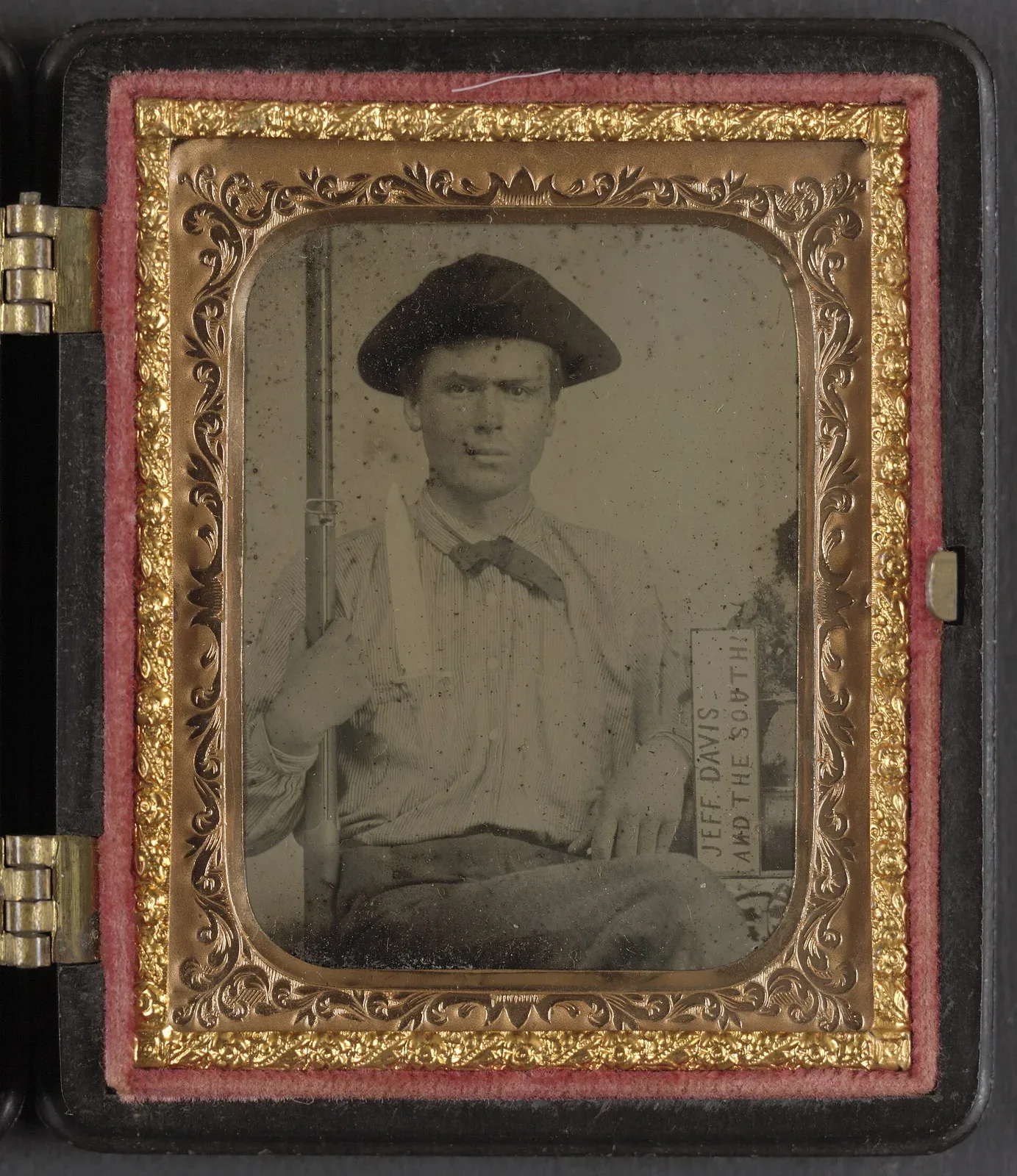
Range Revolution
The tactical consequences were immediate and brutal. A smoothbore musket had an effective range of roughly 50 yards and an extended range of 200 yards. The rifled musket pushed effective range to 300 yards with an extended range approaching half a mile. Artillery crews that had operated just outside smoothbore range during the Napoleonic Wars—safe enough to deliver canister fire into packed infantry—suddenly found themselves within range of individual riflemen. The calculus of assault versus defense shifted hard toward defense.
| Weapon Type | Effective Range | Extended Range | Tactical Implications |
|---|---|---|---|
| Smoothbore Musket | 50 yards | 200 yards | Close combat, linear tactics viable |
| Rifled Musket + Minié | 300 yards | 800+ yards | Defensive advantage, assault casualties |
| Artillery (Napoleonic) | Safe at 200+ yards | N/A | Vulnerable to individual riflemen |
| Firepower Comparison | 500 smoothbore soldiers | 150 rifle soldiers | 3:1 advantage with Minié |
Tactical Consequences
This meant attacking forces could no longer absorb a volley or two and close to bayonet range without catastrophic losses. Defenders in good positions could engage and punish attackers across distances that made traditional linear assault tactics extraordinarily costly. The Battle of Fredericksburg in December 1862, where attacking Union forces suffered 12,500 casualties, and Pickett's Charge at Gettysburg in July 1863, where Confederate forces suffered over 6,000 casualties in a single frontal assault, illustrated this dynamic at its most devastating.
The picture is more complicated than pure tactical revolution, though. Recent scholarship has pushed back on the narrative that the Minié ball transformed long-range killing on Civil War battlefields. Accuracy also depends on the soldier pulling the trigger, and throughout the Civil War—when target practice was minimal—combatants tended to aim too high.
The Minié ball's parabolic trajectory created two effective killing zones, roughly 0–100 yards and 240–350 yards, with soldiers relatively safe in the middle band as bullets arced over them. Most Civil War soldiers lacked the training to compensate for this arc. Attacking troops also learned to navigate between those killing zones more efficiently over time.
| Battle | Date | Attacking Force | Casualties | Tactical Pattern |
|---|---|---|---|---|
| Fredericksburg | Dec 1862 | Union | 12,500 | Frontal assault vs. entrenched defenders |
| Gettysburg (Pickett's Charge) | Jul 1863 | Confederate | 6,000+ | Mass charge across open ground |
| Cold Harbor | Jun 1864 | Union | 7,000+ in one hour | Repeated frontal assaults |
| Civil War Medical | 1861-1865 | Both sides | 3/4 surgeries = amputations | Bone-shattering wounds |
Medical Catastrophe
What the Minié ball indisputably changed—and what the range argument sometimes obscures—was the nature of wounds when it did connect. Unlike a solid ball that could pass through the body nearly intact, the soft hollow-based Minié ball flattened and deformed on impact, creating a shock wave that radiated outward. When it connected, it inflicted damage far beyond simple perforation:
- Flattened and deformed on impact
- Created shock waves radiating outward
- Shattered bones rather than breaking cleanly
- Exit wounds several times larger than entrance wounds
- Carried uniform debris into wounds, increasing infection risk
Wounds to bones typically produced compound fractures severe enough to necessitate amputation. A Minié ball striking a major blood vessel carried serious and often lethal consequences. Minié ball-induced amputations accounted for three out of every four surgical operations performed at Civil War hospitals. The soft lead of the bullet caused it to flatten and splinter on contact with a human target—damage so severe that doctors in the 1870s urged an international ban on soft-lead bullets, arguing they caused similar harm to explosive projectiles.
The medical system was not remotely prepared for what the Minié ball produced. Civil War surgeons were quickly overwhelmed by gaping wounds, mangled bodies, and mutilated limbs. They were accused throughout the war—unfairly—of amputating too readily. In reality, given the state of reconstructive medicine and the pace of casualties, the bone saw was often the only viable option. Adding to the toll, a Minié ball entering the body could carry foreign matter from the soldier's uniform into the wound, dramatically increasing infection risk. Gangrene frequently meant death.
One case from Jubal Early's raid on Washington, D.C., on July 12, 1864, illustrates the severity: a private in the 53rd North Carolina Infantry was struck in the head by a .58 caliber Minié ball that shattered his skull and lodged in the right hemisphere of the brain. He survived sixteen days—recovering briefly before infection and necrosis killed him. His brain was preserved in formaldehyde and donated to the Army Museum in Washington.
Industrial Warfare
On the production side, the Minié ball widened the industrial gap between North and South. Approximately 90 percent of U.S. manufacturing output came from the North by 1860. During the war, the North produced 32 times the number of firearms as the South—for every 100 the South manufactured, the North produced 3,200. The North also controlled roughly 70 percent of the nation's railroads, accelerating distribution to the front. The rifled musket and Minié ball were transformative technologies, but only for the side that could make enough of them fast enough.
The London Times called the Minié "the king of weapons" during the Crimean War, reporting that it swept through Russian ranks "like the hand of the Destroying Angel."
150 soldiers equipped with Minié-loaded rifles could equal the firepower of more than 500 soldiers armed with traditional muskets.
Modern Relevanceedit
Design Legacy
The Minié ball's direct descendants are every conical jacketed rifle bullet in use today. The fundamental geometry—cylindrical body, conical point, base designed to interact with barrel rifling—flows directly from Minié's 1849 design and Burton's 1850s refinements. Modern bullets no longer expand to engage rifling (they're sized to fit), but the form factor Minié established is the template.
The bullet's historical moment ended quickly. Breech-loading weapons and repeating firearms demonstrated a much higher rate of fire than the rifled musket during the Civil War itself. Prussia's needle-gun breechloaders badly outclassed Austrian muzzle-loaders in the Austro-Prussian War of 1866, delivering an object lesson that armies couldn't ignore. The era of ramming powder and a Minié ball down a barrel from the muzzle lasted less than 25 years from adoption to obsolescence.
What lingered was the tactical and medical reckoning the Minié ball forced. The lesson that massed infantry formations attacking prepared defenders would be annihilated by accurate long-range fire—a lesson written in the casualties at Fredericksburg, Gettysburg, and Cold Harbor—didn't fully take hold until World War I forced it on armies that had still not adapted their doctrine to their weapons. The Minié ball wrote the first draft of that argument in the early 1860s.
Collector Interest
For collectors, Minié balls are among the most commonly found Civil War artifacts on and around battlefield sites. The two standard American sizes—.58 caliber and .69 caliber—are well documented and frequently unearthed. Their distinctive hollow-base profile makes them easy to identify. Burton's 1855 design from Harpers Ferry, at 500 grains and .58 caliber, is the reference standard that most collectors and historians work from.
The BGC Takeedit
The Minié ball gets taught as a straightforward story: French captain invents bullet, bullet wins wars, bullet changes history. And that's not wrong, exactly—but it flattens something more interesting.
The real story is about a problem that had been sitting in front of military engineers for 20-plus years. Norton saw it in 1832. Greener refined it in 1836. Both got ignored by bureaucracies that weren't ready to deal with the implications.
Minié got the credit and the 20,000 pounds, but what actually mattered for American soldiers was Burton's work at Harpers Ferry—a working armorer who stripped out the iron plug, deepened the cavity, and figured out how to make the thing cheap enough to produce by the millions. That's the pattern that repeats throughout firearms history: the inventor gets the name, the production engineer gets the impact.
The other thing worth sitting with is the gap between what the Minié ball was supposed to do and what it actually did. The promise was long-range precision—pick off the enemy at 300 yards before he could close. The reality, for most of the war, was that undertrained soldiers still fought at close range, still couldn't consistently hit a man-sized target at distance, and still massed in formations that made them easy targets when they did get within range.
The Minié ball didn't change tactics as much as it changed the cost of getting tactics wrong.
Fredericksburg and Pickett's Charge weren't failures of marksmanship. They were failures of command—generals who knew what the bullet could do but ordered the charge anyway.
The medical legacy is the part that doesn't get enough attention. A generation of American men came home missing arms and legs, and the surgeons who made those calls under fire in inadequate field hospitals got called butchers for it. The Minié ball created the wound. The doctors dealt with it as best they could with what medicine knew in 1863. That's worth remembering the next time someone reduces this bullet to a range statistic.
Referencesedit
- https://en.wikipedia.org/wiki/Mini%C3%A9_ball
- https://historynet.com/minie-ball/
- https://www.history.com/articles/minie-ball
- https://www.britannica.com/biography/Claude-Etienne-Minie
- https://archive.nytimes.com/opinionator.blogs.nytimes.com/2012/08/31/the-bullet-that-changed-history/
- https://www.nrafamily.org/content/throwback-thursday-minie-ball-america-s-civil-war/
- https://www.pritzkermilitary.org/explore/museum/past-exhibits/dignity-duty-journals-erasmus-corwin-gilbreath/minie-ball
- https://gettysburgcompiler.org/2019/04/30/small-but-deadly-the-minie-ball/
Last Updated: February 27, 2026
- Gls Guns(Sumner, IA)
- Bi-mart - Yakima (Fruitvale Ave)(Yakima, WA)
- New Philly Sportsman Specialities(New Philadelphia, OH)
- R&R Sports & Outdoors(Brandon, FL)
Loading comments...