Details
Flintlock Mechanism

A disassembled flintlock mechanism reveals the cock, frizzen, and pan — the core components that create sparks when the trigger releases the hammer.
| Origins | |
|---|---|
| Invented | Early 17th century |
| Inventor | Marin le Bourgeoys |
| Country | France |
| Timeline | |
| Era | Early 17th to mid-19th century |
| Replaced By | Percussion cap ignition |
| Impact | |
| Significance | A reliable and economical ignition system that dominated military and civilian firearms for over two centuries and enabled mass-equipped armies through its low manufacturing cost and high dependability. |
Flintlock Mechanism
Firearms encyclopedia article
From The Boise Gun Club Handbook
Overviewedit
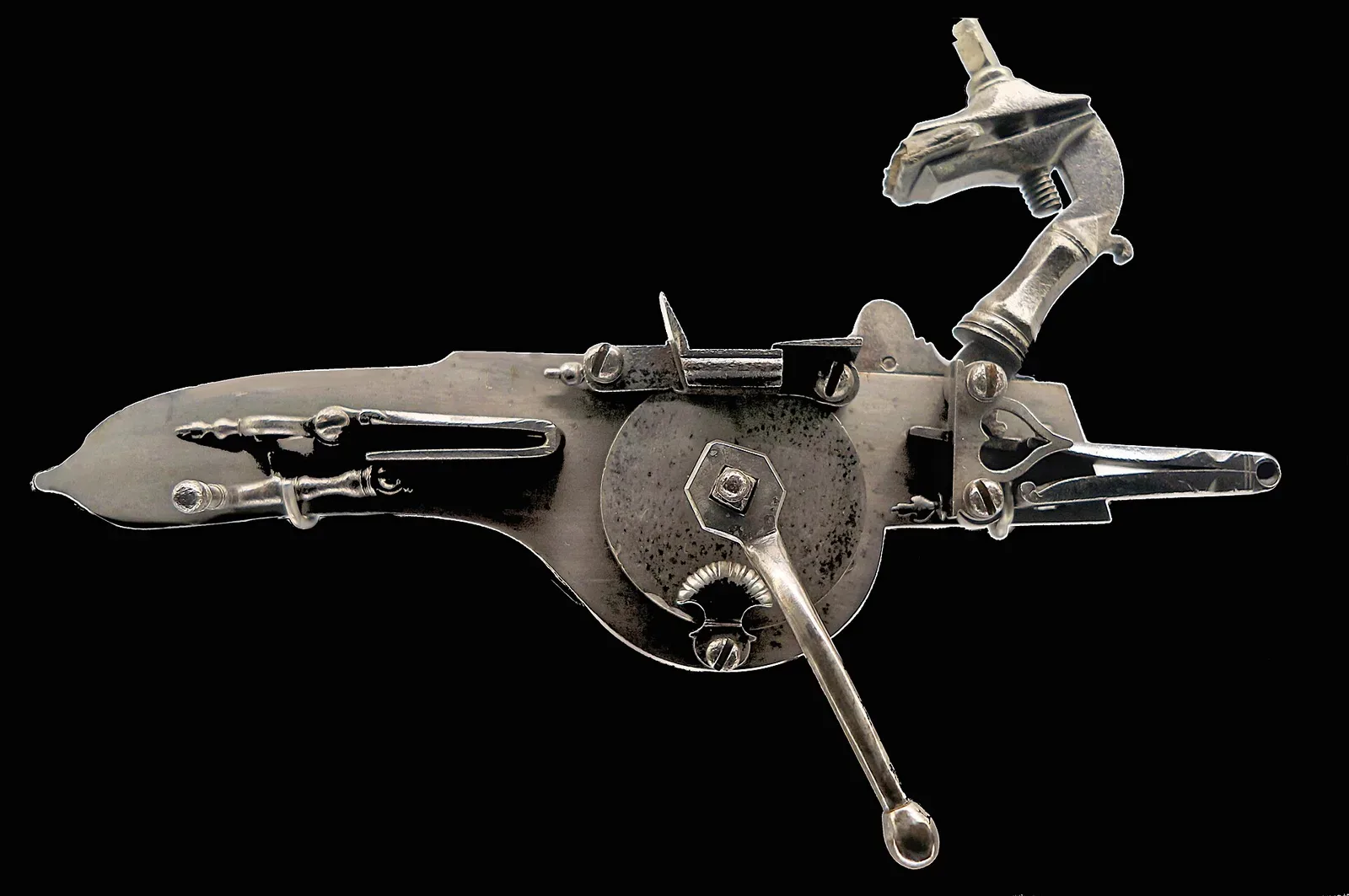
The flintlock mechanism is an ignition system used on muskets, rifles, and pistols from the early 17th to the mid-19th century. In common usage, "flintlock" refers both to the lock itself and to any firearm built around it. The mechanism works by striking a piece of flint against a steel component called the frizzen, generating sparks that ignite a small priming charge, which in turn fires the main powder charge through a touch hole in the barrel.
What looks simple on the surface was, in context, a genuine engineering achievement.
The flintlock solved problems that had plagued earlier ignition systems for over a century -- unreliable pan covers, weather sensitivity, and mechanical complexity -- and it did so with a parts count low enough that armies could manufacture and field it at scale.
According to Wikipedia's entry on the flintlock, the true flintlock was "less expensive to manufacture than earlier flintlocks, which along with general economic development allowed every European soldier to have one by the 18th century."
It dominated military and civilian firearms for more than two centuries, from roughly the 1630s through the 1840s. That kind of staying power doesn't happen by accident.
Development Historyedit
The flintlock didn't arrive fully formed. It was the end product of roughly a century of incremental improvement to flint-based ignition systems, each generation fixing the most glaring problems of the one before it.
Early Predecessors
The first of these predecessors was the snaplock, probably invented shortly before 1517 and in documented use by 1547, according to Wikipedia. It established the basic concept -- a spring-loaded cock holding a piece of flint -- but left the priming pan exposed and relied on a crude external sear arrangement. The snaphaunce, which emerged around 1560, added a separate steel striking plate above the pan and improved the spring mechanism. It was functional enough that the early Dutch States Army issued snaphances to its infantry in the 1620s. But it still required the shooter to manually manage a separate pan cover -- forget to open it, and the gun didn't fire.
Around 1580, according to the NRA Museums article by Jim Supica, the miquelet system appeared, improving on the snaphaunce by combining the steel striking plate and pan cover into a single L-shaped piece -- the frizzen. That was the key insight. When the cock swung forward and struck the frizzen, the impact simultaneously produced sparks and kicked the frizzen out of the way to expose the primed pan. One motion, two results.
| System | Period | Key Features | Limitations |
|---|---|---|---|
| Snaplock | 1517-1560 | Spring-loaded cock with flint | Exposed pan, external sear |
| Snaphaunce | 1560-1580 | Separate steel plate, improved spring | Manual pan cover required |
| Miquelet | 1580-1610 | Combined steel/pan cover (frizzen) | Still mechanically complex |
| True Flintlock | 1610+ | Internal sear, vertically acting tumbler | Weather sensitivity |
The French Lock Innovation
The true flintlock -- also called the French lock -- refined this further in the early 17th century. Credit for the design is generally given to Marin le Bourgeoys, an artist, gunsmith, luthier, and inventor from Normandy, France, who made a firearm incorporating the mechanism for King Louis XIII shortly after his accession to the throne in 1610, per Wikipedia. The exact origins remain somewhat murky, but le Bourgeoys's name is attached to the design in the historical record.
The critical mechanical improvement le Bourgeoys contributed was the vertically acting sear. In earlier designs, the sear protruded through a hole in the lockplate to engage the cock on the outside. Le Bourgeoys moved the engagement point inside the lock, where the sear acted on a piece called the tumbler -- mounted on the same rotating shaft as the cock. This internal arrangement was more protected, more reliable, and cheaper to produce.
According to Wikipedia's flintlock mechanism article, "this design proved to be the most efficient in terms of cost and reliability."
Evolution from early flint ignition systems to the standardized flintlock
Military Adoption
The new system spread fast. The Dutch were the first major power to standardize the true flintlock as their infantry weapon, adopting it by 1640, though the exact transition timeline is uncertain per Wikipedia. By 1630, the design was known and in use across Europe in various forms. The Holy Roman Empire was the last major European power to standardize it -- Emperor Joseph I mandated in 1702 that all matchlocks be converted or scrapped.
France issued its first true flintlock military arms in 1717, per the NIJ Firearms Examiner Training archive, and kept that basic pattern until 1842. That's 125 years on a single ignition system -- a measure of how well the design held up.
How It Worksedit
The flintlock has more going on inside than it looks from the outside, but the sequence of events from trigger pull to fired round takes less than a second.
The Cocking Mechanism
A piece of flint is clamped in the jaws of the cock -- the hammer-shaped arm that provides the mechanical energy. Before firing, the cock is pulled back against the mainspring to the fully cocked position, where the sear engages a notch in the tumbler and holds the system under tension. There's also a half-cocked position, where the sear engages a separate safety notch.
From half-cocked, the trigger cannot release the tumbler -- this is where the phrase "don't go off half-cocked" comes from, and it reflects an actual mechanical property of the lock.
The Firing Sequence
When the trigger is pulled from the fully cocked position, it moves the sear just enough to disengage the tumbler. The mainspring drives the cock forward with force. The flint strikes the frizzen -- the L-shaped steel piece that covers the flash pan -- at an oblique angle.
Two things happen simultaneously at that moment. The flint, being harder than steel, shaves off a shower of tiny iron fragments from the frizzen. Per Wikipedia's mechanism article, these fragments exhibit pyrophoricity -- they ignite spontaneously in air due to their extremely high surface-area-to-volume ratio, which causes rapid oxidation and makes them intensely hot.
Those burning fragments are the sparks. At the same time, the force of the cock's blow pushes the frizzen back on its hinge, uncovering the pan and exposing the priming powder to those same sparks.
Flintlock firing sequence from trigger pull to projectile discharge
Some fragments land in the priming powder and ignite it. The flame from the burning priming charge travels through a small touch hole -- also called the vent -- drilled into the side of the barrel, reaching the main powder charge behind the ball. The main charge fires, and the projectile leaves the barrel.
The frizzen spring holds the frizzen in both positions -- closed over the pan and swung open -- providing the resistance needed for spark generation and keeping the pan sealed when the gun is being carried loaded.
Loading and Safety
The half-cock position serves the practical loading function as well. With the cock at half-cock, the frizzen can be opened manually so powder can be poured into the pan, then closed again before the cock is brought to full cock. This is the standard loading sequence described in both the HowStuffWorks source and Wikipedia's operational description.
One variant worth noting: the internal flintlock, where there is no external cock. Instead, a rod holding the flint operates inside the action, with the pan located on the upper side of the barrel. This design is attributed by some sources to gunsmith Stanislav Patzelta and by others to Austrian gunsmith Karl Bischof -- the sources conflict on the inventor. Either way, this variant was rare.
Impact on Warfare & Societyedit
Tactical Advantages
The flintlock didn't just improve individual firearms -- it changed what infantry tactics were possible and reshaped how armies organized and fought.
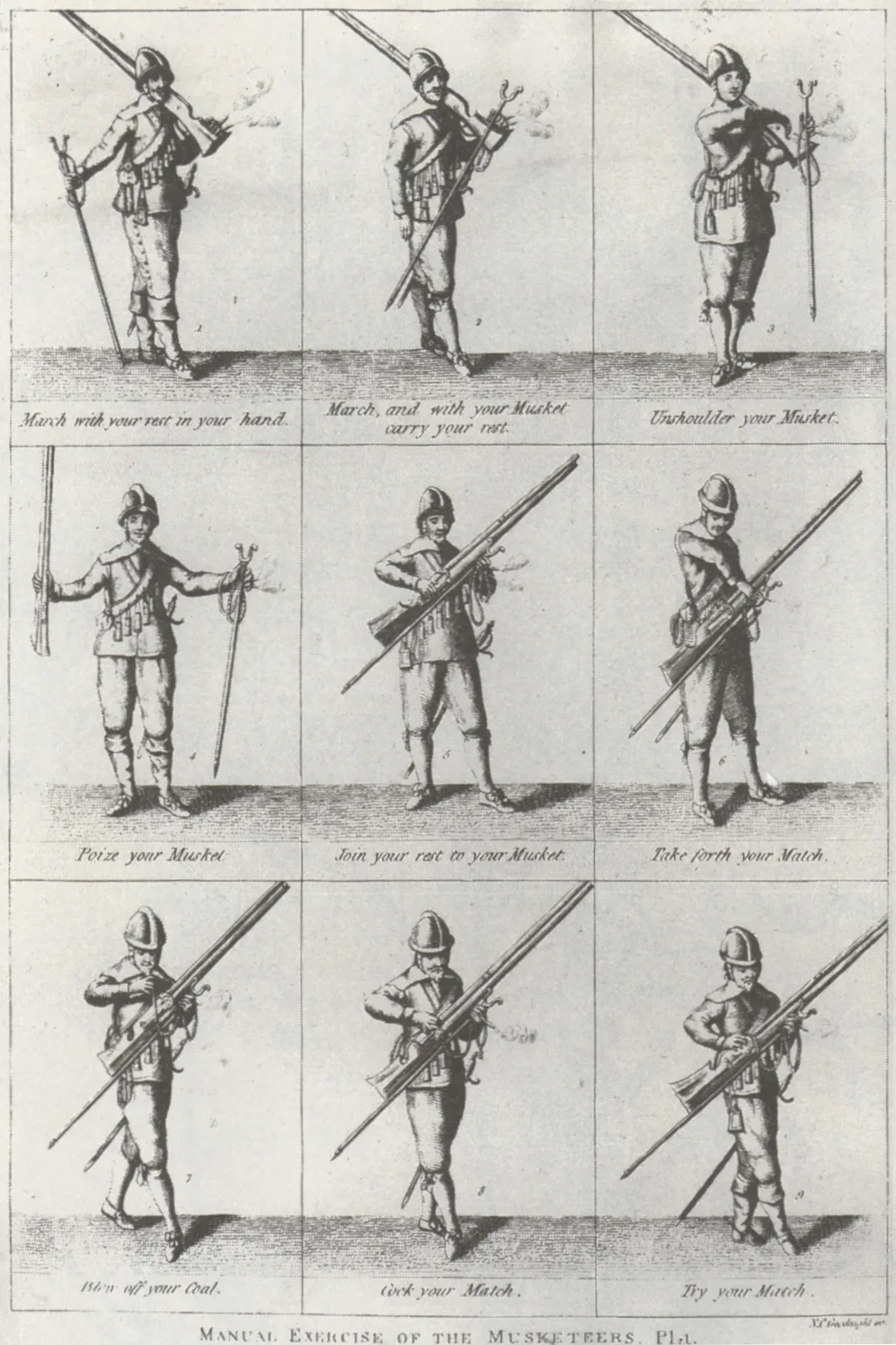
Compared to the matchlock, flintlocks could be reloaded roughly twice as fast and misfired far less often. They didn't require a lit match, which eliminated a significant logistical burden and a genuine fire hazard -- soldiers guarding artillery trains with burning slow-match near gunpowder was an obvious problem. Per Wikipedia, those early troops armed with flintlocks (then called "fusils") guarding artillery were called "fusiliers," a term that survived long after the fusil itself was gone.
The tactical math was stark. According to Wikipedia's flintlock article, citing historical analysis:
A formation equipped entirely with flintlocks could output ten times as many shots in an equivalent period of time as a typical early 17th-century pike and shot formation equipped with matchlocks.
That kind of firepower differential accelerated the decline of the pike, the sword, and the heavily armored cavalry that had defined European warfare for centuries.
| Specification | Flintlock Musket | Notes |
|---|---|---|
| Length | 5-6 feet (without bayonet) | Standardized for infantry use |
| Weight | ~10 pounds | Manageable for extended marching |
| Effective Range | 75-100 meters | Smoothbore barrel limitation |
| Reload Rate | 2x faster than matchlock | Tactical advantage |
| Bayonet Casualties | <2% of battlefield wounds | Primarily psychological deterrent |
Military flintlock muskets were typically 5 to 6 feet long without a bayonet, weighed approximately 10 pounds, and had an effective range of roughly 75 to 100 meters using smoothbore barrels, per Wikipedia. They were fired in mass volleys rather than aimed individually -- the smoothbore barrel and round lead ball simply weren't accurate enough at range for aimed fire to be the primary tactic. The bayonet was attached for close action, though it was largely a deterrent: Wikipedia notes that casualty lists from multiple 18th-century battles showed fewer than 2% of wounds were caused by bayonets.
Naval Warfare Revolution
The flintlock also reshaped naval warfare in a less obvious way. Gunlocks -- flintlock mechanisms adapted to fire cannons -- were first used by the Royal Navy in 1745, per Wikipedia. Before gunlocks, cannon crews used a linstock (a staff with a length of smoldering match) to fire the gun, which required standing to the side and introduced a dangerous delay between application and firing. The gunlock, operated by pulling a lanyard, let the gun-captain stand safely behind the piece, sight along the barrel, and fire precisely when the ship's roll lined up the shot.
The French had still not generally adopted gunlocks by the time of the Battle of Trafalgar in 1805 -- a tactical disadvantage in the engagement that arguably contributed to the outcome.
Industrial Infrastructure
The social and industrial infrastructure built around flintlocks was enormous. Flint knappers in Brandon, Suffolk, became the backbone of British military supply -- by 1804, Brandon was supplying over 400,000 flints per month to British forces, according to Wikipedia. The industry hit its peak during and after the Napoleonic Wars, with Brandon flints achieving something close to a global monopoly in military supply. Brandon was still exporting 11 million flints annually to the Turkish army during the Crimean War, and was sending flints to Africa as late as the 1960s.
| Location | Peak Production | Period | Notes |
|---|---|---|---|
| Brandon, Suffolk | 400,000+ flints/month | 1804 | British military monopoly |
| Brandon, Suffolk | 11 million flints/year | Crimean War | Turkish army supply |
| Meusnes/Couffy, France | Dominant supplier | 17th-19th century | Until ~1780 British takeover |
| Brandon exports | Active trade | Until 1960s | African markets |
That cottage industry came at a human cost. Flint knappers suffered from silicosis -- called "Knappers Rot" -- from inhaling flint dust. Wikipedia records that the condition was claimed to be responsible for the early death of three-quarters of Brandon gun flint makers.
In France, gun flint production centered around the towns of Meusnes and Couffy from the 17th through 19th centuries, and France was the dominant global supplier until around 1780, when the British industry began to eclipse it. The color and manufacturing method of flints differ enough between British and French sources that archaeologists can distinguish between them -- a detail that's been useful in studying battle sites and colonial-era trading posts.
Linguistic Legacy
The flintlock also shaped the English language in ways that are still in use:
- "Flash in the pan" - when priming powder ignites but fails to fire main charge
- "Don't go off half-cocked" - referring to the safety position of the cock
- "Lock, stock and barrel" - the three main components of a complete firearm
- "Keep your powder dry" - essential maintenance for reliable ignition
Beyond warfare, flintlock technology found its way into domestic applications:
- Flintlock tinder lighters for wealthy households
- Alarm clocks with flintlock candle-lighting mechanisms
- Land mines and fougasses with flintlock detonation
- Congreve rocket launching systems
Flintlock tinder lighters -- devices resembling small pistols without barrels, fitted with candle holders -- were used in wealthy households from the 18th century until reliable matches became available, per Wikipedia. Alarm clocks were made that used flintlock mechanisms to light candles; examples from the 18th century are held in the British Museum and the Hermitage Museum in Russia, with one example at the Germanisches Nationalmuseum in Nuremberg dated to 1550. Some early land mines and fougasses used flintlock detonation, and flintlocks were used to launch Congreve rockets.
Modern Relevanceedit
The Transition to Percussion
The flintlock's active military life ended gradually rather than all at once. Reverend Alexander John Forsyth (1768–1843), a Scottish Presbyterian minister and amateur chemist, began experimenting in 1793 with fulminating powder as a firearm primer, per the NIJ source. History credits him with fabricating the first gunlock to use fulminating powder around 1812. The percussion cap that followed -- small cups containing impact-sensitive compounds -- was simpler, more weatherproof, and more reliable than flint and steel.
By around 1830, percussion ignition was in widespread use, per Wikipedia.
The transition was slow by modern standards. The Model 1840 U.S. musket was the last flintlock produced for the American military, per Wikipedia. Even then, obsolete flintlocks didn't disappear immediately -- in 1861, the Army of Tennessee still had over 2,000 flintlock muskets in active service at the opening of the Civil War.
Contemporary Applications
Flintlocks continue to be manufactured today. Companies including Pedersoli, Euroarms, and Armi Sport produce both replicas and functional originals, per Wikipedia. In the United States, many states maintain dedicated black-powder hunting seasons that include flintlock firearms, keeping a genuine shooting community around the platform. Small-scale suppliers of gun flints also still operate, serving this community.
For historians and archaeologists, the physical evidence left by flintlocks -- spent flints, knapped flint debris, gun parts at fortification sites -- remains a significant source of information about military supply chains, trade networks, and colonial-era contact between European and Indigenous populations. In the Eastern United States, Indigenous people reportedly made their own gun flints by reworking stone spear heads and knapping local chert, per Wikipedia, though they preferred imported European flints when available.
The BGC Takeedit
The flintlock gets treated as a stepping stone -- something you mention on the way to the percussion cap and the metallic cartridge. That undersells it considerably.
What le Bourgeoys and the gunmakers who refined his design actually accomplished was creating a mechanical system reliable and cheap enough to equip entire armies -- not just elite cavalry or wealthy nobles, but the rank and file infantryman who couldn't read a manual and had to operate his weapon half-blind in smoke and chaos. The wheellock was technically impressive but required a skilled watchmaker to maintain and a spanner wrench to operate. Lose the wrench, the gun is inoperable. The matchlock required a lit cord at all times -- a logistical nightmare in wet weather and a fire hazard around powder. The flintlock had neither of those failure modes.
What gets missed is how close the tolerances are between a functional flintlock and a useless one. Flint angle, flint sharpness, powder granularity in the pan, the condition of the frizzen face -- any one of these can turn a reliable arm into a flash in the pan, literally.
The soldiers who got good with these guns weren't just pulling a trigger. They were managing a small pyrotechnic system under field conditions, often in rain, often while being shot at.
The institutional knowledge required to keep a flintlock-equipped army fighting is staggering when you think about it from the ground level.
The Brandon flint industry story is a good lens for this. Over 400,000 flints a month to one army. An entire regional economy built around a single component of a single weapon system, with the workers dying slowly from the dust. That's the hidden cost of two centuries of flintlock dominance, and it rarely makes the history books.
The phrases it left in the language -- half-cocked, flash in the pan, lock stock and barrel -- are the mechanism's longest-running legacy. People use them daily with no idea they're quoting a 17th-century firearms manual. That's a kind of immortality most technologies never achieve.
Referencesedit
- https://en.wikipedia.org/wiki/Flintlock_mechanism
- https://en.wikipedia.org/wiki/Flintlock
- https://science.howstuffworks.com/flintlock2.htm
- https://nij.ojp.gov/nij-hosted-online-training-courses/firearms-examiner-training/module-03/ignition-systems
- https://www.nrablog.com/articles/2016/5/a-brief-history-of-firearms-flintlocks
- https://www.outfit4events.com/eur/articles/weapons/guns-with-the-smell-of-gunpowder/
- https://armory.net/blogs/news/the-evolution-of-flintlock-firearms
Last Updated: February 27, 2026
- Gls Guns(Sumner, IA)
- Bi-mart - Yakima (Fruitvale Ave)(Yakima, WA)
- New Philly Sportsman Specialities(New Philadelphia, OH)
- R&R Sports & Outdoors(Brandon, FL)
Loading comments...