State Details
Florida

Overview | |
|---|---|
State | Florida (FL) |
Capital | Tallahassee |
Statehood | 1845 |
Population | 22,610,726 |
Gun Ownership | 35.3% |
Active FFLs | 3,005 |
Carry Laws | |
Constitutional Carry | Yes (2023) |
Open Carry | No |
CCW Permit Available | Yes |
Permit Reciprocity | 37+ states |
Self-Defense | |
Castle Doctrine | Yes |
Stand Your Ground | Yes |
Duty to Retreat | No |
Regulations | |
State Preemption | Yes |
Red Flag / ERPO | Yes |
Waiting Period | 3 days |
Universal BGC | No |
NFA Items | Yes |
Assault Weapons Ban | No |
Magazine Limit | None |
Key Legislation | |
| |
Notable Manufacturers | |
| |
Florida Firearms History: From Spanish Colonial Muskets to Constitutional Carry
Reference article
From The Boise Gun Club Handbook
Overviewedit
Florida has one of the most layered firearms histories of any American state -- shaped by four different governing powers before statehood, three brutal wars fought on its own soil, and a modern legislative record that produced laws now on the books in dozens of other states. The peninsula was never a backwater on these questions. It was a laboratory.
From the moment Spanish conquistadors landed in the early 1500s, firearms were central to who controlled Florida and who survived there.
That dynamic ran straight through to February 26, 2012, when a neighborhood watchman shot a seventeen-year-old named Trayvon Martin in Sanford, and Florida's self-defense statutes became the most debated gun laws in the country. Understanding Florida's firearms culture means tracing a continuous thread from flintlock muskets in St. Augustine to the constitutional carry bill Governor Ron DeSantis signed in 2023.
Florida is also one of the most politically complex gun states in the country. It's a shall-issue state that went constitutional carry. It passed meaningful restrictions after Parkland. It has a powerful gun lobby with deep historical roots and a large urban population that has pushed back hard. The contradictions are real, and they're worth understanding straight.
Spanish, British & Early Territorial Eraedit
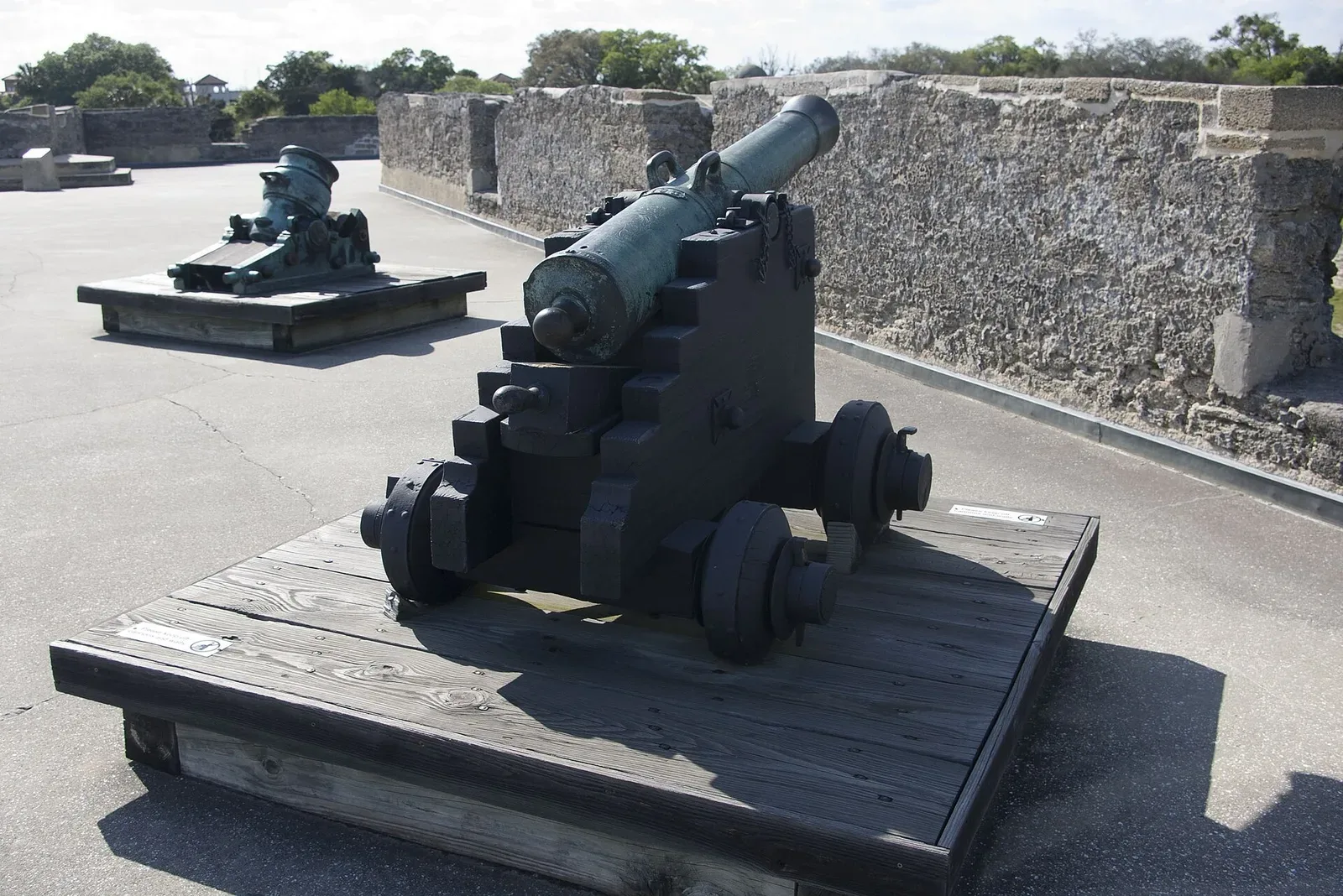
Spanish Colonial Period (1565-1763)
Spain established St. Augustine in 1565 -- the oldest continuously occupied European settlement in what is now the United States -- and firearms were foundational to its survival from day one. The Spanish garrison at Castillo de San Marcos, construction of which began in 1672, was armed with smoothbore muskets and artillery pieces that represented the military technology of the era. Spain maintained Florida primarily as a buffer zone protecting its Caribbean trade routes, so the colony was always militarized relative to its civilian population.
Firearms weren't a cultural accessory here -- they were the reason the colony existed at all.
| Period | Governing Power | Key Armed Events | Firearms Policy |
|---|---|---|---|
| 1565-1763 | Spanish Colonial | Fort Mose militia (1738), Battle of Bloody Mose (1740) | Militarized garrison, armed free Black settlements |
| 1763-1783 | British Colonial | East/West Florida division | Permissive settler arming, Native trade |
| 1783-1821 | Spanish (2nd period) | Jackson's raids (1814, 1818) | Inherited British policies |
| 1821-1845 | U.S. Territory | Fort network establishment | Military supply chains, scattered civilian arms |
Spain made a calculated diplomatic move in the early 1700s that would echo through Florida's history: offering freedom to enslaved people who escaped from British Carolina colonies and converted to Catholicism. The community of Fort Mose, established in 1738 just north of St. Augustine, became the first legally sanctioned free Black settlement in North America. Its residents formed an armed militia, trained and equipped by Spain to defend against British incursions.
Those men carried muskets and fought -- effectively -- at the Battle of Bloody Mose in 1740, repelling a British siege force under General James Oglethorpe of Georgia.
British Rule & Return to Spain
Britain controlled Florida from 1763 to 1783 as a result of the Seven Years' War, splitting it into East Florida and West Florida. During this period, British colonial firearms policies -- more permissive about arming settlers and trading arms with Native nations -- took hold. When Spain regained Florida in 1783 after the American Revolution, it inherited a territory where armed Native communities, particularly the Seminole people, were a permanent feature of the landscape rather than a problem to be quickly resolved.
U.S. Territorial Acquisition
Andrew Jackson invaded Spanish Florida twice -- in 1814 and 1818 -- before the Adams-Onís Treaty of 1819 formalized the transfer of the territory to the United States. Jackson's raids were explicitly about controlling armed resistance, both from Seminole warriors and from communities of free Black people who had found refuge in Florida and were fighting alongside them. The U.S. formally took possession of Florida on July 17, 1821.
The Territorial Period (1821–1845) saw the U.S. Army establish a network of forts across the peninsula. Federal firearms and ammunition flowed into the territory primarily through military channels. Civilian settlers, scattered across a hostile frontier with no reliable supply chains, depended heavily on whatever arms they could bring overland or receive through coastal supply ships.
- Fort Brooke (present-day Tampa, 1824)
- Fort King (near present-day Ocala, 1827)
- Dozens of smaller outposts across the peninsula
19th Century: The Seminole Wars & Statehoodedit
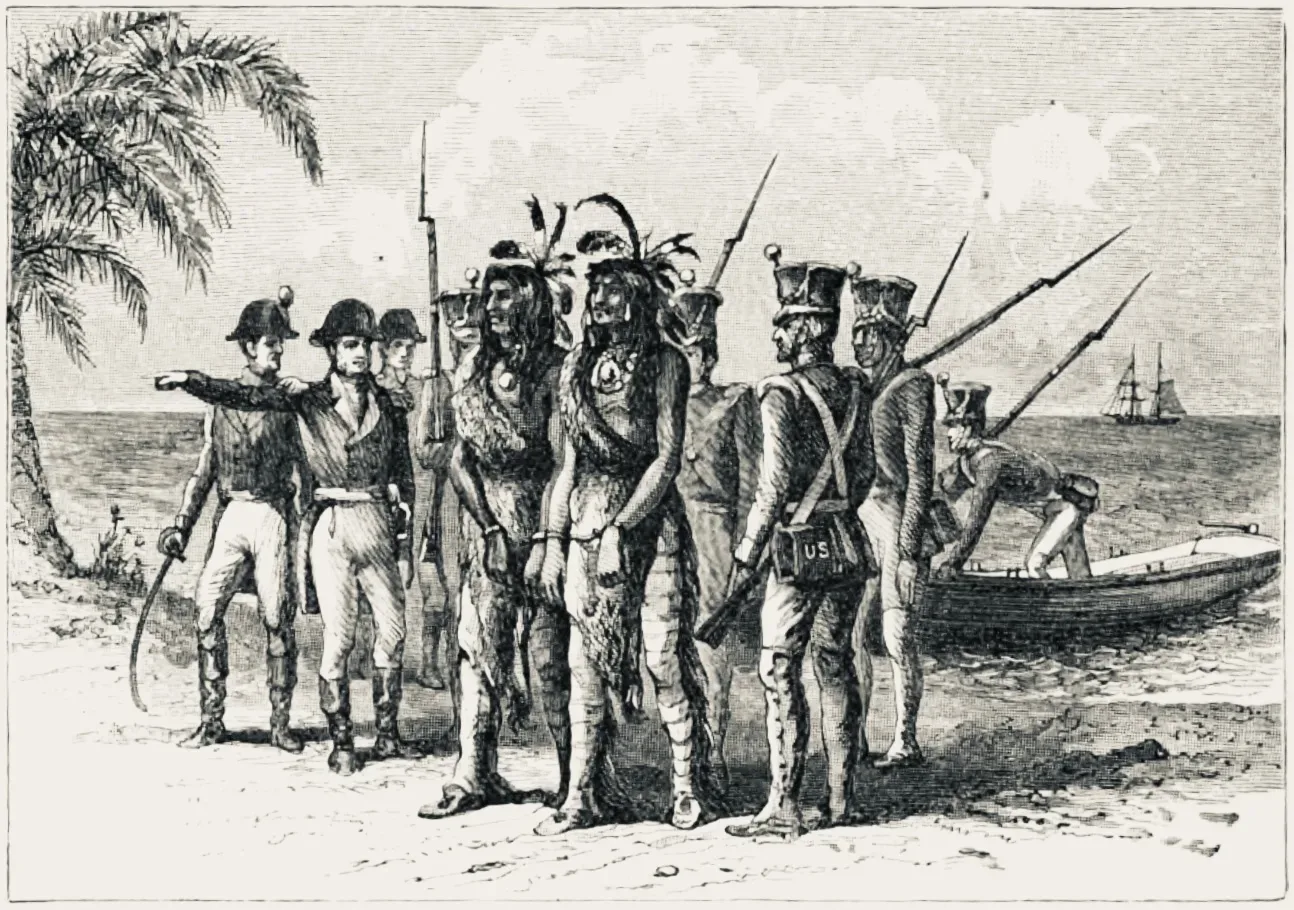
The Three Seminole Wars
No single series of events shaped Florida's early firearms culture more than the Seminole Wars. There were three of them, spanning from 1817 to 1858, and they were among the longest, most expensive, and most tactically frustrating conflicts the U.S. Army fought in the 19th century.
| War | Years | Key Events | Military Impact | Outcome |
|---|---|---|---|---|
| First Seminole War | 1817-1818 | Jackson's punitive raids | Formalized military campaign | Spanish cession pressure |
| Second Seminole War | 1835-1842 | Dade Massacre, Osceola resistance | $40M cost, 1,500+ U.S. dead, tactical adaptation | Most Seminoles removed |
| Third Seminole War | 1855-1858 | Everglades holdouts | Smaller scale operations | Remaining Seminoles stay |
The First Seminole War (1817–1818) was essentially Jackson's punitive raids formalized as a campaign. The Second Seminole War (1835–1842) was a different matter entirely. It began on December 28, 1835, when Osceola and a Seminole war party killed U.S. Indian agent Wiley Thompson near Fort King and, simultaneously, a column of 108 soldiers under Major Francis Dade was ambushed on the military road between Fort Brooke and Fort King.
Only three soldiers survived the Dade Massacre. The Army lost a cannon, weapons, ammunition, and equipment that the Seminoles immediately put to use.
The Second Seminole War forced the U.S. military to adapt in ways that had lasting consequences. The dense subtropical terrain -- sawgrass marshes, cypress hammocks, mangrove coastlines -- rendered conventional European-style linear tactics useless. Soldiers shifted toward lighter arms loads, smaller unit actions, and intelligence-gathering. The Army deployed Navy ships into the Everglades shallows in joint operations that were genuinely novel for the period. The war cost approximately $40 million and over 1,500 U.S. military dead -- more from disease than combat -- before most Seminoles were removed to Indian Territory. A few hundred remained, hidden deep in the Everglades, and their descendants never signed a peace treaty with the United States.
The Third Seminole War (1855–1858) was smaller in scale but illustrative of the permanent armed standoff that characterized Florida's interior for decades. By the time it ended, the U.S. Army had built and abandoned dozens of fortifications across the peninsula and distributed enormous quantities of military small arms throughout the territory.
Statehood & Civil War Era
Florida achieved statehood on March 3, 1845, entering the Union as a slave state. The Florida Constitution of 1838 -- drafted in preparation for statehood -- included the right to bear arms language that would persist through subsequent constitutions. Firearms in antebellum Florida were deeply embedded in plantation culture, the slave patrol system, and frontier subsistence.
Slave patrols were formalized armed bodies empowered to surveil, detain, and punish enslaved people -- and like their counterparts across the South, they were armed by law and custom. When Florida seceded from the Union on January 10, 1861 -- the third state to do so -- Governor Madison Starke Perry moved quickly to seize federal installations. Florida's most significant early-war action was the seizure of the Apalachicola Arsenal and the Chattahoochee Arsenal (also known as the Chattahoochee Arsenal at Quincy), which provided Confederate forces with artillery pieces, muskets, and powder that were immediately shipped to Confederate armies assembling further north.
The Pensacola Navy Yard was partially seized, though Fort Pickens on Santa Rosa Island held out for Union forces throughout the war -- one of only two Southern forts never taken by the Confederacy.
Florida's geographic position made it more valuable as a supply state than a battleground. It produced beef, salt, and some munitions for the Confederacy. The Battle of Olustee on February 20, 1864, was the largest Civil War engagement fought on Florida soil -- a Confederate victory that pushed Union forces back to Jacksonville. The Battle of Natural Bridge on March 6, 1865, was the last significant Confederate victory of the war, preserving Tallahassee as the only Confederate state capital east of the Mississippi never captured by Union forces.
Reconstruction brought the Freedmen's Bureau and federal troops back to Florida, along with attempts -- largely unsuccessful -- to arm and protect newly freed Black citizens from white paramilitary violence. The Ku Klux Klan and similar groups operated in Florida throughout the Reconstruction era, and the disarmament of Black Floridians was a central objective of that violence. Florida's Black Codes of 1865 included provisions specifically targeting Black gun ownership.
20th Century: Wars, the NRA's Florida Stronghold & the Shall-Issue Revolutionedit
World War II Military Expansion
Florida's military significance expanded dramatically in the 20th century. Camp Blanding, established near Starke in 1939, trained over 800,000 soldiers during World War II and remains an active Florida National Guard installation today. Eglin Air Force Base in the Florida Panhandle became one of the largest air bases in the world, and its associated Eglin Proving Ground conducted weapons testing that shaped U.S. military small arms development through the Cold War era. The Springfield Armory's work on the M14 rifle included testing conducted at Eglin facilities in the 1950s.
MacDill Air Force Base in Tampa and NAS Jacksonville anchored major military presences on both coasts, and the post-World War II veteran population that settled in Florida brought both firearms familiarity and a culture of gun ownership that became structural to the state's politics.
The Shall-Issue Revolution
The political turn that matters most in Florida's modern firearms history happened in 1987, and it started with one woman. Marion Hammer, a Florida native who had been president of the Unified Sportsmen of Florida since 1978, successfully lobbied the Florida Legislature to pass the Florida Concealed Weapon Licensing Law -- a shall-issue statute that required the state to issue a concealed carry permit to any applicant who met objective criteria, removing the subjective discretion that local law enforcement had previously exercised. Governor Bob Martinez signed it into law.
| Year | Law/Event | Key Figure | National Impact |
|---|---|---|---|
| 1987 | Florida Concealed Weapon Licensing Law | Marion Hammer | First shall-issue model |
| 1995-1998 | NRA Presidency | Marion Hammer | National gun rights leadership |
| By 2000 | Shall-issue adoption | Multiple states | 30+ states follow Florida model |
| 1986 | FBI Miami Shootout | N/A | Led to .40 S&W development |
This was not a minor legislative event. Before 1987, most states were either no-issue or may-issue, meaning local sheriffs or police chiefs could deny permits based on personal judgment.
Florida's shall-issue law demonstrated that a large, diverse, politically competitive state could implement objective-criteria permitting without the chaos that opponents predicted.
By 2000, more than thirty states had adopted shall-issue frameworks modeled explicitly on Florida's. Hammer herself went on to become the first woman to serve as president of the National Rifle Association (1995–1998), then returned to Florida as the NRA's chief lobbyist in Tallahassee.
How Florida's shall-issue revolution spread nationally through Marion Hammer's advocacy
Drug War Violence
The Drug War of the 1980s had a parallel and darker impact on Florida's firearms landscape. South Florida -- particularly Miami -- became a transit point and marketplace for cocaine trafficking, and the associated violence was extraordinary. The Dadeland Mall shooting on July 11, 1979, in which Colombian cartel gunmen killed two people with MAC-10 submachine guns in a Miami shopping center, was an early and dramatic demonstration of the military-grade firepower available to organized criminal networks.
The FBI Miami Shootout on April 11, 1986 -- in which two bank robbery suspects killed two FBI agents and wounded five others despite being hit multiple times -- directly caused the FBI to move from .38 Special revolvers and 9mm pistols toward the 10mm Auto cartridge and, eventually, contributed to the broader law enforcement shift toward higher-capacity handguns and the development of the 40 S&W.
Modern Era (2000–Present)edit
Stand Your Ground Era
Florida entered the 21st century with the most significant expansion of its self-defense framework since the shall-issue revolution. On October 1, 2005, Governor Jeb Bush signed HB 249 into law -- the Stand Your Ground statute, formally codified at Florida Statutes § 776.013. The bill passed the Florida Senate 39–0 and the Florida House 94–20.
| Date | Event | Outcome | Legislative Response |
|---|---|---|---|
| Oct 1, 2005 | Stand Your Ground signed | HB 249 becomes law (39-0 Senate, 94-20 House) | 30+ states adopt similar laws |
| Feb 26, 2012 | Trayvon Martin shooting | National controversy, acquittal July 2013 | Birth of Black Lives Matter |
| 2017 | Stand Your Ground amendment | Burden shifts to prosecution | Police opposition |
| Feb 14, 2018 | Parkland shooting | 17 killed | Comprehensive gun restrictions |
| Mar 9, 2018 | Marjory Stoneman Douglas Act | Age 21, waiting periods, red flags | Republican governor/legislature |
| July 1, 2023 | Constitutional carry | HB 543 takes effect | 26th constitutional carry state |
| 2025 | Open carry legalization | Expanded carry rights | Combined with Stand Your Ground |
Hammer, again, was the architect on the lobbying side. The American Legislative Exchange Council (ALEC) then helped template the law for other states, and within a decade, more than thirty states had adopted some version of it.
Stand Your Ground eliminated the duty to retreat before using deadly force in any place a person has a legal right to be. It extended the Castle Doctrine -- which had long protected homeowners using force within their homes -- into public spaces. It also provided civil and criminal immunity to those who successfully invoked it.
High-Profile Cases
The law remained largely outside national consciousness until February 26, 2012, when George Zimmerman, a neighborhood watch volunteer in the Retreat at Twin Lakes community in Sanford, shot and killed Trayvon Martin, a seventeen-year-old returning from a nearby convenience store. Zimmerman was not initially arrested -- the Sanford Police Department cited Stand Your Ground as part of its reasoning. The case became a national flashpoint on race, self-defense law, and policing. Six weeks after the shooting, Governor Rick Scott appointed special prosecutor Angela Corey, who charged Zimmerman with second-degree murder.
Zimmerman's defense team did not formally invoke a Stand Your Ground pretrial immunity hearing, instead using Stand Your Ground principles as part of a standard self-defense argument at trial. He was acquitted on July 13, 2013.
The acquittal's aftermath is well-documented: Black Lives Matter was founded in response to the verdict, and Florida's Stand Your Ground statute became the center of a sustained national legislative debate. In 2017, the Florida Legislature amended the law to shift the burden of proof in pretrial immunity hearings from the defendant to the prosecution -- a change that prosecutors and police organizations opposed vigorously.
A separate Stand Your Ground case -- the 2014 movie theater shooting in Wesley Chapel -- illustrated the law's contentious application in a different context. Retired Tampa police captain Curtis Reeves shot and killed Chad Oulson following a dispute over cellphone use during movie previews at a Cobb Theatres location. Reeves initially sought Stand Your Ground immunity; a judge denied it, a ruling upheld on appeal. Reeves proceeded to trial claiming conventional self-defense.
The Jordan Davis case also originated in Florida. On November 23, 2012, Michael Dunn shot into a car at a Gate gas station in Jacksonville, killing seventeen-year-old Davis following an argument over loud music. Dunn invoked Stand Your Ground. He was ultimately convicted of first-degree murder in a 2014 retrial and sentenced to life without parole -- but the case added to the Florida-centered national conversation about who the law protected and who it didn't.
Post-Parkland Restrictions
The trajectory shifted dramatically on February 14, 2018, when Nikolas Cruz killed seventeen students and staff at Marjory Stoneman Douglas High School in Parkland with a legally purchased Smith & Wesson M&P15 rifle. The survivors organized with unusual speed and effectiveness. The March for Our Lives in Washington, D.C. on March 24, 2018 drew an estimated 800,000 people.
Three weeks after the shooting, Florida's Republican-controlled legislature passed the Marjory Stoneman Douglas High School Public Safety Act, signed by Governor Scott on March 9, 2018. It:
- Raised minimum age to purchase any firearm from 18 to 21
- Imposed a three-day waiting period on all firearm sales
- Banned bump stocks in Florida
- Created a risk protection order mechanism (red flag law)
- Allowed certain school staff to be armed through the Guardian Program
Parkland shooting's rapid transformation into comprehensive gun legislation
Constitutional Carry
On April 3, 2023, Governor Ron DeSantis signed HB 543, making Florida the 26th constitutional carry state. The law, effective July 1, 2023, eliminated the requirement to obtain a license before carrying a concealed firearm. Florida's existing licensing infrastructure remained in place -- the Florida Concealed Weapon License is still issued for those who want it, partly for reciprocity with other states that recognize Florida licenses.
In November 2025, Florida legalized open carry, following years of legislative attempts that had previously stalled. The combination of open carry with the existing Stand Your Ground framework created a substantially expanded set of legal circumstances under which Floridians can carry and use firearms in public -- and immediately generated debate among legal scholars, law enforcement, and advocates on both sides.
Notable Figures & Manufacturersedit
Marion Hammer: The Architect
Marion Hammer is the single most consequential figure in Florida firearms law of the modern era. A self-described "five-foot-nothing" woman who learned to shoot as a child growing up in South Carolina, she moved to Florida, built the Unified Sportsmen of Florida into an effective lobbying organization, and authored or co-authored the shall-issue bill, the Stand Your Ground bill, and dozens of other pieces of Florida firearms legislation over five decades.
She held the NRA presidency from 1995 to 1998, then returned to Tallahassee as the NRA's state lobbyist -- a role she held into her eighties. No other individual has shaped Florida gun law as directly or for as long.
Lucy McBath, whose son Jordan Davis was killed in Jacksonville in 2012, became a gun control advocate and was elected to the U.S. House of Representatives from Georgia in 2018, one of the most direct examples of Florida's firearms debates producing national political figures.
Florida's Firearms Industry
On the manufacturing side, Florida is not a major small arms production state historically -- the state's firearms industry is more concentrated in retail, distribution, and accessories than in manufacturing. Kel-Tec CNC Industries, headquartered in Cocoa, Florida, is the most notable exception. Founded by George Kellgren in 1991, Kel-Tec designs and manufactures pistols, rifles, and shotguns with an emphasis on compact, lightweight designs.
The Kel-Tec P-11 was one of the thinnest double-stack 9mm pistols available when it launched in 1995. The Kel-Tec KSG, a bullpup pump-action shotgun with dual magazine tubes, generated significant attention when it was introduced in 2011. The Kel-Tec SUB-2000, a folding semi-automatic carbine chambered in pistol calibers, has been popular with concealed carry permit holders seeking a more capable home-defense option in a compact package. Kellgren, a Swedish-born engineer, brought a design philosophy more common to European firearms development -- emphasis on polymer frames, modular components, and unconventional configurations -- to the American market.
Taurus USA, the American subsidiary of Taurus Armas of Brazil, established its North American headquarters and distribution operations in Bainbridge, Georgia, but its U.S. commercial presence is deeply tied to Florida's gun retail market and the company has maintained significant operational infrastructure in the Miami area. The connection is historical -- Taurus acquired tooling and machinery from Beretta in the late 1960s and built a long-running business relationship with Florida's large Brazilian-American and Latin American communities.
The FBI Miami Field Office deserves mention not as a manufacturer but as a site that changed American firearms history. The 1986 Miami Shootout -- where agents armed with revolvers and semi-automatic pistols struggled against two suspects who shrugged off multiple gunshot wounds -- directly drove the FBI's ammunition and weapons research that produced the 10mm Auto cartridge and, when that proved too powerful for many agents, led to the joint Smith & Wesson and Winchester development of the 40 S&W in 1990. That cartridge became the dominant U.S. law enforcement round for two decades.
Current Legal Landscapeedit
As of 2026, Florida's firearms legal framework sits at one of the more permissive ends of the national spectrum, though not without complexity.
Carry Laws
Constitutional carry has been in effect since July 1, 2023. Any person 21 or older who is legally allowed to possess a firearm may carry a concealed handgun without a license. The Florida Department of Agriculture and Consumer Services continues to issue Concealed Weapon Licenses on a shall-issue basis for those who want the document -- primarily for interstate reciprocity purposes.
Open carry of handguns became legal in 2025, following passage of legislation DeSantis signed. Florida law still prohibits open carry in certain locations including police stations, courthouses, polling places, and schools.
Self-Defense Framework
Stand Your Ground remains in effect under Florida Statutes § 776.012 and § 776.013, with the 2017 burden-shifting amendment in place. A defendant seeking pretrial immunity must present evidence that the use of force was justified; the prosecution then bears the burden of proving by clear and convincing evidence that immunity does not apply.
Restrictions & Red Flags
Risk Protection Order: Florida's red flag law, enacted in 2018, allows law enforcement officers or the State Attorney's Office to petition a circuit court to temporarily remove firearms from an individual who presents a danger to themselves or others. A temporary order can be issued ex parte; a full hearing must be held within 21 days. The process has been used thousands of times since enactment, and Florida courts have largely upheld its constitutionality.
Waiting periods: Florida imposes a three-day waiting period on all firearm purchases. A concealed weapon license previously exempted the holder from the waiting period; after the Parkland legislation, that exemption was removed for long guns but retained for handguns. The legislature subsequently restored the handgun exemption for license holders.
Age restrictions: Florida requires purchasers to be 21 for all firearms -- handguns and long guns alike -- following the 2018 Parkland legislation. This is more restrictive than federal law, which allows licensed dealers to sell long guns to buyers 18 and older.
NFA items: Florida is a NFA-friendly state. Suppressors, short-barreled rifles, short-barreled shotguns, and other Title II firearms are legal to possess with the appropriate federal tax stamp and registration. Florida has no state-level NFA restrictions beyond federal law.
Preemption: Florida has strong statewide firearms preemption law under Florida Statutes § 790.33, which prohibits counties and municipalities from enacting local firearms ordinances more restrictive than state law. The law includes personal liability provisions for officials who knowingly violate it -- a provision added in 2011 after some local governments continued to enforce conflicting ordinances.
Key Statutory Framework
| Florida Statute | Subject | Key Provisions | Effective Date |
|---|---|---|---|
| § 790.06 | Concealed Weapon License | Shall-issue framework | 1987 |
| § 790.053 | Open carry | Handgun open carry legal | 2025 |
| § 776.012-776.013 | Stand Your Ground | No duty to retreat, burden on prosecution | 2005, amended 2017 |
| § 790.33 | Statewide preemption | Prohibits local restrictions | Enhanced 2011 |
| § 790.401 | Risk Protection Orders | Red flag law | 2018 |
| § 790.065 | Background checks | FDLE + NICS system | Ongoing |
Key statutes in Florida's current firearms framework:
- Florida Statutes § 790.06 -- Concealed Weapon License (shall-issue)
- Florida Statutes § 790.053 -- Open carry (as amended 2025)
- Florida Statutes § 776.012–776.013 -- Use of force; Stand Your Ground
- Florida Statutes § 790.33 -- Statewide preemption
- Florida Statutes § 790.401 -- Risk Protection Orders
- Florida Statutes § 790.065 -- Point-of-sale background checks (Florida uses the Florida Department of Law Enforcement system in addition to NICS)
The BGC Takeedit
Florida is a genuinely unusual state for gun owners to parse, and the honest answer is that depends heavily on where in Florida you're standing. The Panhandle and rural North Florida are as gun-friendly in practice as anywhere in the Deep South.
People carry, hunt, and shoot without much drama, and the political infrastructure reflects that. Constitutional carry passed without much legislative resistance once the votes were there, and Marion Hammer's decades of work built a lobbying apparatus in Tallahassee that is -- there's no more accurate word -- dominant.
But Florida is also Miami, Orlando, Tampa, and Jacksonville. It's a state that has been the geographic center of more nationally consequential gun debates than almost any other -- not because Floridians are uniquely violent, but because the state has a large population, a politically divided legislature that has periodically been willing to move, and a talent for producing cases that crystallize arguments. The 1986 FBI Miami Shootout changed American law enforcement ammunition doctrine. The 2005 Stand Your Ground law rewrote self-defense frameworks across the country. The 2018 Parkland shooting produced gun restrictions from a Republican governor and Republican legislature that most people didn't think were politically possible in Tallahassee.
For gun owners, the practical picture in 2026 is about as permissive as it has ever been. Constitutional carry is settled law. Open carry is now legal. Stand Your Ground remains in place.
The complication is that Florida's permissive framework coexists with genuine demographic pressure that runs the other direction. The state's urban population is large and growing, the Parkland generation of voters is now in their mid-to-late twenties and politically active, and the red flag law passed in 2018 has been used aggressively by Florida courts. The preemption statute is strong, but the political coalition that built it requires continuous maintenance.
Kel-Tec is worth mentioning not just as a historical footnote but as a genuine point of Florida firearms pride. They make genuinely weird guns -- the KSG still looks like something from a prop department -- and they've spent thirty years proving that unconventional design choices can produce functional, affordable firearms. For a state that doesn't have the manufacturing history of Georgia, Ohio, or Connecticut, having one innovative manufacturer headquartered in Cocoa is something.
The bottom line for anyone moving to or through Florida: the legal framework is favorable, the gun culture is real and geographically widespread, and the political environment requires paying attention. Florida has proven it can move in either direction. The past decade it moved toward more permissive carry laws; the Parkland year it moved toward restrictions. Which direction it moves next depends substantially on what happens between now and the next legislative session.
Referencesedit
- Mahon, John K. History of the Second Seminole War, 1835–1842. University of Florida Press, 1967.
- Covington, James W. The Seminoles of Florida. University Press of Florida, 1993.
- Gannon, Michael, ed. The New History of Florida. University Press of Florida, 1996.
- Florida Department of Agriculture and Consumer Services. Concealed Weapon License Statistics. Tallahassee, FL. Accessed 2025.
- Florida Legislature. Marjory Stoneman Douglas High School Public Safety Act (SB 7026, 2018). laws.flrules.org.
- Florida Legislature. HB 543 (2023) — Constitutional Carry. laws.flrules.org.
- Florida Statutes § 776.012–776.013. Justifiable Use of Force; Stand Your Ground. leg.state.fl.us.
- Florida Statutes § 790.33. Field of regulation of firearms and ammunition preempted. leg.state.fl.us.
- Florida Statutes § 790.401. Risk protection orders. leg.state.fl.us.
- Klarevas, Louis, Robert Dohrenwend, and David Hemenway. "The Effect of Stand-Your-Ground Laws on Gun Death Rates." JAMA Network Open, 2023.
- Tampa Bay Times. Stand Your Ground: An Investigation. Tampa, FL, 2012–2017.
- U.S. Department of Justice, FBI. Killed in the Line of Duty: A Study of Selected Felonious Killings of Law Enforcement Officers. Washington, D.C., 1992. (Includes analysis of 1986 Miami Shootout and subsequent firearms policy changes.)
- Trefethen, James B. Americans and Their Guns. Stackpole Books, 1967.
- National Rifle Association-Institute for Legislative Action. Marion Hammer: Five Decades of Advocacy. Fairfax, VA, 2022.
- Kel-Tec CNC Industries. Corporate history documentation. Cocoa, FL.
- Florida Department of Law Enforcement. Uniform Crime Reports: Florida. Annual editions, 1987–2024. fdle.state.fl.us.
- Landers, Jane. Black Society in Spanish Florida. University of Illinois Press, 1999. (Fort Mose history.)
- Nulty, William H. Confederate Florida: The Road to Olustee. University of Alabama Press, 1990.
Last Updated: February 24, 2026
- Quail Creek Plantation(Okeechobee, FL)
- 2aHawaii(Honolulu, HI)
- Boston Firearms(Everett, MA)
- Safeshoot(Kingston, NY)
Loading comments...