Specifications
Kentucky Long Rifle

A flintlock mechanism photographed at the Army Museum Waiouru — the cock strikes the frizzen to generate sparks that ignite priming powder in the pan.
HuttyMcphoo at English Wikipedia (Public domain)
| Manufacturer | |
|---|---|
| Made By | |
| Designer | German and Swiss immigrant gunsmiths |
| Origin | United States |
| Specifications | |
| Caliber | .40 to .48 |
| Action | flintlock |
| Weight | 7 to 10 pounds |
| Production | |
| Designed | 1700 |
| Variants | |
| |
| Service Use | |
Continental ArmyDaniel Morgan's RiflemenTennessee and Kentucky militia at Battle of New Orleans | |
Kentucky Long Rifle
Firearms encyclopedia article
From The Boise Gun Club Handbook
Overviewedit
The Kentucky Long Rifle — also called the Pennsylvania Rifle, the American Long Rifle, or simply the long rifle — is a muzzle-loading flintlock firearm developed in the early 1700s in southeastern Pennsylvania. It served American hunters, frontiersmen, and soldiers from roughly 1700 to 1900, appearing in conflicts from the French and Indian War through the American Civil War.
The name is a geographical accident. The gun was born in Lancaster County, Pennsylvania. It earned its "Kentucky" nickname from a popular song celebrating Andrew Jackson's victory at the Battle of New Orleans in 1815 — by which point the rifle had long since followed settlers across the Cumberland Gap.
European firearms authorities have preferred "American rifle" for exactly this reason, and plenty of frontier owners called theirs a Pennsylvania rifle until the day they died.
Before the long rifle, accurate aimed fire at distances beyond 60–100 yards was essentially impossible with smoothbore muskets. The long rifle changed that equation so completely that it reshaped tactics, frontier settlement patterns, and arguably the outcome of the American Revolution.
Design Historyedit
Early Colonial Firearms Problem
The guns available to early American colonists were smoothbore flintlock muskets — the Brown Bess type — imported from England and France. They were heavy, large-bore (.60 to .70 caliber), wasteful of powder and lead, and effective only to about 60 yards.
Their round balls had no stabilizing spin, which caused them to curve unpredictably in flight. On the European battlefield, where massed volleys at close range were the standard tactic, this was an acceptable tradeoff. On the American frontier, where a hunter might carry his entire lead supply for weeks and need to drop game at distance with one shot, it was a serious problem.
German Gunsmith Innovation
The solution came from German and Swiss immigrant gunsmiths who settled in Lancaster County, Pennsylvania, in the early 1700s. They brought with them knowledge of early Jäger rifles — short, large-bore hunting rifles used in Germany — and began adapting that tradition to the demands of the new world.
The adaptation was radical enough that what emerged was functionally a new class of firearm.
Evolution from European firearms to American long rifle design
Key Makers and Regional Centers
The earliest documented gunsmiths in this tradition are Robert Baker and the Martin Meylin, father and son. Robert Baker and his son Caleb erected a gun boring mill on Pequea Creek on August 15, 1719. Martin Meylin's Gunshop was built in 1719 in what is now Willow Street, Pennsylvania, on Long Rifle Road.
The attribution of the first Pennsylvania Long Rifle to Meylin is contested — a 2005 archaeological dig by Millersville University found thousands of artifacts at the site but only evidence of blacksmithing, with no direct evidence of gun-making. No rifle has been positively attributed to either Martin Meylin Sr. or Jr., and a rifle once held by the Lancaster County Historical Society and thought to be his work was found to have a European barrel and stock dated later than the 1710–1750 period. Some historians note that the will of Martin Meylin Sr. makes no mention of gunsmith tools, while the will of Martin Meylin Jr. is full of them.
| Gunsmith | Location | Period | Notable Features |
|---|---|---|---|
| Robert Baker | Pequea Creek, PA | 1719+ | First documented gun boring mill |
| Martin Meylin Sr./Jr. | Willow Street, PA | 1719-1750 | Disputed attribution, archaeological evidence inconclusive |
| Jacob Dickert | Berks County, PA | 1740+ | Continental Army contracts, "brand name" recognition |
| Adam Haymaker | Shenandoah Valley, VA | 1750s+ | Northern Virginia rifle center |
| Isaac Haines | Lancaster County, PA | 1772-1792 | Elaborate Rococo woodcarving specialist |
Better-documented is Jacob Dickert, who moved from Germany to Berks County, Pennsylvania in 1740. Dickert made rifles for the Continental Army and held a contract dated 1792 to furnish rifles to the United States Army. His name became so associated with quality that "Dickert Rifle" functioned as something close to a brand name on the frontier. His descendants, mostly living in Indiana and Missouri, came to use the surname "Deckard."
Other documented centers of rifle-making by the 1750s included Adam Haymaker's shop in the northern Shenandoah Valley of Virginia, the Moravian gunshops at Christian's Spring in Pennsylvania, John Frederick Klette of Stevensburg, Virginia, and shops in the Salem area of North Carolina. Isaac Haines of the Lancaster school was known for elaborate Rococo woodcarving on his stocks and was taxed as a gunsmith in Lampeter Township, Lancaster County, from 1772 to 1792. These shops traced the Great Wagon Road south from eastern Pennsylvania down the Shenandoah Valley, through the Cumberland Gap into Kentucky, and into the Yadkin River area of North Carolina.
Design Evolution Drivers
The design changes that distinguished the long rifle from its European ancestors were driven by practical necessity. Hunters in the American wilderness had to carry everything on their backs for weeks at a time. Smaller caliber — typically .40 to .48 — meant one pound of lead cast three times as many bullets as the large-bore European guns.
The longer barrel (40 inches and up, compared to 30 inches on German Jäger rifles) gave black powder more time to burn completely, increasing muzzle velocity and accuracy while paradoxically requiring less powder per shot. A rule of thumb used by some gunsmiths: make the rifle no longer than the customer's chin height, because you had to see the muzzle while loading. The longer sight radius also allowed finer aiming.
The patch-loading system — a greased cloth or buckskin patch wrapped around an undersized ball, letting it seat easily and engage the rifling on the way out — was another critical development. It cut reload time to a fraction of what tight-ball loading required and allowed a good rifleman to fire more than two rounds per minute under field conditions.
By the 1750s, the distinctive long rifle was common enough that frontiersmen carried it as a matter of course.
Technical Characteristicsedit
Physical Specifications
| Specification | Range | Typical | Notes |
|---|---|---|---|
| Barrel Length | 32-48+ inches | 40-42 inches | Army contract: 42"; Lewis & Clark: 33-36" |
| Caliber | .25-.62 | .40-.48 | Smaller = lead conservation; larger as bores wore |
| Weight | 7-10 lbs | 8-9 lbs | Match rifles: ~19 lbs |
| Muzzle Velocity | 1,200-1,600 fps | ~1,400 fps | 1739 Rosser test: 1,483 fps (.32 cal, 22gr) |
| Effective Range | 60-300 yards | 100-200 yards | Depended heavily on shooter skill |
| Action | Flintlock/Percussion | Flintlock pre-1850 | Many flintlocks converted to percussion |
Performance Characteristics
A 1739 Rosser flintlock tested at the Remington-Union Metallic Cartridge Company factory recorded 1,483 feet per second muzzle velocity with a .32-caliber ball and 22 grains of black powder. Testing by Captain John G.W. Dillin in 1921 put five hits out of ten shots on a man-sized silhouette target at 300 yards with a spiral-groove rifle.
Townsend Whelen, writing in The American Rifle, placed the practical limit closer to 60–100 yards for typical use. An average user could reliably hit at 100 yards; an experienced shooter could be effective to 200–300 yards.
Construction and Materials
The stock was most often curly maple, sometimes cherry or (in the South) apple wood, extending to the muzzle. The crescent-shaped buttplate replaced the older straight design. A patch box — a hinged brass compartment cut into the right side of the butt — stored the greased patches.
Decorative inlays in brass or German silver became increasingly elaborate over the rifle's history. Originally plain, by the 1770s the entire surface of a rifle might carry applied artwork. A skilled long rifle maker had to master multiple trades:
- Blacksmith (barrel forging, lock work)
- Whitesmith (brass and silver work)
- Wood carver (stock shaping and decoration)
- Brass and silver founder (inlay casting)
- Engraver (decorative metalwork)
- Wood finisher (final stock preparation)
Locks were often purchased from England in bulk and fitted to the American-made stock and barrel. The percussion lock became predominant after 1850, and many existing flintlocks were converted.
The flintlock pistol appeared in the long rifle style as well, though less commonly. These were often matched in caliber to their owner's rifle so a single size of patched ball served both weapons. Dueling pistol sets in the long rifle style were also made for wealthy buyers.
Combat & Field Useedit
Frontier Hunting Applications
On the frontier, the long rifle was primarily a hunting tool. Frontiersmen used it to take game at distances the smoothbore musket simply couldn't reach — accounts describe hitting squirrels at 200 yards, dropping bears at distance to avoid dangerous close-quarters encounters, and shooting fish.
The smaller caliber compared to European guns meant enough lead for extended hunts without resupply. The rifle became so central to frontier life that nearly every family owned one, and weekend shooting matches at settlements were routine.
Revolutionary War Service
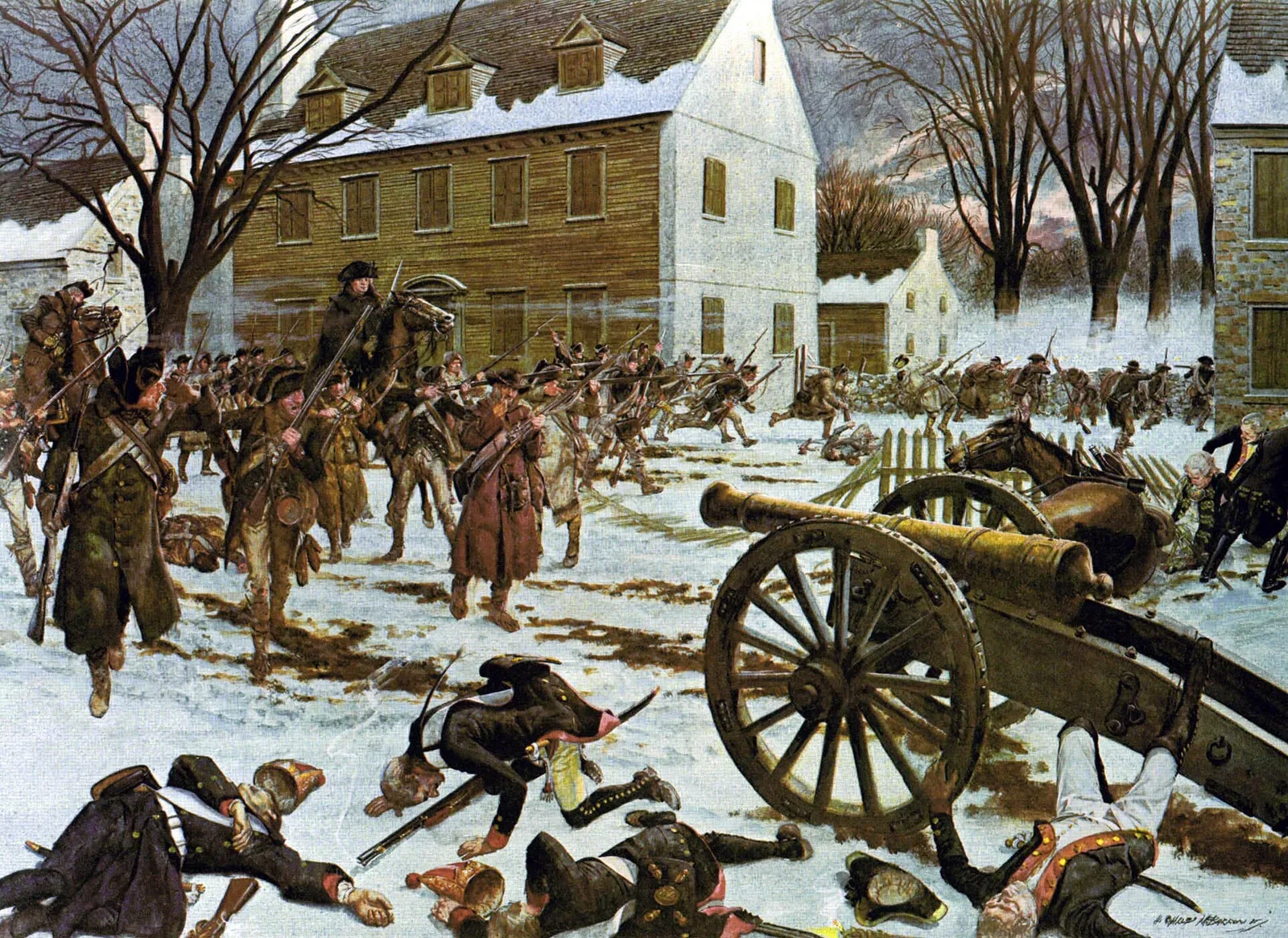
The rifle's military value became apparent in the French and Indian War, where George Washington observed firsthand what riflemen could do. When the Revolution began, he pushed the Continental Congress to recruit frontier riflemen specifically.
One company of 96 men recruited in Virginia by Daniel Morgan marched 600 miles in 21 days to join the army at Cambridge, Massachusetts — some of those men having already walked 200 miles through the wilderness just to enlist.
| Battle | Date | Rifle Role | Outcome |
|---|---|---|---|
| French & Indian War | 1754-1763 | Reconnaissance, targeted shooting | Washington observed effectiveness |
| Saratoga | October 1777 | Officer targeting, disruption | Decisive American victory, French alliance |
| King's Mountain | October 1780 | Accuracy vs. British carbines | American backwoodsmen victory |
| New Orleans | January 1815 | Mass militia engagement | Jackson's victory, rifle gets "Kentucky" name |
Tactical Advantages and Limitations
The tactical contrast between the long rifle and the smoothbore Brown Bess musket used by British regulars was stark. British infantry doctrine called for massed volley fire at relatively close range — a system the smoothbore's 60-yard effective range and fast reload supported well.
American riflemen operated differently: hidden in tree lines and rough terrain, picking individual targets at ranges British soldiers couldn't return fire across.
The psychological effect was significant enough that British General Howe reportedly offered a reward for the capture of a Kentucky rifleman, and when one was finally taken, Howe sent him to London as a demonstration of what the Continental Army had in the field.
Washington also discovered the rifle's intimidation value could be weaponized without firing a shot — he dressed some of his musket-armed soldiers in frontier buckskins, knowing that the British assumed anyone in that garb was carrying a Kentucky rifle.
Morgan's Riflemen were particularly effective at the Battle of Saratoga in October 1777, where riflemen were used to target British officers. One account, repeated in multiple sources, holds that a frontiersman named Daniel Murphy shot British General Fraser from approximately 300 yards — firing three times before Fraser fell. Whether or not the specific details are accurate, Saratoga was a decisive American victory, and the riflemen's role in disrupting British command is well-documented. The French alliance that followed Saratoga changed the entire strategic picture of the war.
At the Battle of King's Mountain in 1780, rifle-armed backwoodsmen from the southern Appalachians defeated a British force — notable because, according to sources from the period, the British at King's Mountain were actually armed with carbines capable of a higher volume of fire than the riflemen. The American victory came down to accuracy. A British captain later wrote that the Americans had riflemen who could hit a man anywhere they chose at 200 paces.
The long rifle's limitations in military use were real:
- Slower reload: 60+ seconds vs. 20 seconds for musket
- Higher cost and manufacturing complexity
- Bore fouling issues during sustained fire
- Difficult loading as powder residue accumulated
- No bayonet capability for close combat
These limitations meant it never replaced the musket as the standard military arm — the bulk of Revolutionary War combat was fought with smoothbores. Riflemen operated as skirmishers and snipers on the flanks of regular formations, not as line infantry.
The long rifle's last significant military moment came at the Battle of New Orleans in January 1815, where Tennessee and Kentucky militia armed with long rifles played a central role in Andrew Jackson's victory over British regulars. The song "The Hunters of Kentucky" that followed gave the rifle its permanent popular name.
Legacy & Influenceedit
Direct Descendants
By 1792, the U.S. Army was already modifying the design — shortening barrels to 42 inches on the 1792 contract rifle. The Harpers Ferry Model 1803, which the Lewis and Clark expedition carried in a 33–36 inch version, represents the transition toward military standardization.
| Development Stage | Period | Key Features | Representative Model |
|---|---|---|---|
| Original Long Rifle | 1700-1792 | 40-48" barrel, .40-.48 cal | Pennsylvania/Kentucky rifles |
| Military Standardization | 1792-1803 | Shortened to 42", mil-spec | 1792 Contract Rifle |
| Expedition Variant | 1803-1806 | 33-36" barrel, portability | Lewis & Clark rifle |
| Western Adaptation | 1830s-1860s | Heavy barrel, horse-portable | Hawken rifle |
| Modern Transition | 1847+ | Minié ball compatibility | Rifled muskets |
From there, the Hawken rifle — developed by brothers Samuel and Jacob Hawken and other St. Louis gunsmiths in the 1830s–1860s — adapted the long rifle for the western fur trade: heavier barrel walls to handle bigger powder charges for larger game, shorter overall length for use on horseback, calibers often around .40 for medium game but scaling up for buffalo and grizzly.
The Minié ball, invented in 1847, resolved the long rifle's core tactical problem. By using a bullet slightly smaller than the bore that expanded into the rifling upon firing, rather than a tightly-fitted patched ball, it made rifled arms nearly as fast to reload as smoothbores. This development allowed rifles to replace muskets as standard military arms — setting the stage for the rifled-musket carnage of the Civil War and, eventually, the breech-loading repeaters that followed.
Cultural Persistence
The long rifle's influence on American culture runs deeper than hardware. The traditions of frontier marksmanship it established — offhand shooting, practical accuracy at distance, the shooting match as community event — persisted long after the rifle itself was obsolete.
The Contemporary Longrifle Association, founded in 1996, exists specifically to preserve the craft of hand-making these rifles using pre-1840 techniques. Internet forums dedicated to traditional muzzleloading had grown to over 3,000 members by 2010.
Modern Revival Movement
The modern revival has serious historical roots. In 1965, Wallace Gusler, as the first master of the Gunsmith Shop at Colonial Williamsburg, became the first person in modern times to recreate a long rifle using 18th-century tools and techniques.
The 1968 film Gunsmith of Williamsburg documented the production of his second all-handmade rifle. Gunmakers trained at Colonial Williamsburg and scholars like John Bivins — who also contributed to the Museum of Early Southern Decorative Arts — trained the next generation of recognized makers including Jim Chambers and Mark Silver.
Key milestones in long rifle development and cultural impact
Strong pockets of traditional long rifle use and manufacture survived in the Appalachian Mountains of Virginia, Tennessee, Kentucky, Ohio, and North Carolina well into the 20th century — not as historical curiosity but as practical tools for rural communities. The rifle was entirely hand-producible from locally available materials with hand tools, which made it uniquely suited to frontier conditions and uniquely persistent in areas that remained frontier-like long after the eastern seaboard had modernized.
In popular culture, the long rifle became permanently attached to the mythology of Daniel Boone and Davy Crockett — figures whose real frontier careers were inseparable from the rifle they carried. James Fenimore Cooper's 1826 novel The Last of the Mohicans features a long rifle-carrying protagonist nicknamed La Longue Carabine by French allies. The rifle has appeared in films including The Revenant, where Leonardo DiCaprio's character carries a Bucks County long rifle built by modern gunmaker Ron Luckenbill.
The BGC Takeedit
The Kentucky Long Rifle is one of those rare pieces of technology where the history and the mythology are both true, and the mythology still undersells it.
What the German gunsmiths in Lancaster did wasn't just make a better gun. They solved a genuine engineering problem — how do you feed a family and defend your homestead when you're weeks from the nearest settlement and every grain of powder counts — and the solution they arrived at was elegant enough to stay useful for 150 years. That's a long run for any design.
The military impact tends to get dramatized in ways that obscure the more honest picture: most Revolutionary War fighting was done with smoothbore muskets, and the long rifle's battlefield role was real but specific.
What it actually changed was the psychological calculus — British officers who would have stood calmly in a musket fight started understanding that a man in buckskins 200 yards away was a personal threat.
It was a sniper's tool, not a line infantry weapon.
The craft side of it deserves more attention than it usually gets. These weren't production guns. Each one was a one-man project from raw iron and maple to finished arm, made by someone who had to be a competent smith, carver, engraver, and ballistician simultaneously. The ones that survive in museum collections are genuinely beautiful objects — which makes sense, because on the frontier, a rifle was the most important tool you owned, and people put their best work into important things.
If you want to actually understand what early American marksmanship culture looked like, go find a traditional muzzleloading shoot. The CLA and the various regional black powder clubs keep this alive at a level of seriousness that most modern shooters don't expect. Loading a patched ball flintlock under time pressure changes your appreciation for what those frontiersmen were actually doing.
Referencesedit
- Wikipedia — Long Rifle: https://en.wikipedia.org/wiki/Long_rifle
- Outdoor Life — Kentucky Rifle History: https://www.outdoorlife.com/guns/kentucky-rifle-history/
- Pennsylvania State University Libraries — The Pennsylvania Long Rifle: https://pabook.libraries.psu.edu/literary-cultural-heritage-map-pa/feature-articles/pennsylvania-long-rifle
- NRA Family — Throwback Thursday: The Revolutionary Kentucky Long Rifle: https://www.nrafamily.org/content/throwback-thursday-the-revolutionary-kentucky-long-rifle/
- TNGenWeb — A Short History of the Kentucky Long Rifle: https://www.tngenweb.org/campbell/hist-bogan/KentuckyLongRifle.html
- Colonial Quills — The American Long Rifle: The Gun That Made a Nation: https://colonialquills.blogspot.com/2015/11/the-american-long-rifle-gun-that-made.html
Last Updated: February 27, 2026
- Gls Guns(Sumner, IA)
- Bi-mart - Yakima (Fruitvale Ave)(Yakima, WA)
- New Philly Sportsman Specialities(New Philadelphia, OH)
- R&R Sports & Outdoors(Brandon, FL)
Loading comments...