Specifications
Brown Bess Land Pattern Musket

CT scan of a circa 1769 Brown Bess reveals internal lock geometry and barrel construction — non-destructive analysis of a 250-year-old artifact.
Cmeide Lighthouse Archaeological Maritime Program (CC BY-SA 3.0)
| Manufacturer | |
|---|---|
| Made By | Tower of London (design and pattern); Birmingham (locks and barrels); London gunmakers and contractors (assembly) |
| Designer | British Royal Board of Ordnance |
| Origin | Great Britain |
| Specifications | |
| Caliber | .75 caliber |
| Action | flintlock |
| Capacity | Single shot |
| Barrel | 46 inches (Long Land Pattern); 42 inches (Short Land Pattern); 39 inches (India Pattern) |
| Length | 62.5 inches (Long Land Pattern); 58.5 inches (Short Land Pattern); 55.25 inches (India Pattern) |
| Weight | 10.4 pounds (Long Land Pattern); 10.5 pounds (Short Land Pattern); 9.68 pounds (India Pattern) |
| Feed | Muzzle-loading smoothbore |
| Sights | Fixed iron sights |
| Performance | |
| Eff. Range | 75–100 yards |
| Muzzle Vel. | 1,400–1,500 feet per second |
| Production | |
| Designed | 1722 |
| In Production | 1728 |
| Produced | Several hundred thousand (exact figure unknown) |
| Variants | |
| |
| Service Use | |
British ArmyBritish East India CompanyAmerican Continental ArmyAmerican Loyalist forcesColonial militias in North AmericaMāori warriorsZulu fightersEgyptian forces | |
| Cultural Note | |
| The Brown Bess was carried across North America, India, Africa, and Europe for nearly 130 years. It appeared on more of the world's battlefields during the eighteenth and early nineteenth centuries than any other single firearm, and left a profound mark on the tactics, politics, and history of the era. It served during the French and Indian War, the American Revolutionary War, the Napoleonic Wars, and numerous colonial campaigns. | |
| Related Firearms | |
Brown Bess: The Land Pattern Musket That Built an Empire
Firearms encyclopedia article
From The Boise Gun Club Handbook
Overviewedit
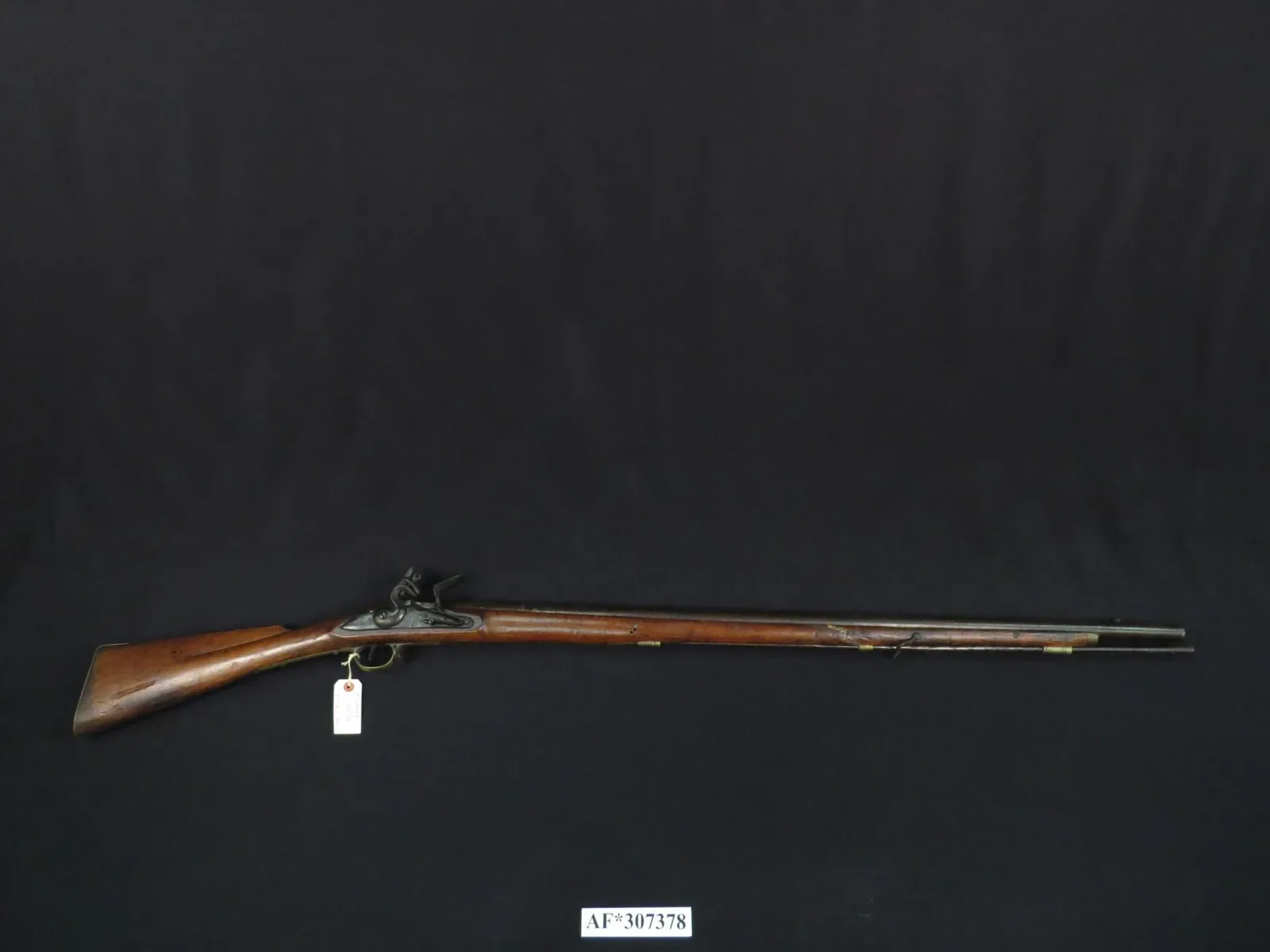
For the better part of 130 years, the Brown Bess was the British Army's answer to the question of how to arm an empire. A muzzle-loading, smoothbore, .75-caliber flintlock musket, it served in one form or another from 1722 until the mid-nineteenth century — carried across North America, India, Africa, and Europe by redcoats, colonial militiamen, Māori warriors, Zulu fighters, and American revolutionaries. No single firearm appeared on more of the world's battlefields during that era, and few weapons have left a deeper mark on the tactics, politics, and history of the period.
The formal designation was the Land Pattern Musket. The nickname "Brown Bess" was what soldiers actually called it — and soldiers have always been more honest about these things than official records.
Design Historyedit
The story of the Brown Bess begins not with a dramatic invention, but with a procurement problem. Through the seventeenth century and into the early eighteenth, Britain had no standardized military firearm. Regiments were individually equipped by their commanding colonels, who were given government funds and kept whatever they didn't spend. The result was a chaotic mix of domestic and foreign patterns varying wildly in caliber, barrel length, and quality — a logistical nightmare when it came to supplying ammunition and spare parts in the field.
The British Royal Board of Ordnance moved to fix this with a contract dated September 15, 1714, according to George Neumann writing in American Rifleman. The goal wasn't to immediately produce a new gun, but to establish a system: accumulate standardized components at the Tower of London, release them to private contractors during wartime, and subject all finished arms to close inspection against a sealed prototype. Locks and barrels came largely from Birmingham; most brass furniture, stocking, and final assembly centered in London.
This system ran headlong into two powerful opponents: regimental colonels who had no interest in surrendering their procurement authority, and the entrenched London Gunmakers' Company, which saw centralized control as a threat to its traditional grip on the trade. The Board's patience eventually won out. A new design called the King's Pattern was finalized in 1722, though resistance and the absence of wartime urgency delayed production until 1728. The musket was first issued in 1730 as the Long Land Pattern — the first of the Brown Bess series.
The stress-bearing components — barrel, lockwork, sling swivels — were made of iron. Furniture pieces like the butt plate, trigger guard, and ramrod pipes were found in both iron and brass in early models, with brass standardized after 1736. The first guns used wooden ramrods, which were gradually replaced by iron and eventually steel, though wooden rammers remained in use by American-service troops as late as 1765 and by Loyalist units into the Revolution.
The design philosophy was straightforward: deliver a large-caliber projectile at moderate velocity, survive years of hard campaigning, function as a club or spear platform in close fighting, and be manufacturable in large numbers by a decentralized cottage industry. It met all of those requirements. What it did not deliver — and was not really designed to deliver — was precision.
Key milestones in Brown Bess development and adoption
Standardization and the Pattern Room
The pattern room system was the key innovation behind the Brown Bess, and it deserves more credit than it usually gets. A reference "pattern musket" was stored at the Tower of London, and arms makers could compare and measure their products against it. This was an early and genuinely important step toward what we'd now call manufacturing to tolerance. It didn't produce interchangeable parts in the modern sense, but it brought enough consistency to make the logistics of a globe-spanning military manageable. For the eighteenth century, that was a significant achievement.
Variants
The Brown Bess was never a single gun. It evolved through several distinct patterns over its long service life, each representing a response to battlefield experience, cost pressures, or the demands of specific branches of service.
| Pattern | Service Period | Barrel Length | Overall Length | Weight | Primary Users |
|---|---|---|---|---|---|
| Long Land Pattern | 1722–1793 | 46" | 62.5" | 10.4 lbs | Infantry, Colonial forces |
| Short Land Pattern | 1740–1797 | 42" | 58.5" | 10.5 lbs | Dragoons, then Infantry |
| India Pattern | 1797–1854 | 39" | 55.25" | 9.68 lbs | East India Company, Army |
| New Land Pattern | 1802–1854 | 39" | 55.5" | ~9.7 lbs | Foot Guards, 4th Regiment |
| New Light Infantry | 1811–1854 | 39" | 55.5" | ~9.7 lbs | Select Light Infantry units |
| Sea Service Pattern | 1778–1854 | 37" | 53.5" | 9 lbs | Royal Navy |
| Cavalry Carbine | 1796–1838 | 26" | 42.5" | 7.37 lbs | Cavalry units |
Long Land Pattern (1722–1793): The original. A 46-inch barrel, overall length of 62.5 inches, weight around 10.4 pounds. The 1730 version was the first issued; the 1742 update added an exterior bridle to the lock and introduced a new trigger guard; the 1756 version added a steel button-head ramrod, a straightened lock profile, and a cast brass nose cap. The 1730 and 1742 patterns were the primary British arms in North America during the French and Indian War (1754–1763). The 1756 version saw the most service in the American Revolutionary War.
Short Land Pattern (1740–1797): Issued initially to dragoons from 1740, adopted as the standard infantry musket in 1768 by a Royal Warrant dated June 11, 1768, per the NRA National Firearms Museum. The barrel was shortened to 42 inches — four inches less than the Long Land — without any meaningful loss of accuracy, and with a real gain in handling ease. Overall length dropped to 58.5 inches, weight was 10.5 pounds. It became the British Army's principal arm after 1777 and remained so through the Napoleonic era.
India Pattern (1797–1854): Originally manufactured for the British East India Company with a 39-inch barrel, formally adopted by the British Army in 1790 and becoming the standard infantry musket from 1797 onward. At 55.25 inches overall and 9.68 pounds, it was the lightest and most maneuverable of the main variants. Some India Pattern muskets were sourced from the East India Company for use in Egypt even before the official 1797 adoption date.
New Land Pattern (1802–1854): Issued exclusively to the Foot Guards and the 4th Regiment of Foot. Also 39-inch barrel, 55.5 inches overall.
New Light Infantry Land Pattern (1811–1854): A specialized variant issued only to specific light infantry battalions — the 43rd, 51st, 52nd, 68th, 71st, and 85th Light Infantry, plus non-rifle battalions of the 60th Foot. Distinguished by a scrolled trigger guard similar to the Baker Rifle, a browned barrel, and a rear notch sight — a notable departure from the standard musket's single fore-sight-only arrangement.
Sea Service Pattern (1778–1854): Issued aboard Royal Navy ships. Barrel length 37 inches, overall 53.5 inches, weight 9 pounds. Marines used Sea Service weapons when serving as part of a ship's company but were issued India Pattern weapons when deployed ashore.
Cavalry Carbine (1796–1838): The shortest variant, with a 26-inch barrel and overall length of 42.5 inches, weighing 7.37 pounds.
Approximately 4.3 million Brown Bess muskets of all variants were built between 1722 and the 1850s. Principal British manufacturers included the Tower Armouries, the H.W. Mortimer Company, and the Royal Small Arms Factory at Enfield — though Enfield did not begin production until 1818. During wartime, supplementary contracts went to continental European manufacturers, including sources in Liege and Germany.
Technical Characteristicsedit
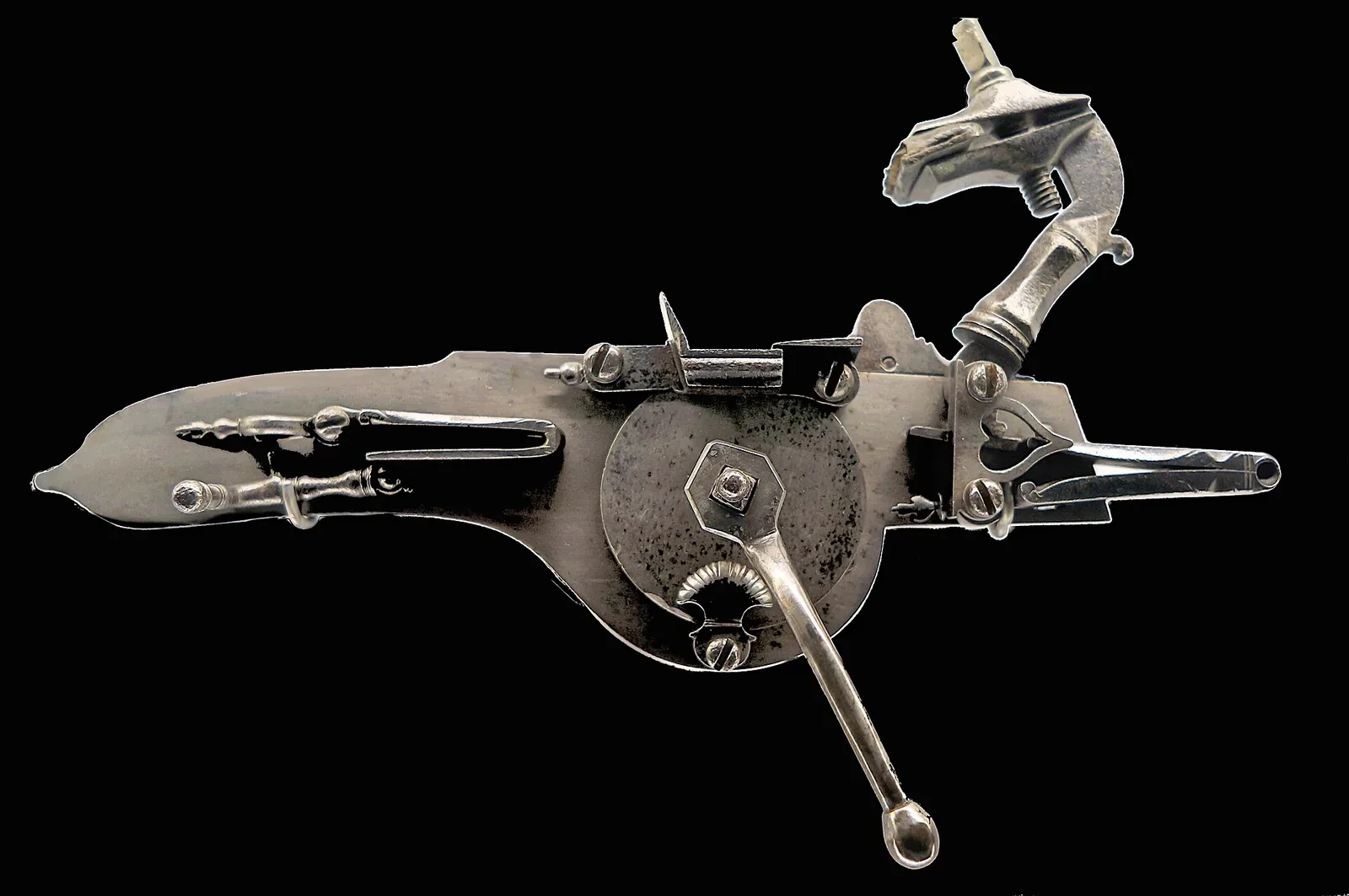
The Brown Bess was a .75-caliber smoothbore. The standard service ball was actually .69 caliber — deliberately undersized by four to six hundredths of an inch to keep the weapon loading quickly even as powder fouling accumulated in the bore. That gap between ball and bore is the core mechanical tradeoff of the entire design: you could load fast, but the ball bounced and skidded up the barrel on firing, exiting in whatever direction its last contact with the bore happened to impart. Accuracy at range was a secondary consideration, and the gun's design acknowledged that honestly.
The fundamental accuracy tradeoff in Brown Bess design
According to James Spearman's The British Gunner (1828), the standard service charge was 6 drams (165 grains) of black powder, including priming powder. Spearman also noted that this charge was larger than necessary given improvements in powder quality, and that it could be reduced by about one-fourth. Analysis of actual paper cartridges recovered from American Revolutionary War archaeological sites found approximately 115 grains of powder — consistent with Spearman's observation.
| Specification | Value |
|---|---|
| Caliber | .75 (19mm) |
| Ball Diameter | .69 (17.5mm) |
| Standard Charge | 6 drams (165 grains) black powder |
| Typical Field Charge | 100-115 grains black powder |
| Muzzle Velocity | 1,000–1,800 fps (varies by load) |
| Muzzle Energy | 1,600–4,000 joules |
| Rate of Fire | 2–4 rounds per minute |
| Bayonet Length | 17" triangular cross-section |
Muzzle velocity varied considerably depending on load and testing method. Modern ballistic testing with electronic ignition demonstrated a possible 1,800 feet per second with approximately 4,000 joules of muzzle energy. When loaded with 100 to 110 grains of modern black powder and fired manually, the Brown Bess typically reached around 1,000 fps with approximately 1,600 joules. Historical data summarized by Roberts et al. suggested that 1,500 fps was not uncommon in period use, generating roughly 3,000 joules of muzzle energy.
The flintlock mechanism itself had a fundamental reliability problem in wet weather. The 1834 percussion cap trials — conducted with 6,000 rounds fired from six muskets of each type under varied conditions — made this concrete:
- Flintlock produced 922 misfires (1 in 6.5 attempts)
- Percussion cap produced only 36 misfires (1 in 166 attempts)
- Flintlock hit target 3,680 times
- Percussion cap hit target 4,047 times
This data came from tests requested by Reverend Alexander John Forsyth (1768–1843) of Scotland, who had patented fulminating powder in 1807.
The 1811 London accuracy test — conducted against a wooden target the size of an infantry or cavalry line — found the following hit rates for ordinary soldiers: 53% at 100 yards, 30% at 200 yards, 23% at 300 yards. The Wikipedia source notes this was shooting by ordinary soldiers with limited training; light infantry, who received more extensive marksmanship instruction, performed better.
Colonel George Hanger, a veteran of the American Revolution who later served under Lt. Colonel Banastre Tarleton, offered the most frequently quoted assessment of the smoothbore's practical accuracy in a letter to Lord Castlereagh published in London in 1808:
A soldier's musket, if not exceedingly ill-bored, will strike the figure of a man at 80 yards, perhaps even at 100; but a soldier must be very unfortunate indeed who shall be wounded by a common musket at 150 yards, provided his antagonist aims at him; and as for firing at a man at 200 yards with a common musket, you might just as well fire at the moon.
Hanger was talking specifically about aimed fire — he wasn't dismissing volley fire at massed formations, which was a different matter entirely.
| Distance | Hit Rate (Ordinary Soldiers) | Notes |
|---|---|---|
| 80-100 yards | 53% at 100 yards | Hanger: "will strike the figure of a man" |
| 150 yards | 30% at 200 yards* | Hanger: "very unfortunate to be wounded" |
| 200 yards | 23% at 300 yards* | Hanger: "might as well fire at the moon" |
| 250 yards | 0% (10 shots, oversized target) | 1841 Royal Engineers test |
1811 London test data interpolated
The Royal Engineers tested the musket in 1841 and found that at 150 yards, careful shooters could hit a target twice as high and twice as broad as a man three times out of four shots — but at 250 yards, 10 shots at the same oversized target produced zero hits.
The weapon weighed 10 to 10.5 pounds depending on variant and could be fitted with a 17-inch triangular cross-section bayonet. The single fore-sight also functioned as the bayonet lug. There was no rear sight on standard patterns. An experienced soldier could manage three to four rounds per minute, though two to three was more typical under field conditions.
Combat & Field Useedit
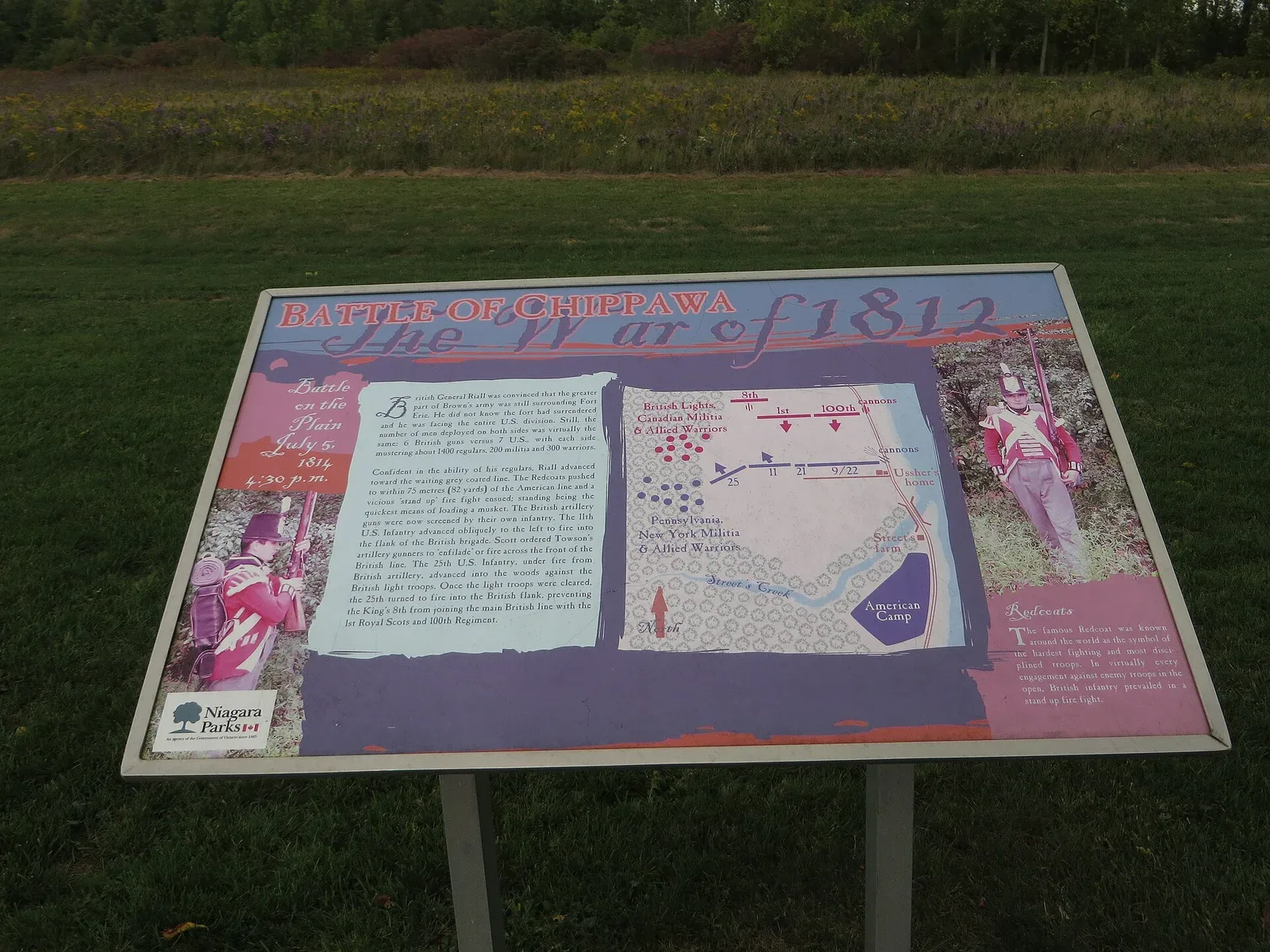
The tactics built around the Brown Bess followed directly from its technical limitations. A smoothbore with an undersized ball and no rear sight is not a precision instrument — it's a delivery mechanism for a mass of lead moving at moderate velocity. Eighteenth-century commanders knew this and planned accordingly.
British infantry typically advanced in long lines, closed to 50 or 60 yards of the enemy, and fired controlled volleys on command. At that range, the accuracy limitations mattered less. The sheer volume of metal in the air at close range produced results even when individual soldiers couldn't hit a specific target. After the volley came the bayonet — and many historians argue, as does the Revolutionary War Journal source, that the bayonet was the Brown Bess's most decisive battlefield attribute. The gun was essentially a handle for 17 inches of triangular steel.
The flintlock's sensitivity to wet weather was a persistent tactical problem. Rain could render a formation effectively unarmed. Soldiers kept their flints sharp, their frizzens properly hardened, and their pans covered — but there was no engineering fix for the fundamental vulnerability of exposed priming powder to moisture. This limitation drove the urgency behind percussion cap development and adoption.
Light infantry used the Brown Bess differently. Rogers' Rangers, skirmishers, irregular troops, and light infantry units employed non-standard tactics and, where trained, aimed fire at individual targets. The New Light Infantry Land Pattern's rear notch sight acknowledged this use case in hardware, though it was a limited issue.
| Conflict/User | Period | Pattern Used | Notes |
|---|---|---|---|
| French & Indian War | 1754–1763 | Long Land 1730, 1742 | Primary British arm |
| American Revolution | 1775–1783 | All patterns | Both sides used extensively |
| Napoleonic Wars | 1803–1815 | Short Land, India | Standard British infantry arm |
| Musket Wars (Māori) | 1820s–1830s | Various patterns | Obtained through European trade |
| Texas Revolution | 1836 | Various patterns | Mexican Army use |
| Anglo-Zulu War | 1879 | India Pattern | Zulu forces vs. British |
| American Civil War | 1861–1865 | Various patterns | Limited use, mostly obsolete |
The American Revolution
The Brown Bess was on both sides of the American Revolution, which is either ironic or perfectly logical depending on how you look at it. Most male citizens of the thirteen colonies were legally required to own arms for militia duty, and the Long Land Pattern was the most common military firearm in the colonies when hostilities began. At the outbreak of war, royal forces had at least 5,200 muskets in storage, primarily in New York and Quebec — mostly the wooden ramrod Long Land 1730 and 1742 patterns.
Active British regiments were generally equipped with the 1756 steel ramrod version. The Continental Army's initial supply situation was improvised at best. Colonial armories were raided; Loyalist arms were confiscated; civilian guns were pressed into service. The early Brown Besses in American hands were typically worn examples of the Long Land 1730 and 1742 designs. At least 17,000 more recent patterns were captured during the conflict, per Neumann's American Rifleman account. The 1763 Long Land Pattern — available in colonial stores from pre-war importation — was the version most closely associated with Washington's forces in the early years.
French military aid beginning in 1777 eventually supplied most of the Continental Line with Charleville flintlocks, which became the basis for the first American-standardized musket produced at Springfield Armory after it was officially established in 1795. But the Brown Bess remained a significant presence in provincial forces through 1783, both as complete muskets and as components remounted on locally assembled American arms.
During the Revolution's eight years, England produced more than 218,000 Land Service longarms and contracted for an additional 100,000 Short Land Pattern 1777 muskets from Liege and German sources after France entered the war in 1778.
The Battle of Bunker Hill illustrated the practical accuracy ceiling of the weapon under combat conditions. American accounts consistently claimed that British soldiers fired too high. The rail fence behind which many American defenders were positioned was reportedly largely undamaged during the first two British assaults, while the upper branches of trees behind the American line were riddled with shot. Most American casualties came after British troops physically overran the redoubt.
Beyond North America
The Brown Bess's service record extended far beyond the Atlantic world. In 1808, during the Napoleonic Wars, the British government delivered significant numbers of Brown Bess muskets to Sweden to support its war effort in the Finnish War of 1808–1809, part of Britain's effort to maintain an ally in the Baltic. During the Musket Wars of the 1820s–1830s, Māori warriors in New Zealand obtained Brown Besses through European traders — with significant consequences for the balance of power between tribal groups. The Mexican Army used Brown Besses during the Texas Revolution of 1836 and the Mexican-American War of 1846–1848, having purchased them from European sources. Zulu warriors who had similarly acquired them from European traders used them during the Anglo-Zulu War in 1879. One was documented in use at the Battle of Shiloh in 1862 — forty years after the design was introduced and decades after Britain had officially retired it.
The India Pattern saw service in the First Opium War and was present during the Indian Rebellion of 1857. The gun's geographic footprint covered conflicts from the Ottoman-Persian Wars to the Boxer Rebellion, carried by users ranging from the Sikh Empire to the Confederate States of America.
The Percussion Transition
By the late 1830s the flintlock mechanism was running out of road. The 1834 trials had made the comparison with percussion cap ignition impossible to ignore. The British Ordnance System began converting existing flintlocks to percussion under the Pattern 1839 Musket designation. A fire at the Tower of London in 1841 destroyed large stocks before they could be converted, necessitating a new Pattern 1842 musket. These percussion cap smoothbores remained in service until the outbreak of the Crimean War in 1853, when they were replaced by the Minié ball-capable P53 Enfield rifled musket — a weapon that represented a fundamentally different relationship between soldier and firearm.
Legacy & Influenceedit
The Brown Bess matters to the history of firearms on several levels, and not all of them are flattering to the gun.
The standardization system that produced it was genuinely significant. The pattern room concept — maintaining a reference specimen against which contractors measure their output — was an early and important step toward what eventually became modern manufacturing to specification. Britain's Board of Ordnance was working through the logic of industrial standardization before the industrial revolution had the tools to fully realize it.
The gun also shaped tactics in ways that outlasted it. The line infantry volley system, the emphasis on rate of fire over individual marksmanship, the primacy of the bayonet charge — these weren't accidental choices. They were rational responses to what a smoothbore flintlock could actually do. When the rifled musket arrived in the mid-nineteenth century and dramatically extended effective range, armies that hadn't updated their tactics paid a catastrophic price. The American Civil War is the clearest example: tactics evolved for Brown Bess-era weapons applied to P53 Enfields and Springfield rifle-muskets produced slaughter on a scale that shocked even experienced soldiers.
The Brown Bess also demonstrates something important about how military technology actually diffuses. The gun didn't stay in British hands. It spread through trade, capture, subsidy, and surplus sales to users across the globe — Māori, Zulu, Mexican, Confederate, Chinese. A weapon designed for European line infantry ended up shaping conflicts that Britain never anticipated and in contexts its designers couldn't have imagined. The 1879 Zulu use of captured and purchased Brown Besses against British forces is almost poetic: the empire's own tool turned against it.
The name itself has outlasted the gun in public consciousness, which is unusual. "Brown Bess" is still immediately recognizable in a way that the "Land Pattern Musket" never would have been. Jonathan Ferguson, Keeper of Firearms and Artillery at the Royal Armouries, traces the name to at least the 1760s, and the Connecticut Courant used it in print in April 1771 — before the Revolution — indicating widespread familiarity by that point. The 1785 Dictionary of the Vulgar Tongue defined it plainly: "Brown Bess: A soldier's firelock. To hug Brown Bess; to carry a fire-lock, or serve as a private soldier." Rudyard Kipling wrote a poem about it in 1911, which tells you something about the gun's hold on British cultural memory even a century after its peak service.
The BGC Takeedit
If you want to understand why firearms history matters to anyone who handles guns today, the Brown Bess is a good place to start — not because it's particularly elegant or technically sophisticated, but because it shows you what a firearm actually is inside a larger system.
The Brown Bess was never a great gun in the sense of being accurate, reliable in bad weather, or comfortable to shoot. The flintlock misfired roughly one in six times under controlled conditions. The accuracy at anything beyond 100 yards was marginal at best. It weighed ten-plus pounds empty. None of that stopped it from shaping the history of the world for 130 years.
What made it consequential was standardization and scale. The insight that a reliable system matters more than a perfect individual weapon is one of the foundational lessons of firearms development.
The Board of Ordnance bet that consistent, inspectable, interchangeable-enough components produced in volume would outperform the patchwork of colonel's-choice arms that preceded it — and they were right. You can draw a straight line from the Tower of London's pattern room to Springfield Armory's production methods to every modern military procurement program.
The transition to percussion cap ignition is also worth sitting with. The 1834 trials didn't reveal anything that experienced soldiers didn't already know from watching their flintlocks fail in the rain. But it took hard numbers — 922 misfires versus 36 — before the institution moved. That pattern, where practical knowledge precedes institutional acknowledgment by years or decades, shows up repeatedly in firearms history. The Brown Bess wasn't retired because someone invented something better. It was retired because the data for something better had existed for years and the Army finally ran out of reasons to ignore it.
The gun that armed an empire, fought a revolution, and ended up in Zulu hands deserves to be understood on its own terms — not romanticized, not dismissed, but read accurately for what it was: the best answer available to a specific set of constraints, for a long time, for a lot of people.
Referencesedit
- Brown Bess — Wikipedia
- Brown Bess – Musket of the American Revolution — Revolutionary War Journal
- The Redcoats' Brown Bess — NRA American Rifleman
- Brown Bess Model 1762 Short Land Pattern Flintlock Musket — NRA National Firearms Museum
- British (First Model) Long Land Pattern Brown Bess Flintlock Musket — Military Heritage
Last Updated: February 27, 2026
- Gls Guns(Sumner, IA)
- Bi-mart - Yakima (Fruitvale Ave)(Yakima, WA)
- New Philly Sportsman Specialities(New Philadelphia, OH)
- R&R Sports & Outdoors(Brandon, FL)
Loading comments...