Specifications
Maxim Gun

| Manufacturer | |
|---|---|
| Made By | Maxim Gun Company, Maxim Nordenfelt Guns and Ammunition Company, Vickers |
| Designer | Sir Hiram Stevens Maxim |
| Origin | United Kingdom |
| Specifications | |
| Caliber | .577/450, 7.62×54mmR |
| Action | recoil operated |
| Weight | 27.2 kg |
| Production | |
| Designed | 1884 |
| Variants | |
| |
| Service Use | |
British ArmyGerman Imperial ArmyImperial Russian ArmyImperial Russian NavyUkrainian forces | |
Maxim Gun
Firearms encyclopedia article
From The Boise Gun Club Handbook
Overviewedit
The Maxim Gun is a recoil-operated, water-cooled heavy machine gun invented in 1884 by Sir Hiram Stevens Maxim. It was the first fully automatic machine gun in the world — meaning the operator needed only to hold the trigger and maintain the ammunition feed to sustain continuous fire.
Every weapon that came before it, from the Mitrailleuse of 1851 to the Gatling gun of 1861, required manual operation of some kind. The Maxim did not.
Historian Martin Gilbert called it "the weapon most associated with imperial conquest." That framing is apt. The Maxim arrived precisely when European powers were racing to carve up Africa and Asia, and it gave small colonial forces a firepower advantage that no amount of courage or numbers on the opposing side could overcome in open terrain.
The weapon most associated with imperial conquest. — Historian Martin Gilbert
It then carried that same logic into the trenches of World War I, where it became the defining killing instrument of the 20th century's first industrial slaughter.
Its direct descendants — the Vickers machine gun, the German MG 08, and the Russian PM M1910 — were still fighting on battlefields more than a century after Maxim filed his first patents. As of 2022, Ukrainian troops have used original PM M1910 Maxims against Russian forces. On September 7, 2025, a volunteer using the call sign "Hrek" shot down a Kh-69 missile over Kyiv with one. The gun is not yet retired.
| Specification | Value |
|---|---|
| Action | Recoil-operated |
| Mass | 27.2 kg (59.97 lb) |
| Length | 1,079 mm (42.48 in) |
| Barrel length | 673 mm (26.5 in) |
| Rate of fire | 550–600 rounds/min |
| Muzzle velocity | 744 m/s (2,440 ft/s) |
| Feed system | 250-round canvas belt |
| Cooling | Water jacket |
| Crew | Typically 4–6 |
Design Historyedit
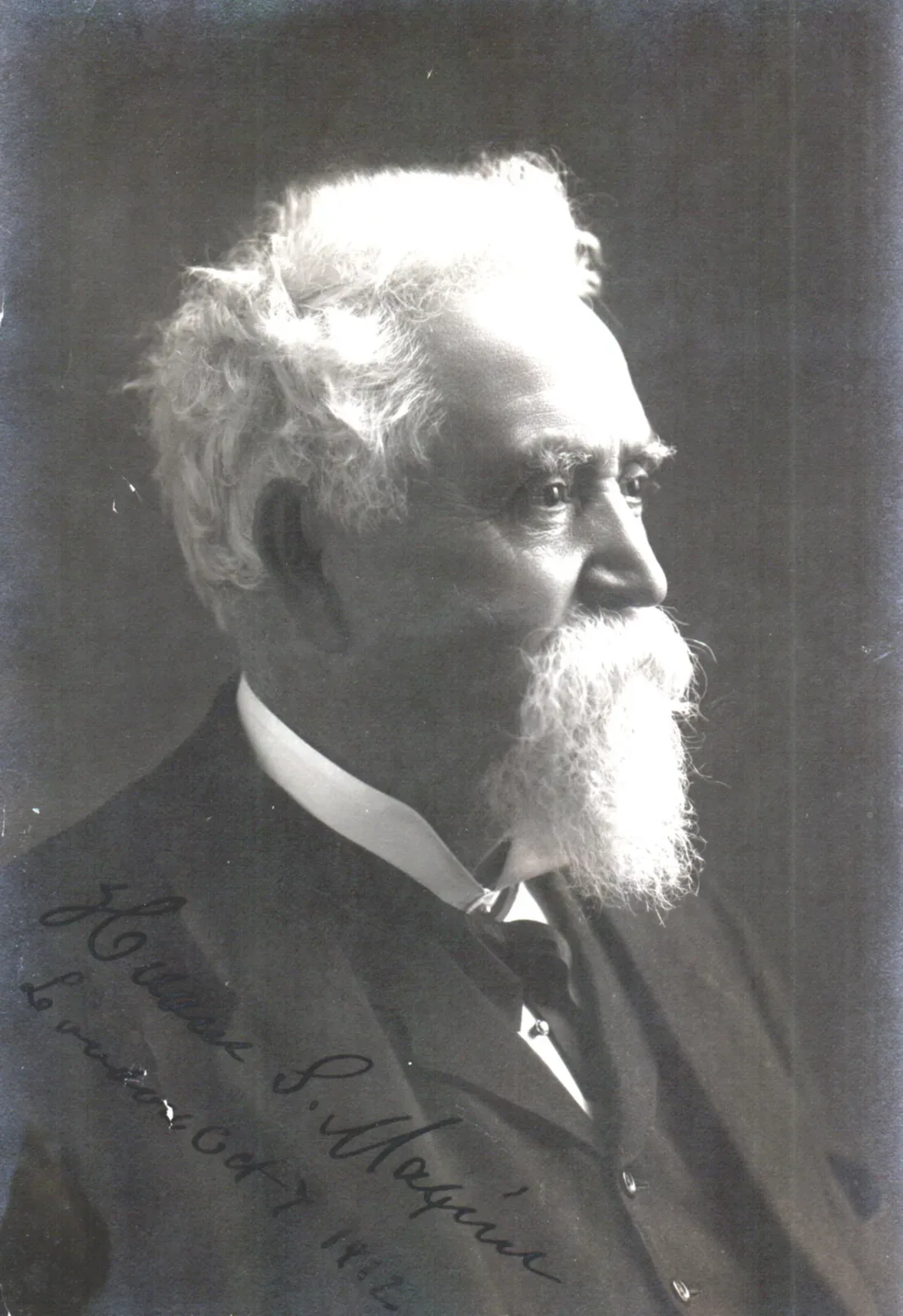
Early Life and Mechanical Genius
Hiram Stevens Maxim was born on February 5, 1840, in Sangerville, Maine. He was largely self-educated — apprenticed at 14 to a carriage maker — but demonstrated mechanical aptitude early and often.
- Born February 5, 1840, in Sangerville, Maine
- Largely self-educated, apprenticed at 14 to carriage maker
- Chief engineer of United States Electric Lighting Company
- Held 271 patents across lifetime
- Inventions ranged from fire extinguishers to curling irons
The machine gun was not a detour from his career. It was the logical endpoint of a mind that looked at any mechanical problem and asked how it could be made to work itself.
The Paris Exhibition Inspiration
The origin story Maxim himself told is almost too neat: at the 1881 Paris Exhibition, where he received the Legion d'Honneur for an electric pressure regulator, an acquaintance advised him that if he wanted to make a fortune, he should "invent something that will enable these Europeans to cut each other's throats with greater facility."
According to Maxim's account, he also remembered the punishing recoil he felt firing a .45-70 rifle and recognized that energy was being wasted. He began working on harnessing recoil to cycle a firearm's action automatically.
His first British patents related to the Maxim gun were granted in June and July 1883. He demonstrated a working prototype to invited guests in October 1884, working from a workshop in Hatton Garden, London.
Corporate Evolution and Manufacturing
That November, he founded the Maxim Gun Company with financing from Albert Vickers, son of steel entrepreneur Edward Vickers. A blue plaque still marks the Hatton Garden factory site at the junction with Clerkenwell Road.
| Company Evolution | Year | Key Changes |
|---|---|---|
| Maxim Gun Company | 1884 | Founded with Albert Vickers financing |
| Maxim Nordenfelt Guns | ~1888 | Merger with Swedish competitor |
| Vickers | ~1897 | Full absorption into Vickers |
| Vickers-Maxim | 1900s | Intermediate redesign |
| Vickers Machine Gun | 1912 | 20 lbs lighter, British Army adoption |
The company's corporate lineage reflects the consolidation typical of late-19th-century arms manufacturing. Maxim Gun Company merged with Swedish competitor Nordenfelt to become Maxim Nordenfelt Guns and Ammunition Company, then was absorbed into Vickers, producing first the Vickers-Maxim gun and ultimately the redesigned Vickers machine gun — 20 pounds lighter than the original Maxim and adopted by the British Army in 1912.
Maxim also patented gas-operated machine gun principles, but he concentrated his developmental energy on recoil operation. According to the EBSCO research summary on his patents, nearly all contemporary machine guns trace their lineage to Maxim's designs, and recoil-operated guns remain almost identical to his original model in their fundamental mechanics.
Technical Characteristicsedit
Revolutionary Operating Principle
The Maxim's operating principle was a departure from everything before it. Previous rapid-fire weapons — the Gatling, the Gardner, the Nordenfelt — were mechanically driven by external human effort. A crew member turned a crank or worked a lever.
The rate of fire was bounded by human endurance and coordination. Maxim eliminated the human from that loop entirely.
Maxim Gun Recoil Operation Cycle - The first fully automatic firing mechanism
In his short-recoil design, the bolt locks to the barrel at the moment of firing. Barrel and bolt recoil together for a short distance, then a toggle mechanism unlocks them. The bolt continues rearward, extracts and ejects the spent case, strips a fresh cartridge from the belt, chambers it, and locks again as it returns to battery — all driven by the energy of the previous shot. Hold the trigger, maintain the ammunition supply, and the gun cycles until something breaks or runs dry.
| Feature | Previous Weapons | Maxim Innovation | Advantage |
|---|---|---|---|
| Operation | Manual crank/lever | Recoil-operated | Eliminated human fatigue limit |
| Feed System | Gravity hoppers/box magazines | 250-round canvas belt | Extended sustained fire |
| Cooling | Air-cooled barrels | Water jacket | Prevented overheating |
| Fire Equivalence | 1 gun = 1 operator | 1 gun = ~60 riflemen | Massive force multiplication |
Belt Feed Innovation
The canvas belt feed system was equally significant. Earlier rapid-fire guns fed from gravity hoppers or box magazines that were awkward to manage under fire and prone to jamming. Maxim's 250-round canvas belt could be extended and pre-staged, giving the gun a practical sustained-fire capability that no previous weapon approached. Belt feed became the universal standard for machine guns.
Water Cooling System
The water-cooled jacket surrounding the barrel addressed the heat problem that had bedeviled single-barrel rapid-fire designs. Air-cooled barrels overheat quickly under sustained fire — Maxim himself acknowledged that his 1895 Extra Light Rifle Calibre Maxim air-cooled variant could fire no more than 400 rounds before requiring a cooling pause. The water jacket allowed the standard Maxim to sustain its 550–600 round-per-minute rate of fire for far longer stretches, at the cost of added weight and the logistical requirement to keep the jacket filled.
Trials demonstrated that a single Maxim could deliver fire equivalent to approximately 60 riflemen of the era. A lone soldier could technically operate it, but standard practice called for a crew of four to six: a gunner, crew members to manage ammunition and water, spotters, and men to move the heavy weapon. Several men were required just to carry and emplace it.
Compared to its predecessors, it was reliable. Colonel Charles Callwell, writing in the 1906 edition of Small Wars, noted that earlier machine guns "jammed at Ulindi, they jammed at Dogali, they jammed at Abu Klea" — often at the worst possible moments. The Maxim was not immune to mechanical failure, and early versions produced telltale clouds of smoke that revealed their position. The adoption of smokeless powder — developed in part by Hudson Maxim — addressed that problem as the gun's service life extended into the smokeless cartridge era.
The Air-Cooled Experiment
In 1895, responding to American interest in the Colt-Browning M1895, Maxim introduced the Extra Light Rifle Calibre Maxim — air-cooled, weighing 20.2 kg complete, and marketed as portable enough for cavalry hit-and-run raids. It was the lightest machine gun in the world at the time and the only one a single man could carry. The U.S. trials board praised its portability. It was still a commercial failure: only 135 were built. The air-cooling system was poorly understood at the time, the barrel overheated quickly, and the market for a machine gun that needed rest breaks was limited.
Combat & Field Useedit
Colonial Warfare Debut
The Maxim entered combat in the hands of colonial forces before any major European army had fully committed to it. A prototype was given to the Emin Pasha Relief Expedition in 1886–1890, led by Henry Morton Stanley — described in source material as more a publicity exercise than a serious military deployment. The gun was used primarily to frighten off attackers during the expedition's retreat from central Africa rather than to slaughter them.
The Matabele Wars
More consequential was its role in the First Matabele War in Rhodesia. At the Battle of Shangani on October 25, 1893, 700 soldiers held off 5,000 Matabele warriors using five Maxim guns. According to the Library of Congress resource guide, approximately 1,500 warriors were killed in that engagement. A week later, another battle produced roughly 2,500 killed out of 6,000 warriors — again, primarily due to Maxim fire. The numbers are staggering even accounting for the fog of 19th-century casualty reporting.
| Conflict | Year | Force | Casualties | Maxims Used | Outcome |
|---|---|---|---|---|---|
| Battle of Shangani | 1893 | 5,000 Matabele warriors | ~1,500 killed | 5 guns | Colonial victory |
| Follow-up Battle | 1893 | 6,000 warriors | ~2,500 killed | Multiple guns | Devastating losses |
| Port Arthur | 1904-05 | 35,000+ Japanese attackers | 6,200 killed | Multiple Russian guns | Defensive success |
The first unit in the world to officially receive the Maxim was the expeditionary force led by Hermann Wissmann, dispatched by the German Imperial government in 1888 to suppress the Abushiri Revolt in German East Africa. Wissmann used it successfully in the capture of Pangani.
The British Army formally adopted the weapon under Sir Garnet Wolseley, appointed Commander-in-Chief in 1888. That October, he ordered 120 rifle-calibre Maxims chambered in .577/450 — the same round as the Martini-Henry rifle already in British service. Wolseley had commanded in Africa during the Ashanti War and the Gordon Relief Expedition and had seen firsthand what rapid fire could do in open terrain against massed infantry tactics.
The Maxim's reputation in colonial warfare has been complicated by historical reassessment. The Wikipedia source notes that modern accounts suggest its significance owed as much to psychological impact as to raw lethality — opponents who could be drawn into pitched battles in open terrain were devastated, but the gun was less decisive in broken terrain or against dispersed opponents who refused to charge. The famous verse by Hilaire Belloc from his 1898 poem "The Modern Traveller" captures the colonial-era understanding:
Whatever happens, we have got / The Maxim gun, and they have not. — Hilaire Belloc, 'The Modern Traveller' (1898)
The gun also appeared in a heavier variant during this period. A large-caliber version firing one-pound explosive shells — manufactured by Maxim-Nordenfelt and capable of 450 rounds per minute — became known during the Second Boer War as the "Pom-Pom" for the sound it made. The Boers' use of this weapon against British forces marked one of the first times a colonial power encountered its own technology turned against it at scale.
Russian Adoption and Service
Russia's relationship with the Maxim was protracted and somewhat reluctant at first. Maxim conducted a demonstration tour in Russia in 1887, which resulted in an order of only 12 guns from the Imperial Russian Navy. Interest revived in 1896, leading to a large Navy order, with 179 guns delivered in 1897 and nearly 300 in Russian service by 1904.
The Imperial Russian Army purchased 58 Maxims chambered in 7.62×54mmR in 1899 and contracted with Vickers in 1902 to manufacture domestically. Mass production at Tula Arsenal did not begin until 1910, with the Maxim M1905 based on the commercial Vickers-Maxim Model 1901 bridging the gap. The Sokolov mount, introduced in 1908 and named for its designer Colonel Alexander A. Sokolov, substantially improved the gun's field mobility — weighing 36–45 kg compared to the previous wheeled mount at 170 kg.
The Russo-Japanese War of 1904–1905 was the Maxim's first major test against a Western-equipped opponent. Russian use of Maxims defending Port Arthur resulted in approximately 6,200 dead among a Japanese attacking force of over 35,000, according to the Library of Congress guide. The Russian Army placed a rush order for 450 additional guns from overseas suppliers during the conflict, most of which reached front-line troops before the war ended.
The Great War's Defining Weapon
By August 1914, the Maxim's direct descendants were the primary machine guns of the two main opposing coalitions. Britain fielded the Vickers machine gun — a refined, lighter Maxim adopted in 1912 and remaining in British service until 1968. Germany fielded the Maschinengewehr 08, a direct copy of the Maxim. Russia fielded the Pulemyot Maxim PM M1910.
World War I became known as 'the machine gun war.' — PBS Documentary
That is not hyperbole. Emplaced machine guns with overlapping fields of fire were responsible for the majority of the war's catastrophic infantry casualties. The tactical implication was decisive: massed infantry assault across open ground against entrenched machine guns was suicidal, and both sides eventually understood this.
The result was the trench system — not a failure of imagination but a rational response to a firepower problem that had no other solution until tanks and aircraft developed further. The EBSCO source on Maxim's patents states it plainly: until armored vehicles arrived, the machine gun "prevented offensive wars of movement, at least between roughly equal forces."
The PBS source notes that Maxim died on November 24, 1916 — just days before the Battle of the Somme concluded, where over one million soldiers fell in four months of machine gun warfare. Whether Maxim viewed that as a legacy or a horror the sources do not say.
Modern Combat Applications
The Maxim in its various national forms saw service across a remarkable span of conflicts:
- Russian Civil War
- Finnish Civil War
- Spanish Civil War (Soviet PM M1910s to Republicans)
- World War II
- Winter War 1939–1940 (Finnish Maxim M/09-21)
- Russo-Ukrainian War (both sides, 2022–present)
| Nation | Maxim Variant | Adoption Year | Notable Features |
|---|---|---|---|
| Britain | Vickers Machine Gun | 1912 | 20 lbs lighter than original |
| Germany | Maschinengewehr 08 | 1908 | Direct Maxim copy |
| Russia | PM M1910 | 1910 | Sokolov mount (1908) |
| Service Span | All variants | 1884–present | 140+ years continuous use |
In the Russo-Ukrainian War, the PM M1910 has appeared on both sides. At least one documented example used by Ukrainian forces in the Battle of Bakhmut was unmodified — original iron wheels intact. A Ukrainian soldier told BBC News in March 2023:
It only works when there is a massive attack going on... then it really works. So we use it every week. — Ukrainian soldier, BBC News, March 2023
Other Maxims have been retrofitted with red dot sights and mounted on technicals. On September 7, 2025, one was used to shoot down a Kh-69 cruise missile over Kyiv — according to Euromaidan Press, with approximately $11 worth of ammunition.
Legacy & Influenceedit
The Maxim did not just add a new weapon to the arsenal. It restructured the relationship between firepower, manpower, and terrain in a way that no previous invention had managed so completely.
Before the Maxim, rapid fire required either many men firing individual weapons or a dedicated crew operating a manually driven mechanism. The Maxim collapsed that equation. A crew of four to six could produce sustained fire equivalent to a company of riflemen. That arithmetic forced every military institution that encountered it to reconsider how infantry operated, how positions were fortified, and how attacks were conducted.
Technical Innovation Impact
The specific technical innovations Maxim introduced — recoil operation, belt feed, adjustable headspace, field-serviceable components — became the template for machine gun design worldwide. The EBSCO source summarizing his patents states that nearly all contemporary machine guns are based on Maxim designs. John Browning's famous machine guns, which became the American standard, grew from Browning's development of Maxim's gas-operation patents. The Vickers, the MG 08, the PM M1910, the Type 24 Chinese heavy machine gun — all are direct descendants.
Maxim Gun technological lineage and modern descendants
The corporate lineage matters too. The Maxim Gun Company became Maxim Nordenfelt, then was absorbed into Vickers. That consolidation helped establish Vickers as one of the dominant arms manufacturers of the early 20th century, with manufacturing operations in England, licensed production in Russia, Germany, Switzerland, and elsewhere, and sales to virtually every major military.
Imperial Warfare Consequences
The weapon's role in colonial warfare is inseparable from its legacy and should not be softened. The Maxim gave European powers a force-multiplier against opponents armed with older technology — and that asymmetry was used to kill tens of thousands of people across Africa and Asia in the service of imperial expansion. Historian Martin Gilbert's characterization of it as "the weapon most associated with imperial conquest" is not rhetorical. It is descriptive.
Countermeasure Development
At the same time, the Maxim's dominance forced the development of the countermeasures that defined 20th-century warfare. The tank was explicitly designed to be immune to machine gun fire. Close air support and ground-attack aviation developed in direct response to the problem of infantry pinned by machine guns they could not see and could not charge. The Maxim did not just change how wars were fought in 1914. It set the conditions for how they would be fought in 1939, 1944, and beyond.
The BGC Takeedit
The Maxim is one of those inventions where the gap between the creator's intentions and the invention's consequences is too wide to paper over. Maxim was chasing patents and contracts. He was a businessman with a knack for engineering, not a military theorist.
By most accounts he understood what his gun could do — the demonstrations were designed to show exactly that — but the industrial-scale carnage of the Western Front was probably not something he modeled when he was working in Hatton Garden in 1883.
What strikes me about the Maxim, coming at it from a mechanical standpoint, is how right he got it the first time. The short-recoil toggle system, the belt feed, the water jacket, the field-serviceable components — these were not ideas that required decades of refinement before they worked. The prototype demonstrated in October 1884 was functionally sound. The armies that adopted it did so reluctantly, not because the gun didn't work, but because institutional inertia is powerful and machine guns were expensive and heavy and required doctrinal changes nobody wanted to make. That reluctance cost an enormous number of lives.
The Russo-Japanese War should have told every European general staff exactly what was coming. The Russians used Maxims at Port Arthur and killed 6,200 Japanese attackers from a force of 35,000. That data existed. It was studied. And then, ten years later, those same armies walked men across open ground into interlocking machine gun fire and acted surprised at the results.
The fact that a 140-year-old gun is still being used in active combat is either a testament to how good Maxim's original design was or a commentary on what happens when logistics chains collapse and you use what's available. Probably some of both.
Either way, it's a hell of a run for a gun invented in a London workshop by a Maine farm boy who started with a self-resetting mousetrap.
Referencesedit
- https://en.wikipedia.org/wiki/Maxim_gun
- https://www.pbs.org/wgbh/theymadeamerica/whomade/maxim_hi.html
- https://www.invent.org/inductees/hiram-s-maxim
- https://www.ebsco.com/research-starters/history/maxim-patents-his-machine-gun
- https://www.britannica.com/technology/Maxim-machine-gun
- https://guides.loc.gov/machine-gun-its-history-development-and-use
Last Updated: February 27, 2026
- Gls Guns(Sumner, IA)
- Bi-mart - Yakima (Fruitvale Ave)(Yakima, WA)
- New Philly Sportsman Specialities(New Philadelphia, OH)
- R&R Sports & Outdoors(Brandon, FL)
Loading comments...