Specifications
Gatling Gun

The 1865 British Gatling gun — Richard Gatling's original design with its distinctive six-barrel cluster and hand-operated crank drive system.
Max Smith (Megapixie) (Public domain)
| Manufacturer | |
|---|---|
| Made By | Colt Fire Arms Company (primary); also manufactured by Broadwell Machine Gun Company and others under license |
| Designer | Richard Jordan Gatling |
| Origin | United States |
| Specifications | |
| Caliber | .45-70 GovernmentAlso: .30 Army (M1893), .58 caliber (early models), 10-pounder cannon variant, 1-pounder cannon variant |
| Action | gas operated |
| Capacity | Hopper-fed (gravity feed) |
| Barrel | Varies by model |
| Weight | Varies significantly by model and configuration |
| Feed | Gravity-fed hopper from top; Bruce feed system (two-row cartridge feed) on later models |
| Sights | Simple sights |
| Performance | |
| Eff. Range | 1,000+ yards (depending on caliber variant) |
| Production | |
| Designed | 1861 |
| In Production | 1862 |
| Produced | Approximately 10,000+ units across all variants |
| Variants | |
| |
| Service Use | |
United States ArmyUnited States NavyBritish military forcesFrench forcesGerman forcesRussian militaryEgyptian forcesOttoman forcesVarious colonial forces on six continents | |
| Cultural Note | |
| The Gatling gun was the first practical rapid-fire firearm in history and a direct forerunner of modern electrically driven rotary cannons. It served continuously from 1862 through 1911 across conflicts on six continents and fundamentally changed battlefield tactics by enabling a small group of soldiers to deliver devastating suppressive fire. | |
| Related Firearms | |
Gatling Gun
Firearms encyclopedia article
From The Boise Gun Club Handbook
Overviewedit
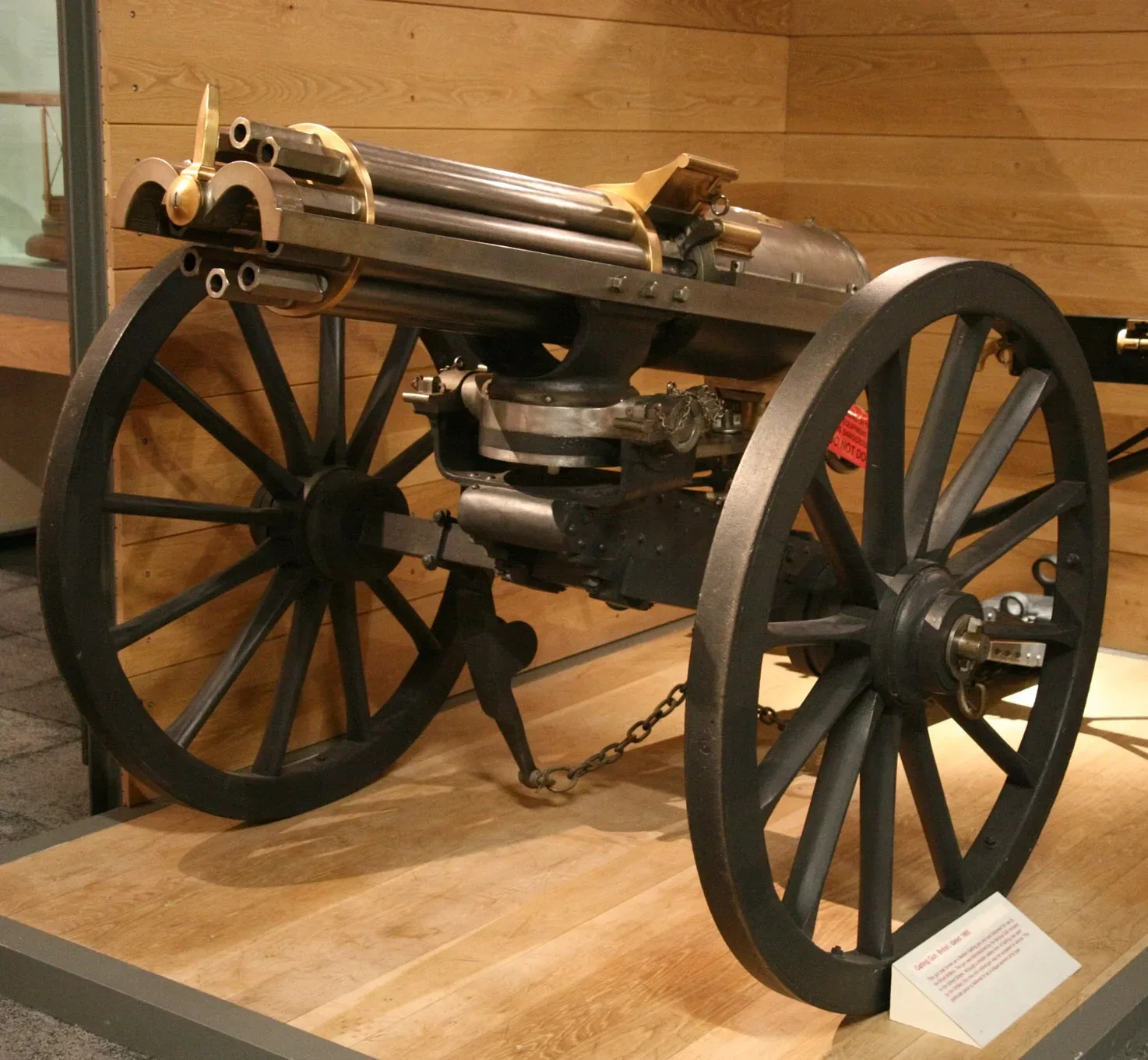
Richard Jordan Gatling invented his Gatling gun in 1861, received a patent on November 4, 1862, and in doing so created the first practical rapid-fire firearm in history. It is an early machine gun and a direct forerunner of the modern electrically driven rotary cannon. The gun served continuously from 1862 through 1911—nearly half a century—across conflicts on six continents, and it changed the calculus of what a small group of soldiers could do to a much larger force.
The machine was hand-cranked, not self-powered, which technically separates it from a true automatic weapon in the modern sense. That distinction would matter enormously for what came after it. But in its own era, nothing else came close to what it could do. Before Gatling, the only way to put a lot of lead in the air quickly was to line up a lot of men with single-shot weapons or lug around a cumbersome volley gun that still needed a full manual reload after each discharge. The Gatling changed that equation permanently.
Design Historyedit
Gatling was born September 12, 1818, in Hertford County in northeastern North Carolina. His father and older brother were inventors themselves—agricultural machinery was the family trade—and Gatling absorbed that disposition early. His first notable invention was a screw propeller for boats, though he arrived at the patent office just days after John Ericsson had filed for an identical design, costing him priority. He later patented a rice-seed planter, converted it to a wheat planter after relocating to the Midwest, earned a medical degree in 1850, and never practiced medicine a day in his life.
His consuming interest was always invention. When the Civil War began, Gatling was living in Indianapolis. What struck him was not the battlefield carnage but the disease. Soldiers were dying by the tens of thousands from illness in camp, and Gatling reasoned—somewhat counterintuitively—that a gun capable of doing the work of a hundred men could shrink armies small enough to reduce that exposure.
It occurred to me that if I could invent a machine—a gun—which could by its rapidity of fire, enable one man to do as much battle duty as a hundred, that it would, to a great extent, supersede the necessity of large armies.
He wrote plainly of his vision. By the end of 1861 he had a working prototype of what he called his "Revolving Battery-Gun."
Early Development & Patent Struggles
The grouped-barrel concept had been kicking around since the 18th century, but poor engineering and the absence of a reliable unitary cartridge had killed every previous attempt. Gatling's initial design used self-contained, reloadable steel cylinders—each holding a ball, a black-powder charge, and a percussion cap on one end. As the barrels rotated, these cylinders dropped into place, fired, and ejected. It was clunky, but it worked well enough to demonstrate the principle.
Technical Evolution & Military Resistance
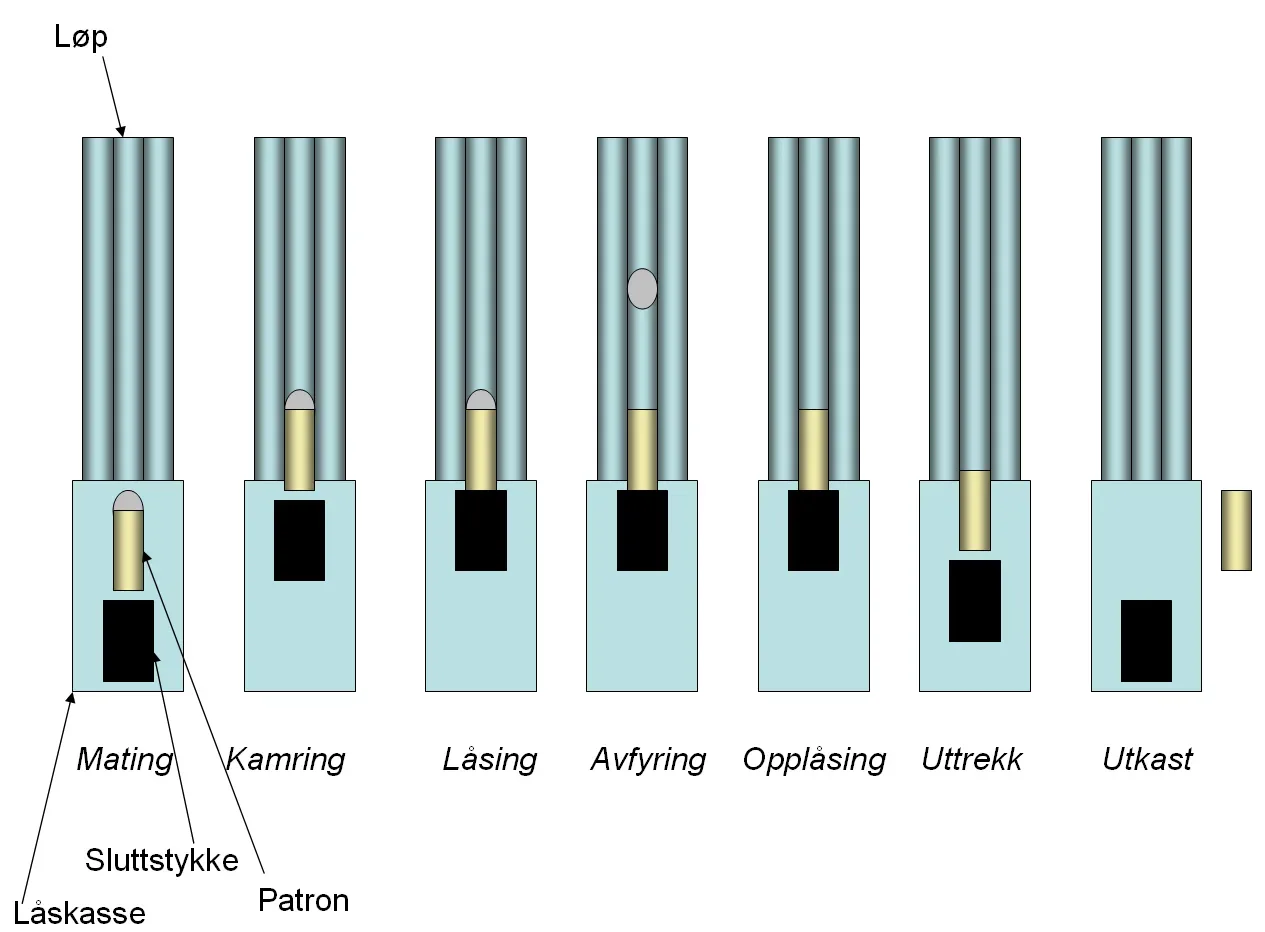
The real leap came when self-contained brass cartridges arrived. After early experiments with paper cartridges that required a separate percussion cap, Gatling recognized that the brass cartridge—with its own integrated primer—was the enabling technology his design had been waiting for. He contrived a cluster of six rotating barrels (some models ran as many as ten), each loaded and fired once per complete revolution via a hand crank. Cartridges fed by gravity from a top-mounted hopper into the grooves of a carrier. A cam inside the housing drove the locks forward to chamber each round, fired it at roughly the four-o'clock position in the rotation, then drew the lock back to eject the spent case at the bottom, where it fell free by gravity. Each barrel spent most of its rotation cooling down—the elegant solution to every overheating problem that had defeated earlier designs.
The early models still relied on the clumsy steel cylinder chambers and paper cartridges, which collected burnt residue and required tedious hand-collection and reloading after firing. Brigadier General James Wolfe Ripley, the Union Army's chief of ordnance, was constitutionally opposed to repeating weapons of any kind—he considered them expensive, ammunition-wasteful, and a logistical burden. Ripley blocked or delayed not just the Gatling but the Spencer, the Henry, and the Sharps as well. Gatling called him "an old fogey" who believed flintlock muskets were adequate for modern warfare.
Faced with that wall, Gatling went directly to President Abraham Lincoln in a February 18, 1864, letter, arguing his gun was entirely different from the Wilson Agar "Coffee Mill Gun"—a single-barreled competitor that Lincoln had already championed—and that it was "just the thing needed to aid in crushing the present rebellion." Lincoln ignored the appeal, almost certainly for political reasons: Gatling's North Carolina roots and an alleged (and disputed) association with the Copperhead-adjacent Order of American Knights made him a liability in an election year.
Later Models & Production End
Gatling was not standing still technically. The Model 1881 introduced the "Bruce" feed system (covered under U.S. Patents 247,158 and 343,532), which accepted two rows of .45-70 cartridges simultaneously—one row feeding while the other was reloaded, enabling genuinely sustained fire. By 1886, that configuration pushed the rate of fire beyond 400 rounds per minute. In 1893, the gun was adapted for the new .30 Army smokeless cartridge; the M1893 featured six barrels initially, later expanded to ten, and was rated at 800–900 rounds per minute at maximum, with 600 rpm recommended for continuous fire. Gatling himself later demonstrated electric-motor-driven examples of the M1893; tests showed bursts of up to 1,500 rpm were achievable. Before selling his patent rights to the Colt Fire Arms Company, Gatling had pushed his design to a demonstrated 1,200 rounds per minute.
The M1895, produced by Colt in a run of 94 guns for the U.S. Army, accepted only the Bruce feeder, was painted olive drab green (all previous models had been left unpainted), and would go on to see the gun's most documented combat. The M1900 followed with minor changes, and the M1903 and M1903-'06 conversions adapted the M1900 receivers to .30-03 and .30-06 respectively—conversions carried out principally at Springfield Armory. In 1911, after 45 years of service, the U.S. military declared all Gatling models obsolete.
Technical Characteristicsedit
Operating Mechanism
The operating principle of the Gatling gun is straightforward once you trace one cartridge through the full cycle. Turning the hand crank rotates a central shaft. Mounted on that shaft—and rotating with it—are the barrels, a grooved carrier, and a drilled lock cylinder, all secured to a solid plate. In front of the housing sits a cam with spiral surfaces; as the assembly rotates, the cam drives each lock forward to chamber a round, holds it there until the cocking ring releases the lock to fire, then draws it rearward to extract and eject the spent case. The empty barrel then rotates away from the firing position and spends roughly five-sixths of each revolution doing nothing but cooling.
The standard six-barrel configuration meant that at any given moment, one barrel was firing while five were in various stages of loading, ejecting, or cooling. This distribution of heat load is the entire reason the gun could sustain fire that would have destroyed any single-barrel weapon of the era. Early models had fibrous matting packed among the barrels that could be soaked with water for additional cooling; later models dropped that as unnecessary.
Feed Systems
Feed systems evolved considerably across the gun's production life. The original gravity-fed hopper dropped loose rounds into the carrier grooves—simple, but sensitive to ammunition inconsistencies that could cause jams. L.W. Broadwell, an agent for Gatling's company, developed a drum feed (patented as U.S. Patent 110,338) arranged as twenty stacks of rounds around a central axis, each stack holding twenty cartridges—400 rounds total, or 240 in a common 15-round-per-stack variant. As each stack emptied, the operator manually rotated the drum to the next. The Bruce double-row feed, introduced on the Model 1881, solved the reload interruption problem by keeping one row available while the other was replenished.
Physical Specifications
The Civil War-era guns were heavy, carriage-mounted weapons more analogous to field artillery than infantry support. The Colt Model 1877 ten-barrel gun weighed 170 pounds without its carriage; carriages themselves added 350–550 pounds. Moving the weapon required horses for transport and a crew of four to six for operation and ammunition handling. The gun lacked a swivel mechanism on its early carriages, meaning horizontal traverse required the crew to physically manhandle the carriage left or right—a significant tactical limitation. Vertical elevation was managed by an elevating screw identical to those on standard field cannon.
The smokeless-powder M1893 and its successors addressed some of these limitations with improved mountings, including the option of an armored field carriage on all models from 1895 through 1903. The ten-barrel M1895 in .30 Army was the configuration that saw the most effective documented combat use.
Combat & Field Useedit
Civil War Service Questions
The Civil War combat record of the Gatling gun is murkier than most histories admit. The standard claim—that the gun "first saw combat" during the Civil War—rests almost entirely on the postwar statements of Gatling himself and accounts written by associates with a financial interest in the weapon's reputation. Major General Benjamin F. Butler allegedly purchased twelve Gatlings personally and used them near Richmond during the Siege of Petersburg, and may have mounted up to eight on gunboats on the James River. But Butler, a man who rarely missed a chance to publicize his own accomplishments, left no record of doing so.
Firearms historian William B. Edwards noted that Butler's silence on the subject is conspicuous. Even Gatling's own grandson acknowledged in 1957 that "no one seems to know any anecdotes on the Civil War use of the gun."
Complicating the record further is the fact that few Union soldiers had ever seen either a Gatling or an Agar gun, and contemporary accounts routinely confused the two. Butler definitely obtained ten Agar Coffee Mill Guns from the Washington Arsenal in February 1864; what his gunboat crews actually operated remains genuinely unclear. The Wikipedia account of the gun states that twelve were purchased by Union commanders and used in the trenches during the Siege of Petersburg (June 1864–April 1865), and that eight were fitted on gunboats—but the sourcing for confirmed combat discharge is thin. What is not disputed is that the U.S. Army did not formally adopt the Gatling until 1866, when a sales representative demonstrated it after the war had already ended.
International Deployment
The gun's first unambiguous field use came after the war, and the pattern of deployment that emerged defined its tactical role for the next four decades: colonial-era suppression of massed infantry and cavalry charges. The Russian Imperial Army was among the earliest adopters, testing two Gatlings in 1865 and eventually building them under license. By 1876 they had 400 organized into eight batteries, known in Russian service as "Gorloffs" after Colonel Aleksandr Pavlovich Gorloff, who had arranged their procurement. Those guns saw action in the Russo-Turkish War of 1877–1878 at the Battle of Nikopol and the Siege of Plevna, and were used during the Russian conquest of Central Asia to break Turkmen cavalry charges—exactly the scenario where a high-volume, crew-served weapon excelled.
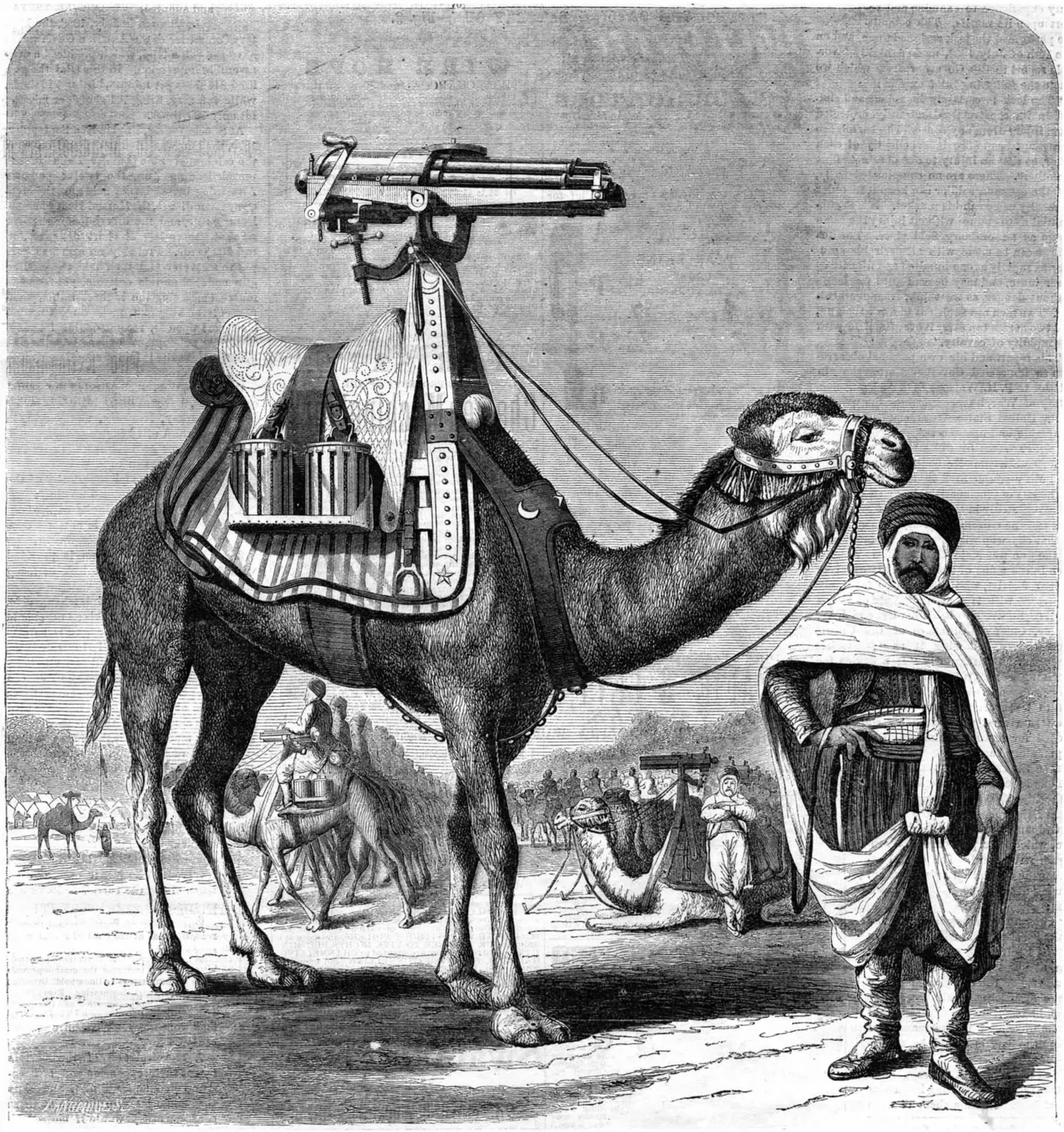
The British Army first deployed the Gatling in the Anglo-Ashanti Wars of 1873–74, then extensively during the Anglo-Zulu War of 1879. The Royal Navy used Gatling guns during the Anglo-Egyptian War of 1882. Egyptian forces under Isma'il Pasha had already ordered 120 Colt 1865 six-barrel Gatlings after Shahine Pasha witnessed demonstrations at Shoeburyness in 1866. During the Siege of Khartoum, an Egyptian Gatling crew using a telescope engaged Sudanese artillery positions at a reported 2,000 yards. The gun spread far beyond the great powers—by 1880, Siam had imported an unknown number and by 1885 maintained a dedicated Gatling gun regiment of 600 men; the Korean Empire possessed at least 40 by 1894, drilled regularly with them (reportedly because the noise pleased Emperor Gojong), and deployed some to defend the capital during the Donghak Rebellion, though no evidence of combat use in that deployment survives.
- Russia: 400 guns in 8 batteries by 1876, used in Russo-Turkish War
- Britain: Anglo-Ashanti Wars (1873-74), Anglo-Zulu War (1879)
- Egypt: 120 Colt 1865 models, used at Siege of Khartoum
- Siam: Dedicated 600-man Gatling gun regiment by 1885
- Korea: 40+ guns, deployed during Donghak Rebellion
The most consequential non-use of the weapon is also its most famous footnote. General George Armstrong Custer declined to bring his three assigned Gatling guns with his main force at the Battle of the Little Bighorn in 1876. He regarded them as too slow and difficult to move over rough terrain. He was killed there along with roughly 200 of his men.
Spanish-American War Vindication
The gun's definitive combat vindication came during the Spanish–American War of 1898. A four-gun battery of Model 1895 ten-barrel Gatlings in .30 Army, formed into a separate detachment under Lieutenant John H. Parker (who would thereafter be known as "Gatling Gun Parker"), supported the American advance at the Battle of San Juan Hill. Three of those guns, fitted with swivel mountings, fired a combined 18,000 rounds in eight minutes against Spanish positions along the crests of San Juan and Kettle hills—an average of over 700 rounds per minute per gun of sustained fire. The effect on the Spanish defenders was significant.
The same campaign also exposed the gun's persistent tactical weakness. The M1895's weight and its artillery-style carriage made it nearly impossible to keep pace with infantry moving through Cuban jungle footpaths. By that point, the U.S. Marines had already been issued the lighter, tripod-mounted M1895 Colt–Browning machine gun in 6mm Lee Navy—a recoil-operated, self-loading weapon that required no hand-cranking. That gun defeated Spanish infantry at Cuzco Wells without any of the Gatling's logistical headaches. The writing was on the wall.
Domestic Use
The Philippine–American War repeated the same lesson. Gatlings were deployed but their carriage hindered movement through forested mountains and steep terrain outside the cities. The gun's era as a primary combat weapon was effectively over, though it continued in U.S. service until the formal obsolescence declaration in 1911.
The Gatling also appeared in domestic contexts that complicate any simple narrative of military progress. Pennsylvania militia brought two Gatlings from Philadelphia to Pittsburgh during the Great Railroad Strike of 1877. Gatling guns were held in reserve by coal companies and used—and looted by miners—during the Battle of Blair Mountain in 1921. The Colorado National Guard deployed them during the Colorado Labor Wars of 1904. The weapon that Gatling designed partly to reduce armies and disease served as a tool of domestic labor suppression as readily as it served in foreign wars.
Legacy & Influenceedit
Obsolescence & Revival
The Maxim gun, invented and patented in 1883 by Hiram Maxim, was the first truly self-loading automatic weapon—it used the energy of the fired cartridge's recoil to cycle the action, requiring no external power source or hand crank. That distinction made the Maxim and its descendants the dominant machine gun paradigm for the next century. Compared to a Maxim, a Gatling required a crew member dedicated solely to turning a crank, which was a genuine operational liability. The original Gatling gun and all other hand-operated machine guns were made obsolete by recoil- and gas-operated weapons once smokeless powder and reliable brass cartridges made those designs practical.
What the Gatling left behind, though, was not just a footnote. The multi-barrel rotating principle solved a real engineering problem—heat management at extreme rates of fire—that recoil-operated single-barrel designs never fully overcame. That solution lay dormant for decades after 1911, resurfacing after World War II when the demands of aerial gunnery exposed the limits of reciprocating-bolt autocannons. High-g environments caused those weapons to jam in ways that a rotating-barrel system did not. The result was the M61 Vulcan, a 20mm six-barrel rotary cannon developed in the early jet age, and ultimately the GAU-8 Avenger—a 30mm seven-barrel cannon mounted in the Fairchild Republic A-10 Thunderbolt II that fires up to 3,900 rounds per minute. Gatling's 1861 insight about distributed barrel loads and coordinated cycling is embedded in every one of those weapons.
Global Proliferation
The Gatling's global footprint in the 19th century was enormous. It served under the flags of Argentina, Austria-Hungary, Brazil, the British Empire, Chile, Egypt, France, Italy, Japan, the Korean Empire, Montenegro, Nicaragua, the Ottoman Empire, Peru, the Qing Empire, Romania, Russia, Siam, the United States, and a number of West African kingdoms—the Kalabari, Ijesha, and Bonny among them, some of whom acquired their guns through trade networks involving figures like King Jaja of Opobo. The weapon proliferated across the globe faster than any previous firearm technology, carried by colonial powers expanding their empires and by smaller states trying to keep pace.
Gatling himself died on February 26, 1903, at age 84, having lived long enough to see his design rendered obsolete but not long enough to witness its revival in the jet age. The North Carolina Department of Natural and Cultural Resources marks his birthplace in Hertford County with a historical marker cast in 1942. The humanitarian justification he offered for the gun's creation—that more efficient killing would require fewer soldiers and thereby reduce death—was never realized. He acknowledged as much, and history has been honest about the irony ever since.
The BGC Takeedit
The Gatling gun sits in an uncomfortable place in firearms history, and that discomfort is worth sitting with for a minute.
Gatling was a genuinely creative engineer working on a real problem: how do you sustain fire without destroying your barrel? His answer—distribute the heat load across multiple barrels in rotation—was elegant, and it was correct. The same logic drives the guns on attack aircraft today. You can't take that away from him.
| Model | Year | Barrels | Cartridge | Rate of Fire | Weight (gun only) |
|---|---|---|---|---|---|
| Model 1862 | 1862 | 6 | Paper cartridge | 200 rpm | 135 lbs |
| Model 1865 | 1865 | 6 | .58 rimfire | 200 rpm | 145 lbs |
| Model 1881 | 1881 | 6-10 | .45-70 | 400+ rpm | 160-170 lbs |
| M1893 | 1893 | 6-10 | .30 Army | 600-900 rpm | 165-180 lbs |
| M1895 | 1895 | 10 | .30 Army | 800 rpm | 170 lbs |
But the humanitarian framing he used to promote the weapon—that a more lethal gun would mean smaller armies and fewer deaths—didn't survive contact with reality. What actually happened is that governments deployed it to suppress strikes, break colonial resistance, and in at least one well-documented case, fire 18,000 rounds into human beings in eight minutes.
The weapon didn't shrink armies. It gave smaller forces the ability to do things that previously required much larger ones, which just changed how violence was organized, not how much of it there was.
The Civil War combat record is also worth being honest about. The standard line—that it "first saw combat" during the Civil War—is repeated in nearly every popular account and is almost certainly an exaggeration built on Gatling's own self-promotion and postwar boosterism. The actual documented record is thin enough that Gatling's own grandson admitted nobody could confirm it. That doesn't make the weapon historically unimportant. It makes the popular history of it slightly less tidy than the myth.
Key milestones in Gatling gun development and service
What the Gatling actually was, stripped of the mythology, is this: the first design to solve the mechanical problem of sustained rapid fire in a way that held up under field conditions. It wasn't a true automatic weapon. It wasn't the Civil War wonder gun the legend describes. But it established a principle that every rotary cannon flying today still uses. That's a genuine legacy, and it doesn't need inflation to be impressive.
Referencesedit
- https://en.wikipedia.org/wiki/Gatling_gun
- https://www.britannica.com/technology/Gatling-gun
- https://www.dncr.nc.gov/blog/2023/12/01/richard-gatling-1818-1903-26
- https://historynet.com/dr-gatlings-wonder-weapon/
- https://worldtreasures.org/blog/fire-away-the-history-of-the-gatling-gun
Last Updated: February 27, 2026
- Gls Guns(Sumner, IA)
- Bi-mart - Yakima (Fruitvale Ave)(Yakima, WA)
- New Philly Sportsman Specialities(New Philadelphia, OH)
- R&R Sports & Outdoors(Brandon, FL)
Loading comments...