Details
Maximilian I, Holy Roman Emperor
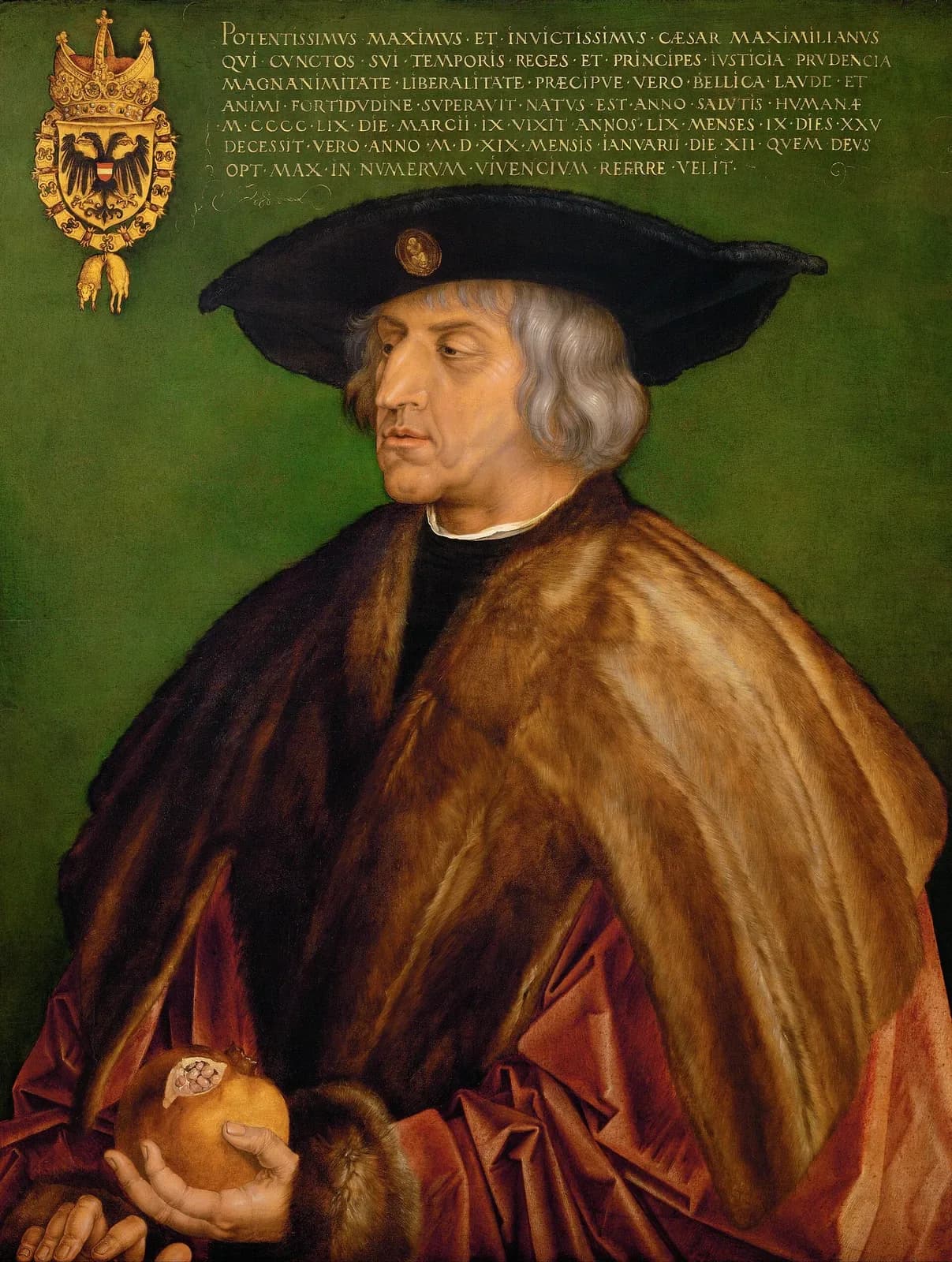
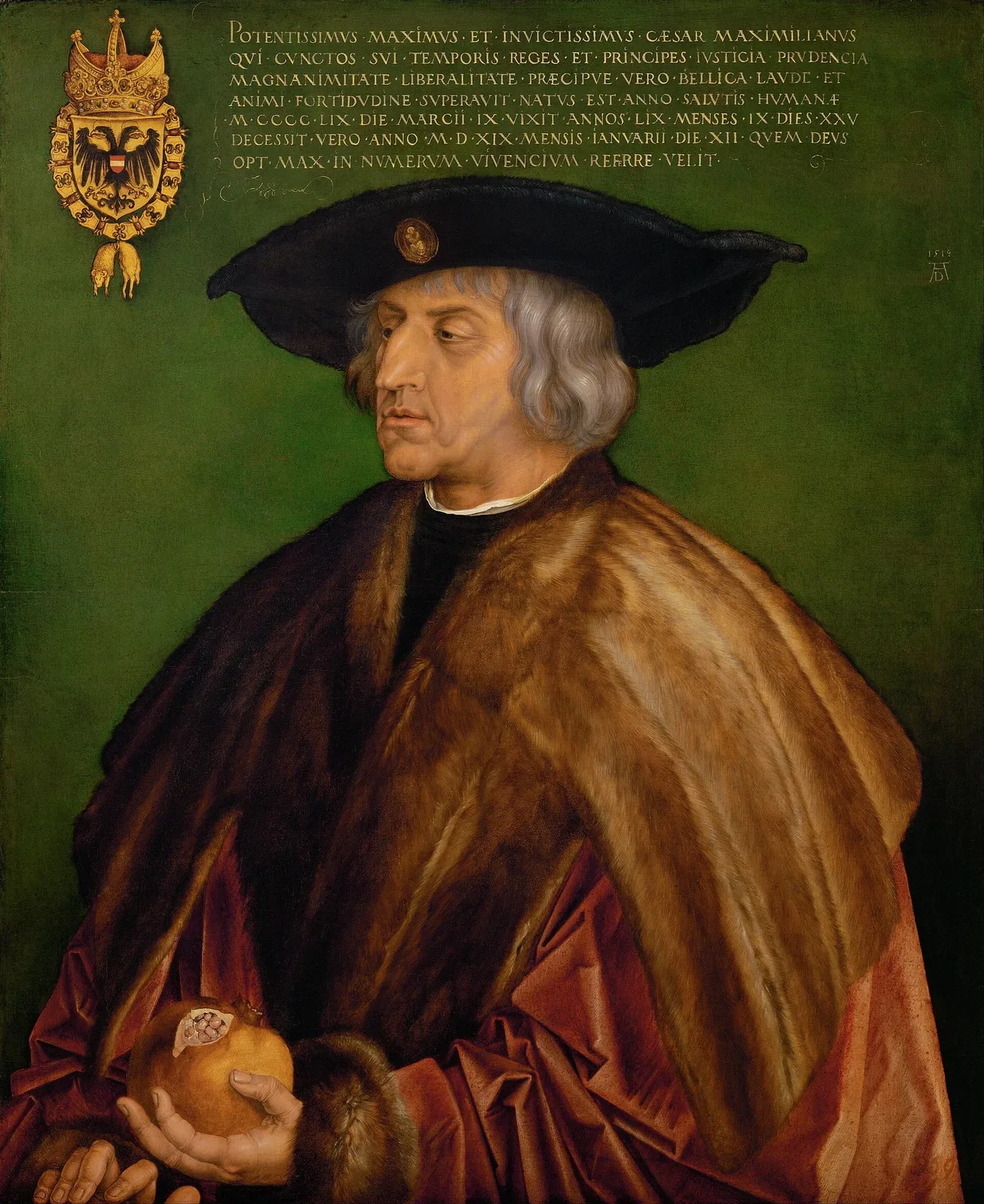
Bernhard Strigel's portrait of Maximilian I — the court painter's definitive image of the emperor in his regalia, now in the Tyrolean State Museum.
| Biography | |
|---|---|
| Born | 22 March 1459 |
| Died | 12 January 1519 |
| Nationality | Holy Roman Empire |
| Legacy | |
| Known For | Standardizing artillery, industrializing arms production, founding the Landsknechte, transitioning military forces from crossbows to handguns, establishing the Habsburg arms industry |
| Key Innovation | Creation of the arsenal system and institutional infrastructure for firearms production; development of combined-arms tactics with infantry, cavalry, and artillery; transition from crossbow to handgun in military forces |
Maximilian I, Holy Roman Emperor
Firearms encyclopedia article
From The Boise Gun Club Handbook
Overviewedit
Maximilian I (22 March 1459 – 12 January 1519) served as King of the Romans from 1486 and Holy Roman Emperor from 1508 until his death. He is one of those figures who sits at a genuine hinge point in military history — a man personally committed to chivalric tradition who simultaneously dismantled the military conditions that made chivalry viable.
He is one of those figures who sits at a genuine hinge point in military history — a man personally committed to chivalric tradition who simultaneously dismantled the military conditions that made chivalry viable.
Historians have called him "the last knight," and the epithet is both accurate and deeply ironic. As the father of the Landsknechte and what contemporaries called "the first cannoneer of the nation," he ended the combat supremacy of heavy cavalry and broke the military and political back of the knight class in the process.
For the story of firearms specifically, Maximilian matters on several levels at once. He made the following contributions to early modern military technology:
- Standardized artillery production and calibers
- Industrialized arms manufacturing
- Built institutional infrastructure (arsenals, supply chains, trained gunfounders)
- Issued early firearms prohibition laws
- Presided over crossbow-to-handgun transition
The world of small arms that emerged in the sixteenth century was substantially shaped by decisions he made and institutions he built.
Early Life & Backgroundedit
Maximilian I was born on 22 March 1459. His father was Frederick III, Holy Roman Emperor, who had assembled the core book collection that would eventually become the Austrian National Library and who maintained a messenger network that Maximilian would later expand into the first modern postal system. The young Maximilian grew up at the intersection of late-medieval chivalric culture and the early Renaissance — he was an exceptional jouster, a genuine enthusiast of tournament combat, and simultaneously a man with a restless appetite for technical and organizational innovation.
| Date | Event | Significance |
|---|---|---|
| 22 March 1459 | Born to Frederick III | Heir to Holy Roman Empire |
| 1477 | Married Mary of Burgundy | Gained access to Burgundian military innovations |
| 1482 | Mary's death, became regent | Practical military logistics education |
| 1486 | King of the Romans | Formal imperial authority |
Formation and Marriage
His marriage in 1477 to Mary of Burgundy brought him into contact with the sophisticated court culture of the Burgundian Netherlands, which shaped his thinking about patronage, propaganda, and military organization for the rest of his life. Mary died in 1482, leaving Maximilian as regent for their young son Philip.
Burgundian Education
His years managing the Burgundian inheritance — perpetually short of money, perpetually fighting — gave him a practical education in military logistics that no amount of courtly training could have supplied. Machiavelli, writing from direct observation, rated him as a general "second to none" while noting that extravagance and catastrophic financial management tended to prevent him from converting military victories into lasting political gains.
Key Contributionsedit
Artillery and the Arsenal System
Maximilian I's most structurally significant contribution to firearms history was his approach to artillery as an organized military system rather than a collection of individual weapons. He began the standardization of artillery according to the weight of cannonballs — a reform that made logistics and ammunition supply vastly more manageable. He also worked to make his guns more mobile, commissioning new cannon types designed to improve range and effectiveness against fortified walls, and concerned himself directly with metallurgy because cannons frequently exploded when fired, killing his own troops.
According to contemporary accounts, he could field an artillery of 105 cannons, including both iron and bronze guns of various sizes. To support and sustain this force, he built the arsenal at Innsbruck as his central facility — recognized at the time as one of the most notable artillery arsenals in Europe — and then constructed a chain of secondary arsenals to defend his borders.
Arsenal Network Development
| Arsenal Location | Primary Defense Against | Construction Period |
|---|---|---|
| Innsbruck | Central facility | Primary base |
| Sigmundskron | Italian threats | During reign |
| Trent | Italian threats | During reign |
| Lindau | Swiss | 1507-1526 |
| Breisach | French | During reign |
| Vienna | Hungarians | During reign |
| Graz | Turks/Venetians | During reign |
| Hochosterwitz | Turks/Venetians | During reign |
| Laibach | Turks/Venetians | During reign |
| Gorizia | Turks/Venetians | During reign |
The arsenal at Lindau, construction of which began in 1507, was not finished until 1526, after his death.
The Löffler Dynasty
The figure most responsible for building out the Innsbruck arsenal was Gregor Löffler, who entered Maximilian's service in 1513, following his father Peter into imperial employ. Löffler is identified in the sources as the first gun master who became an arms manufacturer in the modern sense — producing weapons on an industrial scale rather than as individual commissions. His son Hans Christoph would go on to be the leading gunfounder in Europe in the following generation.
Historian Wilfried Tittmann has argued for the central importance of Nuremberg to this entire system — not just to Maximilian's military but to the early modern military revolution generally. Tittmann and Eugen Heer share the assessment that Maximilian's industrialization policy made Nuremberg "the metropole of the Upper German armament industry," with the city developing the earliest handguns that proved suitable for both field use and export. Marius Mutz finds this argument generally convincing while noting that some of Tittmann's specific claims remain contested among specialists.
The Landsknechte and the Shift to Firearms
Maximilian I and his condottiere George von Frundsberg organized the first formations of the Landsknechte drawing on inspiration from Swiss pikemen, but they made deliberate choices that pushed the new formations toward firearms. Specifically, they increased the ratio of pikemen and favored handgunners over crossbowmen, with new tactics developed around these mixed formations. Discipline, drilling, and what the sources describe as a highly developed staff by the standards of the era were instilled from the beginning.
Infantry Revolution
In battles, the main force of a Landsknecht regiment created a formation called Gewalthaufen. After initial contact, men armed with melee weapons attacked at close range while arquebusiers moved in front of or between formations, with artillery covered by rear guards. This was combined-arms warfare in an early but recognizable form — not a single weapon type dominating but different weapons assigned coordinated roles.
Landsknecht Combined Arms Tactics
Maximilian threw his personal weight behind the infantry soldier in ways that shocked the noblemen around him. He led Landsknechte on foot with a pike on his shoulder and gave their commanders honors and titles.
At the Siege of Padua in 1509, the Chevalier Bayard explicitly objected to mixing noblemen with 'cobblers, blacksmiths, bakers, and laborers' — capturing the social resistance to Maximilian's military reforms.
At the Siege of Padua in 1509, he ordered noble knights to dismount and help storm a breach alongside the Landsknechte — an instruction the French refused to obey, with the Chevalier Bayard explicitly objecting to mixing noblemen with "cobblers, blacksmiths, bakers, and laborers." The siege collapsed when German knights also refused to continue assaulting on foot, and a furious Maximilian ordered the army to retreat.
The anecdote captures both his genuine commitment to the new infantry-based warfare and the social resistance it generated. For the cavalry, he reorganized his heavy horsemen in 1500 using the French gendarmes as a model, creating formations called kyrisser — the predecessors of cuirassiers. Critically, he allowed non-nobles into the cavalry for the first time, and for both heavy and light cavalry, firearms began to replace cold weapons during his reign.
Technology Transitions
In 1517, Maximilian officially abolished the crossbow in his military forces — a formal acknowledgment that the handgun had superseded it. The crossbow continued in use in other countries, but Maximilian's decision to cut it loose was a clear signal about where he saw military technology heading.
That same year, 1517, he took the opposite action regarding the wheellock. The wheellock mechanism — which used a spinning steel wheel against a piece of pyrite to generate sparks — represented a genuine revolution in portable firearms. Unlike the matchlock, which required a constantly burning match and could not easily be carried loaded and ready to fire, a wheellock pistol could be holstered or concealed under a coat in a cocked and loaded state, ready for immediate discharge. This made it the first practical firearm for cavalry, for concealed carry, and for criminal use.
According to the source from capandball.com, on 1–3 November 1517, Maximilian issued an imperial decree specifically banning civilian possession of wheellocks — described in the original German as "die selbschlagenden hanndtpuchsen, die sich selbszundten" (self-striking handguns that ignite themselves).
| Technology | Action Taken | Year | Rationale |
|---|---|---|---|
| Crossbow | Officially abolished | 1517 | Superseded by handgun |
| Wheellock | Banned for civilians | 1517 | Concealment/crime concerns |
| Arquebus | Favored over crossbow | Throughout reign | Superior battlefield effectiveness |
The Wikipedia Legacy article notes his stated concern was partly about the vulnerability of wildlife — he worried specifically about ibexes, which he described as "noble creatures," being shot by peasants with wheellock-equipped hunting arms — and partly about the spreading of crime. One account dates the ban to 1518, while the capandball.com source dates the decree to November 1517. Both sources agree it was Maximilian who issued it and that it targeted the Habsburg territories specifically.
This prohibition stands as one of the earliest recorded firearms laws in European history targeting a specific ignition technology. As the capandball.com source notes with some dry accuracy, banning a firearm is probably the best marketing a new concept can receive — the wheellock spread regardless.
Wheellock Origins
The origins of the wheellock itself remain genuinely unclear. The Löffelholz Codex, dated 1505 and originating from Nuremberg, contains early graphical depictions of wheellock mechanisms. Leonardo da Vinci's Codice Atlantico, drawn between 1478 and 1517, contains a related but distinct design using a coil spring. A 1507 accounting document from Hungary references a "firestone rifle" purchased in Germany and delivered to Ferrara — which, in context, almost certainly means a wheellock.
The capandball.com source concludes that based on current evidence, the wheellock was invented sometime in the last decades of the fifteenth century, in Germany or Italy, or simultaneously in both places.
Master Armorers
Maximilian I had what his contemporaries and modern historians alike recognize as an exceptional personal engagement with armor — not merely as a commissioner but as someone who understood metallurgy, contributed design ideas, and prided himself on his expertise. Under his patronage, master armorers produced custom armors that served as diplomatic gifts and tournament spectacles.
| Master Armorer | Specialty | Notable Contribution |
|---|---|---|
| Lorenz Helmschmid | Custom armor | Diplomatic gifts |
| Konrad Seusenhofer | Advanced metallurgy | Mass production techniques |
| Franck Scroo | Decorative work | Tournament armor |
| Daniel Hopfer | Etching innovation | First acid-wash etching on iron |
| Caspar Riederer | Historical techniques | Treizsaurbeyn armor method |
The style that became dominant during the second half of his reign, featuring elaborate fluting and detailed metalworking rather than the etched or gilded designs of Milanese work, became known as Maximilian armor. He also gave King Henry VIII a jousting helmet modeled on his own appearance — with eyes, nose, a grinning mouth, ram's horns, brass spectacles, and etched beard stubble — which tells you something about both his sense of humor and his understanding of personal diplomacy through objects.
He patronized armor makers in the Netherlands, in Augsburg, and founded a court workshop in Innsbruck. According to the Peabody Museum lecture transcript, Charles V inherited from his grandfather, Maximilian, the major armories in Madrid and Vienna, which then became models for arms and armor collectors across the subsequent centuries. The 2019 Metropolitan Museum exhibition The Last Knight: The Art, Armor, and Ambition of Maximilian I — coinciding with the 500th anniversary of his death — brought together more than 180 objects from some 30 public and private collections to examine this patronage directly.
Knowing that an extinct family called Treizsaurbeyn had possessed a method for making armor that could not be penetrated by any crossbow bolt, Maximilian tracked down their former servant Caspar Riederer, who helped Konrad Seusenhofer recreate the technique. With knowledge gained from Riederer, Maximilian then developed a production method — likely using matrices to stamp armor parts from sheet metal — that allowed 30 front and back plates to be produced at once, specifically to equip his Landsknechte at scale. This is early mass production logic applied to personal protection.
Medical Innovations
Maximilian I introduced structured triage to European armies — not triage itself, which had ancient precedents, but the systematic categorization of wounds by priority and the assignment of trained Feldscherer (field surgeons) to each captain's detachment of 200–500 men, with those surgeons subject to oversight by an Oberfeldarzt (chief field doctor). The primary task beyond first aid was transporting the wounded off the battlefield as quickly as possible. This system spread to other European armies over the following centuries.
Impact on Firearms Developmentedit
The through-line from Maximilian to the firearms world that followed him runs through three main channels: institutional, technological, and tactical.
Key Firearms Development Milestones
Institutional Legacy
Institutionally, he created the Habsburg arms industry. The arsenal network, the gunfounders he trained and elevated, the standardization of artillery calibers, the connection of Nuremberg's precision metalworking industry to military production — these structures outlasted him and provided the material foundation for a century of Habsburg military power. Gregor Löffler's career as the first industrial-scale arms manufacturer began under Maximilian's direct patronage and continued long after his death.
Technological Impact
Technologically, his reign coincided with and in some cases drove the transition from the crossbow to the handgun in European military forces. His decision to favor arquebusiers over crossbowmen in the Landsknecht formations was a deliberate policy choice, not an accident of circumstance. His 1517 wheellock ban, paradoxically, is itself evidence of how seriously the new ignition technology was being taken — you don't ban what isn't spreading.
Tactically, the combined-arms formations he developed with the Landsknechte — arquebusiers working in coordination with pikemen, supported by artillery — became the template for European infantry warfare for the next century. The "war apparatus" he created, as the Legacy Wikipedia article notes, later played an essential role in Austria's standing as a great power.
His reforms, also widely adopted by territories across the Empire and by other European nations, ultimately served his competitors as much as his own successors — Harald Kleinschmidt concludes that Maximilian's reforms did good service to the rivals of his own grandson Charles V. The Encyclopaedia Britannica summary quoted in the Legacy article puts it plainly: his military innovations "would transform Europe's battlefields for more than a century."
Financial Limitations
What he didn't manage — and what historians note as a persistent failure — was converting military innovation into fiscal discipline. He never fully accepted that war depended on money. His arsenals were built, his armies were raised, his artillery was standardized — and then he ran out of funds before campaigns concluded, repeatedly. The gap between what he envisioned and what he could sustain financially is a constant theme in assessments of his reign.
Later Life & Legacyedit
Death and Monuments
Maximilian's health failed badly in 1518, at which point he finally established a Hofrat of 18 jurists and nobles to assist with the responsibilities he could no longer manage alone. He died on 12 January 1519.
His cenotaph in the Hofkirche in Innsbruck — which he designed himself and which was completed long after his death — is considered the most important monument of Renaissance Austria. He left the imperial chapel established in Vienna in 1498, the Golden Roof in Innsbruck (built to watch festivities from a gilded balcony), and the arsenal network that would be expanded by his successors.
Charles V inherited the armories at Madrid and Vienna that became the nucleus of two of the greatest arms and armor collections in the world. The Habsburg military system Maximilian built underpinned the dynasty's position as the dominant power in sixteenth-century Europe.
Modern Commemoration
In Central Europe, his memory has never really faded. The Tiroler Schützen — the armed militia formations established under his 1511 Landlibell, which recognized the connection between freedom and the right to bear arms — still exist, though they became non-governmental after 1918. In 2019, on the 500th anniversary of his death, they organized a major shooting event in commemoration of the emperor. A barracks in Wiener Neustadt, used by the Austrian Armed Forces' Jagdkommando, bears his name. Amsterdam retains his crown as a symbol in its coat of arms. The central canal, named the Keizersgracht (Emperor's Canal) in 1615, still carries his title through the city.
Historical Assessment
Historian Hugh Trevor-Roper's assessment cuts to the essential legacy: "Although Maximilian's politics and wars accomplished little, 'By harnessing the arts, he surrounded his dynasty with a lustrous aura it had previously lacked. It was to this illusion that his successors looked for their inspiration. To them, he was not simply the second founder of the dynasty; he was the creator of its legend.'" Geoffrey Parker, summarizing the political record, credits him with reorganizing the Burgundian Netherlands, forging the sub-Alpine lands into a single Austrian state, reforming the central government of the Holy Roman Empire in ways that lasted nearly to its end, and arranging the dynastic marriages that established the Habsburgs as the premier dynasty in central and eastern Europe.
The verdict on his firearms legacy specifically is less complicated than the verdict on his reign as a whole. He found a crossbow army and left an arquebus army. He found artillery in disorganized assortment and left it standardized by caliber and supported by a network of industrial arsenals. He found arms production scattered among individual craftsmen and left the beginnings of a true arms industry. He encountered the wheellock and immediately grasped — in banning it — that it changed what firearms could do. That's a fairly clean record of recognizing what mattered.
The BGC Takeedit
Maximilian I is one of those historical figures who keeps showing up at the origin point of things. The first imperial wheellock ban. The first industrial-scale gun manufacture. The first standardized artillery system in the Habsburg territories. The Landsknechte formations that pushed handgunners to the front and crossbowmen to the sidelines. You can draw a fairly direct line from decisions he made in the early sixteenth century to what European armies looked like a hundred years later.
What's interesting from a firearms history standpoint is that his 1517 wheellock prohibition is exactly as revealing as his encouragement of the arquebus. He understood what the wheellock was — a concealable, always-ready firearm — and he understood immediately that this changed the social calculus around who could carry a loaded weapon and where. His stated concerns about hunting and crime weren't just pretexts; the wheellock genuinely did represent something new in terms of concealed carry capability. The ban didn't work, of course, but that he issued it tells you he was paying attention.
He didn't accidentally modernize his army while nostalgically jousting on weekends. He understood both worlds and chose, when it mattered operationally, to bet on the handgunner and the cannon.
The irony that the man called "the last knight" spent his reign systematically destroying the military conditions that made knights relevant is one historians keep noting. What they sometimes undersell is how much that destruction was intentional. He didn't accidentally modernize his army while nostalgically jousting on weekends. He understood both worlds and chose, when it mattered operationally, to bet on the handgunner and the cannon. The jousting was real — and so was the firearms policy.
Referencesedit
- https://en.wikipedia.org/wiki/Legacy_of_Maximilian_I,_Holy_Roman_Emperor
- https://www.clevelandart.org/art/1925.466
- https://capandball.com/the-wheel-lock-part-i-the-birth-of-the-wheel-lock/
- https://peabody.harvard.edu/video-allure-collecting-arms-and-armor
- https://new.coinsweekly.com/nations/austria/maximilian-is-legendary-armor-in-new-york/
Last Updated: February 27, 2026
- Gls Guns(Sumner, IA)
- Bi-mart - Yakima (Fruitvale Ave)(Yakima, WA)
- New Philly Sportsman Specialities(New Philadelphia, OH)
- R&R Sports & Outdoors(Brandon, FL)
Loading comments...